
Removal of Organic Pollutants from Textile Mill Effluent using Azadirachta Indica Powder
DOI:
https://doi.org/10.48048/tis.2021.1412Keywords:
Adsorbent, Azadirachta indica, Bio sorbent, Chemical oxygen demand, Textile industry effluentAbstract
Due to stringent environmental regulations and increased awareness about the environment, effluent treatment has always been a key aspect of research. Textile industry is one of the oldest and technologically advanced complex industrial sectors employing variety of chemicals and large amount of fresh water consumption. These effluents contain substantial amount of organic pollutants and suspended impurities in varying compositions and hence cannot be discharged directly into the environment. The current research work focused on the utilization of Azadirachta Indica powder as a natural adsorbent for the effective removal of organic and suspended pollutants from textile mill effluent. A series of batch experimental studies were performed by varying the pH of textile mill effluent, stirring time, stirring speed and dosage of Azadirachta Indica powder. Chemical Oxygen Demand (COD), Total Dissolved Solids (TDS), Total Suspended Solids (TSS), Dissolved Oxygen (DO), conductivity, and turbidity were estimated to study the performance of Azadirachta Indica powder in the removal of pollutants. The characterizations of Azadirachta Indica powder before and after treatment are performed using Scanning Electron Microscopy (SEM), Energy Dispersive X-ray (EDX), X-ray Diffraction (XRD) and Fourier Transform Infrared Spectroscopy (FTIR). The best processing conditions for the effective removal of pollutants from textile mill effluent was obtained at an effluent solution pH 4.0, stirring time 90 min, stirring speed 150 rpm with 1.0 g of Azadirachta Indica powder. The surface morphological structure of Azadirachta Indica powder after batch treatment using scanning electron microscopy indicated that the pollutants are accumulated in the form of clusters on the adsorbent surface. The FTIR spectral analysis indicates the chemical interaction between adsorbent powder and organic pollutants illustrate the characteristic peaks. The study demonstrates that the Azadirachta indica is a promising type of biomass for the effective removal of pollutants from textile mill effluent.
HIGHLIGHTS
- In this research, Azadirachta Indica powder was employed as a natural adsorbent for the effective removal of pollutants from textile mill effluent
- Batch experimental studies were performed by varying the pH of textile mill effluent, stirring time, stirring speed and dosage of Azadirachta Indica powder and the optimum processing conditions were established
- The study demonstrates that the Azadirachta indica is a promising type of biomass for the effective removal of pollutants from textile mill effluent
GRAPHICAL ABSTRACT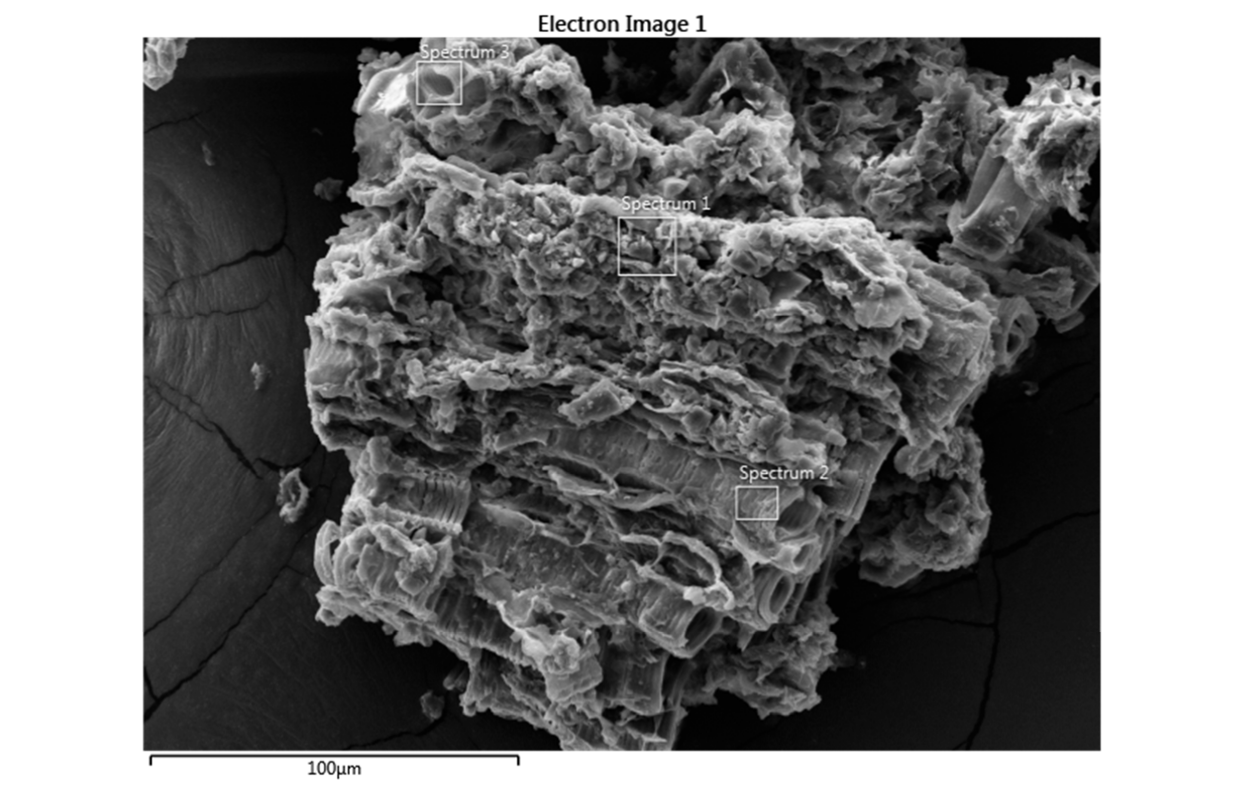
Downloads
References
CG Joseph, A Bono, D Krishnaiah and KO Soon. Sorption studies of methylene blue dye in aqueous solution by optimized carbon prepared from Guava seeds (Psidiumguajava L). Mater. Sci. 2007; 13, 83-7.
M Vikas, U Kanjan and M Bhawna. Effect of neem (Azadirachta Indica) as natural absorbent on the ph of dairy waste water. Int. J. Eng. Res. Tech. 2015; 3, 56-8.
S Vineta, Z Silvana, R Sanja and S Golomeova. Methods for waste waters treatment in textile industry. In: Proceedings of the International Scientific Conference UNITECH 2014, Gabrovo, Bulgaria. 2014.
RP Singh, PK Singh and RL Singh. Present status of biodegradation of textile dyes. Curr. Trends Biomed. Eng. Biosci. 2017; 3, 66-8.
M Dakiky, M Khamis, A Manassra and M Mereb. Selective adsorption of chromium (VI) in industrial wastewater using low-cost abundantly available adsorbents. Adv. Environ. Res. 2002; 6, 533-40.
S Babel and TA Kurniawan. Low cost adsorbents for heavy metals uptake from contaminated water: A review. J. Hazard. Mater. 2003; 97, 219-43.
SE Bailey, TJ Olin, RM Bricka and DD Adrian. A review of potentially low-cost sorbents for heavy metals. Water Res. 1999; 33, 2469-79.
FR Spellman. Handbook of water and wastewater treatment plant operations. 3rd ed. CRC Press Boca Raton, Florida, 2015.
L Yu, M Han and F He. A review of treating oily wastewater. Arab. J. Chem. 2017; 10, 1913-22.
ET Igunnu and GZ Chen. Produced Water Treatment Technologies. Int. J. Low-Carbon Tech. 2014; 9, 157-77.
FR Ahmadun, A Pendashteh, LC Abdullah, DRA Biak, SS Madaenic and ZZ Abidin. Review of technologies for oil and gas produced water treatment. J. Hazard. Mater. 2009; 170, 530-51.
G McKay, MS Otterburn and JA Aga. Fuller’s earth and fired clay as adsorbents for dyestuffs - equilibrium and rate studies. Water Air Soil Poll. 1985; 24, 307-22.
T Robinson, G McMullan, R Marchant and P Nigam. Remediation of dyes in textile effluent: A critical review on current treatment technologies with a proposed alternative. Bioresource Tech. 2001; 77, 247-55.
J Rana and L Singh. A comparative adsorption studies on rice husk ash, activated rice husk and neem leaves by using methylene blue as dye. J. Chem. Mater. Res. 2014; 1, 6064-7.
UA El-Nafaty, IM Muhammad and S Abdulsalam. Biosorption and kinetic studies on oil removal from produced water using banana peel. Civ. Environ. Res. 2013; 3, 125-36.
TH Ibrahim, AS Gulistan, MI Khamis, H Ahmed and A Aidan. Produced water treatment using naturally abundant pomegranate peel. Desalination Water Treat. 2016; 57, 6693-701.
IM Muhammad, UA El-Nafaty, S Abdulsalam and YI Makarfi. Removal of oil from oil produced water-using eggshell. Civ. Environ. Res. 2012; 2, 52-63.
Y Yang, X Zhang and Z Wang. Oilfield produced water treatment with surface-modified fiber ball media filtration. Water Sci. Tech. 2002; 46, 165-70.
S Ibrahim, H Ang, and S Wang. Removal of emulsified food and mineral oils from wastewater using surfactant modified barley straw. Bioresource Tech. 2009; 100, 5744-9.
KG Bhattacharyya and A Sharma. Adsorption of Pb(II) from aqueous solution by Azadirachta indica (Neem) leaf powder. J. Hazard. Mater. 2004; 113, 97-109.
A Sharma and KG Bhattacharyya. Adsorption of chromium (VI) on Azadirachta Indica (Neem) leaf powder. J. Int. Adsorption Soc. 2004; 10, 327-38.
RP Singh, PK Singh, R Gupta and RL Singh. Treatment and recycling of wastewater from textile industry. In: R Singh and R Singh (Eds.). Advances in biological treatment of industrial waste water and their recycling for a sustainable future. Applied environmental science and engineering for a sustainable future. Springer, Singapore, 2019, p. 225-66.
National Research Council. Neem: A tree for solving problems. National Academies Press, Washington DC, 1992.
K Biswas, I Chattopadhyay, RK Banerjee and U Bandyopadhyay. Biological activities and medicinal properties of neem (Azadirachta indica). Curr. Sci. 2002; 82, 1336-45.
VS Kumar and V Navaratnam. Neem (Azadirachta indica): Prehistory to contemporary medicinal uses to humankind. Asia. Pac. J. Trop. Biomed. 2013; 3, 505-14.
S Abbasi and J Inorg. Organometallic. Poly. Mat. 2009; 29, 1.
UI Gaya and AH Abdullah. Heterogeneous photocatalytic degradation of organic contaminants over titanium dioxide: A review of fundamentals, progress and problems. J. Photochem. Photobiol. C Photochem. Rev. 2008; 9, 1-12.
American Public Health Association. Standard methods for the examination of water and wastewater. American Public Health Association, Washington DC, 1992.
A Srivastav and VC Srivastava. Adsorptive desulfurization by activated alumina. J. Hazard. Mater. 2009; 170, 1133-40.
W Ahmad, I Ahmad, M Ishaq and K Ihsan. Adsorptive desulfurization of kerosene and diesel oil by Zn impregnated montmorollonite clay. Arab. J. Chem. 2017; 10, S3263-S3269.
GB Daware, AB Kulkarni and AA Rajput. Desulphurization of diesel by using low cost adsorbent. Int. J. Innovat. Emerg. Res. Eng. 2015; 2, 69-73.
C Marı´n-Rosas, LF Ramı´rez-Verduzco, FR Murrieta-Guevara, G Herna´ndez-Tapiam and LM Rodrı´guez-Otal. Desulfurization of low sulfur diesel by adsorption using activated carbon: Adsorption isotherms. Ind. Eng. Chem. Res. 2010; 49, 4372-4.
K Vijayaraghavan and Y Yun. Bacterial bio sorbents and bio sorption. Biotechnol. Adv. 2008; 26, 266-91.
KR Manjunatha and M Vagish. Study on adsorption efficiency of Neem leaves powder in removal of reactive red dye color from Aqueous solution. Int. Res. J. Eng. Tech. 2016; 3, 437-40.
KS Bharathi and SPT Ramesh. Fixed-bed column studies on biosorption of crystal violet from aqueous solution by Citrullus lanatus rind and Cyperus rotundus. Appl. Water Sci. 2013; 3, 673-87.
MG Devi, SMK Al-Moshrafi, AA Hudaifi and BHA Aisari. Treatment of refinery waste water using environmental friendly adsorbent. J. Inst. Eng. India Ser. E. 2017; 98, 149-54.
Downloads
Published
How to Cite
Issue
Section
License

This work is licensed under a Creative Commons Attribution-NonCommercial-NoDerivatives 4.0 International License.





