
The Potential of Biogas Production with Co-Digestion between Food Waste and Cow Dung
DOI:
https://doi.org/10.48048/tis.2021.1410Keywords:
Biogas production, Food waste, Cow dung, Anaerobic digestion, Co-digestionAbstract
The objective of this research was to analyze the potential of biogas production with co-digestion between food waste and cow dung. The experiment research was batched with small scale and scale up with semi-continuous, temperature was operated within 35 - 37 °C. The suitable condition for biogas production between food waste and cow dung was presented with 75:25 (T1). 55 mL of the biogas potential was obtained which is considered as small scale. Thus, the scale up was presented in 75:25 (T1) ratio. In term of scale up the biogas obtained from the production is 650 ml which is higher than small scale. The scale up reactor of biogas production was 100 liters. Chemical oxygen demand (COD) was reduced from 30,000 to 5,000 - 7,000 mL L-1. The efficiency of COD was obtained 76.67 - 83.3 %, respectively. In term of total solid, it was decreased from 19,000 to 16,500 mL L-1. Initial VFA was presented 4,000 mL L-1, and final was presented 3,800 mL L-1, respectively. However, the biogas production from food waste and cow dung can enhance the performance of municipal solid waste and alternative energy production. Finally, the finding of co-digestion in biogas production system suggested utilization in household and communities.
HIGHLIGHTS
- Food waste is the major waste in household, and it has high potential for energy production
- Co-digestion in biogas production system that suggested utilization in household and communities
- The biogas production from food waste and cow dung can enhance the performance of municipal solid waste and alternative energy production
GRAPHICAL ABSTRACT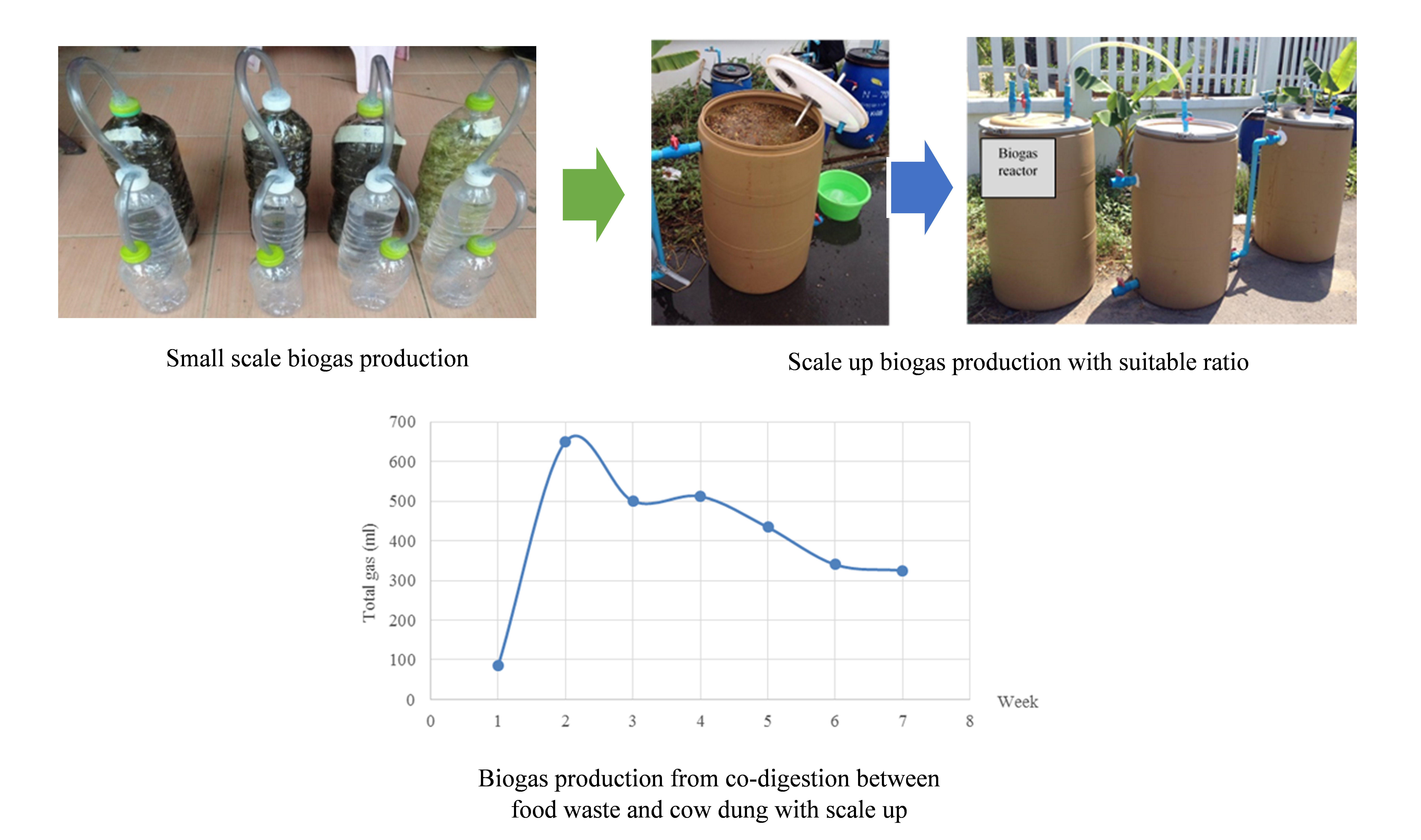
Downloads
References
K Hussaro, J Intanin and S Teekasap. Biogas production from food waste and vegetable waste for the Sakaew Temple Community Angthong Province Thailand. GMSARN Int. J. 2017; 11, 82-9.
V Sawasdee, S Haosagul and N Pisutpaisal. Co-digestion of waste glycerol and glucose to enhance biogas production. Int. J. Hydrogen Energ. 2019; 44, 29575-82.
V Sawasdee and N Pisutpaisal. Feasibility of biogas production from Napier grass. Energ. Proc. 2014; 61, 1229-33.
Budiyono, AD Primaloka, L Ardihannari, HHA Matin and S Sumardiono. Study of biogas production from cassava industrial waste by anaerobic process. MATEC Web Conf. 2018; 156, 03052.
CB Agustini, M Costa and M Gutterres. Tannery wastewater as nutrient supply in production of biogas from solid tannery wastes mixed through anaerobic co-digestion. Process Saf. Environ. Protect. 2020; 135, 38-45.
S Mirmohamadsadeghi, K Karimi, M Tabatabaei and M Aghbashlo. Biogas production from food wastes: A review on recent developments and future perspectives. Bioresource Tech. Rep. 2019; 7, 100202.
C Negri, M Ricci, M Zilio, G D’lmporzano, W Qiao, R Dong and F Adani. Anaerobic digestion of food waste for bio-energy production in China and Southeast Asia: A review. Renew. Sustain. Energ. Rev. 2020; 133, 110138.
TA Trabold and CW Babbitt. Chapter 1 Introduction. In: TA Trabold and CW Babbitt (Eds.). Sustainable Food Waste-to-Energy Systems. Academic Press, Massachusetts, 2018, p. 1-10.
C Chiemchaisri, JP Juanga and C Visvanathan. Municipal solid waste management in Thailand
and disposal emission inventory. Environ. Monit. Assess. 2007; 135, 13-20.
Budiyono, IN Widiasa, S Johari and Sunarso. The influence of total solid contents on biogas yield from cattle manure using rumen fluid inoculum. Energ. Res. J. 2010; 1, 6-11.
Y Yang, K Tsukahara and S Sawayama. Biodegradation and methane production from glycerol-containing synthetic waste with fixed-bed bioreactor under mesophilic and thermophilic anaerobic conditions. Proc. Biochem. 2008; 43, 362-7.
AE Maragkaki, I Vasileiadia, M Fountoulakis, A Kyriakou, K Lasaridi and T Manios. Improving biogas production from anaerobic co-digestion of sewage sludge with a thermal dried mixture of food waste, cheese whey and olive mill wastewater. Waste Manag. 2018; 71, 644-51.
American Public Health Association. Standard methods for the examination of water and wastewater. 20th ed. American Public Health Association, Washington DC, 1998.
M Zamanzadeh, LH Hagen, K Svensson, R Linjordet and SJ Horn. Biogas production from food waste via co-digestion and digestion effects on performance and microbial ecology. Sci. Rep. 2017; 7, 17664.
EA Tampio, L Blasco, MM Vainio, MM Kahala and SE Rasi. Volatile Fatty Acids (VFAs) and methane from food waste and cow slurry: Comparison of biogas and VFA fermentation processes. GCB Bioenerg. 2019; 11, 72-84.
E Athanasoulia, P Melidis and A Aivasdis. Co-digestion of sewage sludge and crude glycerol from biodiesel production. Renew. Energ. 2014; 62, 73-8.
Downloads
Published
How to Cite
Issue
Section
License

This work is licensed under a Creative Commons Attribution-NonCommercial-NoDerivatives 4.0 International License.





