
Extraction of Coconut Coir-Derived Lignin and Fabrication of Electrospun Nanofibers of Nylon 6/Lignin Blends
DOI:
https://doi.org/10.48048/tis.2026.14097Keywords:
Lignin, Coconut coir, Deep eutectic solvent (DES), Nylon 6, Needleless electrospinningAbstract
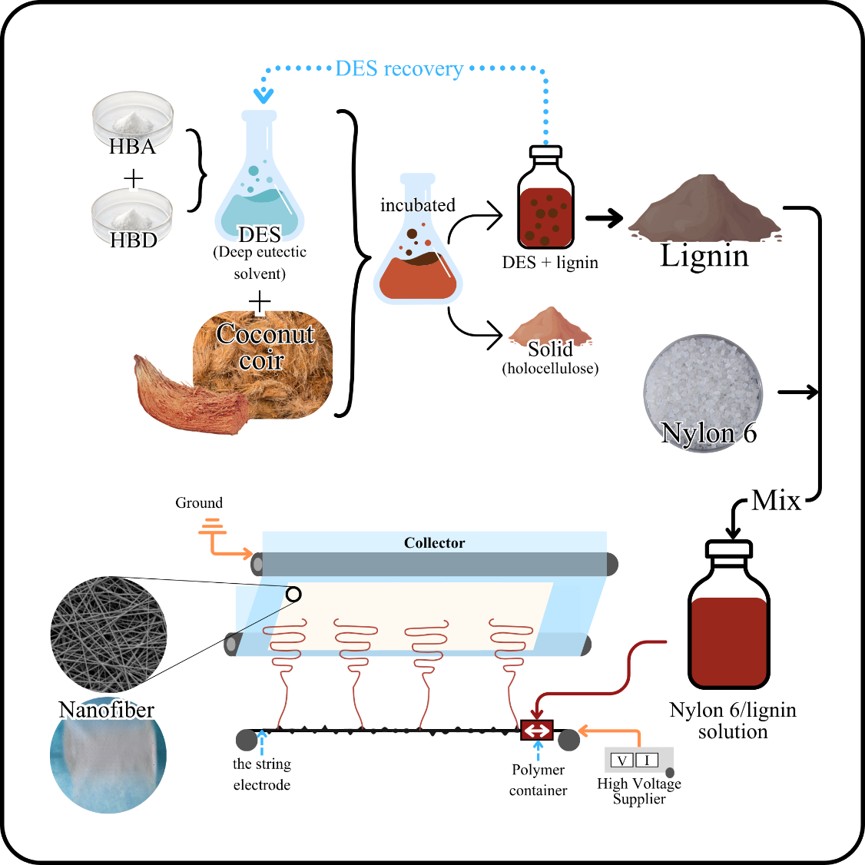
This research introduces a sustainable and integrated approach for utilizing lignin derived from coconut coir, employing a deep eutectic solvent (DES) system to synthesize advanced nanofibers. The study methodically optimized lignin extraction, emphasizing yield, antioxidant capacity, structural attributes (as determined by FTIR and XRD analyses), and antibacterial efficacy. The optimal extraction parameters were established as 80 °C for a duration of 8 h (C80–8). Consequently, this methodology achieved the highest lignin recovery rate (15.95%), while simultaneously maintaining the inherent structural integrity and mitigating condensation. Structural analyses confirmed the retention of critical functional groups and a largely amorphous configuration. The C80–8 lignin demonstrated enhanced antioxidant activity (IC50 = 30 µg/mL) and exhibited significantly improved antibacterial efficacy against both Staphylococcus aureus and Escherichia coli, in contrast to Kraft lignin (KL). Following this, the extracted lignin was integrated into a Nylon 6 matrix and subsequently processed into composite nanofibers via needleless electrospinning. The impact of lignin loading was methodically evaluated through morphological and mechanical characterization. SEM analysis revealed that a 5 wt% lignin loading (N/CL5) produced uniform, bead-free nanofibers with an average diameter of 104 nm, indicating that the conditions for rheology and electrospinning were appropriately optimized. This formulation also had the best mechanical properties, with higher tensile strength, elongation at break, and Youngʼs modulus. The observed results arose from the interactions between lignin and the polymer matrix, specifically the formation of hydrogen bonds. Furthermore, the N/CL5 nanofibers showed significant antibacterial activity against S. aureus, surpassing the effectiveness of both pure Nylon 6 and KL composites. The enhanced functionality of DES-extracted lignin is due to the large number of phenolic hydroxyl groups that were preserved. The findings generally indicate that lignin derived from DES offers two key advantages: Its potential as a reinforcing agent and its utility as a bioactive additive. Consequently, this approach presents a scalable and environmentally sound method for converting lignocellulosic agricultural waste into valuable materials suitable for biomedical, protective, and filtration applications.
HIGHLIGHTS
- Lignin was extracted from coconut coir using a deep eutectic solvent (DES) system with optimized conditions.
- The key lignin functional groups were confirmed by FTIR and XRD analysis.
- The extracted lignin exhibited antioxidant and antibacterial activities and was effectively incorporated into Nylon 6 nanofibers via needleless electrospinning.
- Lignin-loaded Nylon 6 nanofibers demonstrated improved mechanical properties and enhanced antibacterial performance.
GRAPHICAL ABSTRACT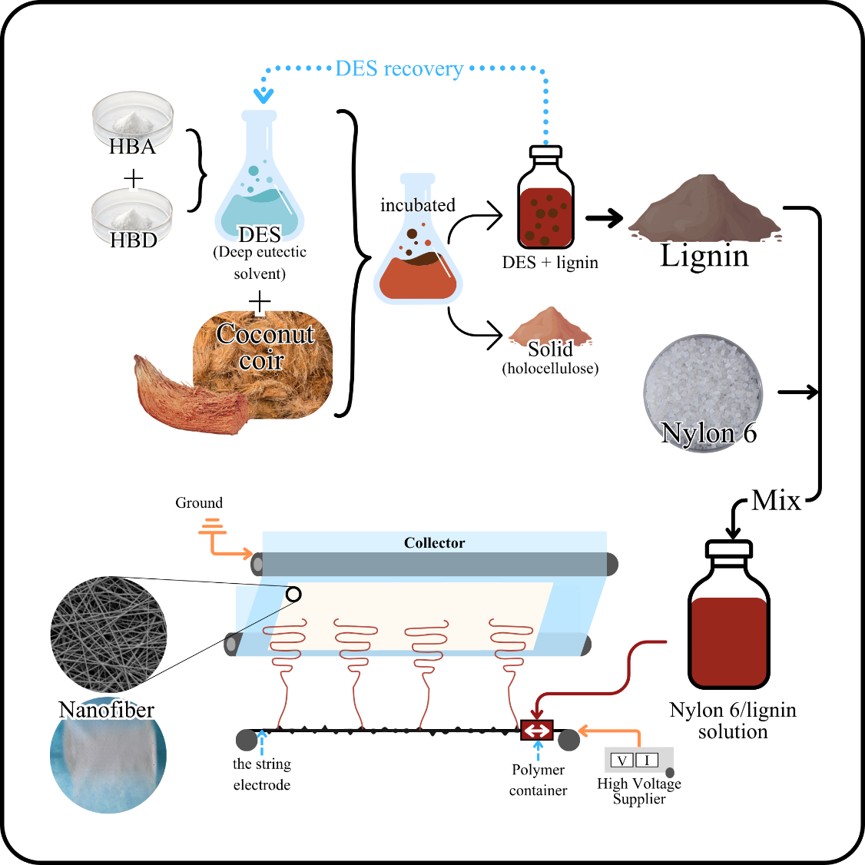
Downloads
References
T Kalak. Potential use of industrial biomass waste as a sustainable energy source in the future. Energies 2023; 16(4), 1783.
M Nissar, KN Chethan, YA Birjerane, S Patil, S Shetty and A Das. Coconut coir fiber composites for sustainable architecture: A comprehensive review of properties, processing, and applications. Journal of Composites Science 2025; 9(10), 516.
F Vieira, HEP Santana, M Jesus, J Santos, P Pires, M Vaz-Velho, DP Silva and DS Ruzene. Coconut waste: Discovering sustainable approaches to advance a circular economy. Sustainability 2024; 16(7), 3066.
D Watkins, M Nuruddin, M Hosur, A Tcherbi-Narteh and S Jeelani. Extraction and characterization of lignin from different biomass resources. Journal of Materials Research and Technology 2015; 4(1), 26-32.
H Sadeghifar and A Ragauskas. Lignin as a UV light blocker—a review. Polymers 2020; 12(5), 1134.
AK Das, K Mitra, AJ Conte, A Sarker, A Chowdhury and AJ Ragauskas. Lignin-A green material for antibacterial application—A review. International Journal of Biological Macromolecules 2024; 261(2), 129753.
M Joshi and S Manjare. Chemical approaches for the biomass valorisation: A comprehensive review of pretreatment strategies. Environmental Science and Pollution Research 2024; 31, 48928-48954.
AK Tamo, I Doench, G Deffo, SLZ Jiokeng, G Doungmo, CG Fotsop, RCT Temgoua, A Montembault, A Serghei, E Njanja, IK Tonle and A Osorio-Madrazo. Lignocellulosic biomass and its main structural polymers as sustainable materials for (bio)sensing applications. Journal of Materials Chemistry A 2025; 13(30), 24185-24253.
Z Yao, G Chong and H Guo. Deep eutectic solvent pretreatment and green separation of lignocellulose. Applied Sciences 2024; 14(17), 7662.
Z Chen, A Ragauskas and C Wan. Lignin extraction and upgrading using deep eutectic solvents. Industrial Crops and Products 2020; 147, 112241.
BAV Maran, S Jeyachandran and M Kimura. A review on the electrospinning of polymer nanofibers and its biomedical applications. Journal of Composites Science 2024; 8(1), 32.
A Al-Abduljabbar and I Farooq. Electrospun polymer nanofibers: Processing, properties, and applications. Polymers 2023; 15(1), 65.
A Nekooei and A Ajji. Integrating alkali lignin into electrospun PET nanofibers for enhanced viral protection in respiratory masks. ACS Omega 2026; 11(4), 6500-6512.
A Alzagameem, SE Klein, M Bergs, XT Do, I Korte, S Dohlen, C Hüwe, J Kreyenschmidt, B Kamm, M Larkins and M Schulze. Antimicrobial activity of lignin and lignin-derived cellulose and chitosan composites against selected pathogenic and spoilage microorganisms. Polymers 2019; 11(4), 670.
V Raja, L Mahalakshmi, MM Leena, JA Moses and C Anandharamakrishnan. Needleless electrospinning: Concepts and applications in the food industry. Food Engineering Reviews 2024; 16, 252-269.
OE Fayemi, PB Letsholo, HO Shoyiga, CC Ahia and EL Meyer. Investigation of the effects of concentration and voltage on the physicochemical properties of Nylon 6 nanofiber membrane. Scientific Reports 2025; 15, 10865.
A Isci and M Kaltschmitt. Recovery and recycling of deep eutectic solvents in biomass conversions: A review. Biomass conversion and biorefinery 2022; 12(1), 197-226.
EA Agustiany, MR Ridho, M Rahmi D N, EW Madyaratri, F Falah, MAR Lubis, NN Solihat, FA Syamani, P Karungamye, A Sohail, DS Nawawi, AH Prianto, AH Iswanto, M Ghozali, WK Restu, I Juliana, P Antov, L Kristak, W Fatriasari and A Fudholi. Recent developments in lignin modification and its application in lignin‐based green composites: A review. Polymer Composites 2022; 43(8), 4848-4865.
AK Kumar, BS Parikh and M Pravakar. Natural deep eutectic solvent mediated pretreatment of rice straw: Bioanalytical characterization of lignin extract and enzymatic hydrolysis of pretreated biomass residue. Environmental science and pollution research 2016; 23, 9265-9275.
J Rencoret, J Ralph, G Marques, A Gutiérrez, AT Martínez and JC del Río. Structural characterization of lignin isolated from coconut (Cocos nucifera) coir fibers. Journal of Agricultural and Food Chemistry 2013; 61(10), 2434-2445.
J Rumpf, R Burger and M Schulze. Statistical evaluation of DPPH, ABTS, FRAP, and Folin-Ciocalteu assays to assess the antioxidant capacity of lignins. International Journal of Biological Macromolecules 2023; 233, 123470.
N Jadid, D Hidayati, SR Hartanti, BA Arraniry, RY Rachman and W Wikanta. Antioxidant activities of different solvent extracts of Piper retrofractum Vahl. using DPPH assay. AIP conference proceedings 2017; 1845(1), 020019.
O Gordobil, R Herrera, M Yahyaoui, S İlk, M Kaya and J Labidi. Potential use of kraft and organosolv lignins as a natural additive for healthcare products. RSC advances 2018; 8(43), 24525-24533.
A Aulova, M Bek, L Kossovich and I Emri. Needleless electrospinning of PA6 fibers: The effect of solution concentration and electrospinning voltage on fiber diameter. Strojniski Vestnik Journal of Mechanical Engineering 2020; 66(7-8), 421-430.
FC Çallıoğlu and HK Güler. Production of essential oil-based composite nanofibers by emulsion electrospinning. Pamukkale Üniversitesi Mühendislik Bilimleri Dergisi 2020; 26(7), 1178-1185.
AR Mankar, A Pandey and KK Pant. Microwave-assisted extraction of lignin from coconut coir using deep eutectic solvents and its valorization to aromatics. Bioresource Technology 2022; 345, 126528.
X Duan, X Wang, J Chen, G Liu and Y Liu. Structural properties and antioxidation activities of lignins isolated from sequential two-step formosolv fractionation. RSC advances 2022; 12(37), 24242-24251.
A Alzagameem, BE Khaldi-Hansen, D Büchner, M Larkins, B Kamm, S Witzleben and M Schulze. Lignocellulosic biomass as source for lignin-based environmentally benign antioxidants. Molecules 2018; 23(10), 2664.
D Agrawal, A Tripathi, P Pal, M Hoque, SD Bharathi and S Jacob. Sustainable extraction strategy for lignin from coconut coir using organosolv and deep eutectic solvents (DES). Waste and Biomass Valorization 2025; 16, 1599-1608.
RAC Gomide, ACS de Oliveira, DAC Rodrigues, CR de Oliveira, OBG de Assis, MV Dias and SV Borges. Development and characterization of lignin microparticles for physical and antioxidant enhancement of biodegradable polymers. Journal of Polymers and the Environment 2020; 28, 1326-1334.
PK Jha, T Jaidumrong, D Rokaya and C Ovatlarnporn. Callistemon viminalis leaf extract phytochemicals modified silver-ruthenium bimetallic zinc oxide nanocomposite biosynthesis: Application on nanocoating photocatalytic Escherichia coli disinfection. RSC advances 2024; 14(16), 11017-11026.
JL Espinoza-Acosta, PI Torres-Chávez, B Ramírez-Wong, CM López-Saiz and B Montaño-Leyva. Antioxidant, antimicrobial, and antimutagenic properties of technical lignins and their applications. BioResources 2016; 11(2), 5452-5481.
NT Tran, TTT Nguyen, D Ha, TH Nguyen, NN Nguyen, K Baek, NT Nguyen, CK Tran, TTV Tran and HV Le. Highly functional materials based on nano-lignin, lignin, and lignin/silica hybrid capped silver nanoparticles with antibacterial activities. Biomacromolecules 2021; 22(12), 5327-5338.
T Rashid, CF Kait, I Regupathi and T Murugesan. Dissolution of kraft lignin using protic ionic liquids and characterization. Industrial Crops and Products 2016; 84, 284-293.
S Ghosh and K Pramanik. A comprehensive review on lignin based electrospun nanomaterials as suitable adsorbents for remediation of Detrimental Water and Air Pollutants. Water, Air, & Soil Pollution 2024; 235, 485.
N Sallem‐Idrissi, M Sclavons, DP Debecker and J Devaux. Miscible raw lignin/nylon 6 blends: Thermal and mechanical performances. Journal of Applied Polymer Science 2015; 133(6), 42963.
I Dallmeyer, F Ko and JF Kadla. Electrospinning of technical lignins for the production of fibrous networks. Journal of Wood Chemistry and Technology 2010; 30(4), 315-329.
CW Park, WJ Youe, SJ Kim, SY Han, JS Park, EA Lee, GJ Kwon, YS Kim, NH Kim and SH Lee. Effect of lignin plasticization on physico-mechanical properties of lignin/poly (Lactic acid) composites. Polymers 2019; 11(12), 2089.
D Kun and B Pukánszky. Polymer/lignin blends: Interactions, properties, applications. European Polymer Journal 2017; 93, 618-641.
M Kumar, M Hietala and K Oksman. Lignin-based electrospun carbon nanofibers. Frontiers in Materials 2019; 6, 62.
MS Jamal, MS Chowdhury, S Bajgai, M Hossain, A Laref, PK Jha and K Techato. Comparative studies on the morphological, structural and optical properties of NiO thin films grown by vacuum and non-vacuum deposition techniques. Materials Research Express 2021; 8, 126404.
S. S. Ojha, M. Afshari, R. Kotek and R. E. Gorga. Morphology of electrospun nylon‐6 nanofibers as a function of molecular weight and processing parameters. Journal of applied polymer science 2008; 108(1), 308-19.
R Ding, H Wu, M Thunga, N Bowler and MR Kessler. Processing and characterization of low-cost electrospun carbon fibers from organosolv lignin/polyacrylonitrile blends. Carbon 2016; 100, 126-136.
G Ajith, GP Tamilarasi, G Sabarees, S Gouthaman, K Manikandan, V Velmurugan, V Alagarsamy and VR Solomon. Recent developments in electrospun nanofibers as delivery of phytoconstituents for wound healing. Drugs and Drug Candidates 2023; 2(1), 148-171.
D Kai, S Jiang, ZW Low and XJ Loh. Engineering highly stretchable lignin-based electrospun nanofibers for potential biomedical applications. Journal of Materials Chemistry B 2015; 3(30), 6194-6204.
MR Ridho, EA Agustiany, MR Dn, EW Madyaratri, M Ghozali, WK Restu, F Falah, MAR Lubis, FA Syamani, Y Nurhamiyah, S Hidayati, A Sohail, P Karungamye, DS Nawawi, AH Iswanto, N Othman, NAM Aini, MH Hussin, K Sahakaro, N Hayeemasae, ..., W Fatriasari. Lignin as green filler in polymer composites: Development methods, characteristics, and potential applications. Advances in Materials Science and Engineering 2022; 2022(1), 1363481.
CL Pai, MC Boyce and GC Rutledge. On the importance of fiber curvature to the elastic moduli of electrospun nonwoven fiber meshes. Polymer 2011; 52(26), 6126-6133.
Y He, HC Ye, TT You and F Xu. Sustainable and multifunctional cellulose-lignin films with excellent antibacterial and UV-shielding for active food packaging. Food Hydrocolloids 2023; 137, 108355.
P Ryšánek, M Malý, P Čapková, M Kormunda, Z Kolská, M Gryndler, O Novák, L Hocelíková, L Bystrianský and M Munzarová. Antibacterial modification of nylon-6 nanofibers: Structure, properties and antibacterial activity. Journal of Polymer Research 2017; 24, 208.
N Charernsriwilaiwat, T Rojanarata, T Ngawhirunpat, M Sukma and P Opanasopit. Electrospun chitosan-based nanofiber mats loaded with Garcinia mangostana extracts. International journal of pharmaceutics 2013; 452(1-2), 333-343.
Downloads
Published
How to Cite
Issue
Section
License
Copyright (c) 2026 Walailak University

This work is licensed under a Creative Commons Attribution-NonCommercial-NoDerivatives 4.0 International License.