
Optimizing Transfection Conditions to Enhance BMP-2 Expression in Umbilical Cord–Derived Mesenchymal Stem Cells
DOI:
https://doi.org/10.48048/tis.2027.14070Keywords:
Mesenchymal stem cells, Umbilical-cord mesenchymal stem cells, Bone morphogenetic protein 2, Non-viral gene delivery, Bone healing, Regenerative medicine, Mesenchymal Stem Cells (MSCs), Umbilical cord–derived MSCs (UC-MSCs), Bone morphogenetic protein-2 (BMP-2), Gene delivery, Transfection optimization, Osteogenic differentiation, Regenerative medicineAbstract
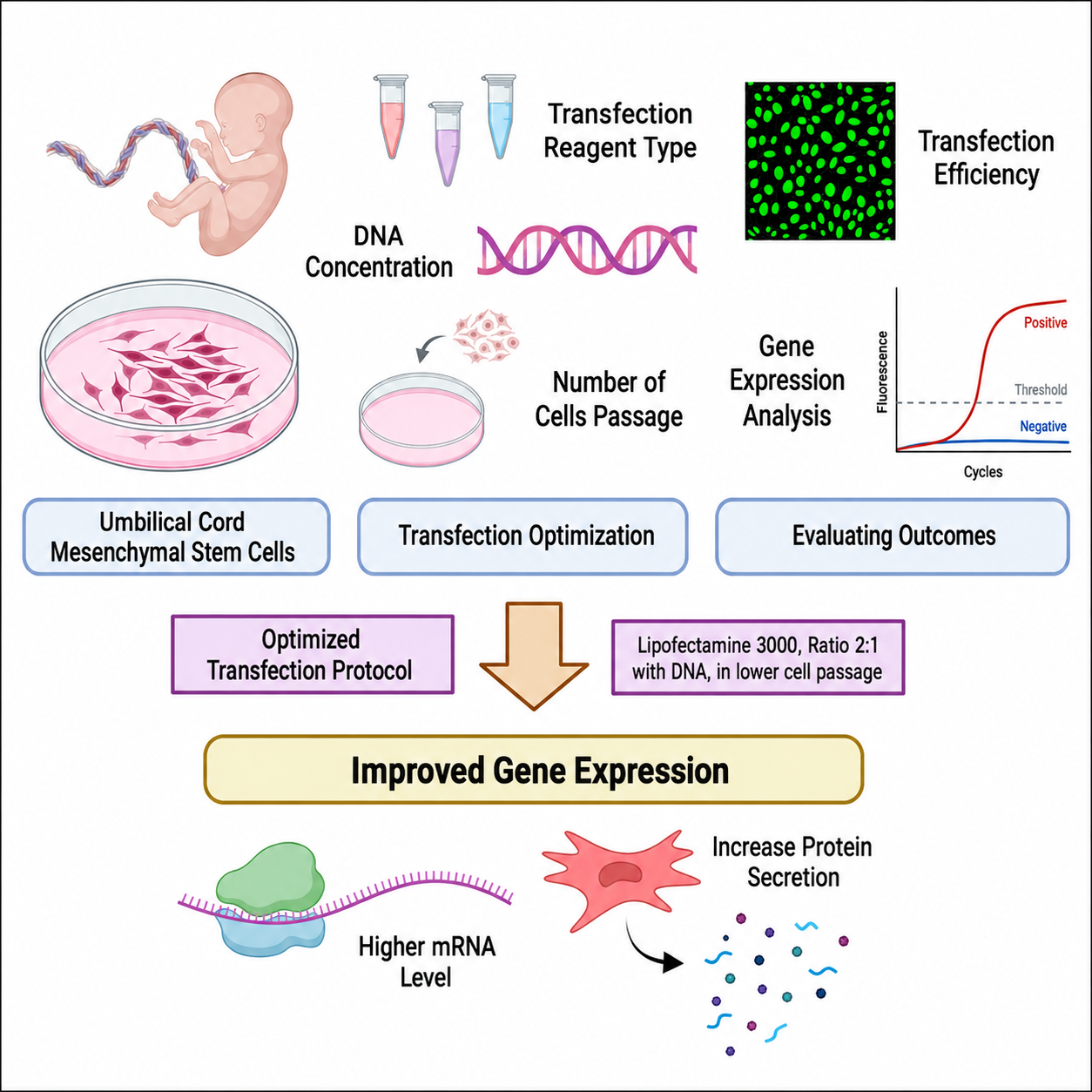
Bone defects remain a major challenge in regenerative medicine due to their limited capacity for spontaneous healing. UC-MSCs represent a promising cell source for bone regeneration; however, their therapeutic potential can be further enhanced through gene delivery strategies that promote osteogenic factor expression, such as BMP-2. Nevertheless, efficient gene delivery into MSCs remains challenging due to low transfection efficiency and potential cytotoxicity. This study aimed to systematically optimize transfection conditions in UC-MSCs to enhance BMP-2 expression including transfection reagents, DNA-to-reagent ratios, and cell passage numbers while maintaining cell viability and phenotypic stability. Transfection efficiency was evaluated using GFP reporter expression through fluorescence microscopy and flow cytometry, while BMP-2 mRNA expression was assessed by qRT-PCR at mRNA level and ELISA at protein level. Cell viability was determined using the Trypan Blue exclusion assay. Among the tested reagents, Lipofectamine™ 3000 demonstrated the highest transfection efficiency {~9% - 10%} with acceptable cytotoxicity {~86%}. Further optimization identified a ratio of 4.5 µL Lipofectamine™ 3000 to 2.5 µg plasmid DNA as the most effective condition, producing the highest BMP-2 mRNA expression {~2.7-fold increase} and protein secretion {~245 pg/mL}. Additionally, lower passage cells {passage 2} exhibited significantly higher transfection efficiency and BMP-2 expression compared to higher passages. Importantly, UC-MSCs maintained their characteristic MSC surface markers {CD73, CD90, CD105} following transfection. In conclusion, optimized transfection conditions significantly improve BMP-2 expression in UC-MSCs while preserving cell viability and phenotype. These findings provide a reproducible strategy to enhance MSC-based gene delivery systems and support their potential application in bone regeneration and regenerative medicine.
HIGHLIGHTS
- Optimization of transfection parameters in UC-MSCs to enhance gene delivery efficiency.
- Identification of optimal conditions (transfection reagents, DNA ratio, and cell passage) to enhanced BMP-2 expression.
- Enhanced BMP-2 expression significantly improves the osteoinductive potential of UC-MSCs.
- Optimized transfection strategy minimizes cytotoxicity while preserving cell viability and functionality.
- Provides a reproducible and scalable approach for improving MSC-based gene therapy in bone regeneration.
GRAPHICAL ABSTRACT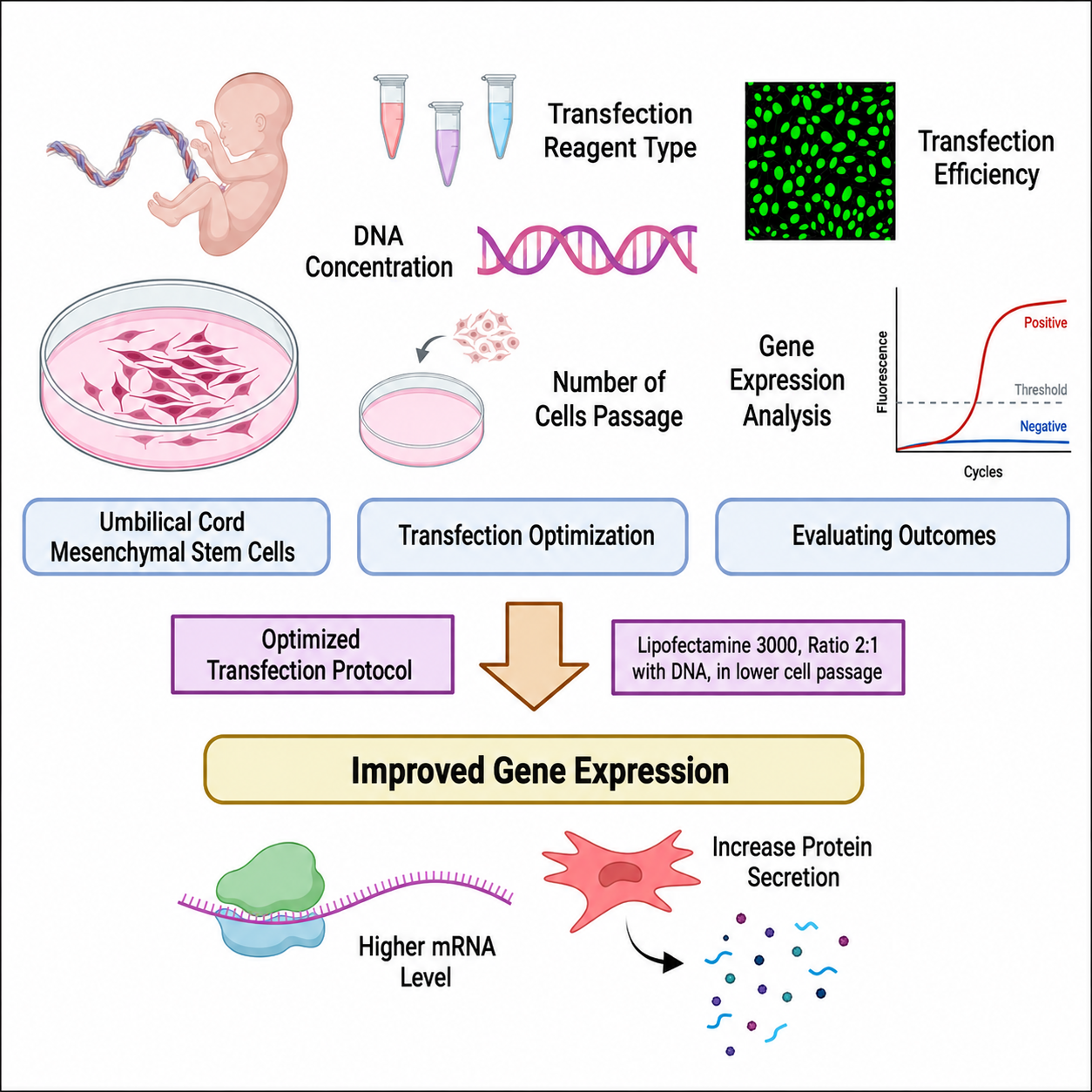
Downloads
References
JW Łuczak, M Palusińska, D Matak, D Pietrzak, P Nakielski, S Lewicki, M Grodzik and Ł Szymański. The future of bone repair: Emerging technologies and biomaterials in bone regeneration. International Journal of Molecular Sciences 2024; 25(23), 12766.
J Quek, C Vizetto-Duarte, SH Teoh and Y Choo. Towards stem cell therapy for critical-sized segmental bone defects: Current trends and challenges on the path to clinical translation. Journal of Functional Biomaterials 2024; 15(6), 145.
F Schulze, A Lang, J Schoon, GI Wassilew and J Reichert. Scaffold guided bone regeneration for the treatment of large segmental defects in long bones. Biomedicines 2023; 11(2), 325.
PL Rodham, VP Giannoudis, NK Kanakaris and PV Giannoudis. Biological aspects to enhance fracture healing. EFORT Open Reviews 2023; 8(5), 264-282.
S Law and S Chaudhuri. Mesenchymal stem cell and regenerative medicine: Regeneration versus immunomodulatory challenges. American Journal of Stem Cells 2013; 2(1), 22-38.
K Zha, Y Tian, AC Panayi, B Mi and G Liu. Recent advances in enhancement strategies for osteogenic differentiation of mesenchymal stem cells in bone tissue engineering. Frontiers in Cell and Developmental Biology 2022; 10, 824812.
MY Artamonov and EL Sokov. Intraosseous delivery of mesenchymal stem cells for the treatment of bone and hematological diseases. Current Issues in Molecular Biology 2024; 46(11), 12672-12693.
S Chetty, R Yarani, G Swaminathan, R Primavera, S Regmi, S Rai, J Zhong, A Ganguly and AS Thakor. Umbilical cord mesenchymal stromal cells-from bench to bedside. Frontiers in Cell and Developmental Biology 2022; 10, 1006295.
M Hussein. Advancing regenerative therapies with umbilical cord-derived mesenchymal stem cells: A review. Biomolecules and Biomedicine 2025; 26(4), 537-546.
S Moghadasi, M Elveny, HS Rahman, W Suksatan, AT Jalil, WK Abdelbasset, AV Yumashev, S Shariatzadeh, R Motavalli, F Behzad, F Marofi, A Hassanzadeh, Y Pathak and M Jarahian. A paradigm shift in cell-free approach: The emerging role of MSCs-derived exosomes in regenerative medicine. Journal of Translational Medicine 2021; 19, 302.
CM Trigo, JS Rodrigues, SP Camões, S Solá and JP Miranda. Mesenchymal stem cell secretome for regenerative medicine: Where do we stand? Journal of Advanced Research 2025; 70, 103-124.
B Torrecillas-Baena, V Pulido-Escribano, G Dorado, MÁ Gálvez-Moreno, M Camacho-Cardenosa and A Casado-Díaz. Clinical potential of mesenchymal stem cell-derived exosomes in bone regeneration. Journal of Clinical Medicine 2023; 12(13), 4385.
A Lotfy, NM AboQuella and H Wang. Mesenchymal stromal/stem cell (MSC)-derived exosomes in clinical trials. Stem Cell Research & Therapy 2023; 14, 66.
J Cheng, Y Sun, Y Ma, Y Ao, X Hu and Q Meng. Engineering of MSC-derived exosomes: A promising cell-free therapy for osteoarthritis. Membranes 2022; 12(8), 739.
MCDCP Cestari, RF Tovo and DF Bueno. MSC-derived secretome and exosomes in dermatology: Mechanisms, therapeutic opportunities, and scientific challenges-a narrative review. International Journal of Dermatology 2026; 65(2), 257-272.
IH Dilogo, J Fiolin, AF Canintika, JA Pawitan and E Luviah. The effect of secretome, xenogenic bone marrow-derived mesenchymal stem cells, bone morphogenetic protein-2, hydroxyapatite granule and mechanical fixation in critical-size defects of rat models. Archives of Bone and Joint Surgery 2022; 10(1), 17-22.
JB Lee, JY Hong, H Shim, S Kim, DW Lee, B Kwon and JH Yun. Bone morphogenetic protein-2-derived osteogenic peptide promotes bone regeneration via osteoblastogenesis. Regenerative Therapy 2025; 30, 911-919.
R Taday, P Jungbluth, S Zensen, T Krakau, J Windolf, MJ Hoffmann and V Grotheer. BMP-2-driven osteogenesis: A comparative analysis of porcine BMSCs and ASCs and the role of TGF-β and FGF signaling. Biology 2025; 14(6), 610.
X Chen, B Tan, Z Bao, S Wang, R Tang, Z Wang, G Chen, S Chen, WW Lu, D Yang and S Peng. Enhanced bone regeneration via spatiotemporal and controlled delivery of a genetically engineered BMP-2 in a composite hydrogel. Biomaterials 2021; 277, 121117.
JH Lee, JH Youn, HJ Park and SJ Hyun. Low-dose bone morphogenetic protein use in spinal fusion: Rethinking clinical efficacy. Journal of Korean Neurosurgical Society 2025; 68(6), 632-643.
NF Mazfufah, IH Dilogo, RW Nurhayati, D Oceandy, ST Widyaningtyas, MD Pratama and G Jang. Genetic engineering of umbilical cord-derived mesenchymal stem cells to enhance BMP-2 secretion via signal peptide optimization. Biomedicines 2026; 14(1), 76.
F Li, J Wu, D Li, L Hao, Y Li, D Yi, KWK Yeung, D Chen, WW Lu, H Pan, TM Wong and X Zhao. Engineering stem cells to produce exosomes with enhanced bone regeneration effects: An alternative strategy for gene therapy. Journal of Nanobiotechnology 2022; 20, 135.
JA Pawitan, TA Bui, W Mubarok, RD Antarianto, RW Nurhayati, IH Dilogo and D Oceandy. Enhancement of the therapeutic capacity of mesenchymal stem cells by genetic modification: A systematic review. Frontiers in Cell and Developmental Biology 2020; 8, 587776.
S Huang, TR Henderson, CD Soeandy, A Lezhanska and JT Henderson. An efficient low cost means of biophysical gene transfection in primary cells. Scientific Reports 2024; 14, 13179.
S Christoffers, L Seiler, E Wiebe and C Blume. Possibilities and efficiency of MSC co-transfection for gene therapy. Stem Cell Research & Therapy 2024; 15, 150.
R Allen and T Yokota. Endosomal escape and nuclear localization: Critical barriers for therapeutic nucleic acids. Molecules 2024; 29(24), 5997.
S Honrath, M Burger and JC Leroux. Hurdles to healing: Overcoming cellular barriers for viral and nonviral gene therapy. International Journal of Pharmaceutics 2025; 674, 125470.
Y Jin, G Han, Y Gao, H Cheng, C Sun, J Ni, J Zhou, H Zhang and Y Ding. Serum-tolerant polymeric complex for stem-cell transfection and neural differentiation. Nature Communications 2025; 16, 2022.
S Noske, M Karimov, M Hansen, N Zatula, A Ewe and A Aigner. Non-viral siRNA transfection of primary mesenchymal stromal cells (MSCs): Assessment of tyrosine-modified PEI and PPI efficacy and biocompatibility. International Journal of Pharmaceutics 2022; 612, 121359.
R Ojha, E Timin, L Szirovicza, W Xu and J Hepojoki. A systematic comparison of in-house prepared transfection reagents in the delivery of mRNA or DNA to a wide range of cultured cells. Journal of Biological Chemistry 2025; 301(12), 110742.
M Taghavi, A Parham, H Dehghani and H Naderi-Meshkin. Optimizing Lipofectamine LTX complex and G-418 concentration for improvement of transfection efficiency in human mesenchymal stem cells. Archives of Razi Institute 2021; 76(5), 1315-1325.
CDT Runzer, S Anand, C Mota, L Moroni, C Plank, M van Griensven and ER Balmayor. Cellular uptake of modified mRNA occurs via caveolae-mediated endocytosis, yielding high protein expression in slow-dividing cells. Molecular Therapy: Nucleic Acids 2023; 32, 960-979.
E Voke, ML Arral, HJ Squire, TJ Lin, R Coreas, A Lui, AT Iavarone, RL Pinals, KA Whitehead and MP Landry. Protein corona formed on lipid nanoparticles compromises delivery efficiency of mRNA cargo. Nature Communications 2025; 16, 8699.
Z Jahanafrooz, B Bakhshandeh and E Shirzadi. Comparative evaluation of Lipofectamine and dendrimer for transfection of short RNA into human T47D and MCF-10A cell lines. Advanced Pharmaceutical Bulletin 2023; 13(2), 385-392.
J Casper, SH Schenk, E Parhizkar, P Detampel, A Dehshahri and J Huwyler. Polyethylenimine (PEI) in gene therapy: Current status and clinical applications. Journal of Controlled Release 2023; 362, 667-691.
H Wang, X Liu, X Ai, KC Remant-Bahadur, TA Dick, B Yan, T Lu, X Zhou, R Luo, M Liu, X Wang, K Li, W Wang, H Uludag and W Fu. Safe and effective delivery of mRNA using modified PEI-based lipopolymers. Pharmaceutics 2023; 15(2), 410.
S Yang, Q Zhang, Y Zhuang, J Li and X Fu. Plate centrifugation enhances the efficiency of polyethylenimine-based transfection and lentiviral infection. Journal of Virological Methods 2024; 330, 115039.
D Pozzi and G Caracciolo. Looking back, moving forward: Lipid nanoparticles as a promising frontier in gene delivery. ACS Pharmacology & Translational Science 2023; 6(11), 1561-1573.
H Tae, S Park, LY Tan, C Yang, YA Lee, Y Choe, T Wüstefeld, S Jung and NJ Cho. Elucidating structural configuration of lipid assemblies for mRNA delivery systems. ACS Nano 2024; 18(17), 11284-11299.
S Meinhard, F Erdmann, H Lucas, M Krabbes, S Krüger, C Wölk and K Mäder. T14diLys/DOPE liposomes: An innovative option for siRNA-based gene knockdown? Pharmaceutics 2024; 17(1), 25.
F Zhao, D Nayyar, YS Hwang, R Bartucci and A Salvati. Effect of positive charges on liposome stability, uptake efficacy and impact on cells. International Journal of Pharmaceutics 2025; 681, 125881.
J Shi, JL Choi, B Chou, RN Johnson, JG Schellinger and SH Pun. Effect of polyplex morphology on cellular uptake, intracellular trafficking, and transgene expression. ACS Nano 2013; 7(12), 10612-10620.
A Carreño, R Guerrero-Yagüe, E Casal, R Mendoza and JL Corchero. Tuning plasmid DNA amounts for cost-effective transfections of mammalian cells: When less is more. Applied Microbiology and Biotechnology 2024; 108, 98.
SN Rajput, BK Naeem, A Ali, A Salim and I Khan. Expansion of human umbilical cord derived mesenchymal stem cells in regenerative medicine. World Journal of Stem Cells 2024; 16(4), 410-433.
B Casorati, I Zafferri, S Castiglioni and JA Maier. Replicative senescence in mesenchymal stem cells: An in vitro study on mitochondrial dynamics and metabolic alterations. Antioxidants 2025; 14(4), 446.
L Fang, G Ravindran, ME Al-Masawa, N Mohamad-Fauzi, MS Seghayat, A Salsabila and P Hafez. Immunophenotypic characterization and clinical relevance of passage number in umbilical cord mesenchymal stromal cells: A review. Cell Transplantation 2026; 35, 9636897261433504.
N Carballo-Pedrares, F Ponti, J Lopez-Seijas, D Miranda-Balbuena, N Bono, G Candiani and A Rey-Rico. Non-viral gene delivery to human mesenchymal stem cells: A practical guide towards cell engineering. Journal of Biological Engineering 2023; 17, 49.
E Momotyuk, N Ebrahim, K Shakirova and E Dashinimaev. Role of the cytoskeleton in cellular reprogramming: Effects of biophysical and biochemical factors. Frontiers in Molecular Biosciences 2025; 12, 1538806.
Downloads
Published
How to Cite
Issue
Section
License
Copyright (c) 2026 Walailak University

This work is licensed under a Creative Commons Attribution-NonCommercial-NoDerivatives 4.0 International License.