
Smartphone-Assisted Fluorescence Detection of Histamine Using Chitosan-Derived Graphene Quantum Dots for Food Safety Monitoring
DOI:
https://doi.org/10.48048/tis.2027.13978Keywords:
Graphene quantum dots, Histamine, Fluorescence sensing, Smartphone-Assisted detection, RGB analysisAbstract
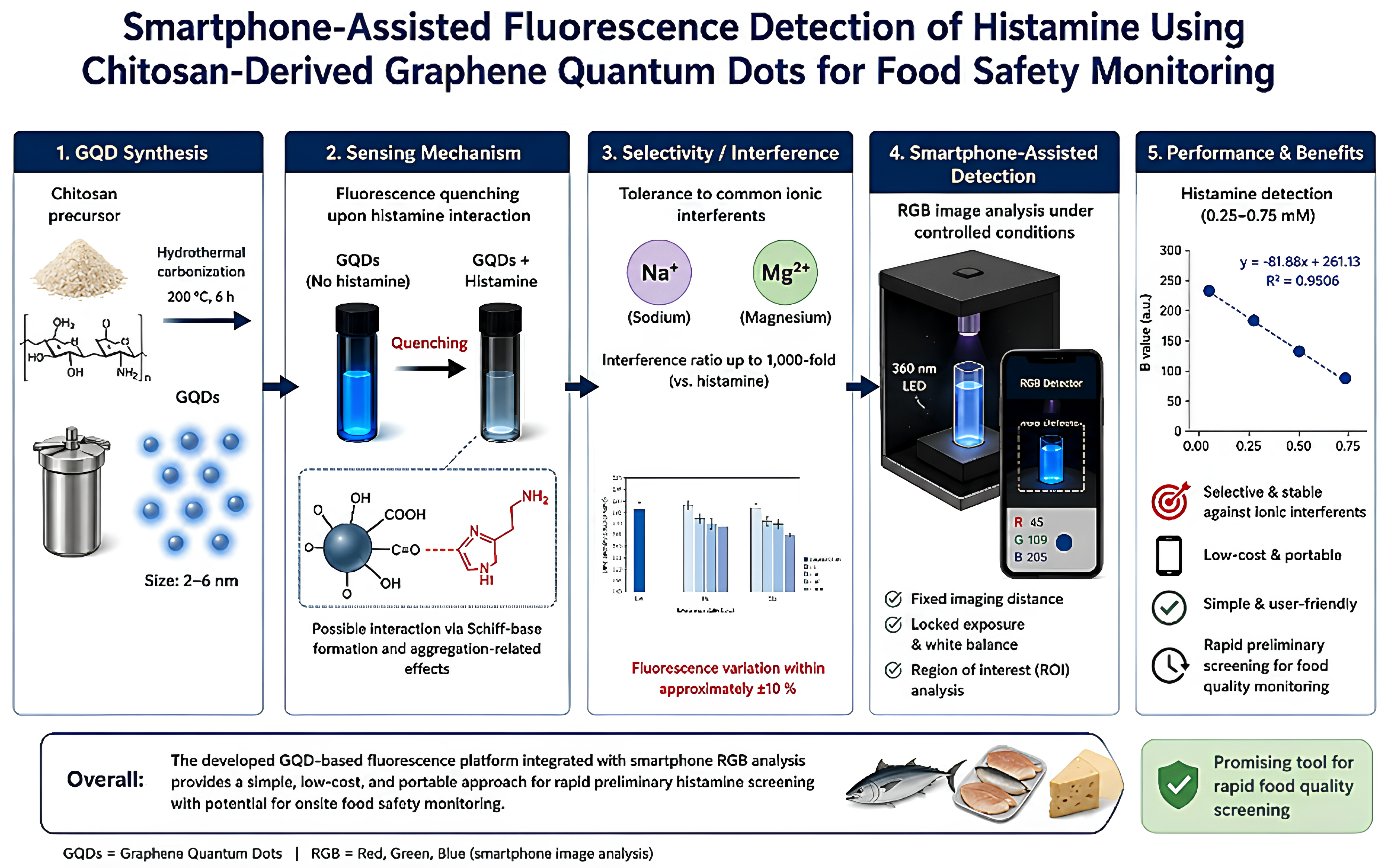
This research aimed to develop a smartphone-assisted fluorescence sensing platform for rapid histamine detection using graphene quantum dots (GQDs) synthesized from chitosan precursor via a hydrothermal carbonization process. The synthesized GQDs, with particle sizes ranging from 2 to 6 nm, exhibited fluorescence quenching behavior upon interaction with histamine, possibly associated with Schiff-base formation and aggregation-related effects. The sensing platform demonstrated selective fluorescence response toward histamine in the presence of common ionic interferents, including sodium and magnesium ions at concentrations up to 1,000-fold higher. Histamine detection was evaluated within the concentration range of 0.25 - 0.75 mM using fluorescence intensity and smartphone-assisted RGB analysis under controlled imaging conditions. The proposed platform offers a simple, low-cost, portable, and user-friendly approach with promising potential for rapid preliminary food quality screening and onsite monitoring applications.
HIGHLIGHTS
- Chitosan-derived graphene quantum dots (GQDs) were successfully synthesized for smartphone-assisted fluorescence sensing of histamine.
- The developed sensing platform demonstrated concentration-dependent blue fluorescence responses toward histamine under optimized buffer and pH conditions.
- Smartphone-based RGB analysis combined with a 3D-printed optical enclosure enabled low-cost and portable fluorescence monitoring.
- The proposed sensing system exhibited satisfactory selectivity against common ionic interferents relevant to food analysis applications.
- The study demonstrates the potential of GQD-based fluorescence sensing as a preliminary screening tool for rapid food safety monitoring.
GRAPHICAL ABSTRACT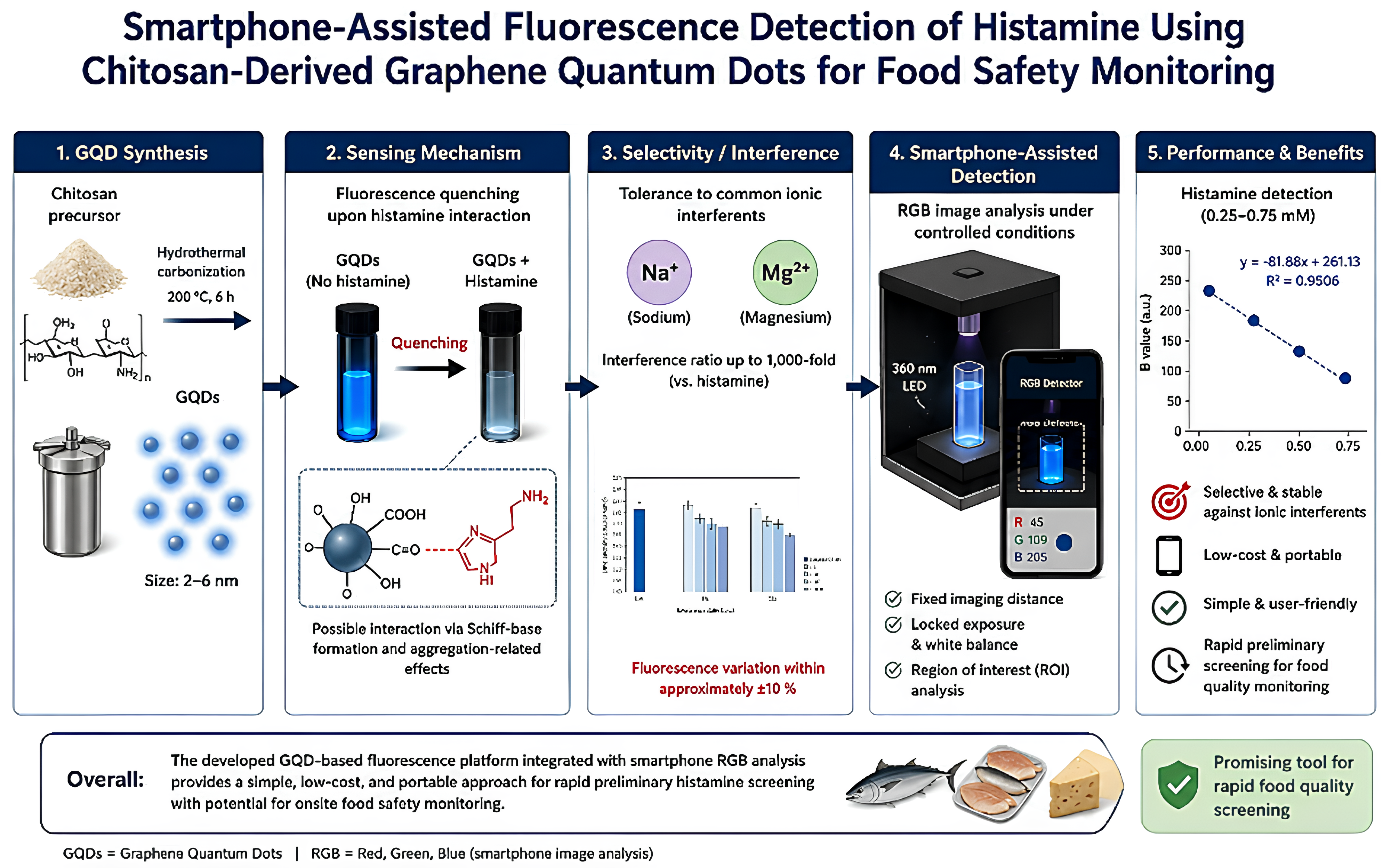
Downloads
References
KP Rai, HR Pradhan, BK Sharma and SK Rijal. Histamine in foods: Its safety and human health implications. Journal of Food Science and Technology Nepal 2013; 8, 1-11.
A Halász, Á Baráth, L Simon-Sarkadi and W Holzapfel. Biogenic amines and their production by microorganisms in food. Trends in Food Science & Technology 1994; 5(2), 42-49.
AR Shalaby. Significance of biogenic amines to food safety and human health. Food Research International 1996; 29(7), 675-690.
JM Hungerford. Scombroid poisoning: A review. Toxicon 2010; 56(2), 231-243.
P Visciano, M Schirone, R Tofalo and G Suzzi. Biogenic amines in raw and processed seafood. Frontiers in Microbiology 2012; 3, 188.
A Önal. A review: Current analytical methods for the determination of biogenic amines in foods. Food Chemistry 2007; 103(4), 1475-1486.
R Shi, S Feng, CY Park, KY Park, J Song, JP Park, HS Chun and TJ Park. Fluorescence detection of histamine based on specific binding bioreceptors and carbon quantum dots. Biosensors and Bioelectronics 2020; 167, 112519.
G Rateni, P Dario and F Cavallo. Smartphone-based food diagnostic technologies: A review. Sensors 2017; 17(6), 1453.
M Li, T Chen, JJ Gooding and J Liu. Review of carbon and graphene quantum dots for sensing. ACS Sensors 2019; 4(7), 1732-1748.
MJ Molaei. Principles, mechanisms, and application of carbon quantum dots in sensors: A review. Analytical Methods 2020; 12(10), 1266-1287.
G Wu, X Dou, D Li, S Xu, J Zhang, Z Ding and J Xie. Recent progress of fluorescence sensors for histamine in foods. Biosensors 2022; 12(3), 161.
SN Baker and GA Baker. Luminescent carbon nanodots: Emergent nanolights. Angewandte Chemie International Edition 2010; 49(38), 6726-6744.
S Zhu, Q Meng, L Wang, J Zhang, Y Song, H Jin, K Zhang, H Sun, H Wang and B Yang. Highly photoluminescent carbon dots for multicolor patterning, sensors, and bioimaging. Angewandte Chemie International Edition 2013; 52(14), 3953-3957.
Z Huang and L Ren. Large scale synthesis of carbon dots and their applications: A review. Molecules 2025; 30(4), 774.
P Dubey. An overview on animal/human biomass-derived carbon dots for optical sensing and bioimaging applications. RSC Advances 2023; 13(50), 35088-35126.
TB Leta, JO Adeyemi and OA Fawole. Carbon dot nanoparticles synthesized from horticultural extracts for postharvest shelf-life extension of fruits and vegetables. Plants 2025; 14(16), 2523.
NK Khairol Anuar, HL Tan, YP Lim, MS So’aib and NF Abu Bakar. A review on multifunctional carbon-dots synthesized from biomass waste: Design/fabrication, characterization and applications. Frontiers in Energy Research 2021; 9, 626549.
H Li, Z Kang, Y Liu and ST Lee. Carbon nanodots: Synthesis, properties and applications. Journal of Materials Chemistry 2012; 22(46), 24230-24253.
YP Sun, B Zhou, Y Lin, W Wang, KS Fernando, P Pathak, MJ Meziani, BA Harruff, X Wang and H Wang. Quantum-sized carbon dots for bright and colorful photoluminescence. Journal of the American Chemical Society 2006; 128(24), 7756-7757.
Y Qin, P Huang and FY Wu. Histamine-responsive dye-incorporated carbon dots for visual monitoring of food spoilage. Sensors and Actuators B: Chemical 2022; 365, 131911.
Y Dong, H Pang, HB Yang, C Guo, J Shao, Y Chi, CM Li and T Yu. Carbon-based dots co-doped with nitrogen and sulfur for high quantum yield and excitation-independent emission. Angewandte Chemie International Edition 2013; 52(30), 7800-7804.
J Liu and Y Cao. An electrochemical sensor based on an anti-fouling membrane for the determination of histamine in fish samples. Analytical Methods 2021; 13(5), 685-694.
R Liu, D Wu, S Liu, K Koynov, W Knoll and Q Li. An aqueous route to multicolor photoluminescent carbon dots using silica spheres as carriers. Angewandte Chemie International Edition 2009; 48(25), 4598-4601.
ZL Wu, P Zhang, MX Gao, CF Liu, W Wang, F Leng and CZ Huang. One-pot hydrothermal synthesis of highly luminescent nitrogen-doped amphoteric carbon dots for bioimaging from Bombyx mori silk-natural proteins. Journal of Materials Chemistry B 2013; 1(22), 2868-2873.
X Li, M Rui, J Song, Z Shen and H Zeng. Carbon and graphene quantum dots for optoelectronic and energy devices: A review. Advanced Functional Materials 2015; 25(31), 4929-4947.
Y Dong, J Shao, C Chen, H Li, R Wang, Y Chi, X Lin and G Chen. Blue luminescent graphene quantum dots and graphene oxide prepared by tuning the carbonization degree of citric acid. Carbon 2012; 50(12), 4738-4743.
S Qu, X Wang, Q Lu, X Liu and L Wang. A biocompatible fluorescent ink based on water-soluble luminescent carbon nanodots. Angewandte Chemie International Edition 2012; 51(49), 12215-12218.
Q Li, B Chen and B Xing. Aggregation kinetics and self-assembly mechanisms of graphene quantum dots in aqueous solutions: Cooperative effects of pH and electrolytes. Environmental Science & Technology 2017; 51(3), 1364-1376.
C Li, A Hassan, M Palmai, P Snee, PC Baveye and CJ Darnault. Colloidal stability and aggregation kinetics of nanocrystal CdSe/ZnS quantum dots in aqueous systems: Effects of ionic strength, electrolyte type, and natural organic matter. SN Applied Sciences 2022; 4(4), 101.
A Maity, D Bagchi, H Tabassum, P Nath, S Sinha and A Chakraborty. Diverse role of buffer mediums and protein concentrations to mediate the multimodal interaction of phenylalanine-functionalized gold nanoparticle and lysozyme protein at same nominal pH. The Journal of Physical Chemistry B 2024; 128(43), 10625-10635.
X Zhang, M Asif, A Aziz, J Wang, X Sun, R Zhao, R Wang, C Dong and S Shuang. Dual fluorophores embedded into zeolitic imidazolate framework-8 for ratiometric fluorescence monitoring of pH and histamine in seafood samples and bioimaging. Talanta 2026; 296, 128476.
AS El-Shafie, S Hassan, S Al-Meer, K Al-Saad and M El-Azazy. Smart fluorescence graphene quantum dot-based on-off sensor for tracing antibiotic residues in milk. Emergent Materials 2025; 8(7), 5643-5658.
MSA Ja’farawy, D Thirumalai, J Lee, HS Jung, SC Chang, JH Yoon and DH Kim. Graphene quantum dot nanocomposites: Electroanalytical and optical sensor technology perspective. Journal of Analytical Science and Technology 2023; 14(1), 29.
T Krishnan, HN Wang and T Vo-Dinh. Smartphone-based device for colorimetric detection of MicroRNA biomarkers using nanoparticle-based assay. Sensors 2021; 21(23), 8044.
L Ciaccheri, B Adinolfi, AA Mencaglia and AG Mignani. Smartphone-enabled colorimetry. Sensors 2023; 23(12), 5559.
MA Hossain and J Canning. Developments and drivers of low-cost smartphone instrumentation. Advanced Devices & Instrumentation 2024; 5, 0068.
L Shen, JA Hagen and I Papautsky. Point-of-care colorimetric detection with a smartphone. Lab on A Chip 2012; 12(21), 4240-4243.
B Coleman, C Coarsey and W Asghar. Cell phone based colorimetric analysis for point-of-care settings. Analyst 2019; 144(6), 1935-1947.
M Vargas-Muñoz, J Morales, V Cerdà, L Ferrer and E Palacio. Paper sensor-based method using a portable 3D-printed platform and smartphone-assisted colorimetric detection for ammonia and sulfide monitoring in anaerobic digesters and wastewater. Microchemical Journal 2023; 188, 108469.
SD Kim, Y Koo and Y Yun. A smartphone-based automatic measurement method for colorimetric pH detection using a color adaptation algorithm. Sensors 2017; 17(7), 1604.
ZY Gündüz, C Gündüz, C Özpınar and OA Urucu. A novel Schiff-base as a Cu (II) ion fluorescent sensor in aqueous solution. Spectrochimica Acta Part A: Molecular and Biomolecular Spectroscopy 2015; 136, 1679-1683.
L Wang, X Ran, H Tang and D Cao. Recent advances on reaction-based amine fluorescent probes. Dyes and Pigments 2021; 194, 109634.
KS Keremane, MG Acharya, P Naik, CC Malakar, K Wang and B Poudel. Recent advances in aggregation-induced emission (AIE) fluorescent sensors for biomolecule detection. Chemosensors 2025; 13(5), 174.
Downloads
Published
How to Cite
Issue
Section
License
Copyright (c) 2026 Walailak University

This work is licensed under a Creative Commons Attribution-NonCommercial-NoDerivatives 4.0 International License.