
Placental Lead (Pb) Accumulation and Maternal Metabolic Disturbance in Pregnant Rats: An In Vivo and In Silico Study
DOI:
https://doi.org/10.48048/tis.2026.13887Keywords:
Gestasional diabetes melitus, Glucose metabolism, Methylglyoxal, Lead exposure, Placenta, Pregnancy, TNF-αAbstract
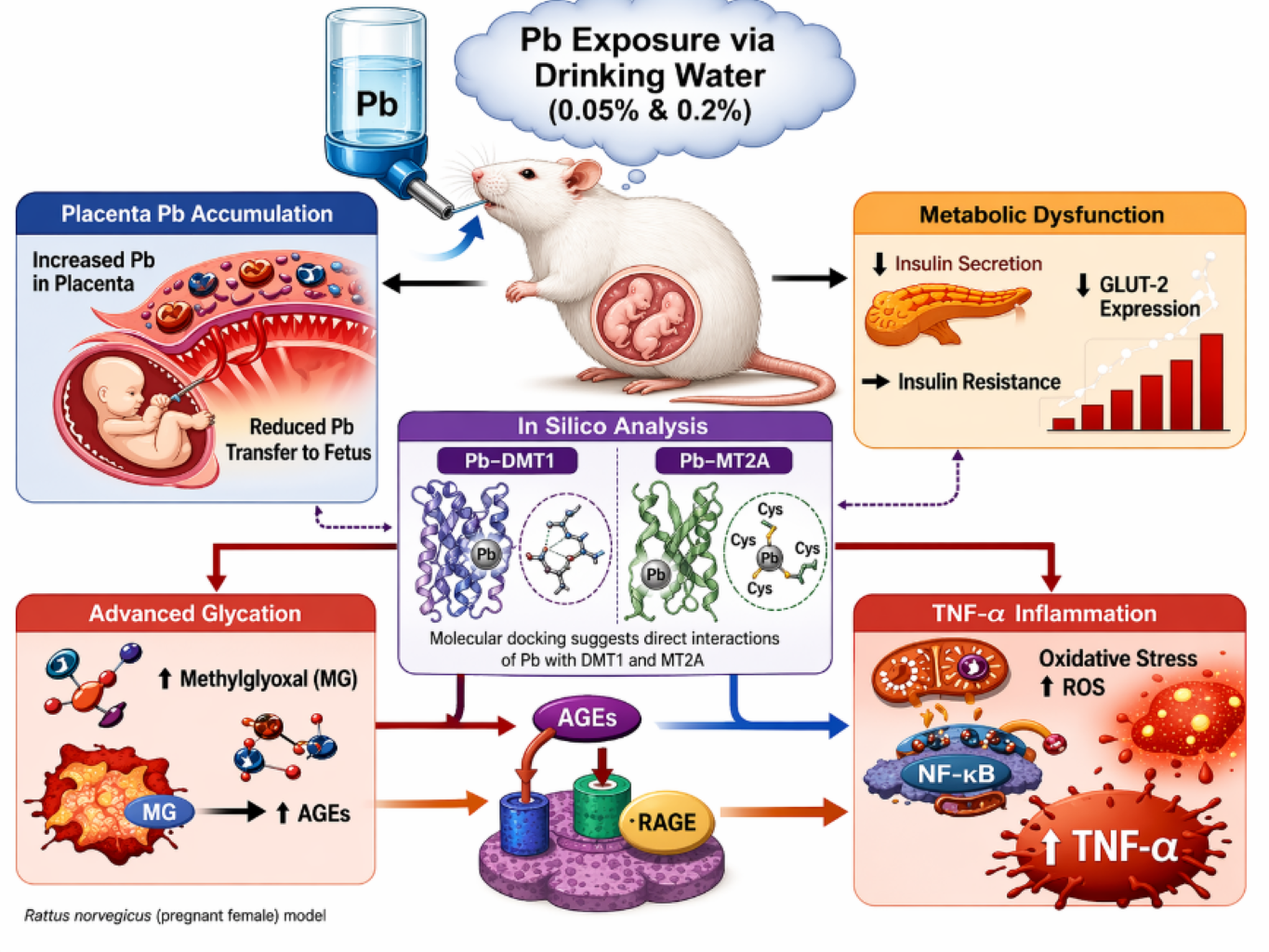
Prenatal Pb exposure is an important environmental health concern because it may disrupt maternal metabolic homeostasis during pregnancy. However, experimental evidence linking placental Pb accumulation with metabolic and inflammatory alterations relevant to gestational diabetes mellitus (GDM)-associated pathophysiology remains limited. This study evaluated the effects of prenatal Pb exposure on placental Pb accumulation and maternal metabolic-inflammatory biomarkers in pregnant rats and explored a supportive placental metal-handling mechanism using in silico analysis. A post-test control group design was conducted using pregnant Sprague-Dawley rats allocated into nine groups, including a control group and treatment groups exposed continuously to Pb acetate in drinking water at concentrations of 0.05% and 0.2% from gestational day 1 (GD1) to GD7, GD14, or GD21/parturition. Placental Pb, maternal blood glucose, methylglyoxal (MG), and TNF-α were measured. Placental Pb differed significantly among treatment groups and was highest in the 0.2% Pb group (1.044 ± 0.052 mg/g, p = 0.007). After adjustment for exposure duration, maternal blood glucose in the 0.2% Pb group was 62.333 mg/dL higher than in controls (p < 0.001), while MG and TNF-α were also consistently highest in the 0.2% group. No significant interaction between exposure duration and treatment was observed, indicating that Pb concentration exerted a stronger effect than exposure duration on biomarker changes. In silico analysis showed higher predicted Pb interaction with DMT1 than with MT2A, supporting a model of transporter-related Pb entry followed by intracellular sequestration. Overall, prenatal Pb exposure promoted placental Pb accumulation and maternal metabolic-inflammatory alterations in pregnant rats. While these biomarkers are associated with GDM in humans, this study does not directly diagnose GDM.
HIGHLIGHTS
- High Pb exposure markedly increased placental Pb accumulation in pregnant rats.
- Pb exposure elevated maternal blood glucose, methylglyoxal (MG), and Tumor Necrosis Factor- α (TNF-α) levels.
- Pb concentration exerted a stronger effect than exposure duration on biomarker changes.
- In silico analysis supported Divalent Metal Transporter 1(DMT1)-mediated Pb entry and metallothionein 2A (MT2A)-related sequestration.
- Combined in vivo and in silico findings support placental Pb handling in metabolic-inflammatory disturbance.
GRAPHICAL ABSTRACT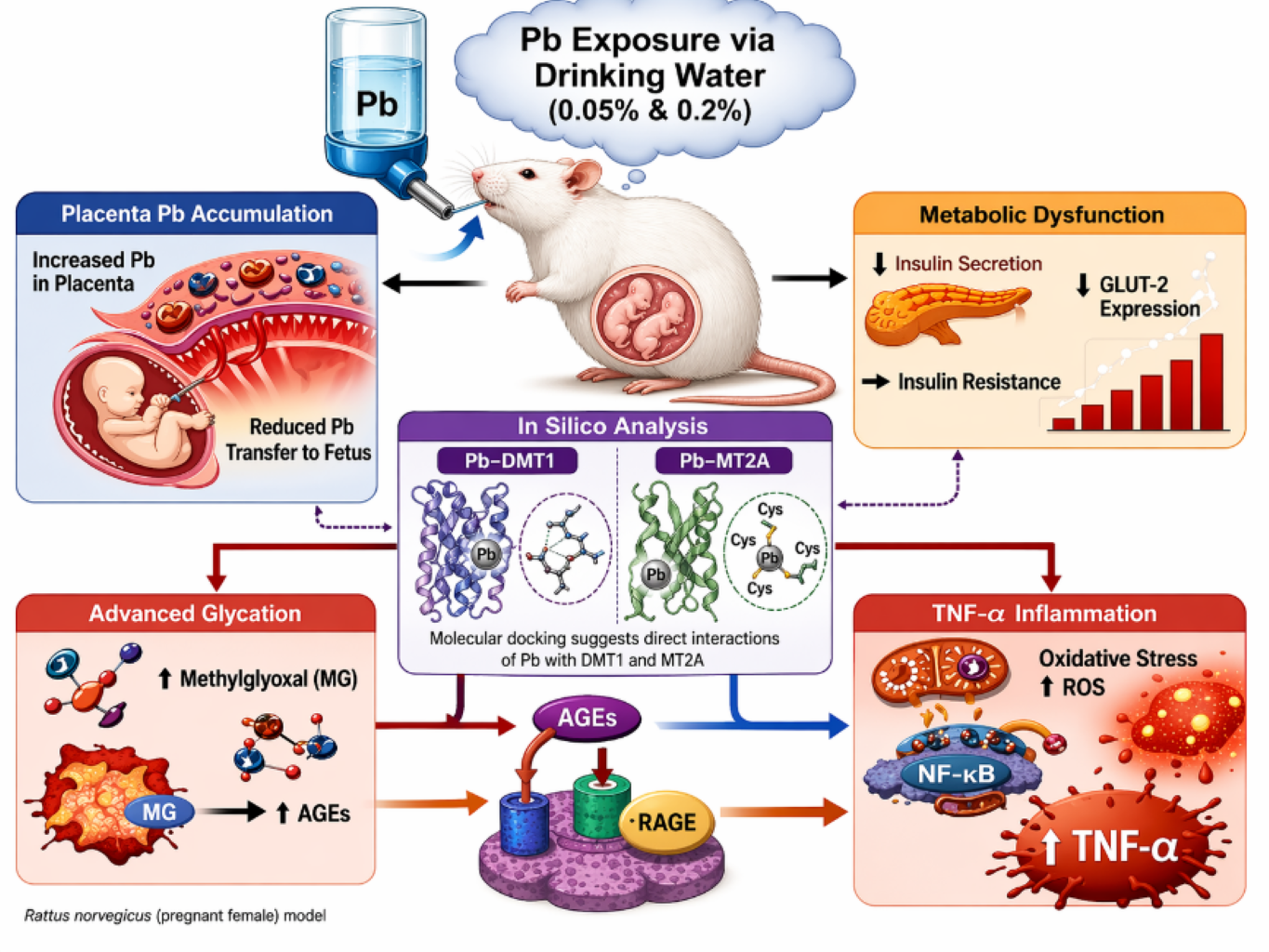
Downloads
References
AC Olufemi, A Mji and MS Mukhola. Potential health risks of lead exposure from early life through later life: Implications for public health education. International Journal of Environmental Research and Public Health 2022; 19(23), 16006.
HB Santoso, Hidayaturrahmah, E Suhartono, R Yunita, D Biyatmoko and D Anggraini. Heavy metal concentrations in water, sediment and giant mudskipper (Periophthalmodon Schlosseri) in the coastal wetlands of kuala lupak estuary of The Barito River, Indonesia. AACL Bioflux 2021; 14(5), 2878-2893.
A Kadarsah, D Salim and DS Husain. Study of water and sediment quality and heavy metal pollution (Pb) at south kalimantan mangrove ecosystem. IOP Conference Series: Earth and Environmental Science 2020; 499, 012001.
Herliwati, M Rahman, AS Hidayat, U Amri and I Sumantri. The occurrences of heavy metals in water, sediment and wild shrimps caught from barito estuary, South Kalimantan, Indonesia. Hayati Journal of Biosciences 2022; 29(5), 643-647.
Iskandar, YDC Salan, AA Utama, NA Putri, GMP Putera, HL Sekartaji, NNA Eriana and E Suhartono. The role of prenatal environmental risk factors in autism spectrum disorder severity: Insight from lead exposure, tobacco smoke, and low birth weight. Gema Lingkungan Kesehatan 2026; 24(1), 155-161.
E Suhartono, Z Noor, WY Budianto and R Idroes. Effect of chronic lead exposure on bone using ATR-FTIR spectroscopy. AIP Conference Proceeding 2019; 2108, 020025.
Iskandar, WY Budianto and E Suhartono. Effect of cadmium exposure on increasing risk of diabetes melitus through the measurement of blood glucose level and liver glucokinase activity in rats. Berkala Kedokteran 2017; 13(2), 137-145.
E Suhartono, IK Oktaviani, Adenan and I Thalib. The protective efficacy of kelakai (Stenochlaena Palustris) on cadmium-induced glucose metabolism alteration in vitro. In: Proceedings of the 2nd Syiah Kuala International Contence on Medicine and Health Sciences, Aceh, Indonesia. 2018, p. 156-162.
E Suhartono, N Komari and SCPT Siahaan. Interaction of mercury and cadmium on key enzymes in glycolysis in silico. Jurnal Ilmiah Kedokteran Wijaya Kusuma 2021; 10(2), 253-260.
V Halim, E Suhartono and A Biworo. Cadmium impact on liver glucose level in white rat (Rattus Norvegicus) in vitro. Jurnal Ilmiah Kedokteran Wijaya Kusuma 2018; 7(2), 189-195.
EA Pratidina, E Suhartono and B Setiawan. Impact of heavy metals on hexokinase isoforms: An in silico study. Berkala Kedokteran 2022; 18(2), 29-35.
A Lahdimawan, SA Bulan, E Suhartono and B Setiawan. The impact of cadmium and mercury on carbohydrate metabolism: An in silico study of glycogen synthase and phosphofructokinase enzymes. Jurnal Ilmiah Ibnu Sina 2021; 7(1), 109-115.
S Chen, J Zhou, M Zhu, J Tong, C Liang, X Wu, G Gao, S Yan, F Tao and K Huang. Potential interactive effect of placental heavy metals and gestational diabetes mellitus on neonatal anthropometric measures: A birth cohort study. Environmental Pollution 2025; 384, 126930.
X Jia, L Zhang, J Zhao, M Ren, Z Li, J Wang, S Wang, Y Liu, H An, Y Li, L Yan, Z Li, X Liu, B Pan and R Ye. Associations between endocrine-disrupting heavy metals in maternal hair and gestational diabetes mellitus: A nested case-control study in China. Environment International 2021; 157, 106770.
W Wang, P Jing, H Zhao, J Cheng, Z Yang, F He and S Lv. Association between glycosylated hemoglobin and blood lead: A cross-sectional study. PLoS One 2025; 20(2), 0318580.
P Flores-Espinosa, R Menon, A Kammala and LS Richardson. Lead exposure at the feto-maternal interface: A cause for concern for fetal membrane trophoblasts. Toxicological Sciences 2025; 203(2), 195-205.
K Somsuan, L Phuapittayalert, Y Srithongchai, P Sonthi, W Supanpaiboon, W Hipkaeo and N Sakulsak. Increased DMT-1 expression in placentas of women living in High-Cd-Contaminated areas of Thailand. Environmental Science and Pollution Research 2019; 26, 141-151.
R Widhalm, I Ellinger, S Granitzer, M Forsthuber, R Bajtela, K Gelles, PY Hartig, M Hengstschläger, H Zeisler, H Salzer and C Gundacker. Human placental cell line HTR-8/SVneo accumulates cadmium by divalent metal transporters DMT1 and ZIP14. Metallomics 2020; 12(11), 1822-1833.
V Michaelis, L Aengenheister, M Tuchtenhagen, J Rinklebe, F Ebert, T Schwerdtle, T Buerki-Thurnherr and J Bornhorst. Differences and interactions in placental manganese and iron transfer across an in vitro model of human villous trophoblasts. International Journal of Molecular Sciences 2022; 23(6), 3296.
D Tekin, Z Kayaaltı and T Söylemezoğlu. The effects of metallothionein 2A polymorphism on lead metabolism: Are pregnant women with a heterozygote genotype for metallothionein 2A polymorphism and their newborns at risk of having higher blood lead levels? International Archives of Occupational and Environmental Health 2012; 85, 631-637.
NP du Sert, V Hurst, A Ahluwalia, S Alam, MT Avey, M Baker, WJ Browne, A Clark, IC Cuthill, U Dirnagl, M Emerson, P Garner, ST Holgate, DW Howells, NA Karp, SE Lazic, K Lidster, CJ MacCallum, M Macleod, EJ Pearl, …, H Würbel. The ARRIVE guidelines 2.0: Updated guidelines for reporting animal research. PLOS Biology 2020; 18(7), 3000410.
MH Nooranizadeh, A Mogheiseh, M Kafi, M Sepehrimanesh and H Vaseghi. Induction of superovulation in mature mice and rats using serum of spayed female dogs. Laboratory Animal Research 2018; 34(4), 211-215.
PR Situmorang, B Zalukhu and DS Napitupulu. Comparison of increasing blood sugar levels before and after giving white sugar, palm sugar, and honey to tlm students at santa elisabeth stikes medan 2023. Journal of Indonesian Medical Laboratory and Science, 2023; 4(2), 136-147.
Irnawati, R Idroes, M Akmal, E Suhartono and I Seriana. Effect of arsenic exposure on MDA, SOD, H2O2 and TNF-α levels of uterus homogenate of female Sparague-Dawleys rats. F1000Research 2023; 12, 108.
E Sjöstedt, W Zhong, L Fagerberg, M Karlsson, N Mitsios, C Adori, P Oksvold, F Edfors, A Limiszewska, F Hikmet, J Huang, Y Du, Lin, Z Dong, L Yang, X Liu, H Jiang, X Xu, J Wang, H Yang, ..., J Mulder. An atlas of the protein-coding genes in the human, pig, and mouse brain. Science 2020; 367(6482), 5947.
HB Santoso, Hidayaturrahmah, E Suhartono, R Yunita, D Biyatmoko and D Anggraini. Antioxidative responses in the skin mucus of Periophthalmodon schlosseri as biomarkers for the assessment of heavy metal pollution in the coastal wetlands of kuala lupak estuary of The Barito River, Indonesia. AACL Bioflux 2022; 15(5), 2500-2511.
Chen, C Ma, Q Li, JG Hang, J Shen, SF Nakayama, T Kido, Y Lin, H Feng, CR Jung, XL Sun and J Lou. Prenatal exposure to heavy metals and adverse birth outcomes: Evidence from an e-waste area in China. GeoHealth 2023; 7(11), 2023GH000897.
S Pyatha, H Kim, D Lee and K Kim. Co-exposure to lead, mercury, and cadmium induces neurobehavioral impairments in mice by interfering with dopaminergic and serotonergic neurotransmission in the striatum. Frontiers in Public Health 2023; 11, 1265864.
J Zhou, J Tong, C Liang, P Wu, J Ouyang, W Cai, J Sheng, G Gao, S Yan, F Tao and K Huang. Prenatal placental metal accumulation and its association with child attention deficit/hyperactivity disorder and autism spectrum disorder symptom at 3 years of age: The role of psychosocial-environmental support in infancy. Environmental Research 2025; 274, 121294.
M Grundeken, K Gustin, M Vahter, M Delaval, M Barman, A Sandin, AS Sandberg, AE Wold, K Broberg and M Kippler. Toxic metals and essential trace elements in placenta and their relation to placental function. Environmental Research 2024; 248, 118355.
S Molina-Mesa, JP Martinez-Cendan, D Moyano-Rubiales, I Cubillas-Rodriguez, J Molina-Garcia and E Gonzalez-Mesa. Detection of relevant heavy metal concentrations in human placental tissue: Relationship between the concentrations of Hg, As, Pb and Cd and the diet of the pregnant woman. International Journal of Environmental Research and Public Health 2022; 19(22), 14731.
P de Angelis, RK Miller, TH Darrah, PJ Katzman, EK Pressman, TR Kent and K O’Brien. Element content of the placenta: A comparison between two high-risk obstetrical populations, adult women carrying multiples adolescents carrying singletons. Environmental Research 2017; 158, 553-565.
K Kot, D Kosik-Bogacka, N Łanocha-Arendarczyk, W Malinowski, S Szymański, M Mularczyk, N Tomska and I Rotter. Interactions between 14 elements in the human placenta, fetal membrane and umbilical cord. International Journal of Environmental Research and Public Health 2019; 16(9), 1615.
J Grzesik-Gasior, J Sawicki, A Pieczykolan and A Bien. Content of selected heavy metals in the umbilical cord blood and anthropometric data of mothers and newborns in poland: Preliminary data. Scientific ReportsRep 2023; 13, 14077.
MC Sahu, MR Yogeshbhai, H Oza, K Upadhyay, K Chanania and S Pati. Blood lead levels in pregnant women and their newborn infants at an Indian Teaching Hospital. Journal of Family Medicine and Primary Care 2024; 13(1), 348-355.
S Dutta and DM Ruden. Heavy metals in umbilical cord blood: Effects on epigenetics and child development. Cells 2024; 13(21), 1775.
I Vornic, V Buciu, CG Furau, PN Gaje, RA Ceausu, CS Dumitru, AC Barb, D Novacescu, AA Cumpanas, SC Latcu, TG Cut and F Zara. Oxidative stress and placental pathogenesis: A contemporary overview of potential biomarkers and emerging therapeutics. International Journal of Molecular Sciences 2024; 25(22), 12195.
JB Tyrrell, S Hafida, P Stemmer, A Adhami and T Leff. Lead (Pb) exposure promotes diabetes in obese rodents. Journal of Trace Elements in Medicine and Biology 2017; 39, 221-226.
A Singh, R Kukreti, L Saso and S Kukreti. Mechanistic insight into oxidative stress-triggered signaling pathways and type 2 diabetes. Molecules 2022; 27(3), 950.
E Mlynarska, M Grabarczyk, K Leszto, G Luba, K Motor, A Sosinska, J Rysz and B Franczyk. Environmental insults to glucose metabolism: The role of pollutants in insulin resistance. International Journal of Molecular Sciences 2025; 26(18), 8979.
N Ebrahim, K Shakirova and E Dashinimaev. PDX1 is the cornerstone of pancreatic β-cell functions and identity. Frontiers in Molecular Biosciences 2022; 9, 1091757.
B Sun, H Chen, J Xue, P Li and X Fu. The role of GLUT2 in glucose metabolism in multiple organs and tissues. Molecular Biology Reports 2023; 50, 6963-6974.
M Chlubek and I Baranowska-Bosiacka. Selected functions and disorders of mitochondrial metabolism under lead exposure. Cells 2024; 13(14), 1182.
DJ Fazakerley, AY Minard, JR Krycer, KC Thomas, J Stöckli, DJ Harney, JG Burchfield, GJ Maghzal, ST Caldwell, RC Hartley, R Stocker, MP Murphy and DE James. Mitochondrial oxidative stress causes insulin resistance without disrupting oxidative phosphorylation. Journal of Biological Chemistry 2018; 293(19), 7315-7328.
P Gonzalez, P Lozano, G Ros and F Solano. Hyperglycemia and oxidative stress: An integral, updated and critical overview of their metabolic interconnections. International Journal of Molecular Sciences 2023; 24(11), 9352.
Z Zhang, Q Huang, D Zhao, F Lian, X Li and W Qi. The impact of oxidative stress-induced mitochondrial dysfunction on diabetic microvascular complications. Frontiers in Endocrinology 2023; 14, 1112363.
A Feezan, S Afzal, SM Shoaib, MSH Akash and K Rehman. Impact of lead and nickel contamination on metabolic health: Associations with diabetes mellitus in a Pakistani Cohort. Emerging Contaminants 2025; 11(1), 100419.
T Jin, EY Park, B Kim and JK Oh. Environmental exposure to lead and cadmium are associated with triglyceride glucose index. Scientific Reports 2024; 14, 2496.
H Wan, B Wang, Y Cui, Y Wang, K Zhang, C Chen, F Xia, L Ye, L Wang, N Wang and Y Lu. Low-level lead exposure promotes hepatic gluconeogenesis and contributes to the elevation of fasting glucose level. Chemosphere 2021; 276, 130111.
B Wang, W Zhang, C Chen, Y Chen, F Xia, N Wang and Y Lu. Lead exposure and impaired glucose homeostasis in chinese adults: A repeated measures study with 5 years of follow-up. Ecotoxicology and Environmental Safety 2022; 243, 113953.
JH Ji, MH Jin, JH Kang, S Il Lee, S Lee, SH Kim and SY Oh. Relationship between heavy metal exposure and Type 2 diabetes: A large-scale retrospective cohort study using occupational health examinations. BMJ Open 2021; 11, 039541.
M Hasanuzzaman, K Nahar, A Rahman, JA Mahmud, HF Alharby and M Fujita. Exogenous glutathione attenuates lead-induced oxidative stress in wheat by improving antioxidant defense and physiological mechanisms. Journal of Plant Interactions 2018; 13(1), 203-212.
C Perez, AM Barkley-Levenson, BL Dick, PF Glatt, Y Martinez, D Siegel, JD Momper, AA Palmer and SM Cohen. Metal-binding pharmacophore library yields the discovery of A Glyoxalase 1 inhibitor. Journal of Medical Chemistry 2019; 62(3), 1609-1625.
J Vaskova, G Kovacova, J Pudelsky, D Palencar and H Mickova. Methylglyoxal formation —metabolic routes and consequences. Antioxidants 2025; 14(2), 212.
YT Tseng, YH Tsai, F Fülöp, FR Chang and YC Lo. 2-Iodo-4′-Methoxychalcone attenuates methylglyoxal-induced neurotoxicity by activation of GLP-1 receptor and enhancement of neurotrophic signal, antioxidant defense and glyoxalase pathway. Molecules 2019; 24(12), 2249.
MH Baig, AT Jan, G Rabbani, K Ahmad, JM Ashraf, T Kim, HS Min, YH Lee, WK Cho, JY Ma, EJ Lee and I Choi. Methylglyoxal and advanced glycation end products: Insight of the regulatory machinery affecting the myogenic program and of its modulation by natural compounds. Scientific Reports 2017; 7, 5916.
V Cepas, F Manig, JC Mayo, M Hellwig, D Collotta, V Sanmartino, R Carrocera-Pumarino, M Collino, T Henle and RM Sainz. In vitro evaluation of the toxicological profile and oxidative stress of relevant diet-related advanced glycation end products and related 1,2-Dicarbonyls. Oxidative Medicine and Cellular Longevity 2021; 2021, 9912240.
Y Chen, Z Meng, Y Li, S Liu, P Hu and E Luo. Advanced glycation end products and reactive oxygen species: Uncovering the potential role of ferroptosis in diabetic complications. Molecular Medicine 2024; 30, 141.
AL Oliveira, MG de Oliveira, FZ Mónica and E Antunes. Methylglyoxal and advanced glycation end products (AGEs): Targets for the prevention and treatment of diabetes-associated bladder dysfunction? Biomedicines 2024; 12(5), 939.
V Matovic, A Buha, D Dukic-Cosic and Z Bulat. Insight into the oxidative stress induced by lead and/or cadmium in blood, liver and kidneys. Food and Chemical Toxicology 2015; 78, 130-140.
J Salavati, H Fallah, Y Niknejad and DB Tari. Methyl jasmonate ameliorates lead toxicity in Oryza sativa by modulating chlorophyll metabolism, antioxidative capacity and metal translocation. Physiology and Molecular Biology of Plants 2021; 27(5), 1089-1104.
GER Antara, TIA Saturti and TGB Mahadewa. The role of inflammatory cytokines in the pathogenesis of obesity: A crucial area of study in the field of inflammation and obesity. Bali Medical Jourmal 2025; 14(1), 279-285.
R Mittal, K Prasad, JRN Lemos, G Arevalo and K Hirani. Unveiling gestational diabetes: An overview of pathophysiology and management. International Journal of Molecular Sciences 2025; 26(5), 2320.
K Koshta, A Chauhan, S Singh and V Srivastava. Prenatal arsenic exposure alters EZH2-H3K27me3 occupancy at TNF-α promoter leading to insulin resistance and metabolic syndrome in a mouse model. Environment InternationalInt 2024; 190, 108929.
S He, T Jiang, D Zhang, M Li, T Yu, M Zhai, B He, T Yin, X Wang, F Tao, Y Yao, D Ji, Y Yang and C Liang. Association of exposure to multiple heavy metals during pregnancy with the risk of gestational diabetes mellitus and insulin secretion phase after glucose stimulation. Environmental Research 2024; 248, 118237.
A Varthaliti, V Lygizos, M Fanaki, V Pergialiotis, A Papapanagiotou, K Pappa, M Theodora, MA Daskalaki, P Antsaklis and G Daskalakis. The role of IL-6 and TNF-α as early biomarkers in the prediction and diagnosis of gestational diabetes mellitus. Biomedicines 2025; 13(7), 1627.
K Chibowska, I Baranowska-Bosiacka, A Falkowska, I Gutowska, M Goschorska and D Chlubek. Effect of lead (Pb) on inflammatory processes in the brain. International Journal of Molecular Sciences 2016; 17(12), 2140.
K Lingappan. NF-ΚB in oxidative stress. Current Opinion in Toxicology 2018; 7, 81-86.
IM Attafi, SA Bakheet, SF Ahmad, OM Belali, FE Alanazi, SA Aljarboa, IA AL-Alallah and HM Korashy. Lead nitrate induces inflammation and apoptosis in rat lungs through the activation of NF-ΚB and AhR signaling pathways. Environmental Science and Pollution Research 2022; 29, 64959-64970.
F Gomez-Chavez, D Correa, P Navarrete-Meneses, JC Cancino-Diaz, ME Cancino-Diaz and S Rodriguez-Martinez. NF-ΚB and its regulators during pregnancy. Frontiers in Immunology 2021; 12, 679106.
CH Lu, CC Chen, CS Yu, YY Liu, JJ Liu, ST Wei and YF Lin. MIB2: Metal ion-binding site prediction and modeling server. Bioinformatics 2022; 38(18), 4428-4429.
R Yang, D Roshani, B Gao, P Li and N Shang. Metallothionein: A comprehensive review of its classification, structure, biological functions, and applications. Antioxidants 2024; 13(7), 825.
MD Peris-Díaz, R Guran, C Domene, VDL Rios, O Zitka, V Adam and A Krȩżel. An integrated mass spectrometry and molecular dynamics simulations approach reveals the spatial organization impact of metal-binding sites on the stability of metal-depleted Metallothionein-2 Species. Journal of the American Chemical Society 2021; 143(40), 16486-16501.
M Liziczai, A Fuchs, C Manatschal and R Dutzler. Structural basis for metal ion transport by the human SLC11 proteins DMT1 and NRAMP1. Nature Communications 2025; 16, 761.
XB Ling, HW Wei, J Wang, YQ Kong, YY Wu, JL Guo, TF Li and JK Li. Mammalian Metallothionein-2A and oxidative stress. International Journal of Molecular Sciences 2016; 17(9), 1483.
Downloads
Published
How to Cite
Issue
Section
License
Copyright (c) 2026 Walailak University

This work is licensed under a Creative Commons Attribution-NonCommercial-NoDerivatives 4.0 International License.





