
Phytochemical Characterization and Evaluation of Extracts from the Wild Edible Mushroom Russula emetica against Herpes Simplex Virus Type 1 (Wild-Type and Drug-Resistant Strains), Human Papillomavirus Type 16 and Cervical Cancer
DOI:
https://doi.org/10.48048/tis.2027.13885Keywords:
Russula emetica, FTIR, HPAEC, HPLC, Russula emetica, Human papillomavirus, Herpes simplex virus, Cervical cancer, FTIR, HPAEC, HPLC, Molecular dockingAbstract
Russula emetica is mildly poisonous, but boiling and salt pickling can neutralize its toxins. This mushroom is consumed in some countries, including Thailand. Previous studies on its anticancer compounds are limited, and their potential inhibitory effects against HPV or drug-resistant HSV remain largely unexplored. This study investigated hot water extracts of fresh and dried R. emetica fruiting bodies, as well as their freeze-dried counterparts, against HPV-16, HPV-16-positive cervical cancer cells, and HSV-1 (wild-type and drug-resistant strains), and examined potential inhibitory mechanisms. Hot water extraction was performed on fresh and dried fruiting bodies, followed by centrifugation and filtration; half of each water extract was frozen and subjected to freeze-drying. Bioactive compounds in each extract were evaluated using colorimetric assays, HPAEC, and HPLC. FTIR spectroscopy was used to identify functional groups and characterize the chemical composition of the extracts. Cytotoxicity was assessed in Vero, CaSki, and 293FT cell lines. Sub-toxic concentrations were used to evaluate HPV-16 infectivity, E6 expression, CaSki cell growth, and inhibition of HSV-1 KOS drug-susceptible) and HSV-1 dxpIII (drug-resistant). Gene expression profiles in treated cells were examined by RT-PCR. Freeze-dried extracts from fresh fruiting bodies significantly inhibited HSV-1 KOS and HSV-1 dxpIII at the post-entry stage and reduced viral gD mRNA levels and genome copy number. Freeze-dried extracts also significantly reduced HPV-16 E6, c-fos, and YY1 mRNA expression and increased p53 protein levels, suppressed cell migration and colony formation, and promoted cancer cell death. Catechin and rutin identified in R. emetica extracts were predicted by molecular docking to exhibit potential binding affinity toward HSV-1 DNA polymerase and HPV-16 E6 proteins. Overall, freeze-dried extracts showed efficacy in inhibiting HSV infection, and suppressing HPV-16 E6 expression and cervical cancer cell growth, suggesting their potential as agents for antiviral activity against HSV and potential anticancer effects in cervical cancer.
HIGHLIGHTS
- Russula emetica extracts derived from fresh and dried fruiting bodies, based on hot water extraction, were first investigated for their anti-HPV-16 pseudovirus infection and HSV drug-resistant strain.
- emetica extracts more effectively inhibited the drug-resistant HSV-1 strain.
- Fresh and dried emetica extracts were analyzed for lipid, polysaccharide, protein, tannin, terpene, and antioxidant activity, as well as sugar compositions, phenolic/flavonoid contents, and functional groups.
- Catechin and rutin identified in emetica extracts were predicted by molecular docking analysis to strongly bind to HSV-1 DNA polymerase and HPV-16 E6 proteins.
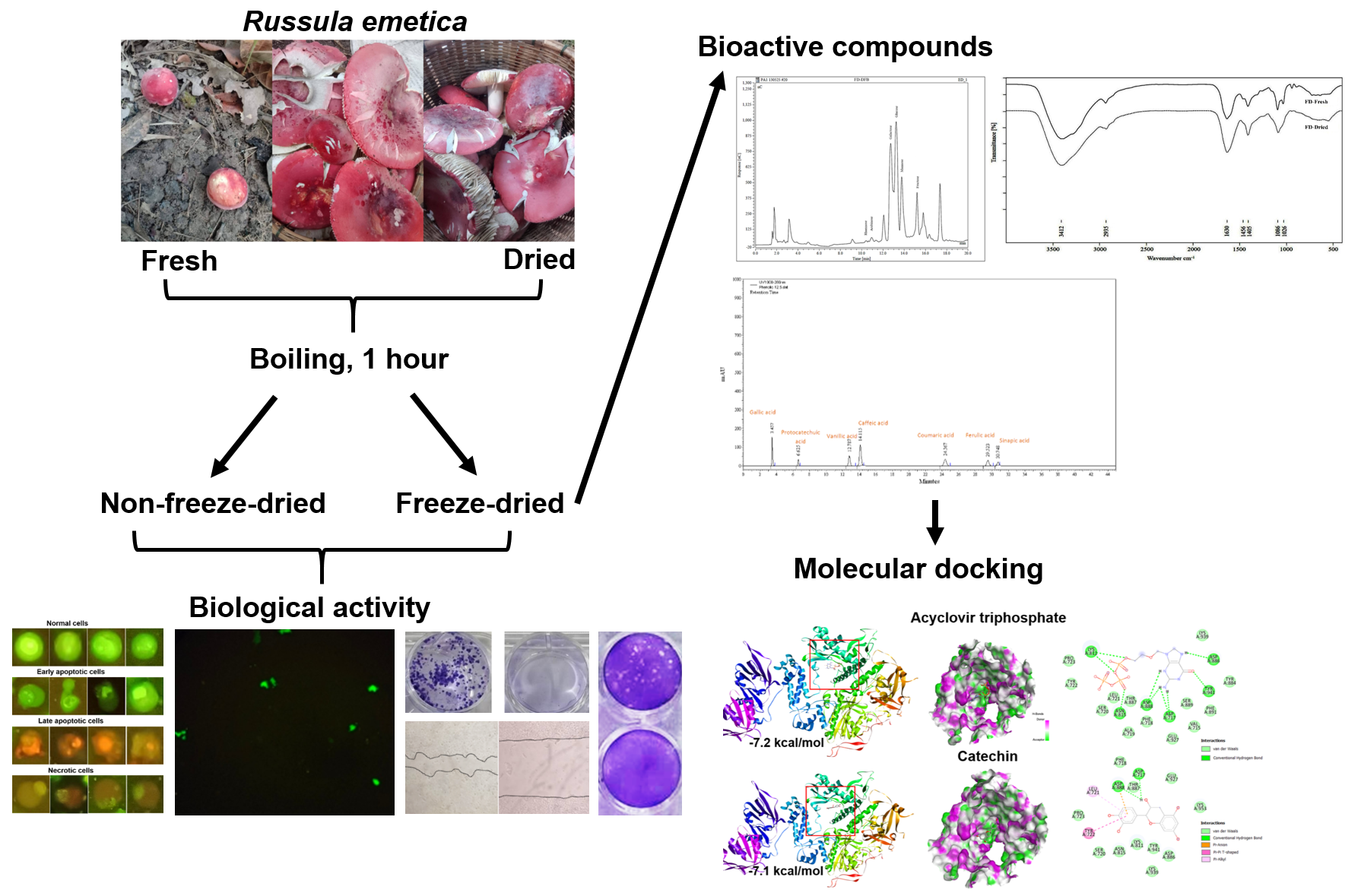
GRAPHICAL ABSTRACT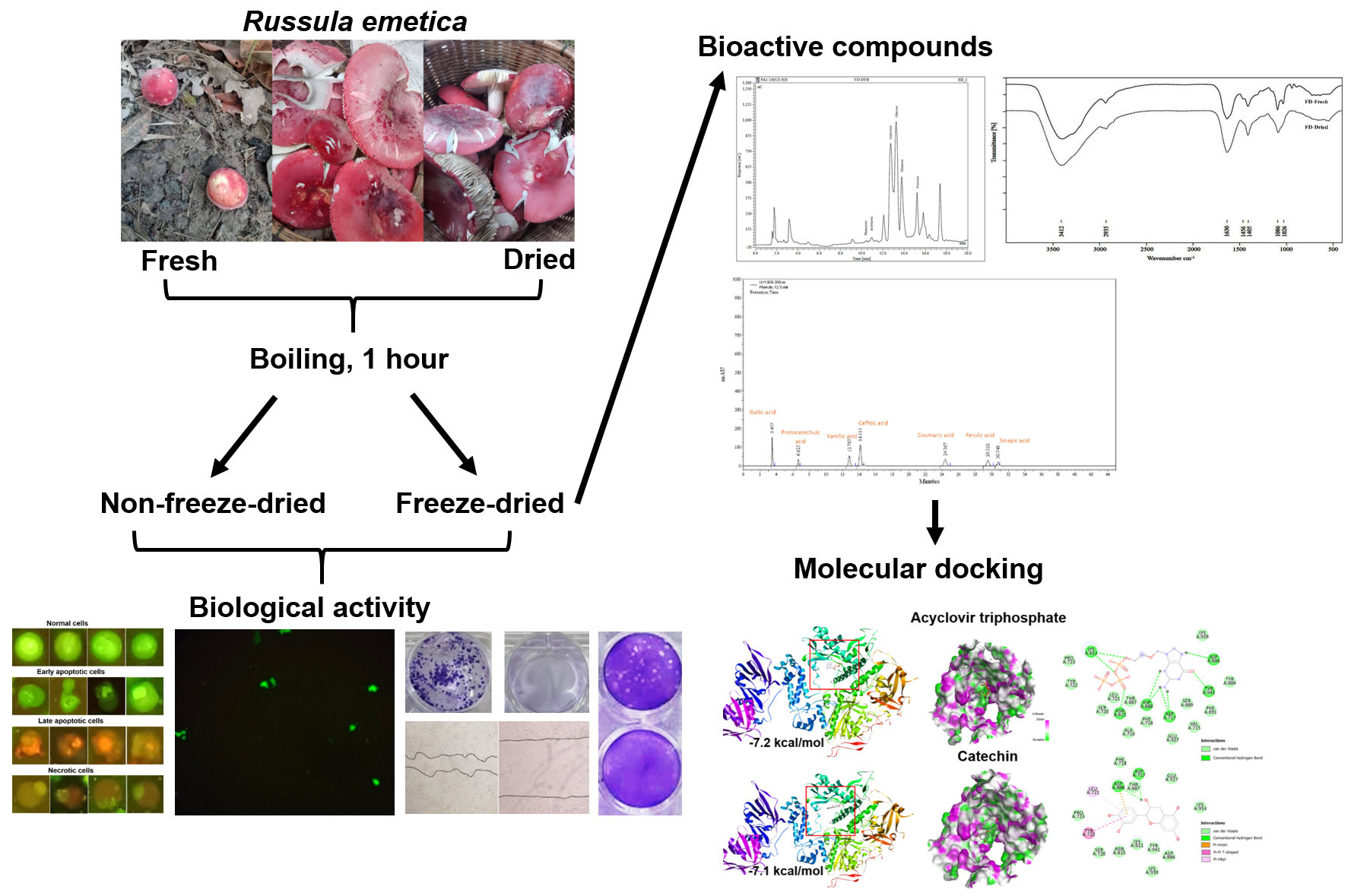
Downloads
References
A Pandit, SK Shrivastava and S Sethi. Contemporary challenges in sexually transmitted diseases: From diagnostics to drug resistance. Venereology 2026; 5(2), 14.
C Loymunkong, K Choowongkomon, C Heawchaiyaphum, N Chatchawankanpanich, C Pientong, T Ekalaksananan and J Chuerduangphui. Anti-herpes simplex virus (wild-type and drug-resistant) properties of herbal KerraTM, KSTM, and MinozaTM. Viruses 2025; 17(7), 889.
C James, M Harfouche, NJ Welton, KM Turner, LJ Abu-Raddad, SL Gottlieb and KJ Looker. Herpes simplex virus: Global infection prevalence and incidence estimates, 2016. Bulletin of the World Health Organization 2020; 98(5), 315-329.
R Duan, RD de Vries, AD Osterhaus, L Remeijer and GMGM Verjans. Acyclovir-resistant corneal HSV-1 isolates from patients with herpetic keratitis. The Journal of Infectious Diseases 2008; 198(5), 659-663.
R Stránská, R Schuurman, E Nienhuis, IW Goedegebuure, M Polman, JF Weel, PM Wertheim-Van Dillen, RJ Berkhout and AMV Loon. Survey of acyclovir-resistant herpes simplex virus in the Netherlands: Prevalence and characterization. Journal of Clinical Virology 2005; 32(1), 7-18.
J Piret and G Boivin. Resistance of herpes simplex viruses to nucleoside analogues: Mechanisms, prevalence, and management. Antimicrobial Agents and Chemotherapy 2011; 55(2), 459-472.
TH Bacon, MJ Levin, JJ Leary, RT Sarisky and D Sutton. Herpes simplex virus resistance to acyclovir and penciclovir after two decades of antiviral therapy. Clinical Microbiology Reviews 2003; 16(1), 114-128.
J Lopes-Nunes, M Lopes, B Rosado, IG Maocha, J Rolo, C Gaspar, B Pires, T Rosado, E Gallardo, A Palmeira-de-Oliveira, J Martinez-de-Oliveira, C Ferreira, MPC Campello, A Paulo, B Medeiros-Fonseca, L Félix, C Venâncio, MDL Pinto, PA Oliveira, R Palmeira-de-Oliveira and C Cruz. Vaginal formulation development: A strategy based on aptamer-guided liposome for human papillomavirus-induced lesions. European Journal of Pharmaceutics and Biopharmaceutics 2025; 210, 114693.
S Sethi, A Ali, X Ju, A Antonsson, R Logan, K Canfell, M Smith, G Garvey, J Hedges and L Jamieson. A systematic review and meta‐analysis of the prevalence of human papillomavirus infection in Indigenous populations–A Global Picture. Journal of Oral Pathology & Medicine 2021; 50(9), 843-854.
RM Lewis, JF Laprise, JW Gargano, ER Unger, TD Querec, HW Chesson, M Brisson and LE Markowitz. Estimated prevalence and incidence of disease-associated human papillomavirus types among 15-to 59-year-olds in the United States. Sexually Transmitted Diseases 2021; 48(4), 273-277.
X Meng, B Yang, H Yin, J Chen, W Ma, Z Xu and Y Shen. Global burden and incidence trends in cancers associated with human papillomavirus infection: A Population-based systematic study. Pathogens 2025; 14(9), 880.
M Brisson and M Drolet. Global elimination of cervical cancer as a public health problem. The Lancet Oncology 2019; 20(3), 319-321.
M Palagudi, S Para, N Golla, KC Meduri, SP Duvvuri, Y Vityala, DC Sajja and U Damineni. Adverse effects of cancer treatment in patients with cervical cancer. Cureus 2024; 16(2), e54106.
LE Markowitz, V Tsu, SL Deeks, H Cubie, SA Wang, AS Vicari and JM Brotherton. Human papillomavirus vaccine introduction–the first five years. Vaccine 2012; 30(S5), F139-F148.
H Polansky, E Itzkovitz and A Javaherian. Human papillomavirus (HPV): Systemic treatment with Gene-Eden-VIR/Novirin safely and effectively clears virus. Drug Design, Development and Therapy 2017; 11, 575-583.
N Chaomuang, AJ Dede, S Saokaew and A Umnuaypornlert. Effects of home drug delivery on drug-related problems: Preliminary evidence for improved patient outcomes during the COVID-19 pandemic in Thailand. Journal of the American Pharmacists Association 2022; 62(4), 1206-1213.
B Yan, Z Jiang, J Yuan, M Li, J Zeng, J Tang, ZK Lu, H Ding, J Xia and Q Wang. Effects and safety of herbal medicines among community-dwelling residents during COVID-19 pandemic: A large prospective, randomized controlled trial (RCT). Phytomedicine 2021; 85, 153403.
M Ekor. The growing use of herbal medicines: Issues relating to adverse reactions and challenges in monitoring safety. Frontiers in Pharmacology 2014; 4, 177.
P Radford. Fungi, food, poison and mystery. Bristol Medico-Chirurgical Journal 1982; 97(3-4), 12-15.
T Yuwa-Amornpitak and PN Yeunyaw. Diversity of wild mushrooms in the community forest of Na Si Nuan sub-district, Thailand. Journal of Biochemical Technology 2020; 11(3), 28-36.
P Klungsupya. Apoptotic activity of ethanolic extract of Thai indigenous mushroom Russula alboareolata against L929, HeLa and HepG2 cells by MMP assay. Thai Journal of Pharmaceutical Sciences 2016; 40, 123-126.
J Wang, H Wang and TB Ng. A peptide with HIV-1 reverse transcriptase inhibitory activity from the medicinal mushroom Russula paludosa. Peptides 2007; 28(3), 560-565.
J Yang, SC Karunarathna, N Patabendige, E Tarafder, D Lou, Y Zhou and K Hapuarachchi. Unveiling the bioactive compounds and therapeutic potential of Russula: A comprehensive review. Journal of Fungi 2025; 11(5), 341.
K Kaewnarin, N Suwannarach, J Kumla and S Lumyong. Phenolic profile of various wild edible mushroom extracts from Thailand and their antioxidant properties, anti-tyrosinase and hyperglycaemic inhibitory activities. Journal of Functional Foods 2016; 27, 352-364.
K Kaewnarin, N Suwannarach, J Kumla, S Choonpicharn, K Tanreuan and S Lumyong. Characterization of polysaccharides from wild edible mushrooms from Thailand and their antioxidant, antidiabetic, and antihypertensive activities. International Journal of Medicinal Mushrooms 2020; 22(3), 221-233.
Y Cheng, J Gan, B Yan, P Wang, H Wu and C Huang. Polysaccharides from Russula: A review on extraction, purification, and bioactivities. Frontiers in Nutrition 2024; 11, 1406817.
S Jiamworanunkul and P Chomcheon. Screening of antimicrobial and antioxidant properties of ethyl acetate extracts from wild edible mushrooms. Thai Journal of Pharmaceutical Sciences 2015; 43(3), 161-167.
DJ Seo and C Choi. Antiviral bioactive compounds of mushrooms and their antiviral mechanisms: A review. Viruses 2021; 13(2), 350.
A Arab, F Amini, A Iraji and MH Hashempur. The potential of polyphenols and polyphenol-rich extracts against human papillomavirus infections and associated cancers. Journal of Functional Foods 2025; 129, 106873.
S Butsat and S Siriamornpun. Phenolic acids and antioxidant activities in husk of different Thai rice varieties. Food Science and Technology International 2010; 16(4), 329-336.
X Zhang, Z Wu, P Weng and Y Yang. Analysis of tea catechins in vegetable oils by high-performance liquid chromatography combined with liquid–liquid extraction. International Journal of Food Science and Technology 2015; 50(4), 885-891.
Y Su and L Li. Structural characterization and antioxidant activity of polysaccharide from four auriculariales. Carbohydrate Polymers 2020; 229, 115407.
S Fiorentino, L Bellani, M Santin, A Castagna, MC Echeverria and L Giorgetti. Effects of microalgae as biostimulants on plant growth, content of antioxidant molecules and total antioxidant capacity in Chenopodium quinoa exposed to salt stress. Plants 2025; 14(5), 781.
O Trott and AJ Olson. AutoDock Vina: Improving the speed and accuracy of docking with a new scoring function, efficient optimization, and multithreading. Journal of Computational Chemistry 2010; 31(2), 455-461.
K Zanier, S Charbonnier, AOMHO Sidi, AG McEwen, MG Ferrario, P Poussin-Courmontagne, V Cura, N Brimer, KO Babah, T Ansari, I Muller, RH Stote, J Cavarelli, SV Pol and G Travé. Structural basis for hijacking of cellular LxxLL motifs by papillomavirus E6 oncoproteins. Science 2013; 339(6120), 694-698.
S Shankar, J Pan, P Yang, Y Bian, G Oroszlán, Z Yu, P Mukherjee, DJ Filman, JM Hogle, M Shekhar, DM Coen and J Abraham. Viral DNA polymerase structures reveal mechanisms of antiviral drug resistance. Cell 2024; 187(20), 5572.e15-5586.e15.
M Manassila, T Sooksa-Nguan, N Boonkerd, S Rodtong and N Teaumroong. Phylogenetic diversity of wild edible Russula from northeastern Thailand on the basis of internal transcribed spacer sequence. Science Asia 2005; 31, 323-328.
A Morselt, WTM Smits and T Limonard. Histochemical demonstration of heavy metal tolerance in ectomycorrhizal fungi. Plant and Soil 1986; 96(3), 417-420.
Y Yusran, E Erniwati, H Maksum, A Khumaidi and R Setiarto. Effect of cooking on the proximate composition and minerals content of wild edible macro fungi from Lore Lindu National Park, Central Sulawesi, Indonesia. African Journal of Food, Agriculture, Nutrition and Development 2022; 22(5), 20523-20541.
L Jakobek. Interactions of polyphenols with carbohydrates, lipids and proteins. Food Chemistry 2015; 175, 556-567.
N Bibi Sadeer, D Montesano, S Albrizio, G Zengin and MF Mahomoodally. The versatility of antioxidant assays in food science and safety—Chemistry, applications, strengths, and limitations. Antioxidants 2020; 9(8), 709.
X Zhong, Y Zhang, M Yuan, L Xu, X Luo, R Wu, Z Xi, Y Li and H Xu. Prunella vulgaris polysaccharide inhibits herpes simplex virus infection by blocking TLR-mediated NF-κB activation. Chinese Medicine 2024; 19(1), 6.
FS Reis, E Pereira, L Barros, MJ Sousa, A Martins and ICFR Ferreira. Biomolecule profiles in inedible wild mushrooms with antioxidant value. Molecules 2011; 16(6), 4328-4338.
Y Li, C Zhang, L Feng, Q Shen, F Liu, X Jiang and B Pang. Application of natural polysaccharides and their novel dosage forms in gynecological cancers: Therapeutic implications from the diversity potential of natural compounds. Frontiers in Pharmacology 2023; 14, 1195104.
CE Isaacs, GY Wen, W Xu, JH Jia, L Rohan, C Corbo, VD Maggio, EC Jenkins and S Hillier. Epigallocatechin gallate inactivates clinical isolates of herpes simplex virus. Antimicrobial Agents and Chemotherapy 2008; 52(3), 962-970.
AD Oliveira, SD Adams, LH Lee, SR Murray, SD Hsu, JR Hammond, D Dickinson, P Chen and TC Chu. Inhibition of herpes simplex virus type 1 with the modified green tea polyphenol palmitoyl-epigallocatechin gallate. Food and Chemical Toxicology 2013; 52, 207-215.
G Uwanyagasani, E Song’Oro, J Ndacyayisenga, EM Terefe and J Muriuki. In vitro activity of various Kenyan tea extracts against HeLa human cervical cancer cell line and molecular docking of tea catechins on high-risk HPV16E6 protein. Informatics in Medicine Unlocked 2024; 44, 101420.
S Khatua, AK Dutta, S Chandra, S Paloi, K Das and K Acharya. Introducing a novel mushroom from mycophagy community with emphasis on biomedical potency. PLoS One 2017; 12(5), e0178050.
L Dou, X Zhang, MM Zangeneh and Y Zhang. Efficient biogenesis of Cu2O nanoparticles using extract of Camellia sinensis leaf: Evaluation of catalytic, cytotoxicity, antioxidant, and anti-human ovarian cancer properties. Bioorganic Chemistry 2021; 106, 104468.
S Suresh, S Karthikeyan and K Jayamoorthy. FTIR and multivariate analysis to study the effect of bulk and nano copper oxide on peanut plant leaves. Journal of Science: Advanced Materials and Devices 2016; 1(3), 343-350.
S Wang, Y Wang, Q Cai, X Wang, H Jin and Z Luo. Multi-step separation of monophenols and pyrolytic lignins from the water-insoluble phase of bio-oil. Separation and Purification Technology 2014; 122, 248-255.
H Cao, X Wang, M Shi, X Guan, C Zhang, Y Wang, L Qiao, H Song and Y Zhang. Influence of physicochemical changes and aggregation behavior induced by ultrasound irradiation on the antioxidant effect of highland barley β-glucan. Food Chemistry: X 2023; 19, 100793.
W Kansandee, S Moonmangmee, S Vangpikul, P Kosawatpat and M Tamtin. Physicochemical properties and in vitro prebiotic activity of Ulva rigida polysaccharides. Biocatalysis and Agricultural Biotechnology 2024; 59, 103252.
N Marcin, V Thesnor, V Duvauchelle, A Ponce-Mora, L Gimeno-Mallench, S Narayanin-Richenapin, L Brelle, E Bejarano, C Yacou, M Sylvestre, C Onésippe-Potiron, P Meffre, Z Benfodda and G Cebrian-Torrejon. Characterization of alginates of Sargassum from the archipelago of Guadeloupe. Separations 2024; 11(8), 226.
M Amoros, J Boustie, ML Py, V Hervé and V Robin. Antiviral activity of Homobasidiomycetes: Evaluation of 121 Basidiomycetes extracts on four viruses. International Journal of Pharmacognosy 1997; 35(4), 255-260.
J Sutter, PJ Bruggeman, B Wigdahl, FC Krebs and V Miller. Manipulation of oxidative stress responses by non-thermal plasma to treat herpes simplex virus type 1 infection and disease. International Journal of Molecular Sciences 2023; 24(5), 4673.
HH Pan, XT Yu, T Li, HL Wu, CW Jiao, MH Cai, XM Li, YZ Xie, Y Wang and T Peng. Aqueous extract from a Chaga medicinal mushroom, Inonotus obliquus (higher basidiomyetes), prevents herpes simplex virus entry through inhibition of viral-induced membrane fusion. International Journal of Medicinal Mushrooms 2013; 15(1), 29-38.
S Santoyo, AC Ramírez-Anguiano, L Aldars-García, G Reglero and C Soler-Rivas. Antiviral activities of Boletus edulis, Pleurotus ostreatus and Lentinus edodes extracts and polysaccharide fractions against herpes simplex virus type 1. Journal of Food & Nutrition Research 2012; 51(4), 225-235.
FTGDS Cardozo, CM Camelini, A Mascarello, MJ Rossi, RJ Nunes, CRM Barardi, MMD Mendonça and CMO Simões. Antiherpetic activity of a sulfated polysaccharide from Agaricus brasiliensis mycelia. Antiviral Research 2011; 92(1), 108-114.
H Liu, J Xu, Y Yang, X Wang, E Wu, V Majerciak, T Zhang, RDM Steenbergen, HK Wang, NS Banerjee, Y Li, W Lu, C Meyers, J Zhu, X Xie, LT Chow and ZM Zheng. Oncogenic HPV promotes the expression of the long noncoding RNA lnc-FANCI-2 through E7 and YY1. Proceedings of the National Academy of Sciences 2021; 118(3), e2014195118.
J Chuerduangphui, C Loymunkong, T Ekalaksananan and C Pientong. Arecoline, a main alkaloid in Areca catechu, induces biological changes in human papillomavirus 16-positive cervical cancer cells via upregulation of viral oncogenes and cellular transcriptional factors. Asian Pacific Journal of Tropical Biomedicine 2025; 15(3), 119-128.
ETT Anton, GI Anton, IS Scripcariu, I Dumitrașcu, DV Scripcariu, IM Balmus, C Ionescu, M Visternicu and DG Socolov. Oxidative stress, inflammation, and antioxidant strategies in cervical cancer—a narrative review. International Journal of Molecular Sciences 2025; 26(10), 4961.
T Kanaya, S Kyo and LA Laimins. The 5′ region of the human papillomavirus type 31 upstream regulatory region acts as an enhancer which augments viral early expression through the action of YY1. Virology 1997; 237(1), 159-169.
W Wang, Z Yue, Z Tian, Y Xie, J Zhang, Y She, B Yang, Y Ye and Y Yang. Expression of Yin Yang 1 in cervical cancer and its correlation with E-cadherin expression and HPV16 E6. PLoS One 2018; 13(2), e0193340.
E Grönroos, AA Terentiev, T Punga and J Ericsson. YY1 inhibits the activation of the p53 tumor suppressor in response to genotoxic stress. Proceedings of the National Academy of Sciences 2004; 101(33), 12165-12170.
F Liang, S Kina, H Takemoto, A Matayoshi, T Phonaphonh, N Sunagawa, K Arakaki, A Arasaki, H Kuang and H Sunakawa. HPV16E6-dependent c-Fos expression contributes to AP-1 complex formation in SiHa cells. Mediators of Inflammation 2011; 2011, 263216.
SK Ghosh, T Sanyal and T Bera. Anticancer activity of solvent extracts of Hexogonia glabra against cervical cancer cell lines. Asian Pacific Journal of Cancer Prevention 2020; 21(7), 1977-1986.
PY He, YH Hou, Y Yang and N Li. The anticancer effect of extract of medicinal mushroom Sanghuangprous vaninii against human cervical cancer cell via endoplasmic reticulum stress-mitochondrial apoptotic pathway. Journal of Ethnopharmacology 2021; 279, 114345.
AT Kiddane, MJ Kang, TC Ho, AT Getachew, MP Patil, BS Chun and GD Kim. Anticancer and apoptotic activity in cervical adenocarcinoma HeLa using crude extract of Ganoderma applanatum. Current Issues in Molecular Biology 2022; 44(3), 1012-1026.
C Loymunkong, K Panyawut, M Chaleesean and J Chuerduangphui. Potential water-based extracts from fresh and dried Auricularia auricula-judae on the inhibitory effect of human papillomavirus type 16 and cervical cancer cell line in CaSki. Journal of Medical Pharmaceutical and Allied Sciences 2022; 11(6), 5469-5475.
CW Choi, JW Yoon, GH Yon, YS Kim, SY Ryu, SJ Seok, S Kang and YH Kim. Multidrug resistance reversal activity of methanol extracts from basidiomycete mushrooms in cancer cells. Natural Product Sciences 2012; 18(4), 239-243.
MA Islam, MS Hossain, S Hasnat, MH Shuvo, S Akter, MA Maria, A Tahcin, MA Hossain and MN Hoque. In-silico study unveils potential phytocompounds in Andrographis paniculata against E6 protein of the high-risk HPV-16 subtype for cervical cancer therapy. Scientific Reports 2024; 14(1), 17182.
P Strus, K Sadowski, W Ploch, A Jazdzewska, P Oknianska, O Raniszewska and I Mlynarczuk-Bialy. The effects of podophyllotoxin derivatives on noncancerous diseases: A systematic review. International Journal of Molecular Sciences 2025; 26(3), 958.
SW Chiu, SC Law, ML Ching, KW Cheung and MJ Chen. Themes for mushroom exploitation in the 21st century: Sustainability, waste management, and conservation. The Journal of General and Applied Microbiology 2000; 46(6), 269-282.
Downloads
Published
How to Cite
Issue
Section
License
Copyright (c) 2026 Walailak University

This work is licensed under a Creative Commons Attribution-NonCommercial-NoDerivatives 4.0 International License.