
Synergy and Sensory Harmonization in Essential Oil Blends of Zanthoxylum limonella, Z. bungeanum, and Z. simulans: A Chemical and Bioactive Evaluation
DOI:
https://doi.org/10.48048/tis.2026.13881Keywords:
Z. bungeanum, Z. limonella, Z. simulans, Antioxidant, C. acnes inhibition, Synergistic effectAbstract
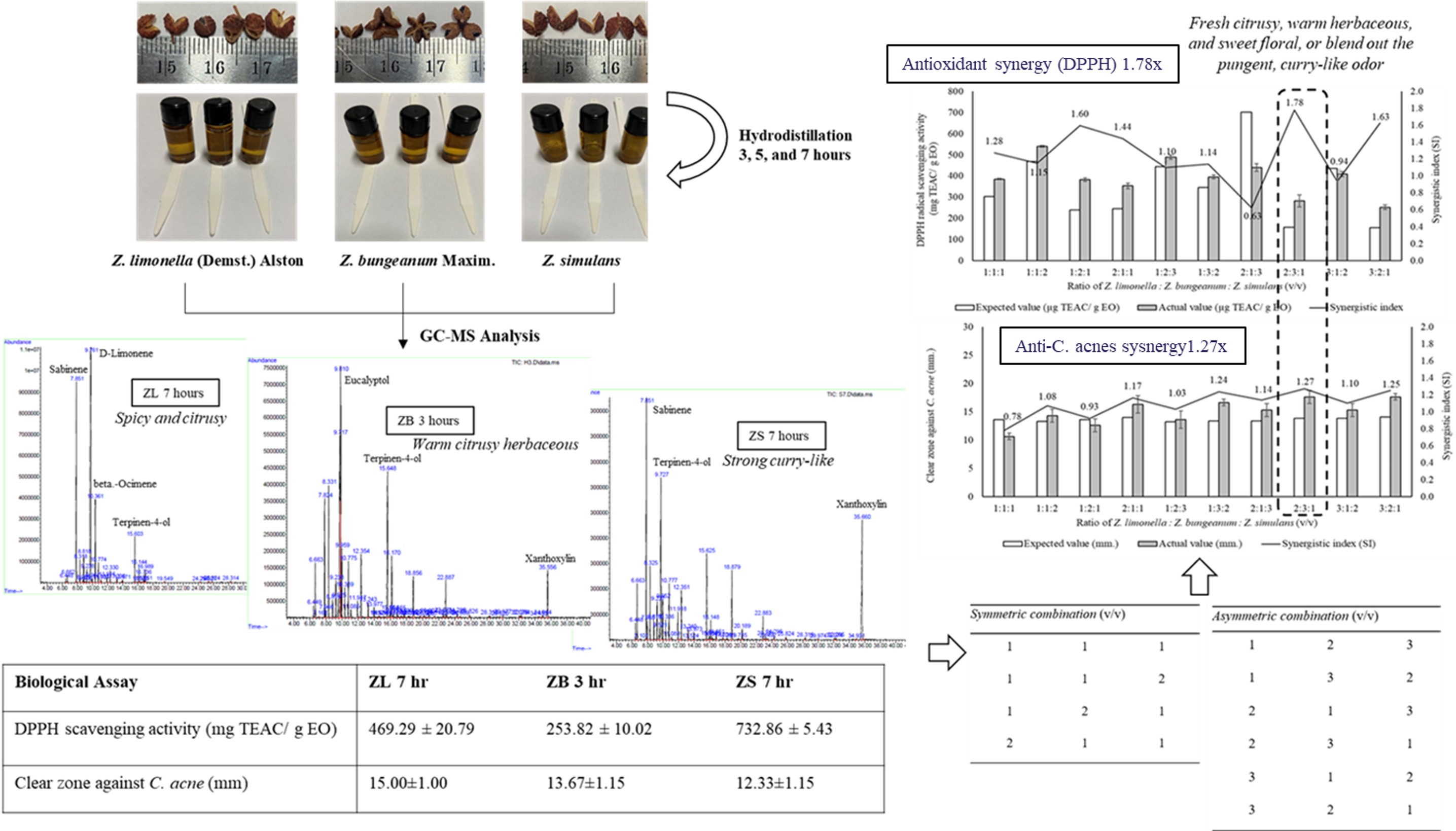
Essential oils (EOs) from the genus Zanthoxylum are widely valued for their traditional medicinal and culinary uses. There is limited research on the synergistic effects of their combinations. This study investigated the volatile profile and antioxidant activity of EOs from Z. limonella (ZL), Z. bungeanum (ZB), and Z. simulans (ZS) at different extraction times. GC-MS analysis identified key constituents, including: D-limonene (45.9%) and sabinene (22.76%) in ZL, Eucalyptol (15.46%) and terpinen-4-ol (12.44%) for ZB, and Sabinene (17.21%) and xanthoxylin (16.68%) in ZS. The highest antioxidant activity was observed at 3 h for ZB and at 7 hours for ZL and ZS. Importantly, the ZL:ZB:ZS combinations exhibited significant synergistic antioxidant effects, reaching 1.78-fold at the 2:3:1 ratio. The inhibition of C. acnes was observed by a clear zone measurement. ZL has the highest activity, followed by ZB and ZS, respectively. The 2:3:1 ratio remained the highest synergized combination (1.27 times higher than expected). The combinations showed lower cytotoxicity against NIH/3T3 cell lines than ZS alone. These findings demonstrate that blending enhances bioactivity while achieving sensory harmonization by masking pungent odors with citrus notes. This could underscore their potential as versatile bioactive agents for multiple applications.
HIGHLIGHTS
- Optimized the hydrodistillation process for Zanthoxylum limonella, bungeanum, and Z. simulans, revealing that a 7-hour extraction maximizes the retention of key bioactive volatiles like D-limonene and xanthoxylin.
- Identified a specific 2:3:1 (ZL:ZB:ZS) blend ratio that achieved a 1.78-fold synergistic increase in antioxidant capacity and a 1.27-fold enhancement in Cutibacterium acnes
- Demonstrated sensory harmonization by successfully masking the pungent, “curry-like” odor of simulans with fresh citrus and herbaceous notes from Z. limonella and Z. bungeanum.
- Proven that multi-oil blending mitigates individual cytotoxicity, maintaining cell viability above 80% while simultaneously amplifying biological efficacy compared to single-oil applications.
- Provided a scientific validation for the traditional “Mala” spice combination, establishing a framework for its use as a standardized, safe, and potent bioactive agent in food and cosmetic formulations.
GRAPHICAL ABSTRACT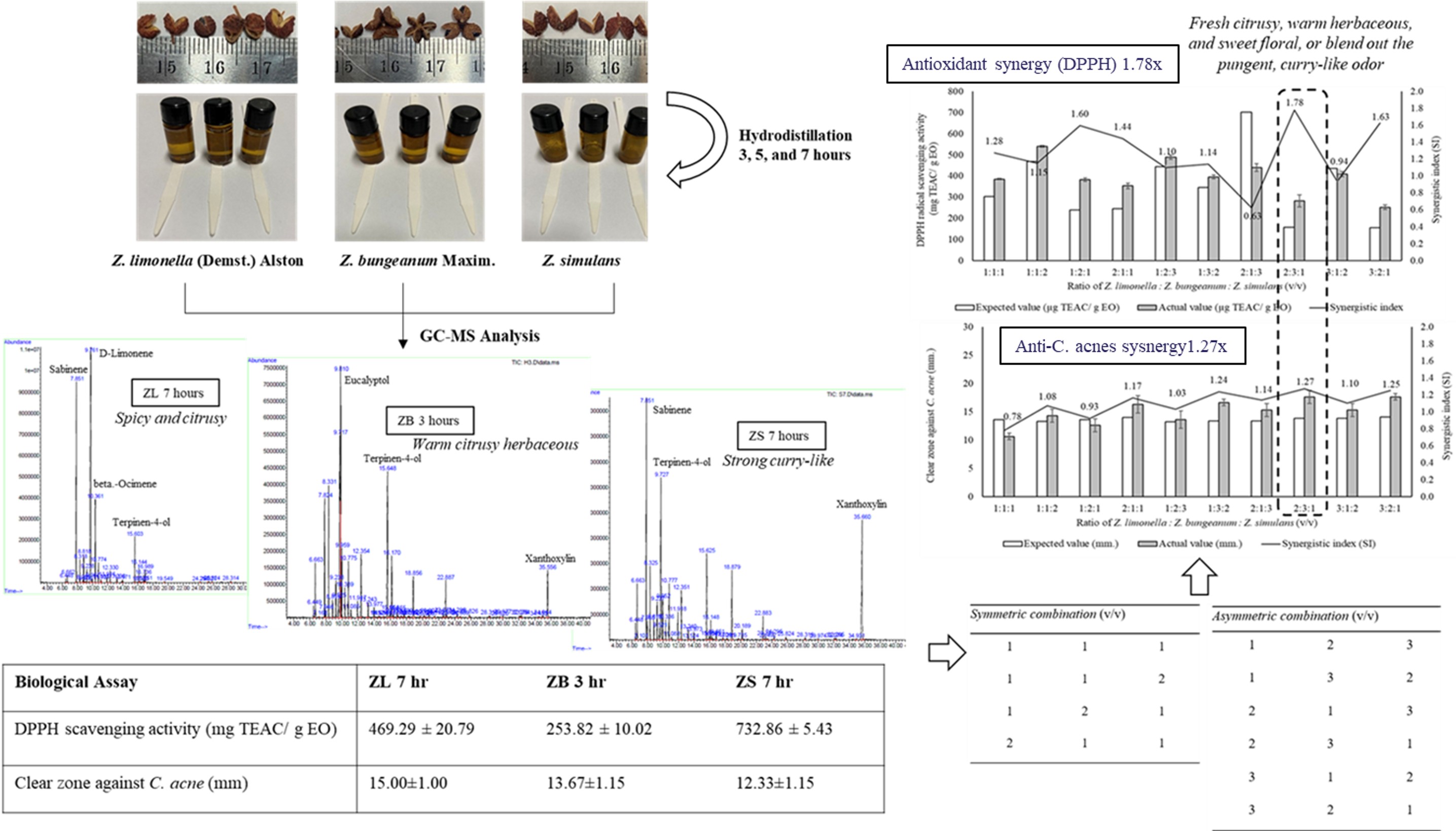
Downloads
References
J Wen, Q Xiang, J Guo, J Zhang, N Yang, Y Huang, Y Chen, T Hu and C Rao. Pharmacological activities of Zanthoxylum L. plants and its exploitation and utilization. Heliyon 2024; 10(12), e33207.
JO Ombito. Phytochemistry and pharmacology of the genus zanthoxylum (Rutaceae): A review. The Natural Products Journal 2021; 11(1), 21-43.
X Cai, Y Zeng, K Zhu, Y Peng, P Xv, P Dong, M Qiao and W Fan. Characterization of the quality and flavor in Chinese sausage: Comparison between Cantonese, five-spice, and Mala sausages. Foods 2025; 14(11), 1982.
S Liang, W Hu, W Cheng, S Zhang and R Zou. Zanthoxylum bungeanum essential oil: Extraction and component analysis for α-glucosidase inhibitory activity and the underlying mechanism based on molecular docking. Applied Science 2023; 13(4), 2627.
S Khruengsai, T Sripahco and P Pripdeevech. Antibacterial activity and synergic effects of the essential oils of Amomum verum Blackw and Zanthoxylum limonella (Dennst.) Alston. Archives of Microbiology 2023; 205(3), 102.
B Salehi, S Upadhyay, I Erdogan Orhan, A Kumar Jugran, SLD Jayaweera, DA Dias, F Sharopov, Y Taheri, N Martins, N Baghalpour, WC Cho and J Sharifi-Rad. Therapeutic potential of α- and β-pinene: A miracle gift of nature. International Journal of Molecular Sciences 2019; 20(24), 6238.
M Zhang, J Wang, L Zhu, T Li, W Jiang, J Zhou, W Peng and C Wu. Zanthoxylum bungeanum Maxim. (Rutaceae): A Systematic Review of Its Traditional Uses, Botany, Phytochemistry, Pharmacology, Pharmacokinetics, and Toxicology. International Journal of Molecular Sciences 2017; 18(10), 2172.
K Fidyt, A Fiedorowicz, L Strządała and A Szumny. β-caryophyllene and β-caryophyllene oxide-natural compounds of anticancer and analgesic properties. Cancer Medicine 2016; 5(10), 3007-3017.
A Touati, A Mairi, NA Ibrahim and T Idres. Essential oils for biofilm control: Mechanisms, synergies, and translational challenges in the era of antimicrobial resistance. Antibiotics 2025; 14(5), 503.
S Khruengsai, N Promhom, T Sripahco, P Siriwat and P Pripdeevech. Optimization of enzyme-assisted microwave extraction of Zanthoxylum limonella essential oil using response surface methodology. Scientific Reports 2023; 13(1), 12872.
Q Peng, Y Lu, R Mo and Q He. Antioxidant and nitrite-scavenging activities of Zanthoxylum bungeanum Maxim. and Capsicum annuum L.: A synergistic, additive or antagonistic effect of the extracts? European Food Research and Technology 2021; 247, 2877-2885.
M Hamdan, N Jaradat, N Al-Maharik, S Ismail and M Qadi. Chemical composition, cytotoxic effects and antimicrobial activity of combined essential oils from Citrus meyeri, Citrus paradise, and Citrus sinensis leaves. Industrial Crops and Products 2024; 210, 118096.
S Bunrathep, P Thongphasuk, S Settharaksa and N Kamkaen. Effect of an essential oil blend of citronella, lemongrass, and patchouli on acne-causing bacteria. Songklanakarin Journal of Science and Technology 2020; 42(5), 1106-1112.
SR Leigh-De, A Viljoen and SV Vuuren. S. Essential oil blends: The potential of combined use for respiratory tract infections. Antibiotics 2021; 10(12), 1517.
S Sangthong, I Promputtha, P Pintathong and P Chaiwut. Chemical constituents, antioxidant, anti-tyrosinase, cytotoxicity, and anti-melanogenesis activities of Etlingera elatior (Jack) leaf essential oils. Molecules 2022; 27(11), 3469.
Y Lan, H Li, YY Chen, YW Zhang, N Liu, Q Zhang and Q Wu. Essential oil from Zanthoxylum bungeanum Maxim. and its main components used as transdermal penetration enhancers: A comparative study. Journal of Zhejiang University Science B 2014; 15(11), 940-952.
S Sangthong, S Phosri, N Thitilertdecha, N Yaowiwat, P Chaiwut, M Wilai and T Theansungnoen. Phytochemicals and antimicrobial properties of Thai edible plant extracts and their prebiotic-like effects. Journal of Agriculture and Food Research 2024; 16, 101152.
FM Abdelhamed, NF Abdeltawab, MT ElRakaiby, RN Shamma and NA Moneib. Antibacterial and anti-inflammatory activities of Thymus vulgaris essential oil nanoemulsion on acne vulgaris. Microorganisms 2022; 10(9), 1874.
N Khodaei, M Houde, S Bayen and S Karboune. Exploring the synergistic effects of essential oil and plant extract combinations to extend the shelf life and the sensory acceptance of meat products: Multi-antioxidant systems. Journal of Food Science and Technology 2023; 60(2), 679-691.
H Qi, WX Wang, JL Dai and L Zhu. In vitro anthelmintic activity of Zanthoxylum simulans essential oil against Haemonchus contortus. Veterinary Parasitology 2015; 211(3-4), 223-227.
R Supabphol and J Tangjitjareonkun. Chemical constituents and biological activities of Zanthoxylum limonella (Rutaceae): A review. Tropical Journal of Pharmaceutical Research 2014; 13(12), 2119-2130.
J Sun. D-Limonene: Safety and clinical applications. Alternative Medicine Review 2007; 12(3), 259-264.
F Bakkali, S Averbeck, D Averbeck and M Idaomar. Biological effects of essential oils: A review. Food and Chemical Toxicology 2008; 46(2), 446-475.
S Nanasombat and P Wimuttigosol. Antimicrobial and antioxidant activity of spice essential oils. Food Science and Biotechnology 2011; 20, 45-53.
J Tangjitjaroenkun, R Supabphol and W Chavasiri. Antioxidant effect of Zanthoxylum limonella Alston. Journal of Medicinal Plants Research 2012; 6(8), 1407-1414.
V Morocho, O Eras, T Rojas, B Jiménez, MF Roa and L Cartuche. Biological activity and chemical composition of essential oil from leaves and fruits of Zanthoxylum mantaro (J.F. Macbr.). Antibiotics 2025; 14(3), 216.
Y Yang, Y Li, H He, L Yang, J Zeng, M Bai and H Wu. Comparison of essential oil components and in vitro antioxidant activity of Zanthoxylum nitidum from different parts. Plants 2025; 14(8), 1194.
MJ Zhou, XZ He, CJ Li and XF Liang. Study on antioxidant activity and synergistic effect of flavonoids from Zanthoxylum armatum DC. Food Machinery 2023; 39(5), 23.
Y Du, S Duan, Y Yang, JJ Tibenda, S Huang, Y Nan, Z Zhang and L Yuan. Antitumor components and mechanisms of Zanthoxylum bungeanum Maxim with medicine and food homology. Frontier in Pharmacology 2025; 16, 1525313.
Downloads
Published
How to Cite
Issue
Section
License
Copyright (c) 2026 Walailak University

This work is licensed under a Creative Commons Attribution-NonCommercial-NoDerivatives 4.0 International License.





