
Synergistic Biopolymer Films from Sago Starch/Poly (Vinyl Alcohol) Blends: Structure-property Relationships
DOI:
https://doi.org/10.48048/tis.2027.13821Keywords:
Biopolymer film, Sago starch, Poly (Vinyl alcohol), Water vapor transmission, Water contact angle, UV-visible absorbance, Tensile propertyAbstract
In this study, sago starch (SS) was blended with polyvinyl alcohol (PVA) at SS/PVA ratios of 90/10, 80/20, 70/30, 60/40, 50/50, and 40/60 to improve the physical, mechanical, and structural properties of starch-based films. The effect of PVA incorporation on film performance was systematically investigated. The results showed that moisture content do not significant decrease, while water solubility increased with increasing PVA content. Water vapor transmission values decreased with increasing PVA incorporation, indicating enhanced water vapor barrier properties of the blended films. The SS/PVA (70/30) film exhibited the lowest WVTR (0.00073 g.cm-2.h-1), suggesting optimal intermolecular hydrogen bonding and compact network formation, while higher PVA content slightly increased WVTR due to increased free volume and partial disruption of the polymer network. Water contact angle analysis showed that the incorporation of PVA decreased the surface hydrophilicity of SS/PVA blend films, with contact angle values decreasing from 89.3° for neat SS film to 43.8° for neat PVA film. The SS/PVA blends exhibited contact angle (50° - 70°), indicating that intermolecular hydrogen bonding between SS and PVA influenced surface wettability. Tensile strength increased with increasing PVA content, while the modulus gradually decreased, indicating reduced stiffness and enhanced flexibility of the films. In addition, elongation at break significantly increased at higher PVA ratio, confirming improved ductility and flexibility of the SS/PVA blend films. FTIR analysis confirmed hydrogen-bonding interactions between SS and PVA hydroxyl groups, which contributed to the improved film properties. XRD and DSC analyses revealed that the blend films exhibited a semi-crystalline structure, with crystallinity increasing as the PVA content increased. SEM observation further showed that films containing higher PVA ratio (SS50/PVA50 and SS40/PVA60) exhibited rougher and more heterogeneous surface morphologies.
HIGHLIGHTS
- SS/PVA blend films demonstrate a tunable balance between mechanical strength and water resistance via composition control.
- Reduced WVTR and solubility confirm enhanced barrier performance, supporting suitability for biodegradable packaging applications.
- Microstructural analysis reveals phase heterogeneity at higher PVA loadings, clarifying structure–property relationships governing film performance.
GRAPHICAL ABSTRACT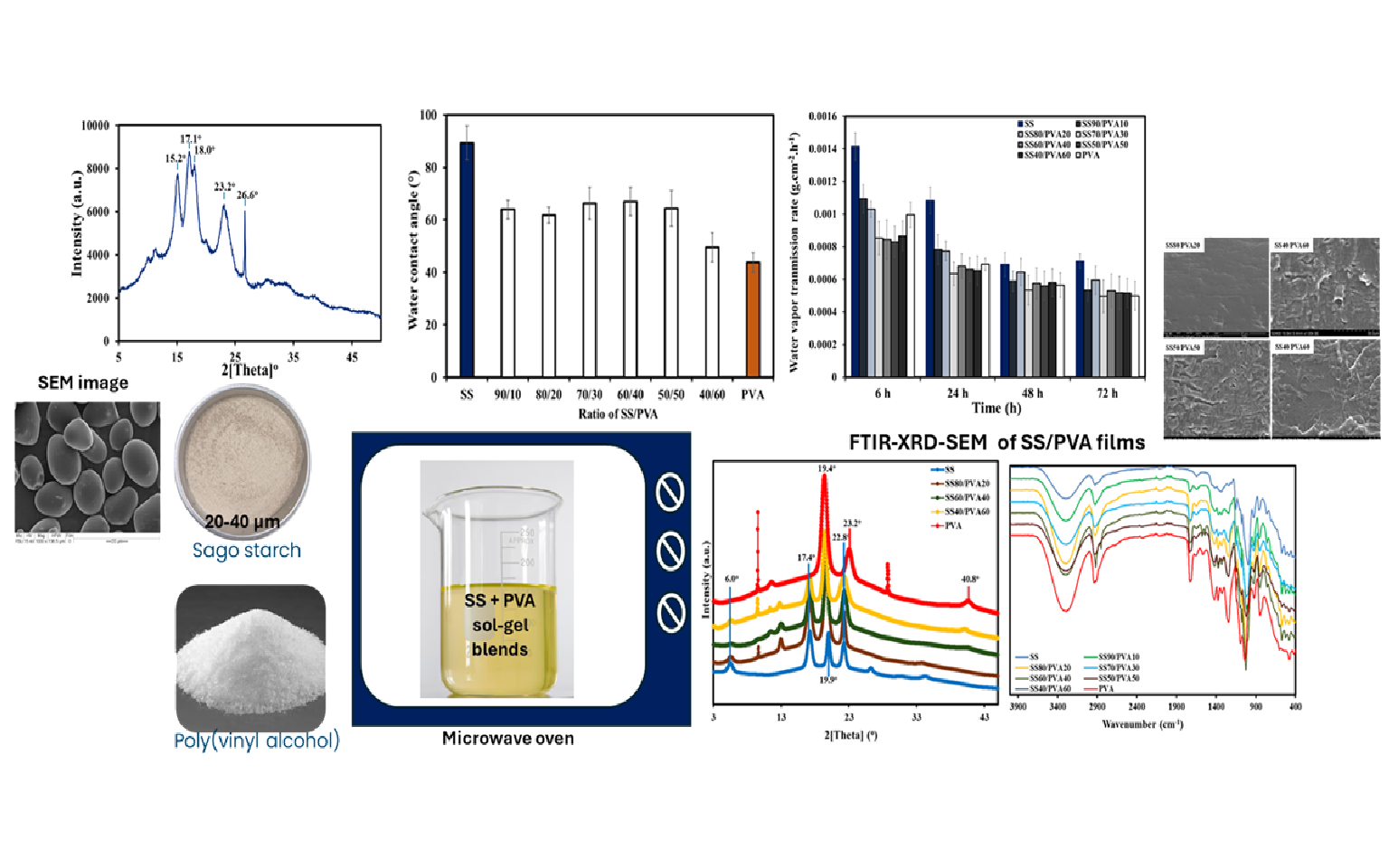
Downloads
References
H Onyeaka, K Obileke, G Makaka and N Nwokolo. Current research and applications of starch-based biodegradable films for food packaging. Polymers 2022; 14(6), 1126.
D Dutta and N Sit. A comprehensive review on types and properties of biopolymers as sustainable bio‐based alternatives for packaging. Food Biomacromolecules 2024; 1(2), 58-87.
SP Bangar and WS Whiteside. Nano-cellulose reinforced starch bio composite films - A review on green composites. International Journal of Biological Macromolecules 2021; 185, 849-860.
EE Sirbu, A Dinita, M Tănase, AI Portoacă, A Bondarev, CE Enascuta and C Calin. Influence of plasticizers concentration on thermal, mechanical, and physicochemical properties on starch films. Processes 2024; 12(9), 2021.
K Miller, C Silcher, M Lindner and M Schmid. Effects of glycerol and sorbitol on optical, mechanical, and gas barrier properties of potato peel-based films. Packaging Technology and Science 2021; 34(1), 11-23.
L Arroyo-Esquivela, VM Jiměnezc, F Vásquezd and P Esquivel. Plasticizers improved flexibility, homogeneity, and color stability in pitahaya (Hylocereus sp.) peel-based biopolymer films aimed at food packaging. Industrial Crops and Products 2025; 227, 120757.
MA Otache, RU Duru, O Achugasim and OJ Abayeh. Advances in the modification of starch via esterification for enhanced properties. Journal of Polymers and the Environment 2021; 29, 1365-1379.
SP Bangar, KV Sunooj, M Navaf, Y Phimolsiripol and WS Whiteside. Recent advancements in cross-linked starches for food applications- a review. International Journal of Food Properties 2024; 27(1), 411-430.
FM Fakhouri, SM Martelli, T Caon, JI Velasco and LHI Mei. Edible films and coatings based on starch/gelatin: Film properties and effect of coatings on quality of refrigerated Red Crimson grapes. Postharvest Biology and Technology 2015; 109, 57-64.
PA Pawase, AM Pathare, O Bashir, F Saleem, E Shrama, S Mudgal and M Ahmad. Physical, chemical, and nano-enabled modifications of starch for sustainable food packaging films: Recent trends, challenges, and prospects. Carbohydrate Polymer Technologies and Applications 2025; 11, 100986.
F Zhu. Starch based films and coatings for food packaging: Interactions with phenolic compounds. Food Research International 2025; 204, 115758.
C Campanale, S Galafassi, FD Pippo, I Pojar, C Massarelli and VF Uricchio. A critical review of biodegradable plastic mulch films in agriculture: Definitions, scientific background and potential impacts. Trends in Analytical Chemistry 2024; 170, 117391.
S Wannaphatchaiyong, J Suksaeree, R Waiprib, A Kaewpuang, W Saelee and W Pichayakorn. Gelatin/gelatinized sago starch biomembranes as a drug delivery system using rubber latex as plasticizer. Journal of Polymers and the Environment 2019; 27, 2380-2394.
EF Tethool, S Raharjo, Y Pranoto and S Supriyadi. Investigation of pregelatinized sago starch-decanoic acid complex by ultrasonication and its potential to stabilize oil-in-water emulsion. Trends in Sciences 2025; 22(3), 9241.
FB Ahmad, PA Williams, JL Doublier, S Durand and A Buleon. Physico-chemical characterisation of sago starch. Carbohydrate Polymers 1999; 38(4), 361-370.
SN David Chua, EP Kho, SF Lim and MH Hussain. Sago palm (Metroxylon sagu) starch yield, influencing factors and estimation from morphological traits. Advances in Materials and Processing Technologies 2022; 8(2), 1845-1866.
C Du, F Jiang, W Jiang, W Ge and SK Du. Physicochemical and structural properties of sago starch. International Journal of Biological Macromolecules 2020; 164, 1785-1793.
A Mittal, S Garg, A Premi and AS Giri. Synthesis of polyvinyl alcohol/modified starch-based biodegradable nanocomposite films reinforced with starch nanocrystals for packaging applications. Polymers and Polymer Composites 2021; 29(5), 405-416.
HC Oyeoka, CM Ewulonu, IC Nwuzor, CM Obele and JT Nwabanne. Packaging and degradability properties of polyvinyl alcohol/gelatin nanocomposite films filled water hyacinth cellulose nanocrystals. Journal of Bioresources and Bioproducts 2021; 6(2), 168-185.
S Sharma, K Nakano, S Kumar and V Katiyar. Edible packaging to prolong postharvest shelf-life of fruits and vegetables: A review. Food Chemistry Advances 2024; 4, 100711.
TA Nguyen and VH Nguyen. High-performance flame-retardant PVA/nanoclay/MWCNTs composite films: Fabrication, multifunctional properties, and advanced characterization. Trends in Sciences 2025; 22(9), 10219.
R Hussain, SA Batool, A Aizaz, M Abbas and MAU Rehman. Biodegradable packaging based on poly (vinyl alcohol) and carboxymethyl cellulose films incorporated with ascorbic Acid for food packaging application. ACS Omega 2023; 8(45), 42301-42310.
N Park, MA Friest and L Liu. Enhancing the properties of polyvinyl alcohol films by blending with corn stover-derived cellulose nanocrystals and beeswax. Polymers 2023; 15(21), 4321.
WA Rahman, LT Sin, AR Rahmat and AA Samad. Thermal behaviour and interactions of cassava starch filled with glycerol plasticized polyvinyl alcohol blends. Carbohydrate Polymers 2010; 81(4), 805-810.
R Yahia, ME Owda, RE Abou Zeid, F Abdelhai, HY El Gamil, AM Abdo and AA Ali. Biodegradable, UV absorber and thermal stable bioplastic films from waxy corn starch/polyvinyl alcohol blends. Biomass Conversion and Biorefinery 2024; 14, 27989-28006.
MMR Khan and MMH Rumon. Synthesis of PVA-based hydrogels for biomedical applications: Recent trends and advances. Gels 2025; 11(2), 88.
JM Castro, MG Montalbán, N Martínez-Pěrez, D Domene-L´opez, JM P´erez, FM Arrabal-Campos, I Fernández, I Martín-Gullón and JC García-Quesada. Thermoplastic starch/polyvinyl alcohol blends modification by citric acid–glycerol polyesters. International Journal of Biological Macromolecules 2023; 244, 125478.
BA Omoike, FE Okieimen, C Imoisi and MA Abubakar. Characterization and evaluation of properties of cassava starch/poly (Vinyl alcohol) films for food and pharmaceutical packaging applications. Singapore Journal of Scientific Research 2024; 14(1), 34-42.
K Lu, C Post, J Hu, D Maniar, R Folkersma, VSD Voet and K Loos. Structure and properties of biodegradable self-healing starch/PVA/chitosan hydrogels. Polymer 2025; 336, 128864.
AOAC. Official methods of analysis. 17th ed. The Association of Official Analytical Chemists, Gaithersburg, 2000.
ASTM International. ASTM E96/E96M-24: Standard test methods for water vapor transmission of materials. ASTM International, Pennsylvania, 2024.
J Ruamcharoen, R Munlee and P Ruamcharoen. Eco-friendly bio-based composites of cassava starch and natural rubber compatibilized with nanoclays. Polymer Composites 2023; 44(2), 1071-1082.
ASTM International. ASTM D882-12 Standard test method for tensile properties of thin plastic sheeting. ASTM International, Pennsylvania, 2014.
DNA Wahab, MBM Siddique, JJ Chew, HT Su, N Khairuddin, DS Khaerudini, MS Hossain and J Sunarso. Characterization of starch biofilm reinforced with cellulose microfibers isolated from Musa Saba’ midrib residue and its application as an active packaging film. Journal Applied Polymer Science 2023; 140(48), e54720.
ZZ Tryznowska and A Kałuza. The influence of starch origin on the properties of starch films: Packaging performance. Materials 2021; 14(5), 1146.
C Shanbhag, R Shenoy, P Shetty, M Srinivasulu and R Nayak. Formulation and characterization of starch based novel biodegradable edible films for food packaging. Journal of Food Science and Technology 2023; 60(11), 2858-2867.
S Patil, AK Bharimalla, A Mahapatra, J Dhakane-Lad, A Arputharaj, M Kumar, ASM Raja and N Kambli. Effect of polymer blending on mechanical and barrier properties of starch-polyvinyl alcohol based biodegradable composite films. Food Bioscience 2021; 44(A), 101352.
ZW Abdullah and Y Dong. Biodegradable and water resistant poly (Vinyl alcohol) (PVA)/starch (ST)/glycerol (GL)/halloysite nanotube (HNT) nanocomposite films for sustainable food packaging. Frontiers in Materials 2019. https://doi.org/10.3389/fmats.2019.00058
MK Chan and TH Tang. The properties of starch/cellulose/polyvinyl alcohol composite as hydrodegradable film. Polymers and Polymer Composites 2022; 30, 1-8.
S Masood, L Gulnar, AD Chandio, H Arshad, W Rehman and A Atique. Preparation and optical characterization of poly (Vinyl alcohol) and starch (native and modified) blend films. Journal of Polymer Research 2022; 29, 528.
SN Kareem, MH Suhail and OG Abdullah. Effect of salt content and operating temperature on the nitrogen dioxide gas sensing performance of sodium-ion conducting solid polymer electrolyte. Trends in Sciences 2023; 20(10), 5890.
HN Wei, XY Liu, CC Wang, R Feng and B Zhang. Characteristics of corn starch/polyvinyl alcohol composite film with improved flexibility and UV shielding ability by novel approach combining chemical cross-linking and physical blending. Food Chemistry 2024; 456, 140051.
Guimarães, VR Botaro, KM Novack, FG Teixeira and GHD Tonoli. High moisture strength of cassava starch/polyvinyl alcohol-compatible blends for the packaging and agricultural sectors. Journal of Polymer Research 2015; 22, 192.
OW Guirguis and MTH Moselhey. Thermal and structural studies of poly (Vinyl alcohol) and hydroxypropyl cellulose blends. Natural Science 2012; 4(1), 57-67.
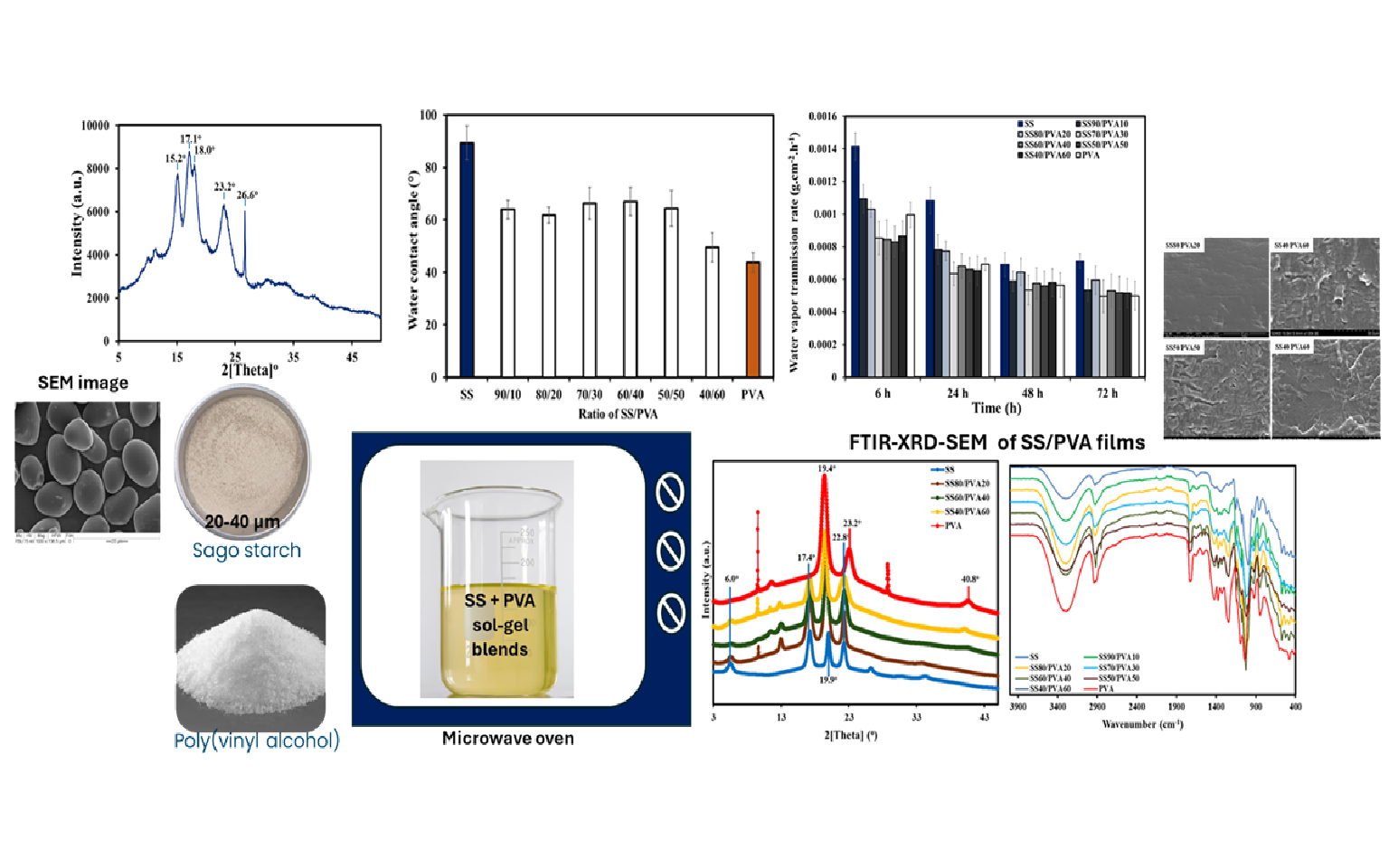
Downloads
Published
How to Cite
Issue
Section
License
Copyright (c) 2026 Walailak University

This work is licensed under a Creative Commons Attribution-NonCommercial-NoDerivatives 4.0 International License.