
Design and Optimization of A Modified Serum-Free Medium for Chicken Myoblast Proliferation
DOI:
https://doi.org/10.48048/tis.2027.13761Keywords:
Chicken satellite cells, Myoblast cells, Design of experiments, Serum substitutes, Cultured meat, Chicken myoblast cells, Design of experiments, Serum substitutes, Serum-free mediumAbstract
The growing global population is increasing the demand for meat, while conventional livestock farming remains limited and environmentally burdensome. Cultured meat offers a more sustainable option, and serum-free media are preferred because animal sera pose cost, variability, and ethical concerns. This study aimed to develop an optimized serum-free medium for chicken myoblasts. Five serum substitutes (BSA, ST, YE, CDLC and r-EGF) were screened using a 25−1 fractional factorial design (FFD), which identified BSA, ST, and YE as significant. These were optimized using a central composite design, resulting in 150 mg/L BSA, 1.0 g/L ST, 0.500 g/L YE, 0.5% (v/v) CDLC, and 0.005 mg/L r-EGF. The optimized medium supported myoblast proliferation and allowed subculture for up to 3 passages, partially supporting cell growth compared with serum-containing medium. An initial seeding density of 6×10⁴ cells/cm² resulted in the highest cell proliferation, although growth remained limited due to insufficient cell attachment despite gelatin-coated culture surfaces. Overall, this study identifies key factors required for serum-free cultivation of chicken myoblasts and provides a foundation for further advancement in cultivated meat research. Further optimization will be necessary to fully enhance the performance and long-term potential of the developed medium.
HIGHLIGHTS
- Developed an optimized serum-free medium for chicken myoblast cells.
- Applied a 2⁵⁻¹ fractional factorial design and central composite design (CCD) to screen and optimize serum substitutes.
- Identified optimal levels of BSA, soytone, yeast extract, CDLC, and r-EGF.
- The optimized medium supported chicken myoblast proliferation and subculture for up to 3 passages, although proliferation remained limited by the finite generation capacity of primary cells.
GRAPHICAL ABSTRACT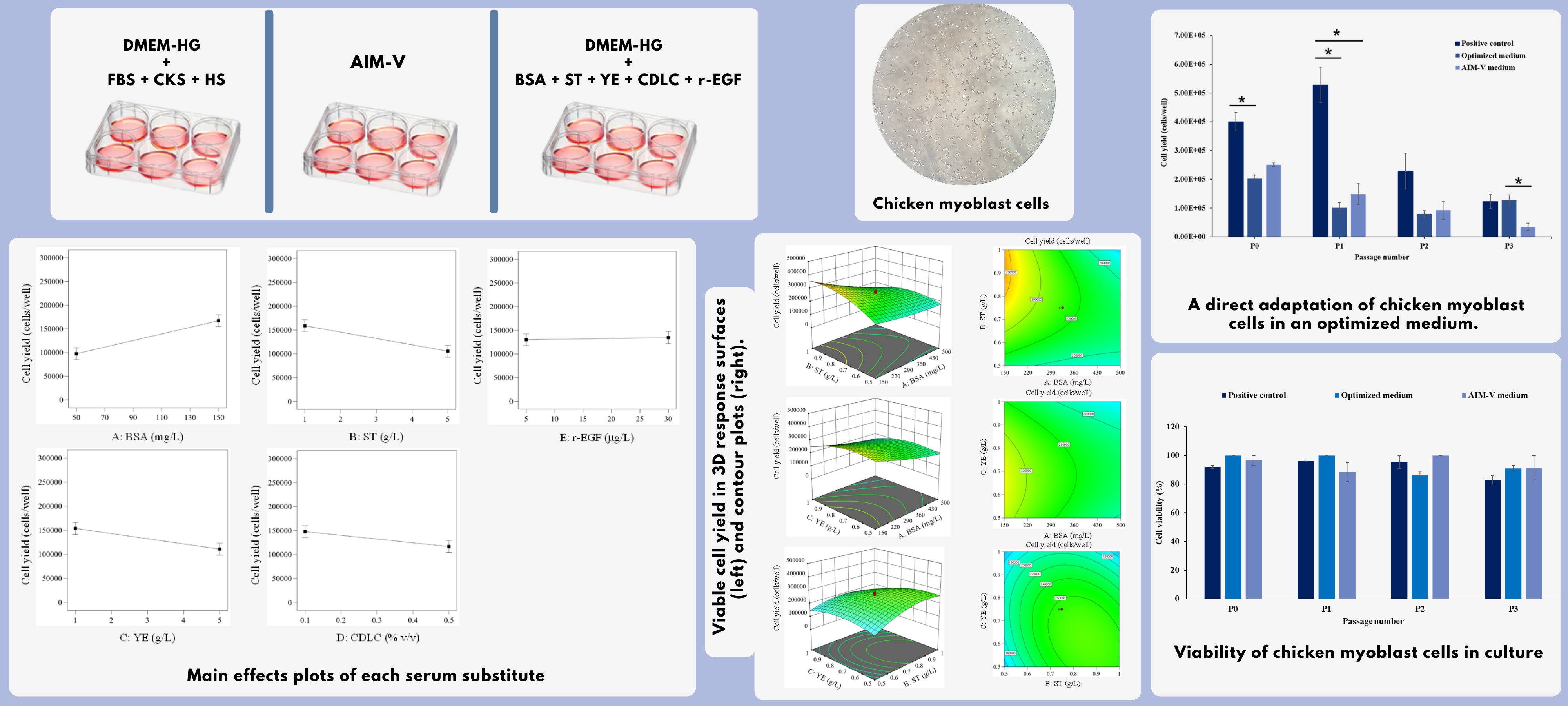
Downloads
References
G Jiang, K Ameer, H Kim, EJ Lee, K Ramachandraiah and GP Hong. Strategies for sustainable substitution of livestock meat. Foods 2020; 9(9), 1227.
S Shaikh, E Lee, K Ahmad, SS Ahmad, H Chun, J Lim, Y Lee and I Choi. Cell types used for cultured meat production and the importance of myokines. Foods 2021; 10(10), 2318.
TK Hong, DM Shin, J Choi, JT Do and SG Han. Current issues and technical advances in cultured meat production: A review. Food Science of Animal Resources 2021; 41(3), 355-372.
SS Ahmad, HJ Chun, K Ahmad, S Shaikh, JH Lim, S Ali, SS Han, SJ Hur, JH Sohn, EJ Lee and I Choi. The roles of growth factors and hormones in the regulation of muscle satellite cells for cultured meat production. Journal of Animal Science and Technology 2023; 65(1), 16.
TK Hong and JT Do. Generation of chicken contractile skeletal muscle structure using decellularized plant scaffolds. ACS Biomaterials Science & Engineering 2024; 10(5), 3500-3512.
SH Kim, CJ Kim, EY Lee, YM Son, YH Hwang and ST Joo. Optimal pre-plating method of chicken satellite cells for cultured meat production. Food Science of Animal Resources 2022; 42(6), 942-952.
U Jung, M Kim, K Piacquadio, E Shepherd and BH Voy. An optimized method to isolate, purify, and differentiate satellite cells from broiler chicks. Journal of Animal Science 2022; 100(12), skac342.
T Yao and Y Asayama. Animal‐cell culture media: History, characteristics, and current issues. Reproductive Medicine and Biology 2017; 16(2), 99-117.
J Jiang, J Tan, B Jiang, D Wu, X Yao, Z Zhao, Y Zhao, W Wu and Y Fu. Serum-free media for cultured meat: Insights into protein hydrolysates as proliferation enhancers. Food Research International 2025; 219, 117016.
M Butler. Animal cell culture and technology. Taylor & Francis, London, 2004.
M Shahbazi, P Cundiff, W Zhou, P Lee, A Patel, SL D’Souza, F Abbasi, T Quertermous and JW Knowles. The role of insulin as a key regulator of seeding, proliferation, and mRNA transcription of human pluripotent stem cells. Stem Cell Research & Therapy 2019; 10(1), 228.
A Abedelahi, M Salehnia and AA Allameh. The effects of different concentrations of sodium selenite on the in vitro maturation of preantral follicles in serum-free and serum supplemented media. Journal of Assisted Reproduction and Genetics 2008; 25(9-10), 483-488.
J Keenan, D Pearson and M Clynes. The role of recombinant proteins in the development of serum-free media. Cytotechnology 2006; 50(1-3), 49-56.
Y Lee. Role of vitamin C in targeting cancer stem cells and cellular plasticity. Cancers 2023; 15(23), 5657.
D Patel and SN Witt. Ethanolamine and phosphatidylethanolamine: Partners in health and disease. Oxidative Medicine and Cellular Longevity 2017; 2017, 4829180.
FV Ritacco, Y Wu and A Khetan. Cell culture media for recombinant protein expression in Chinese hamster ovary (CHO) cells: History, key components, and optimization strategies. Biotechnology Progress 2018; 34(6), 1407-1426.
N Liao, Y Shi, C Zhang, Y Zheng, Y Wang, B Zhao, Y Zeng, X Liu and J Liu. Antioxidants inhibit cell senescence and preserve stemness of adipose tissue-derived stem cells by reducing ROS generation during long-term in vitro expansion. Stem Cell Research & Therapy 2019; 10(1), 306.
C Morrison, K Bandara, W Wang, L Zhang and BF Jr. Improvement of growth rates through nucleoside media supplementation of CHO clones. Cytotechnology 2019; 71(3), 733-742.
Y Matsuyoshi, M Akahoshi, M Nakamura, R Tatsumi and W Mizunoya. Isolation and purification of satellite cells from young rats by Percoll density gradient centrifugation. In: S Rønning (Ed.). Myogenesis: Methods and protocols. Springer, New York, 2018, p. 81-93.
D Guo, S Lin, X Wang, Z Jiao, G Li, L An, Z Zhang and L Zhang. Establishment and characterization of a chicken myoblast cell line. International Journal of Molecular Sciences 2024; 25(15), 8340.
YY Ho, HK Lu, ZFS Lim, HW Lim, YS Ho and SK Ng. Applications and analysis of hydrolysates in animal cell culture. Bioresources and Bioprocessing 2021; 8(1), 93.
GL Francis. Albumin and mammalian cell culture: Implications for biotechnology applications. Cytotechnology 2010; 62(1), 1-16.
S Skrivergaard, JF Young, N Sahebekhtiari, C Semper, M Venkatesan, A Savchenko, PJ Stogios, M Therkildsen and MK Rasmussen. A simple and robust serum-free media for the proliferation of muscle cells. Food Research International 2023; 172, 113194.
A Capes-Davis, RI Freshney, RJ Geraghty and RW Nims. Freshney’s culture of animal cells: A manual of basic technique and specialized applications. 8th ed. Wiley-Blackwell, Hoboken, 2021.
CC Burteau, FR Verhoeye, JF Molsl, JS Ballez, SN Agathos and YJ Schneider. Fortification of a protein-free cell culture medium with plant peptones improves cultivation and productivity of an interferon-γ-producing CHO cell line. In Vitro Cellular & Developmental Biology - Animal 2003; 39(7), 291-296.
H Yin, F Price and MA Rudnicki. Satellite cells and the muscle stem cell niche. Physiological Reviews 2013; 93(1), 23-67.
RL Harding, O Halevy, S Yahav and SG Velleman. The effect of temperature on proliferation and differentiation of chicken skeletal muscle satellite cells isolated from different muscle types. Physiological Reports 2016; 4(8), e12770.
AM Kolkmann, MJ Post, MAM Rutjens, ALM Van Essen and P Moutsatsou. Serum-free media for the growth of primary bovine myoblasts. Cytotechnology 2020; 72(1), 111-120.
T Katayama, Y Chigi and D Okamura. The ensured proliferative capacity of myoblast in serum-reduced conditions with Methyl-β-cyclodextrin. Frontiers in Cell and Developmental Biology 2023; 11, 1193634.
V Bodiou, AA Kumar, E Massarelli, T van Haaften, MJ Post and P Moutsatsou. Attachment promoting compounds significantly enhance cell proliferation and purity of bovine satellite cells grown on microcarriers in the absence of serum. Frontiers in Bioengineering and Biotechnology 2024; 12, 1443914.
P Mogha, S Iyer and A Majumder. Extracellular matrix protein gelatin provides higher expansion, reduces size heterogeneity, and maintains cell stiffness in a long-term culture of mesenchymal stem cells. Tissue and Cell 2023; 80, 101969.
Downloads
Published
How to Cite
Issue
Section
License
Copyright (c) 2026 Walailak University

This work is licensed under a Creative Commons Attribution-NonCommercial-NoDerivatives 4.0 International License.