
The Polyherbal of Extract Ethanolic Ocimum Sanctum, Clitorea Ternatea and Moringa Oleifera Prevent Neuronal Apoptosis on the Alzheimer’s Disease Model-Rat Pheochromocytoma Cell Line Mediated by Upregulation of ChAT and BDNF
DOI:
https://doi.org/10.48048/tis.2026.13743Keywords:
Alzheimer’s disease, Cell line, Holy basil, Phytochemical, Polyherbal, Alzheimer’s disease, Cell line, Holy basil, Phytochemical, PolyherbalAbstract
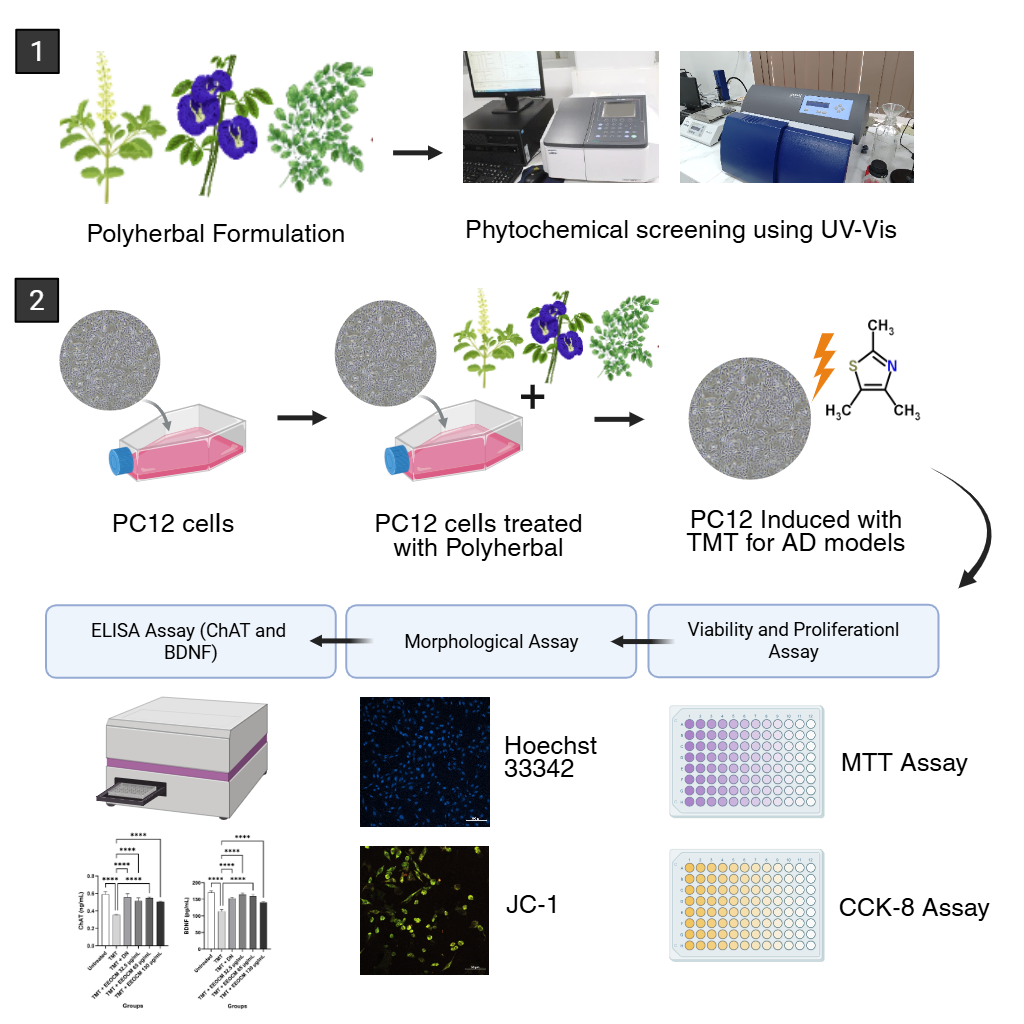
The progressive neurodegenerative condition known as Alzheimerʼs disease (AD) demonstrates intellectual processing deterioration, underscoring the need for new therapies. Polyherbal formulations offer synergistic, multi-target actions with low toxicity. While Ocimum sanctum shows neuroprotective potential, the combined effects with Moringa oleifera and Clitoria ternatea are unknown. This study evaluated their polyherbal formulation in trimethyltin (TMT)-induced PC-12 cells employed as an in vitro model of AD-related neurotoxicity. Phytochemical screening was performed by Thin Layer. Chromatography (TLC) and UV-Vis spectrophotometry. The optimal combination was determined from IC50 values via MTT assay. Cell proliferation was assessed by CCK-8, apoptosis by Hoechst staining, JC-1 fluorescence assay was applied to assess mitochondrial membrane potential (ΔΨm), and neurocognitive biomarkers Brain-Derived Neurotrophic Factor (BDNF) and Choline Acetyltransferase (ChAT) by ELISA. Ethanolic extract of polyherbal contained flavonoids 13.55% (w/w), phenols 7.53% (w/w), tannins 2.31% (w/w), saponins 0.75% (w/w), alkaloids 0.33% (w/w), steroids 0.24% (w/w), and terpenoids. The optimal ratio (O. sanctum: M. oleifera: C. ternatea = 7:2:1) at 65 µg/mL enhanced viability and proliferation, reduced nuclear fragmentation, and suppressed apoptosis. JC-1 staining showed preserved ΔΨm, indicating mitochondrial protection. BDNF and ChAT levels were significantly elevated, suggesting improved neurocognitive function. This polyherbal combination demonstrates synergistic neuroprotection and promising therapeutic prospect candidate for AD.
HIGHLIGHTS
- IC₅₀-guided optimization was employed to formulate the polyherbal combination of Ocimum sanctum, Clitoria ternatea, and Moringa oleifera.
- The formulation significantly enhanced neuronal cell viability and proliferation in AD-induced PC12 cells using MTT and CCK-8 assays.
- Apoptotic nuclear condensation and fragmentation were markedly reduced as demonstrated by Hoechst staining.
- Mitochondrial membrane potential was preserved as evidenced by JC-1 staining, indicating attenuation of mitochondrial dysfunction.
- Neuroprotective effects were associated with upregulation of ChAT and BDNF expression.
GRAPHICAL ABSTRACT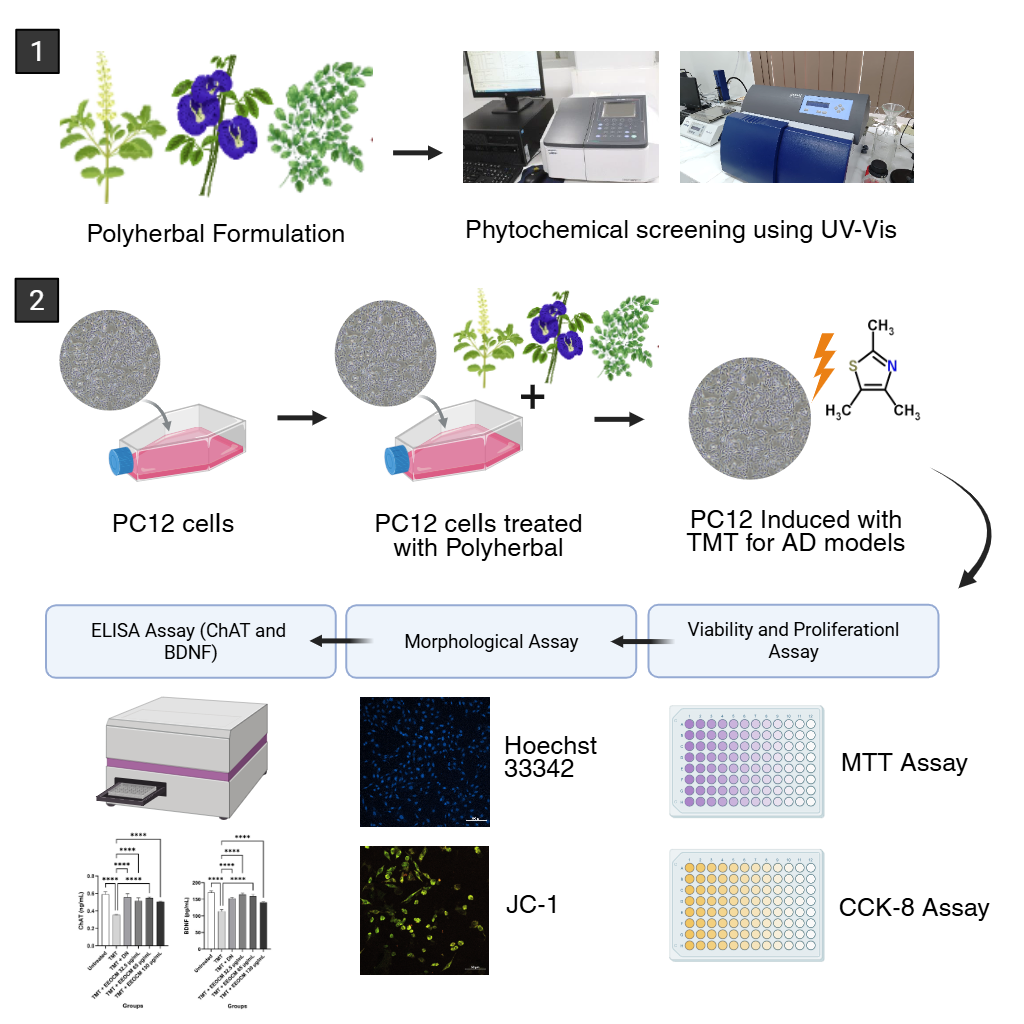
Downloads
References
T Earnest, B Yang, D Kothapalli and A Sotiras. Comprehensive evaluation of AT(N) imaging biomarkers for predicting cognition. medRxiv 2024. https://doi.org/10.1101/2024.11.25.24317943
CRJ Jr, DA Bennett, K Blennow, MC Carrillo, B Dunn, SB Haeberlein, DM Holtzman, W Jagust, F Jessen, J Karlawish, E Liu, JL Molinuevo, T Montine, C Phelps, KP Rankin, CC Rowe, P Scheltens, E Siemers, HM Snyder, R Sperling, ..., N Silverberg. NIA‐AA Research Framework: Toward a biological definition of Alzheimer’s disease. Alzheimer’s & Dementia 2018; 14(4), 535-562.
SC Burnham, PM Coloma, QX Li, S Collins, G Savage, S Laws, J Doecke, P Maruff, RN Martins, D Ames, CC Rowe, CL Masters and VL Villemagne. Application of the NIA-AA research framework: Towards a biological definition of Alzheimer’s disease using cerebrospinal fluid biomarkers in the AIBL study. The Journal of Prevention of Alzheimer’s Disease 2019; 6(4), 248-255.
SJ Yim, S Yasar, N Schoenborn and E Lang. Expanded disease definitions in Alzheimer’s disease and the new era of disease-modifying drugs. BMJ Evidence-Based Medicine 2025; 30(5), 288-290.
S Toniolo, FD Lorenzo, S Bernardini, NB Mercuri and GM Sancesario. Blood–Brain barrier dysfunction and Aβ42/40 ratio dose-dependent modulation with the ApoE Genotype within the ATN Framework. International Journal of Molecular Sciences 2023; 24(15), 12151.
M Franczak. Alzheimer disease: What’s new, what’s true? Available at: https://tressless.com/research/alzheimers-disease-new-insights-truths-7RzG, accessed January 2024.
R Wang. Global Burden of Alzheimer’s disease and other dementias during 1990 - 2021: A Global Burden of disease and risk factors study 2021-based study. Neuroepidemiology 2025; 60(1), 16-27.
Y Turana, J Tengkawan, I Suswanti, DY Suharya, W Riyadina and J Pradono. Primary prevention of Alzheimer’s disease in Indonesia. International Journal of Aging Research 2019; 2, 40.
J Tanoey and H Becher. Diabetes prevalence and risk factors of early-onset adult diabetes: Results from the Indonesian family life survey. Global Health Action 2021; 14(1), 2001144.
MPG Moreta, N Burgos-Alonso, M Torrecilla, J Marco-Contelles and C Bruzos-Cidón. Efficacy of acetylcholinesterase inhibitors on cognitive function in Alzheimer’s disease. Review of Reviews. Biomedicines 2021; 9(11), 1689.
C Fruchtengarten, LMVRE Ribeiro, MM Schichman, BPBD Souza, DMAD Sousa, GDM Vieira, DFD Arruda, LFEVDM Fernandes, JPS Barbara, LM Gaissler, RL Silva and CSDM Pereira. Pharmacological treatment of Alzheimer’s disease: An integrative review on the effectiveness of cholinesterase and memantine inhibitors. International Journal of Health Science 2023; 3(41), 15934123010610.
V Marinho, E Bertrand, R Naylor, I Bomilcar, J Laks, A Spector and DC Mograbi. Cognitive stimulation therapy for people with dementia in Brazil (CST‐Brasil): Results from a single blind randomized controlled trial. The International Journal of Geriatric Psychiatry 2021; 36(2), 286-293.
U Kustiati, TSD Ratih, NDA Agung, DL Kusindarta and H Wihadmadyatami. In silico molecular docking and in vitro analysis of ethanolic extract Ocimum sanctum Linn.: Inhibitory and apoptotic effects against non-small cell lung cancer. Veterinary World 2021; 14(12), 3175-3178.
D Aliffia, DA Ramadhani, W Wasityastuti, DRT Sari, U Kustiati, H Wihadmadyatami, and DL Kusindarta. Ocimum sanctum leaves prevent neuronal cell apoptosis through reduction of Caspase-3 and -9 expressions and inhibition of β-amyloid oligomerization. Indonesian Biomedical Journal 2023; 15(4), 322-332.
MBA Mataram, P Hening, FN Harjanti, S Karnati, W Wasityastuti, DAA Nugrahaningsih, DL Kusindarta and H Wihadmadyatami. The neuroprotective effect of ethanolic extract Ocimum sanctum Linn. in the regulation of neuronal density in hippocampus areas as a central autobiography memory on the rat model of Alzheimer’s disease. Journal of Chemical Neuroanatomy 2021; 111, 101885.
A Villarruel-López, DALL Mora, OD Vazquez-Paulino, AG Puebla-Mora, MR Torres-Vitela, LA Guerrero-Quiroz and K Nuno. Effect of Moringa oleifera consumption on diabetic rats. BMC Complementary and Alternative Medicine 2018; 18, 127.
BD Tambe and PD Gadhave. Phytochemical screening and in vitro antibacterial activity of Moringa oleifera (Lam.) leaf extract. International Journal of Science and Research Archive 2024; 12(1), 125-130.
WBT Sanjaya, DR Tirtosari, R Widayanti, DAA Nugrahaningsih, GR Saragih, H Wihadmadyatami and DL Kusindarta. Characterization of phytochemicals of Clitorea ternatea and the potention as neuroprotectant to prevent Alzheimer’s disease. Biodiversitas 2025; 26(7), 3144-3159.
MY Ali, MI Khalil, FN Jahan, MB Hossain and AK Samanta. Moringa oleifera: A review on nutritional attributes, therapeutic applications and value-added product generation. SAARC Journal of Agriculture 2022; 20(2), 63447.
S Dubey and AK Dixit. Preclinical evidence of polyherbal formulations on wound healing: A systematic review on research trends and perspectives. Journal of Ayurveda and Integrative Medicine 2023; 14(2), 100688.
VL Yap, LF Tan, M Rajagopal, C Wiart, M Selvaraja, MY Leong and PL Tan. Evaluation of phytochemicals and antioxidant potential of a new polyherbal formulation TC-16: Additive, synergistic or antagonistic? BMC Complementary Medicine and Therapies 2023; 23, 39.
MC Rîmbu, L Popescu, M Mihaila, RC Sandulovici, D Cord, CM Mihailescu, ML Galatanu, M Panturoiu, CE Manea, A Boldeiu, O Brincoveanu, M Savin, A Grigoroiu, FD Ungureanu, E Amzoiu, M Popescu and E Truta. Synergistic effects of green nanoparticles on antitumor drug efficacy in hepatocellular cancer. Biomedicines 2025; 13(3), 641.
LC Crowley, BJ Marfell, and NJ Waterhouse. Analyzing cell death by nuclear staining with Hoechst 33342. Cold Spring Harbor Protocols 2016; 2016(9), 778-782.
D Velásquez-Jiménez, DA Corella-Salazar, BS Zuñiga-Martínez, JA Domínguez-Avila, M Montiel-Herrera, NJ Salazar-López, J Rodrigo-Garcia, MA Villegas-Ochoa and GA González-Aguilar. Phenolic compounds that cross the blood–brain barrier exert positive health effects as central nervous system antioxidants. Food & Function 2021; 12(21), 10356-10369.
R Shimazu, M Anada, A Miyaguchi, Y Nomi and H Matsumoto. Evaluation of blood-brain barrier permeability of polyphenols, anthocyanins, and their metabolites. Journal of Agricultural and Food Chemistry 2021; 69(39), 11676-11686.
JD Sánchez-Martínez, A Valdés, R Gallego, ZJ Suárez-Montenegro, M Alarcón, E Ibañez, G Alvarez-Rivera and A Cifuentes. Blood-brain barrier permeability study of potential neuroprotective compounds recovered from plants and Agri-food by-Products. Frontier in Nutrition 2022; 9, 924596.
YJ Wu, BS Wong, SH Yea, CI Lu and SH Weng. Sinularin induces apoptosis through mitochondria dysfunction and inactivation of the pI3K/Akt/mTOR pathway in Gastric carcinoma cells. Marine Drugs 2016; 14(8), 142.
EM El-Sheref, AA Aly, MB Alshammari, AB Brown, SMN Abdel-Hafez, WY Abdelzaher, S Brase and EMN Abdelhafez. Design, synthesis, molecular docking, antiapoptotic and Caspase-3 Inhibition of New 1,2,3-Triazole/Bis-2(1H)-Quinolinone Hybrids. Molecules 2020; 25(21), 5057.
MN Raditya, AMM Bagus, U Kustiati, H Wihadmadyatami and DL Kusindarta. Data of the expression of serotonin in Alzheimer’s disease (AD) rat model under treatment of ethanolic extract Ocimum sanctum Linn. Data in Brief 2020; 30, 105654.
DL Kusindarta, H Wihadmadyatami and A Haryanto. The analysis of hippocampus neuronal density (CA1 and CA3) after Ocimum sanctum ethanolic extract treatment on the young adulthood and middle age rat model. Veterinary World 2018; 11(2), 135-140.
KN Jiji and P Muralidharan. Neuroprotective effects of Clitoria ternatea L. against propionic acid-induced behavior and memory impairment in autistic rat model. Future Journal of Pharmaceutical Sciences 2021; 7, 163.
M Mundkar, A Bijalwan, D Soni and P Kumar. Neuroprotective potential of Moringa oleifera mediated by NF‐kB/Nrf2/HO‐1 signaling pathway: A review. Journal of Food Biochemistry 2022; 46(12), e14451.
J Matsubayashi, Y Kawaguchi, Y Kawakami and K Takei. Brain‐derived neurotrophic factor (BDNF) induces antagonistic action to Nogo signaling by the upregulation of lateral olfactory tract usher substance (Lotus) expression. Journal of Neurochemistry 2023; 164(1), 29-43.
A Hidayat, M Arief, A Wijaya and S As’ad. Vascular endothelial growth factor and brain-derived neurotropic factor levels in ischemic stroke subject. Indonesian Biomedical Journal 2016; 8(2), 115-118.
RA Williams, KW Johnson, FS Lee, HCH Jr and J Platholi. A common human brain-derived neurotrophic factor polymorphism leads to sustained depression of excitatory synaptic transmission by isoflurane in hippocampus. bioRxiv 2022. https://doi.org/10.1101/2021.12.30.474566
SMG Solinas, E Edelmann, V Leßmann and M Migliore. A kinetic model for brain-derived neurotrophic factor mediated spike timing-dependent LTP. PLoS Computational Biology 2019; 15(4), e1006975.
H Fgaier, IHI Mustafa, AAR Awad and A Elkamel. Modeling the interaction between β-Amyloid aggregates and choline acetyltransferase activity and its relation with cholinergic dysfunction through two-enzyme/two compartment model. Computational and Mathematical Methods in Medicine 2015; 2015, 923762.
MR Gielow and L Zaborszky. The input-output relationship of the cholinergic basal forebrain. Cell Reports 2017; 18(7), 1817-1830.
Downloads
Published
How to Cite
Issue
Section
License
Copyright (c) 2026 Walailak University

This work is licensed under a Creative Commons Attribution-NonCommercial-NoDerivatives 4.0 International License.