
Value Addition of Low-Grade Dragon Fruit (Hylocereus undatus) as a Functional Noodle Ingredient: In Vitro Enzyme Inhibition and In Vivo Glycaemic Response
DOI:
https://doi.org/10.48048/tis.2026.13685Keywords:
Dragon fruit, Antioxidant activity, Antihyperglycemic activity, Glycaemic index, Functional noodlesAbstract
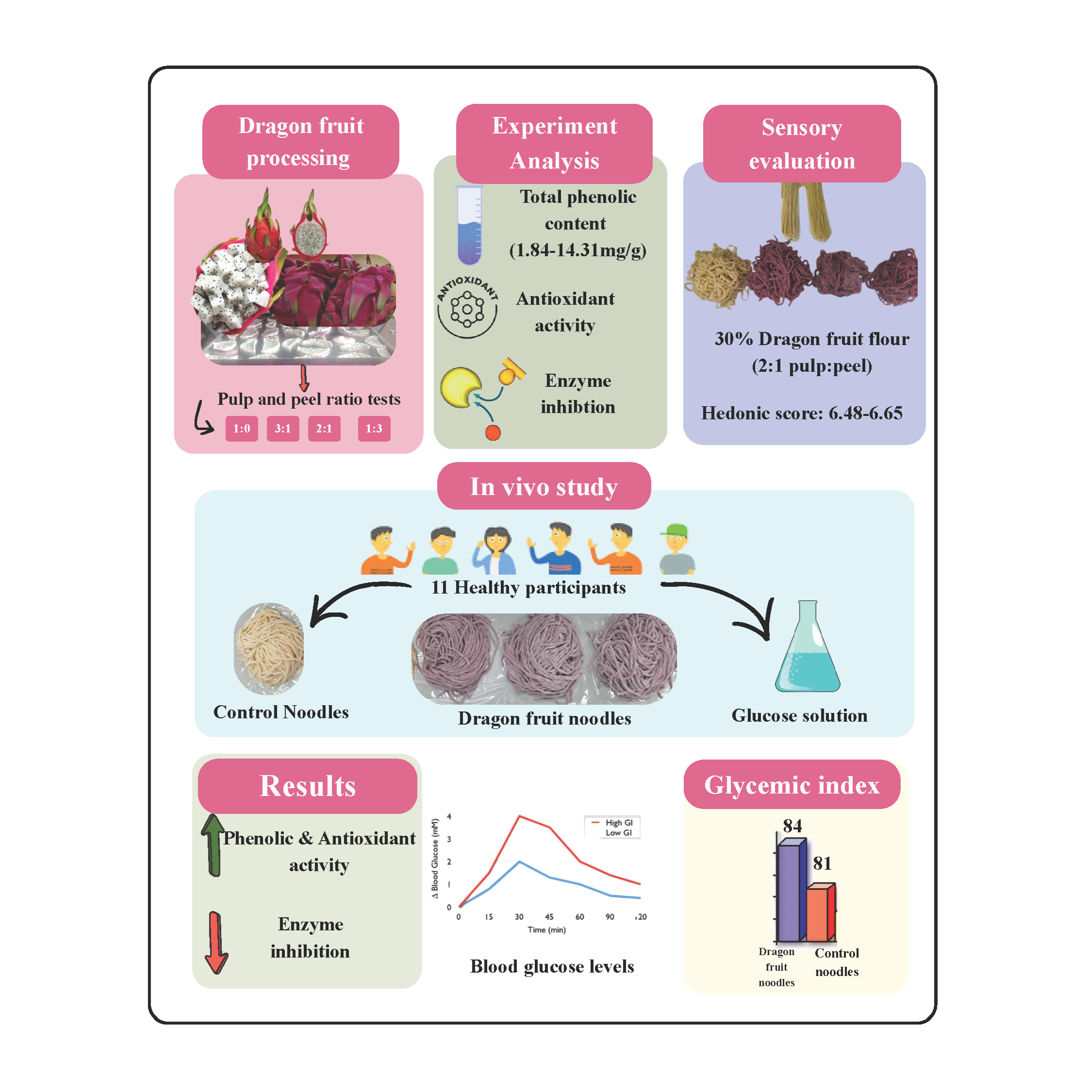
This study evaluated pulp:peel powder ratios from low-grade dragon fruit for antioxidant activity, carbohydrate-digesting enzyme inhibition, sensory performance in fresh noodles, and in vivo glycaemic response. Five pulp:peel formulations were evaluated, including pulp only (1:0), peel only (0:1), and mixed blends (1:1, 1:2, and 2:1). Total phenolic content ranged from 3.00 to 77.92 mg GAE/g dry extract. The peel-only sample (0:1) exhibited the strongest antioxidant activity, whereas the 2:1 blend showed the highest α-amylase and α-glucosidase inhibition, at 54.38 ± 3.54% and 69.67 ± 0.17%, respectively. Sensory evaluation using a 9-point hedonic scale (n = 50) showed that control noodles scored 6.48, whereas noodles containing 30% dragon fruit powder at a 2:1 pulp:peel ratio scored 6.65. In 11 healthy participants, glycaemic responses of dragon fruit noodles, control noodles, and a glucose solution were measured at 0, 15, 30, 60, 90, and 120 min. Both noodle products produced lower postprandial glucose responses than the glucose solution (p < 0.05), but glycaemic index (GI) remained high and did not differ meaningfully between dragon fruit noodles (GI 84) and control noodles (GI 81). Dragon fruit fortification increased phenolic content and antioxidant capacity, but it did not lower the glycaemic index compared to the control. These findings support the use of low-grade dragon fruit as a value-added ingredient for antioxidant-enriched noodles.
HIGHLIGHTS
- Low-grade white-fleshed dragon fruit was valorised as a functional noodle ingredient.
- Dragon fruit peel showed the highest phenolic content and strongest antioxidant activity.
- The 2:1 pulp:peel blend balanced enzyme inhibition, colour, and sensory acceptance.
- Dragon fruit noodles retained antioxidant activity after boiling and met microbiological safety criteria.
- The fortified noodles remained high-GI, so they are better described as antioxidant-enriched noodles.
GRAPHICAL ABSTRACT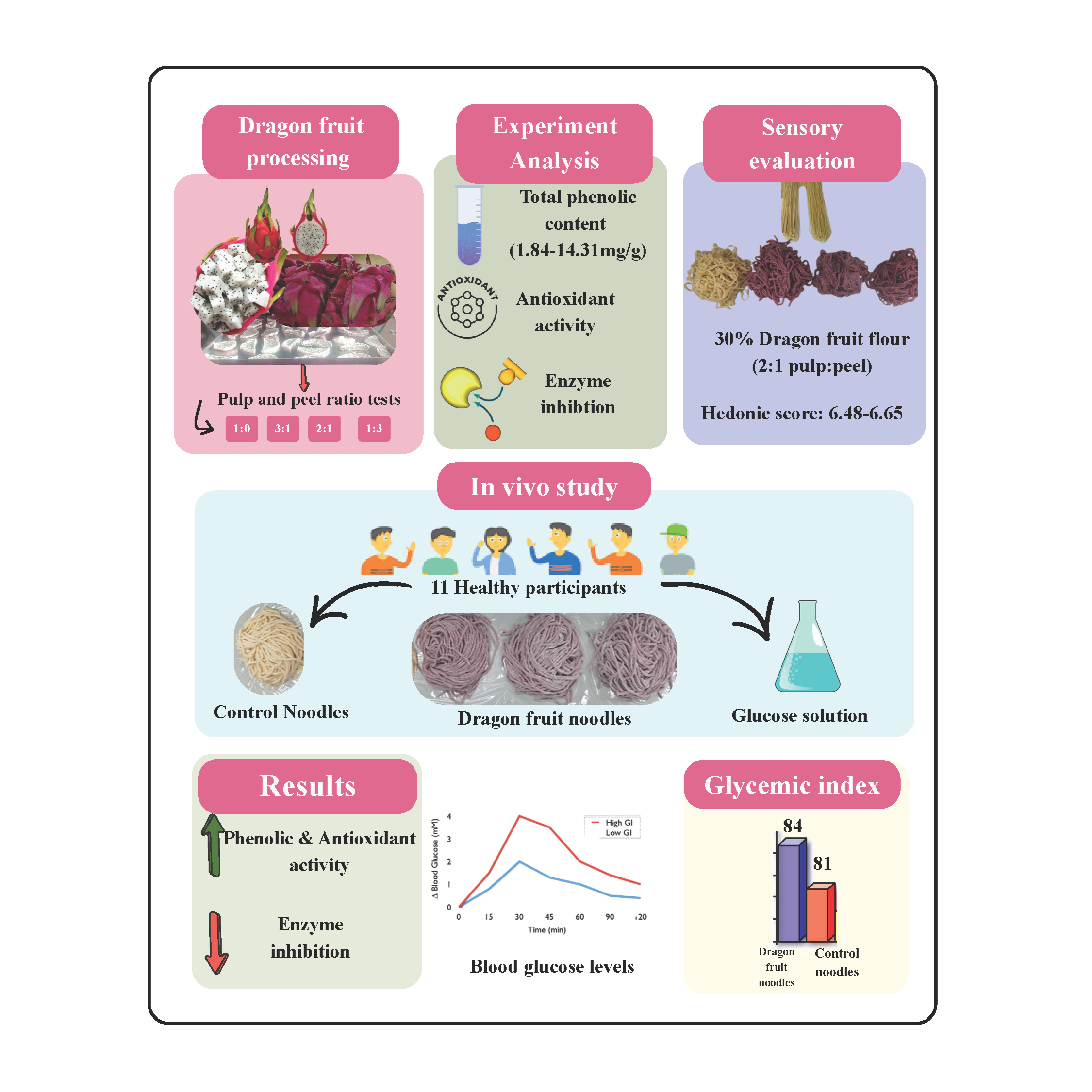
Downloads
References
SY Chen, CY Xu, MS Mazhar and M Naiker. Nutritional value and therapeutic benefits of dragon fruit: A comprehensive review with implications for establishing australian industry standards. Molecules 2024; 29(23), 5676.
A Yasmin, MJ Sumi, K Akter, RHM Rabbi, HS Almoallim, MJ Ansari, A Hossain and S Imran. Comparative analysis of nutrient composition and antioxidant activity in three dragon fruit cultivars. PeerJ 2024; 12, 17719.
HE Khoo, A Azlan, ST Tang and SM Lim. Anthocyanidins and anthocyanins: Colored pigments as food, pharmaceutical ingredients, and the potential health benefits. Food & Nutrition Research 2017; 61, 1361779.
P Putson, B Wanikorn and S Sae‐tan. Effects of age and food processing of sapodilla leaves for botanical beverage application. Food Science and Technology 2022; 42, 55022.
B Saibandith, JPE Spencer, IR Rowland and DM Commane. Olive polyphenols and the metabolic syndrome. Molecules 2017; 22(7), 1082.
I Tarte, A Singh, AH Dar, A Sharma, A Altaf and P Sharma. Unfolding the potential of dragon fruit (Hylocereus spp.) for value addition: A review. eFood 2023; 4(2), 76.
K Shah, J Chen, J Chen and Y Qin. Pitaya nutrition, biology, and biotechnology: A review. International Journal of Molecular Sciences 2023; 24(18), 13986.
C Cui, Y Wang, J Ying, W Zhou, D Li and LJ Wang. Low glycemic index noodle and pasta: Cereal type, ingredient, and processing. Food Chemistry 2024; 431, 137188.
IS Huh, H Kim, HK Jo, CS Lim, JS Kim and SJ Kim. Instant noodle consumption is associated with cardiometabolic risk factors among college students in Seoul. Nutrition Research and Practice 2017; 11(3), 232-239.
S Jansuna, L Charoensup, Y Jirakiattikul and B Harakotr. Effects of drying temperatures and times on antioxidant contents and their activities of Centella asiatica (L.) Urb. Leaves. Thai Science and Technology Journal 2020; 28(12), 2261-2272.
NL Tze, CP Han, YA Yusof, CN Ling, RA Talib, FS Taip and MG Aziz. Physicochemical and nutritional properties of spray-dried pitaya fruit powder as natural colorant. Food Science and Biotechnology 2012; 21(3), 675-682.
Z Wang, CJ Barrow, FR Dunshea and HAR Suleria. A comparative investigation on phenolic composition, characterization and antioxidant potentials of five different australian grown pear varieties. Antioxidants 2021; 10(2), 151.
S Fakngoen and S Meerod. Extraction and separation of anthocyanins from Carissa carandas L. In: The Vth Kamphaeng Phet Rajabhat University National Conference, Kamphaeng Phet, Thailand. 2017, p. 1005.
W Brand-Williams, ME Cuvelier and C Berset. Use of a free radical method to evaluate antioxidant activity. LWT - Food Science and Technology 1995; 28(1), 25-30.
NGER Etsassala, JA Badmus, JL Marnewick, EI Iwuoha, F Nchu and AA Hussein. Alpha-glucosidase and alpha-amylase inhibitory activities, molecular docking, and antioxidant capacities of Salvia aurita constituents. Antioxidants 2020; 9(11), 1149.
LH Ho and NW binti Abdul Latif. Nutritional composition, physical properties, and sensory evaluation of cookies prepared from wheat flour and pitaya (Hylocereus undatus) peel flour blends. Cogent Food & Agriculture 2016; 2(1), 1136369.
SL Chia and GH Chong. Effect of drum drying on physico-chemical characteristics of dragon fruit peel (Hylocereus polyrhizus). International Journal of Food Engineering 2015. https://doi.org/10.1515/ijfe-2014-0198
K Rugkitsiri. 2006, Quality and shelf life extension of Thai fresh noodles (Bamee). Master Thesis. University of Kasetsart, Bangkok, Thailand.
Z Guo, L Wang, R Cao and J Qiu. Effect of frozen treatment on the sensory and functional quality of extruded fresh noodles made from whole tartary buckwheat. Foods 2022; 11(24), 3989.
GW Latimer. Official Methods of Analysis of AOAC INTERNATIONAL. 22nd ed Oxford University Press, England, 2023.
World Health Organization. Food consumption and exposure assessment of chemicals: Report of a FAO/WHO consultation, Geneva, Switzerland, 10-14 February 1997.
R Nurliyana, IS Zahir, KM Suleiman, AM Rehan and KR Kamarudin. Antioxidant study of pulps and peels of dragon fruits: A comparative study. International Food Research Journal 2010; 17, 367-375.
J Choo, RY Koh and APK Ling. Medicinal properties of pitaya: A review. Spatula DD 2016; 5(4), 1.
C Saenjum, T Pattananandecha and K Nakagawa. Antioxidative and anti-inflammatory phytochemicals and related stable paramagnetic species in different parts of dragon fruit. Molecules 2021; 26(12), 3565.
H Kim, HK Choi, JY Moon, YS Kim, A Mosaddik and SK Cho. Comparative antioxidant and antiproliferative activities of red and white pitayas and their correlation with flavonoid and polyphenol content. Journal of Food Science 2010; 76(1), 38-45.
T Abu, AJ Adedayo, WS Luma and OO Ogbole. Potential antidiabetic effects by alpha-amylase inhibition and free radical scavenging activity of extracts from five medicinal plants used in Nigeria. Discover Plants 2025; 2, 50.
WA Tamagno, AP Vanin, NT Sutorillo, D Bilibio, RA Dada, LM Colla, DC Zamberlan, RR Kaizer and LJG Barcellos. Fruit extract of red pitaya (Hylocereus undatus) prevents and reverses stress-induced impairments in the cholinergic and antioxidant systems of Caenorhabditis elegans. Journal of Food Biochemistry 2021; 46(4), 13981.
TTH Luu, TL Le, N Huynh and P Quintela-Alonso. Dragon fruit: A review of health benefits and nutrients and its sustainable development under climate changes in Vietnam. Czech Journal of Food Sciences 2021; 39(2), 71-94.
VS Coelho, DG de Moura, LL Aguiar, LV Ribeiro, VDM Silva, VT da Veiga Correia, AC Melo, MR Silva, ACCF Ferreira de Paula, RLB de Araújo and JOF Melo. The profile of phenolic compounds identified in pitaya fruits, health effects, and food applications: An integrative review. Plants 2024; 13(21), 3020.
B Navajas-Porras, S Pérez-Burillo, ÁJ Valverde-Moya, D Hinojosa-Nogueira, S Pastoriza and JÁ Rufián-Henares. Effect of cooking methods on the antioxidant capacity of plant foods submitted to in vitro digestion-fermentation. Antioxidants 2020; 9(12), 1312.
C Miglio, E Chiavaro, A Visconti, V Fogliano and N Pellegrini. Effects of different cooking methods on nutritional and physicochemical characteristics of selected vegetables. Journal of Agricultural and Food Chemistry 2008; 56(1), 139-147.
GC Tenore, E Novellino and A Basile. Nutraceutical potential and antioxidant benefits of red pitaya (Hylocereus polyrhizus) extracts. Journal of Functional Foods 2012; 4(1), 129-136.
W Tang, W Li, Y Yang, X Lin, L Wang, C Li and R Yang. Phenolic compounds profile and antioxidant capacity of pitahaya fruit peel from two red-skinned species (Hylocereus polyrhizus and Hylocereus undatus). Foods 2021; 10(6), 1183.
F Zhu, YZ Cai and H Corke. Evaluation of Asian salted noodles in the presence of Amaranthus betacyanin pigments. Food Chemistry 2010; 118(3), 663-669.
I Arcan and A Yemenicioğlu. Incorporating phenolic compounds opens a new perspective to use zein films as flexible bioactive packaging materials. Food Research International 2011; 44(2), 550-556.
C Codex Alimentarius. Guidelines on Nutrition Labelling (CXG 2-1985). FAO/WHO Codex Alimentarius, Rome, 2023.
WHO, Available at: https://www.who.int/data/gho/data/themes/topics/anaemia_in_women_and_children, accessed 2025.
MB Zimmermann and RF Hurrell. Nutritional iron deficiency. Lancet 2007; 370(9586), 511-520.
J Dai and RJ Mumper. Plant phenolics: Extraction, analysis and their antioxidant and anticancer properties. Molecules 2010; 15(10), 7313-7352.
K Hanhineva, R Törrönen, I Bondia-Pons, J Pekkinen, M Kolehmainen, H Mykkänen and K Poutanen. Impact of dietary polyphenols on carbohydrate metabolism. International Journal of Molecular Sciences 2010; 11(4), 1365-1402.
B Ray and A Bhunia. Fundamental food microbiology. 5ed. CRC press, United Kingdom, 2025.
FS Atkinson, JC Brand-Miller, K Foster-Powell, AE Buyken and J Goletzke. International tables of glycemic index and glycemic load values 2021: A systematic review. American Journal of Clinical Nutrition 2021; 114(5), 1625-1632.
DJ Jenkins, TM Wolever, RH Taylor, H Barker, H Fielden, JM Baldwin, AC Bowling, HC Newman, AL Jenkins and DV Goff. Glycemic index of foods: A physiological basis for carbohydrate exchange. American Journal of Clinical Nutrition 1981; 34(3), 362-366.
Kavita Dipnaik and P Kokare. Ratio of amylose and amylopectin as indicators of glycaemic index and in vitro enzymatic hydrolysis of starches of long, medium and short grain rice. International Journal of Research in Medical Sciences 2017; 5(10), 4502-4505.
FX Pi-Sunyer. Glycemic index and disease. American Journal of Clinical Nutrition 2002; 76(1), 290-298.
P Wongvasu. The possible uses of polyphenols-rich diets in postprandial glycemic control. Journal of Food Technology Siam University 2020; 15(1), 1-14.
Downloads
Published
How to Cite
Issue
Section
License
Copyright (c) 2026 Walailak University

This work is licensed under a Creative Commons Attribution-NonCommercial-NoDerivatives 4.0 International License.





