
Nanocellulose-Enhanced Thin Film Nanocomposite Membrane Derived from Pineapple Leaf Waste for Methylene Blue Removal
DOI:
https://doi.org/10.48048/tis.2027.13646Keywords:
Thin-film nanocomposite membrane, Nanocrystalline cellulose, Pineapple leaf waste, Interfacial polymerization, Methylene blue removal, Wastewater treatmentAbstract
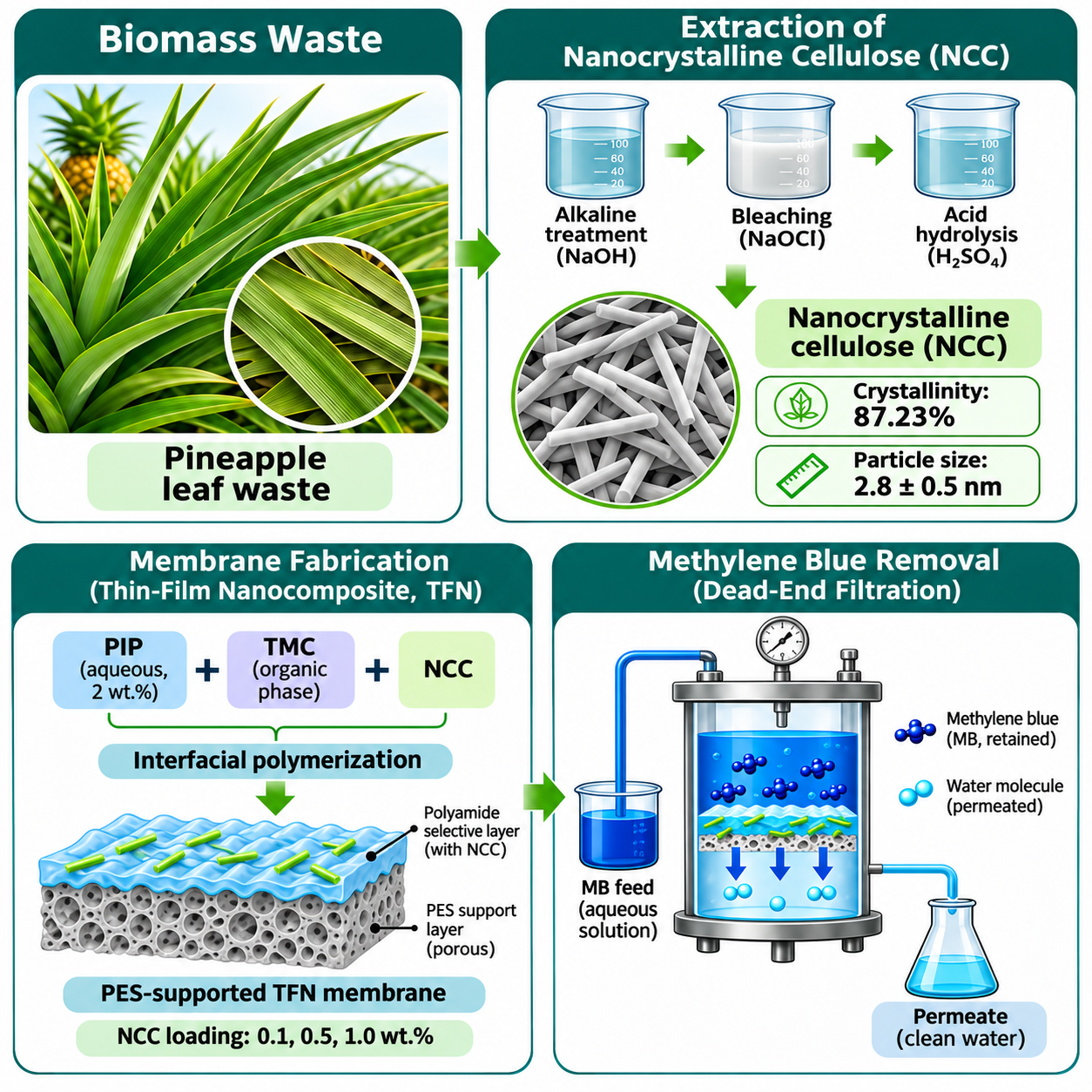
Thin-film nanocomposite (TFN) membranes incorporating nanocrystalline cellulose (NCC) derived from pineapple leaf waste were fabricated and evaluated for methylene blue removal from aqueous solutions. NCC was extracted through sequential alkaline treatment, bleaching, and sulfuric acid hydrolysis, yielding highly crystalline nanocellulose with an average particle size of 2.8 ± 0.5 nm and a crystallinity index of 87.23%. The TFN membranes were prepared via interfacial polymerization of piperazine and trimesoyl chloride on polyethersulfone ultrafiltration supports, with NCC loadings of 0, 0.1, 0.5, and 1.0 wt.% incorporated into the polyamide layer. Membrane characterization revealed that NCC incorporation markedly affected surface chemistry, morphology, and structural integrity. Fourier transform infrared spectroscopy confirmed the presence of cellulose-related functional groups, while scanning electron microscopy showed the formation of a dense and well-defined selective layer at moderate NCC concentrations. Thermal and mechanical analyses demonstrated enhanced thermal stability and tensile strength with increasing NCC content. Pure water permeability decreased with higher NCC loading, indicating increased membrane compactness, while dye rejection performance improved significantly. The TFN membrane containing 1.0 wt.% NCC exhibited the highest methylene blue rejection of 92.45%, whereas the membrane with 0.5 wt.% NCC provided an optimal balance between permeability and selectivity. These results highlight the effectiveness of pineapple leaf-derived NCC as a sustainable nanofiller for enhancing TFN membrane performance, offering a promising, low-cost approach for advanced wastewater treatment applications. In addition, the structure-performance relationship was further analyzed to elucidate the influence of NCC loading on membrane densification, permeability-selectivity trade-off, and dye rejection mechanisms. The limitations related to nanofiller dispersion and long-term stability are also discussed to provide a comprehensive evaluation of the developed membrane system.
HIGHLIGHTS
- Nanocrystalline cellulose (NCC) was successfully extracted from pineapple leaf waste and applied as a sustainable nanofiller.
- Thin-film nanocomposite (TFN) membranes were fabricated via interfacial polymerization incorporating NCC into the polyamide layer.
- NCC loading significantly influenced membrane morphology, permeability, and mechanical strength.
- An optimal NCC concentration enhanced water permeability while maintaining high dye rejection.
- The TFN membrane achieved up to 92.45% methylene blue rejection, demonstrating strong potential for wastewater treatment.
GRAPHICAL ABSTRACT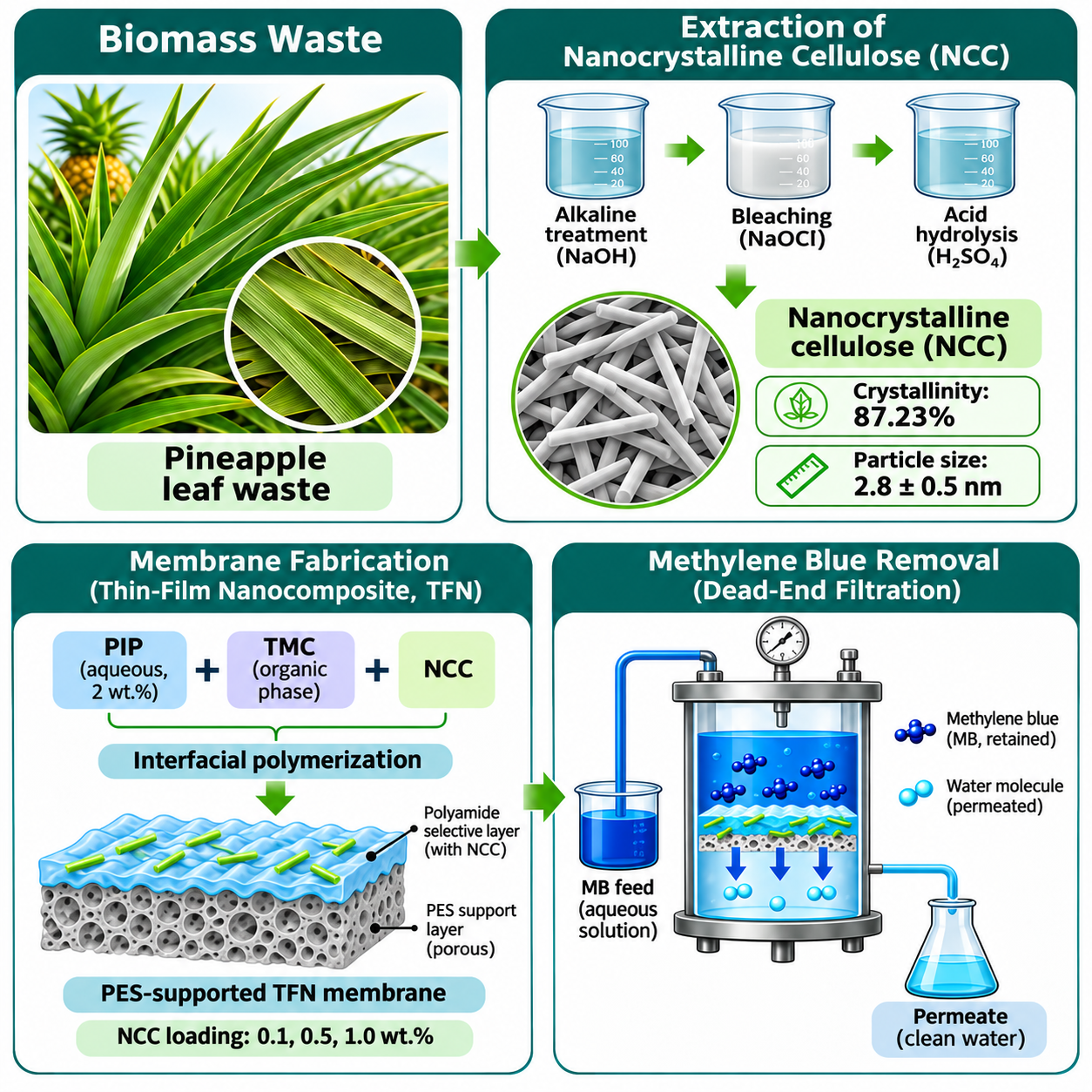
Downloads
References
H Tsade Kara, ST Anshebo, FK Sabir and G Adam Workineh. Removal of methylene blue dye from wastewater using periodiated modified nanocellulose. International Journal of Chemical Engineering 2021; 2021(1), 9965452.
N Benosmane, B Boutemeur, SM Hamdi and M Hamdi. Removal of methylene blue dye from aqueous solutions using polymer inclusion membrane technology. Applied Water Science 2022; 12(5), 104.
OS Bayomie, H Kandeel, T Shoeib, H Yang, N Youssef and MM El-Sayed. Novel approach for effective removal of methylene blue dye from water using fava bean peel waste. Scientific Reports 2020; 10(1), 7824.
JM Luque-Alled, L Martínez-Izquierdo, P Gorgojo, C Téllez and J Coronas. Organic solvent-free fabrication of thin film polyamide/zeolitic imidazolate framework membranes for removal of dyes from water. Chemical Engineering Journal 2023; 470, 144233.
WJ Lau, S Gray, T Matsuura, D Emadzadeh, JP Chen and AF Ismail. A review on polyamide thin film nanocomposite (TFN) membranes: History, applications, challenges and approaches. Water Research 2015; 80, 306-324.
F Whba, F Mohamed, MI Idris, & MS Yahya. (2022). Characterization of Cellulose Nanocrystals (CNCs) derived from Microcrystalline Cellulose (MCC) synthesized using acid hydrolysis method, Available at https://doi.org/10.21203/rs.3.rs-2078344/v2, accessed February 2026.
MS Rana, MA Rahim, MP Mosharraf, MFK Tipu, JA Chowdhury, MR Haque, S Kabir, MS Amran and AA Chowdhury. Morphological, spectroscopic and thermal analysis of cellulose nanocrystals extracted from waste jute fiber by acid hydrolysis. Polymers 2023; 15(6), 1530.
V Raju, R Revathiswaran, KS Subramanian, KT Parthiban, K Chandrakumar, EV Anoop and CJ Chirayil. Isolation and characterization of nanocellulose from selected hardwoods, viz., Eucalyptus tereticornis Sm. and Casuarina equisetifolia L., by steam explosion method. Scientific Reports 2023; 13(1), 1199.
K Vasić, M Dokl, Ž Knez and M Leitgeb. Isolation and characterization of nanocellulose from Polypodiophyta fern using chemo-mechanical method. Biomimetics 2024; 9(10), 624.
SM Beyan, TA Amibo, SV Prabhu and AG Ayalew. Production of nanocellulose crystal derived from enset fiber using acid hydrolysis coupled with ultrasonication, isolation, statistical modeling, optimization, and characterizations. Journal of Nanomaterials 2021; 2021, 7492532.
DM Fellicia, TY Rus and AM Sulaiman. Isolation and extraction of microcellulose from pineapple leaves fiber. Mechanics Exploration and Material Innovation 2024; 1(2), 61-66.
MH Hemida, H Moustafa, S Mehanny, M Morsy, EN Abd El Rahman and MM Ibrahim. Valorization of Eichhornia crassipes for the production of cellulose nanocrystals further investigation of plethoric biobased resource. Scientific Reports 2024; 14(1), 12387.
ESA Rashid, A Gul, WAH Yehya and NM Julkapli. Physico-chemical characteristics of nanocellulose at the variation of catalytic hydrolysis process. Heliyon 2021; 7(6), e07267.
M Mulder. Basic principles of membrane technology. Springer, Dordrecht, Netherlands, 1996.
M Hashemibeni, E Ameri, J Hashemibeni and H Seifi. Synthesis of nanocomposite membranes embedded with cellulose nanocrystals and their application to filtrate of arsenic aqueous solutions. Desalination and Water Treatment 2022; 247, 17-27.
D Liu, J Liu, S Lin, X Wei and MJ Guo. Preparation and characterization of cellulose nanocrystals with different aspect ratios as nano-composite membrane for cationic dye removal. SN Applied Sciences 2019; 1(12), 1596.
EPN Ntone, S Abd Rahman, RA Samah, MSA Wahab, ZA Jawad and H Hasbullah. A comparison study on performance of thin film composite membrane embedded with graphene oxide for acetaminophen, diclofenac and ibuprofen separation from waste water. Chemical Engineering Research and Design 2023; 195, 28-37.
AI Syahrul, MD Rosyidin, S Hidayat, K Khaerunisa, N Soraya, NH Sari and S Syahrul. Characterization of nanocellulose from banana stem fiber and its bionanocomposite as a thermal insulation material. Dinamika Teknik Mesin 2025; 15(1), 65-75.
H Wang, J Wu, B Huang and QL Lu. One-pot synthesis of UPy-functionalized nanocellulose under mechanochemical synergy for high-performance epoxy nanocomposites. Polymers 2022; 14(12), 2428.
Downloads
Published
How to Cite
Issue
Section
License
Copyright (c) 2026 Walailak University

This work is licensed under a Creative Commons Attribution-NonCommercial-NoDerivatives 4.0 International License.