
Evaluation of Phytochemical Contents and In Vitro Antioxidant, Anti-Inflammatory, and Anti-Acne Activities of Aqueous Extracts from A Traditional Thai Polyherbal “Ya Mong Ngoo” Formulation
DOI:
https://doi.org/10.48048/tis.2026.13596Keywords:
Ya Mong Ngoo, Polyherbal formulation, Aqueous extraction, Phytochemical contents, Antioxidant activity, Anti-Inflammatory activity, Anti-Acne activityAbstract
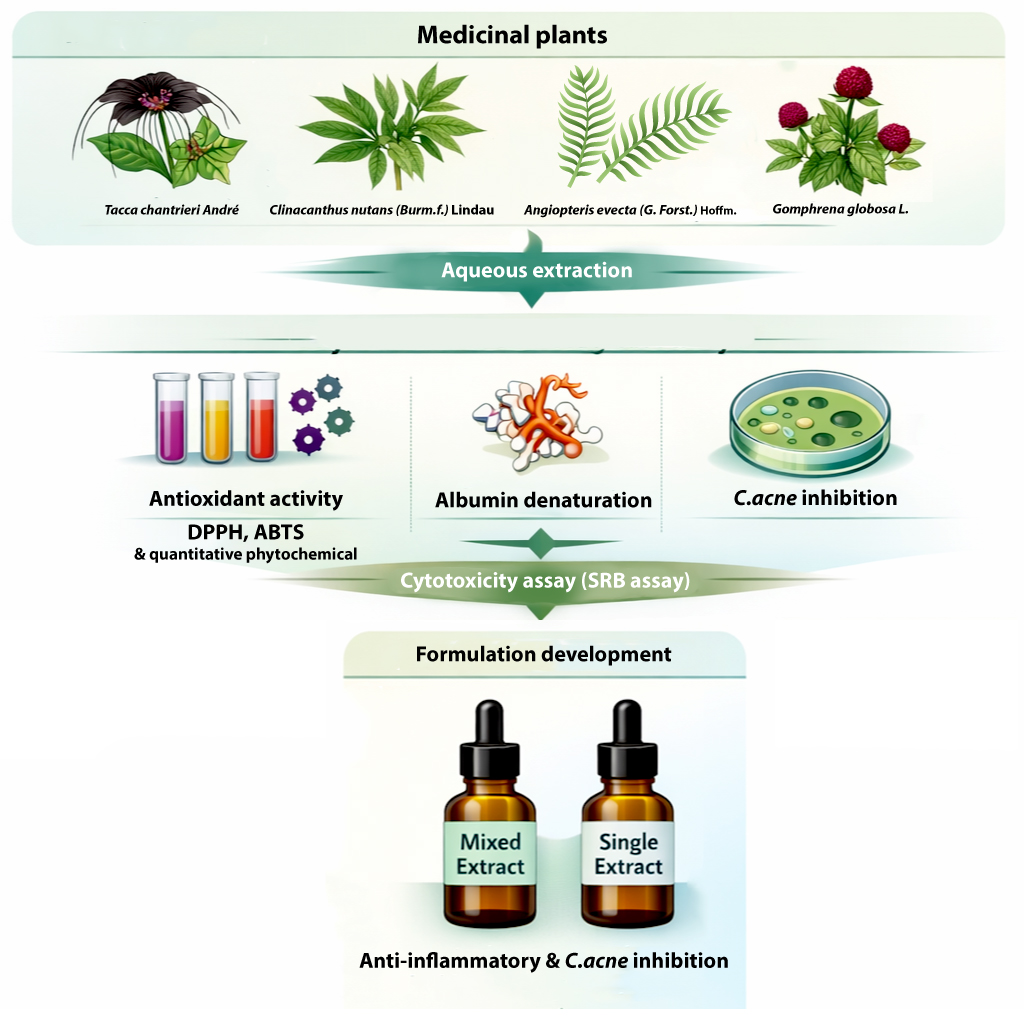
This study aimed to evaluate the biological potential of aqueous extracts from herbal ingredients in the traditional Ya Mor Ngu formulation, namely Angiopteris evecta (G. Forst.) Hoffm., Clinacanthus nutans (Burm.f.) Lindau, Tacca chantrieri André, and Gomphrena globosa L. as well as to develop an herbal serum formulation for skincare applications. All herbal materials were subjected to quality control by determination of moisture content according to AOAC methods prior to aqueous extraction and freeze drying. Subsequently, the extracts were evaluated for antioxidant activities (DPPH and ABTS assays), total phenolic content (TPC), total flavonoid content (TFC), in vitro anti-inflammatory activity (albumin denaturation assay), inhibitory activity against Cutibacterium acnes (C. acnes), and cytotoxicity toward human dermal fibroblasts using the SRB assay. The results demonstrated that all herbal raw materials had moisture contents below 10%. The extract of Tacca chantrieri André, exhibited the most prominent biological potential, showing strong antioxidant activities (DPPH and ABTS), which correlated with high total phenolic (TPC) and total flavonoid (TFC) contents, and it was the only extract capable of inhibiting C. acnes. In contrast, the extract of Angiopteris evecta (G. Forst.) Hoffm. showed superior anti-inflammatory activity. Cytotoxicity assessment at the cellular level confirmed the safety of all extracts at low to moderate concentrations. Regarding herbal serum development, the mixed extract formulation exhibited higher anti-inflammatory activity than the single extract formulation, whereas the serum containing a single extract demonstrated stronger inhibitory activity against C. acnes than the mixed formulation. Nevertheless, the C. acnes inhibitory activity of the serum formulations remained lower than that of the standard drug. In conclusion, extracts from the Ya Mor Ngu formulation, particularly Tacca chantrieri André, show potential for development as active ingredients in skincare products targeting antioxidant, anti-acne, and anti-inflammatory effects.
HIGHLIGHTS
- A traditional Thai polyherbal “Ya Mong Ngoo” formulation was evaluated for antioxidant, anti-inflammatory, and anti-acne activities.
- Tacca chantrieri André rhizome extract exhibited the strongest antioxidant activity and the highest phenolic and flavonoid contents.
- Angiopteris evecta (G. Forst.) Hoffm. rhizome extract demonstrated anti-inflammatory activity comparable to the reference drug.
- Only Tacca chantrieri André rhizome extract inhibited Cutibacterium acnes in the preliminary disc diffusion assay.
- Herbal serum formulations showed potential for development as multifunctional cosmeceutical products targeting skin inflammation and acne.
GRAPHICAL ABSTRACT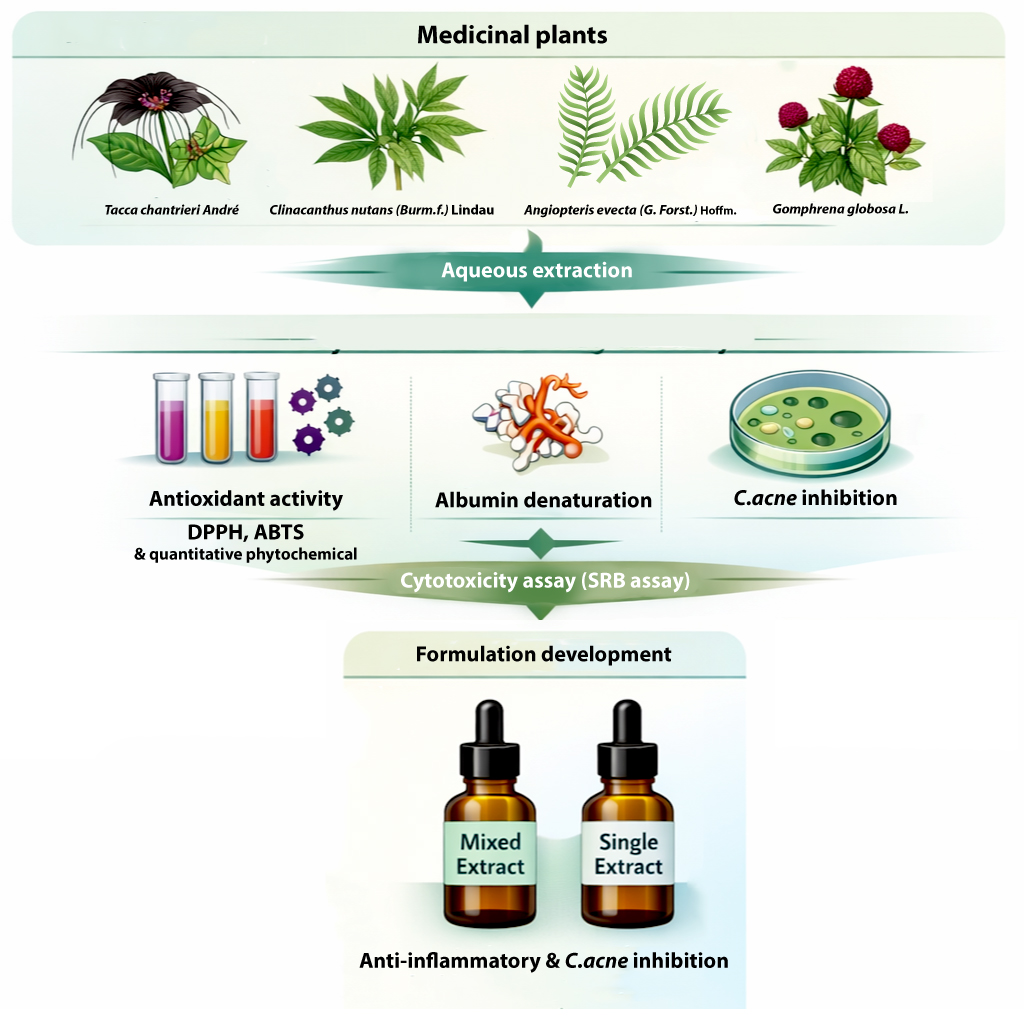
Downloads
References
A Niedzwiedzka, MP Micallef, M Biazzo and C Podrini. The role of the skin microbiome in acne: Challenges and future therapeutic opportunities. International Journal of Molecular Sciences 2024; 25(21), 11422.
MA Kayiran, AS Karadag, S Al-Khuzaei, W Chen and LC Parish. Antibiotic resistance in acne: Mechanisms, complications and management. American Journal of Clinical Dermatology 2020; 21(6), 813-819.
W Johnson, WF Bergfeld, DV Belsito, DE Cohen, CD Klaassen, DC Liebler, LA Peterson, RC Shank, TJ Slaga, PW Snyder, MM Fiume and B Heldreth. Safety assessment of Equisetum arvense-derived ingredients as used in cosmetics. International Journal of Toxicology 2026; 45(S1), 106S-121S.
Y Li, X Hu, G Dong, X Wang and T Liu. Acne treatment: Research progress and new perspectives. Frontiers in Medicine 2024; 11, 1425675.
E Kim, HH Seo, DS Shin, J Song, SK Yun, JH Lee and SH Moh. Safety validation of plant-derived materials for skin application. Cosmetics 2025; 12(4), 153.
SN Gade, AK Shirsat, GG Tambe and SS Muley. Toxicity and adverse effects of herbal ingredients in cosmetic products: A comprehensive review. International Journal of Pharmaceutical Sciences 2024; 2(10), 1837-1842.
P Arjsri, K Srisawad, W Semmarath, L Rueankham, A Saiai, S Anuchapreeda and P Dejkriengkraikul. (-)-Epi-Osmundalactone-rich fraction from Angiopteris evecta suppresses proliferation and induces intrinsic apoptosis in non-small cell lung cancer cells via MAPK pathway modulation. Plants 2026; 15(5), 764.
W Alam, H Khan, MA Shah, O Cauli and KH Sait. In vitro inhibition of cyclooxygenase enzymes and evaluation of anti-inflammatory activity of bioactive compounds. Frontiers in Pharmacology 2023; 14, 10511884.
WY Ong, DR Herr, GY Sun and TN Lin. Anti-inflammatory effects of phytochemical components of Clinacanthus nutans. Molecules 2022; 27(11), 3607.
S Thewaanukhor, A Rongjumnong, P Karamart, O Vito, S Aluksanasuwan, N Teerapattarakan, A Morchang, P Hankittichai, C Thepmalee and K Somsuan. Tacca chantrieri rhizome extract induces apoptosis and inhibits colony formation and migration in breast cancer cell lines. Trends in Sciences 2025; 22(10), 10525.
T Hawiset, N Sriraksa, S Anukanon, U Kamsrijai, S Praman, N Teerapattarakan and P Inkaew. Tacca chantrieri Andre rhizome extract alleviates scopolamine-induced cognitive impairment and neuroinflammation in rats. Advances in Pharmacological and Pharmaceutical Sciences 2025; 2025, 7334303.
CY Chou, YJ Lin and HT Wu. Photoprotective effects of Gomphrena globosa extracts against UV-induced oxidative stress in human keratinocytes. Molecules 2021; 26(4), 1134.
S Ruthaphan, L Thawatchai, R Wannisa and S Alisa. In vitro anti-inflammatory and antibacterial activities of three Phlai (Zingiber cassumunar Roxb.) extracts using extraction processes adapted from Thai traditional medicine knowledge. Khon Kaen University Science Journal 2025; 53(3), 320-334.
AOAC International. Official methods of analysis of AOAC International. 17th ed. AOAC International, Gaithersburg, Maryland, 2000.
B Yongkhamcha, S Khankhum and N Buddhakala. Total phenolic and flavonoid contents, antioxidant, antibacterial and anti-inflammatory activities and toxicities of ethanol extracts from Curcuma mangga, Zingiber officinale and Zingiber montanum. Trends in Sciences 2024; 21(9), 8086.
AG Nomi, H Handayani, RH Khuluk and AH Karomah. Antioxidant activity and metabolite changes in Centella asiatica with different drying methods using FTIR- and quantitative HPLC-based metabolomics. International Food Research Journal 2024; 31(1), 228-238.
JS Fakir, CM Ahire, KR Surana and A Kalam. Antibacterial and anti-inflammatory emulgel containing Eugenia caryophyllus buds extract. Biosciences Biotechnology Research Asia 2024; 21(3), 1183-1196.
F Dell’Annunziata, S Cometa, R Della Marca, F Busto, V Folliero, G Franci and AD Filippis. In vitro antibacterial and anti-inflammatory activity of Arctostaphylos uva-ursi leaf extract against Cutibacterium acnes. Pharmaceutics 2022; 14(9), 1952.
JA Bauer, AM Sysel, AJ Heston and MJ Dunphy. Standardized sulforhodamine B colorimetric cell proliferation assay for anticancer activity screening in educational and research laboratories. MethodsX 2025; 15, 103469.
K Phumle, A Itharat, HY Lee, P Pongcharoen, GS Moon, P Chakkavittumrong and NM Davies. Hydrogel patch containing mangosteen ethanolic extract and its clinical safety for acne vulgaris treatment. Asian Medical Journal and Alternative Medicine 2022; 22(S1), S136-S141.
S Suriyaprom, T Kaewkod, I Promputtha, M Desvaux and Y Tragoolpua. Evaluation of antioxidant and antibacterial activities of white mulberry (Morus alba L.) fruit extracts. Plants 2021; 10(12), 2736.
O Ishola, IE Ojo, ET Babatunde, AT Iyiola, TO Fabiyi and AA Adeyanju. Determination of antioxidant capacity in aqueous extracts of Corymbia citriodora using DPPH, ABTS, FRAP, TPC, and hydrogen peroxide assays. Asian Journal of Research in Biochemistry 2025; 15(3), 171-178.
Downloads
Published
How to Cite
Issue
Section
License
Copyright (c) 2026 Walailak University

This work is licensed under a Creative Commons Attribution-NonCommercial-NoDerivatives 4.0 International License.





