
Mitochondrial Marker-Based EvaGreen Real-Time PCR for Specific Detection and Quantification of Exserohilum rostratum in Rice Tissues
DOI:
https://doi.org/10.48048/tis.2026.13546Keywords:
Rice, Leaf spot, Exserohilum rostratum, Setosphaeria rostrata, Real-time PCR, qPCR assay, Mitochondrial markersAbstract
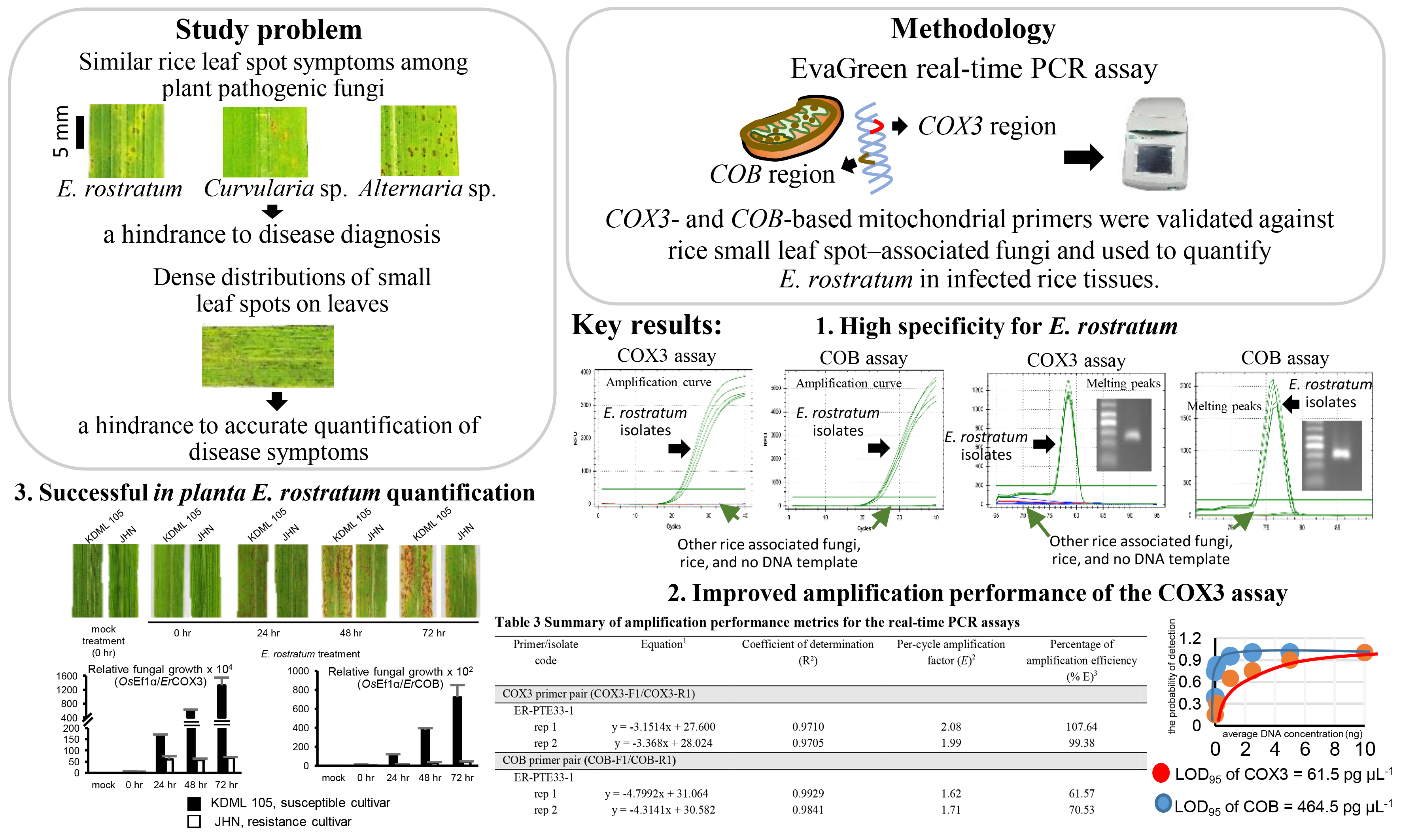
Exserohilum rostratum is a globally distributed ascomycetous fungus with a broad host range, including rice, where it causes brown to reddish-brown leaf spots and grain discoloration. The temperature-dependent development of rice leaf spot disease highlights E. rostratum as a promising model pathogen for studying rice-fungus interactions under elevated temperature conditions. However, disease diagnosis remains challenging due to symptom overlap with other rice-associated fungi and the presence of numerous small, scattered lesions that hinder reliable disease assessment. In addition, sensitive and specific molecular tools for accurate quantification of E. rostratum in rice tissues remain limited. To address this gap, and to our knowledge for the first time, we developed a dye-based real-time PCR assay using EvaGreen chemistry for the specific detection and quantification of E. rostratum in rice tissues. Primers were designed from nuclear loci, including the actin (ACT) and glyceraldehyde-3-phosphate dehydrogenase (GAPDH) gene regions, and from mitochondrial loci, including cytochrome c oxidase subunits 1 and 2 (COX1/2), cytochrome c oxidase subunit 3 (COX3), and apocytochrome b (COB). The COX3 and COB assays showed high specificity for E. rostratum, with no amplification of other common rice-associated fungi. The COX3 assay demonstrated superior performance, with higher amplification efficiency (94.65% - 109.08%) and approximately 7.5-fold greater sensitivity (LOD95 = 61.50 pg μL-1) than the COB assay (59.04% - 75.44% and LOD95 = 464.50 pg μL-1). Both assays enabled successful monitoring of fungal colonization in inoculated rice tissues and showed strong positive correlations between symptom development and pathogen DNA levels. These assays provide accurate and reliable tools for pathogen diagnosis, quantitative disease assessment, cultivar screening, and studies of disease dynamics in the rice–E. rostratum pathosystem.
HIGHLIGHTS
- Established EvaGreen-based qPCR assays for accurate detection and quantification of Exserohilum rostratum in rice.
- COX3 and COB mitochondrial markers provided high specificity against rice-associated fungi.
- The COX3 assay showed higher sensitivity and amplification efficiency than COB.
- The developed assays enables quantitative assessment of rice leaf spot progression in planta.
GRAPHICAL ABSTRACT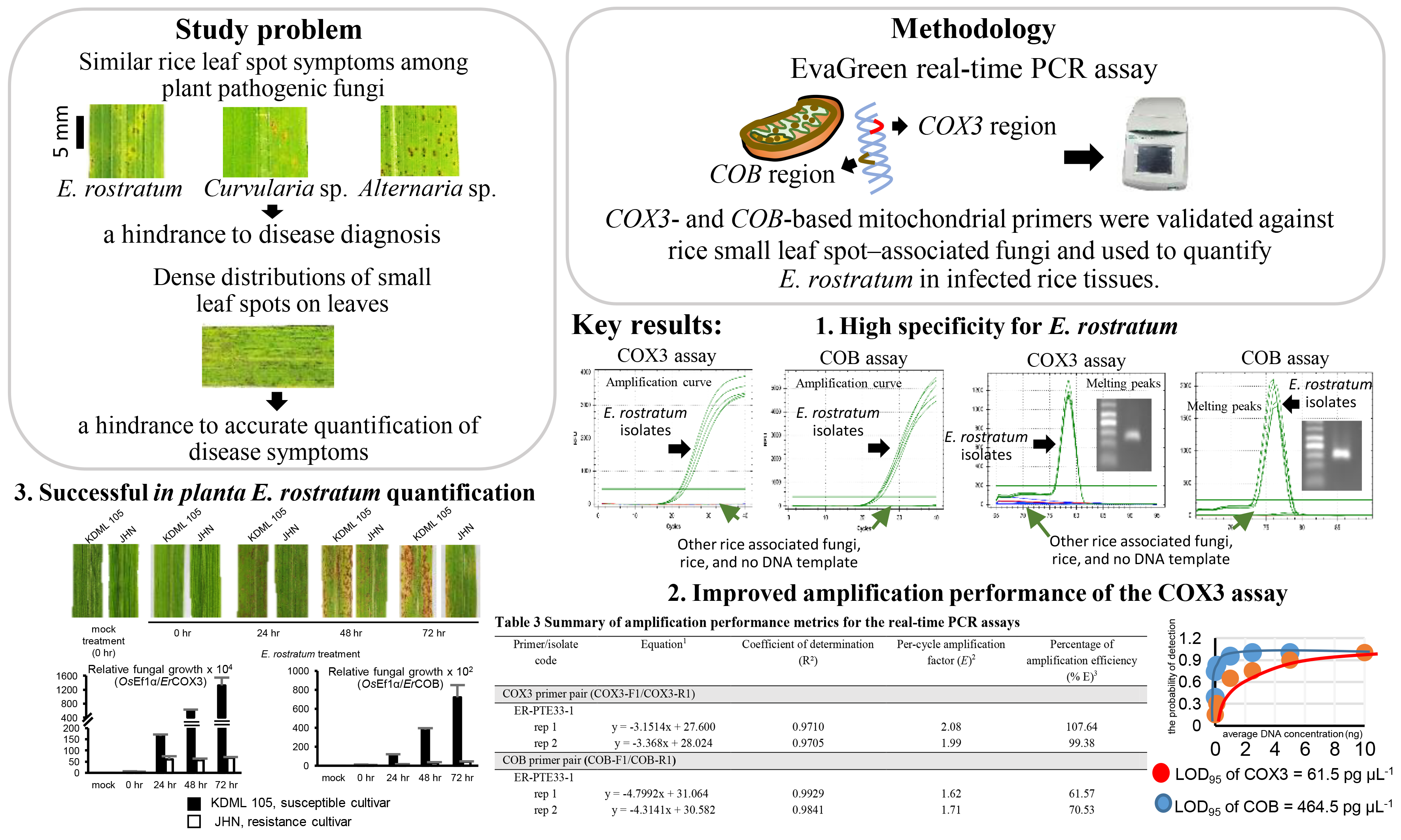
Downloads
References
Office of Agricultural Economics, Available at: https://oae.go.th/uploads/files/2025/08/07/853f981624250b80.pdf, accessed September 2025.
S Raghu, MS Baite, NB Patil, P Sanghamitra, MK Yadav, SR Prabhukarthikeyan, U Keerthana, GG Pandi, S Aravindan and PC Rath. Grain discoloration in popular rice varieties (Oryza sativa L) in eastern India, associated mycoflora, quality losses and management using selected biocontrol agents. Journal of Stored Products Research 2020; 88, 101682.
M Hernández-Restrepo, H Madrid, YP Tan, KC da Cunha, J Gené, J Guarro and PW Crous. Multi-locus phylogeny and taxonomy of Exserohilum. Persoonia - Molecular Phylogeny and Evolution of Fungi 2018; 41, 71-108.
KH Kaboré, D Diagne, J Milazzo, H Adreit, MH Lebrun and D Tharreau. First report of rice brown spot caused by Exserohilum rostratum in Mali. Plant Disease 2022; 106(6), 1747.
SK Aggarwal, MA Ahangar, A Singh, M Gupta, SI Harlapur, VS Shinde, N Mallikarjuna, H Kaur, P Kumar, R Kaur, P Goyal and HS Jat. First report of Exserohilum rostratum causing leaf blight on maize (Zea mays) in India. Plant Disease 2025; 109(11), 2435.
T Korra, S Navathe, S Biradar and R Chand. Pathogenicity and infection behaviour of Exserohilum rostratum on wheat and associated collateral hosts. Journal of Plant Pathology 2023; 105, 695-709.
J Li, S Zhou, X Huang and W Shen. First report of leaf spot disease on sugarcane caused by Exserohilum rostratum in China. Plant Disease 2026; 110(4), 1474.
XD Sun, QQ Pang, FH Gao, W Zhang, XL Cai and M Zhou. First report of leaf spot on cherry tomatoes caused by Exserohilum rostratum in Hainan Province, China. Plant Disease 2023; 107(9), 2842.
Y Boonkorn, V Tongsri, O Piasai and P Songkumarn. Characterization, pathogenicity and fungicide response of Exserohilum rostratum causing leaf spot on rice in Thailand. European Journal of Plant Pathology 2024; 170, 549-566.
K He, C Zhao, M Zhang, J Li, Q Zhang, X Wu, S Wei, Y Wang, X Chen and C Li. The Chromosome-scale genomes of Exserohilum rostratum and Bipolaris zeicola pathogenic fungi causing rice spikelet rot disease. Journal of Fungi 2023; 9(2), 177.
R Cardona and MS González. First report of Exserohilum rostratum associated with rice seed in Venezuela. Plant Disease 2007; 91(2), 226.
FJA Silva, SLP Maich, PR Meneses, C Bellé, DR de Barros and CRJ Farias. First report on Exserohilum rostratum pathogenicity causing brown spot to rice in Brazil. Plant Disease 2016; 100(12), 2531.
RA Majeed, AA Shahid, GA Liaqat, K Saleem, M Asif, M Shafiq, MS Haider and M Noreen. First report of Setosphaeria rostrata causing brown leaf spot of rice in Pakistan. Plant Disease 2016; 100(10), 2162.
KH Kaboré, AI Kassankogno, H Adreit, J Milazzo, S Guillou, L Blondin, L Chopin, S Ravel, F Charriat, M Barro, C Tollenaere, MH Lebrun and D Tharreau. Genetic diversity and structure of Bipolaris oryzae and Exserohilum rostratum populations causing brown spot of rice in Burkina Faso based on genotyping-by-sequencing. Frontiers in Plant Science 2022; 13, 1022348.
MFA Khan, A Riaz, R Ahsan, I Ahmad, S Ullah, A Raza and M Zakria. Genetic variability among isolates of Curvularia lunata and Exserohilum rostratum causing brown leaf spot of rice from Pakistan. Current Microbiology 2025; 82, 436.
JGA Barbedo. A review on the main challenges in automatic plant disease identification based on visible range images. Biosystems Engineering 2016; 144, 52-60.
TM Matsunaga, D Ogawa, F Taguchi-Shiobara, M Ishimoto, S Matsunaga and Y Habu. Direct quantitative evaluation of disease symptoms on living plant leaves growing under natural light. Breeding Science 2017; 67(3), 316-319.
MS Mirmajlessi, E Loit, M Mand and SM Mansouripour. Real-time PCR applied to study on plant pathogens: Potential applications in diagnosis - a review. Plant Protection Science 2015; 51(4), 177-190.
CJ Smith and AM Osborn. Advantages and limitations of quantitative PCR (Q-PCR)-based approaches in microbial ecology. FEMS Microbiology Ecology 2009; 67(1), 6-20.
Y Zhang, Z Wei, J Zhang, C Chen and F Liu. Application of PCR and PCR-derived technologies for the detection of pathogens infecting crops. Physiological and Molecular Plant Pathology 2025; 136, 102589.
S Kumar, PL Kashyap, S Mahapatra, P Jasrotia and GP Singh. New and emerging technologies for detecting Magnaporthe oryzae causing blast disease in crop plants. Crop Protection 2021; 143, 105473.
YH Lin, SM Shen, CJ Wen, YJ Lin, TD Chang and SC Chu. Molecular detection assays for rapid field-detection of rice sheath blight. Frontiers in Plant Science 2021; 11, 552916.
K Singh, S Sharma, A Tyagi, S Gupta, BM Bashyal, MS Gurjar, MS Saharan, M Choudhary and R Aggarwal. Development, validation and utility of conventional and real-time PCR based marker for the detection of Bipolaris oryzae causing brown spot disease of rice. Australasian Plant Pathology 2025; 54, 101-110.
GM Gauthier and NP Keller. Crossover fungal pathogens: The biology and pathogenesis of fungi capable of crossing kingdoms to infect plants and humans. Fungal Genetics and Biology 2013; 61, 146-157.
L Gadea, DE Grgurichb, TM Kerkeringb, ME Brandta and AP Litvintseva. Utility of real-time PCR for detection of Exserohilum rostratum in body and tissue fluids during the multistate outbreak of fungal meningitis and otheri infections. Journal of Clinical Microbiology 2015; 53(2), 618-625.
Y Zhao, R Petraitiene, TJ Walsh and DS Perlin. A real-time PCR assay for rapid detection and quantification of Exserohilum rostratum, a causative pathogen of fungal meningitis associated with injection of contaminated methylprednisolone. Journal of Clinical Microbiology 2013; 51(3), 1034-1036.
P Chaijuckam, P Songkumarn and JJG Guerrero. Genetic diversity and aggressiveness of Bipolaris oryzae in North-Central Thailand. Applied Science and Engineering Progress 2019; 12(2), 116-125.
Y Boonkorn, V Tongsri and P Songkumarn. Response of some rice varieties against the fungus, Exserohilum rostratum, causing leaf spot disease on rice and expression of plant hormone responsive genes in rice during infection. Thai Agricultural Research Journal 2024; 42(3), 257-271.
JJ Doyle and JL Doyle. A rapid DNA isolation procedure for small quantities of fresh leaf tissue. Phytochemical Bulletin 1987, 19(1), 11-15.
KA Seifert, RA Samson, JR deWaard, J Houbraken, CA Lévesque, JM Moncalvo, G Louis-Seize and PDN Hebert. Prospects for fungus identification using CO1 DNA barcodes, with Penicillium as a test case. PNAS 2007; 104(10), 3901-3906.
SA Bustin, V Benes, JA Garson, J Hellemans, J Huggett, M Kubista, R Mueller, T Nolan, MW Pfaffl, GL Shipley, J Vandesompele and CT Wittwer. The MIQE guidelines: Minimum information for publication of quantitative real-time PCR experiments. Clinical Chemistry 2009; 55(4), 611-622.
C Caldana, WR Scheible, B Mueller-Roeber and S Ruzicic. A quantitative RT-PCR platform for high-throughput expression profiling of 2500 rice transcription factors. Plant Methods 2007; 3, 7.
CH Park, S Chen, G Shirsekar, B Zhou, CH Khang, P Songkumarn, AJ Afzal, Y Ning, R Wang, M Bellizzi, B Valent and GL Wang. The Magnaporthe oryzae effector AvrPiz-t targets the RING E3 ubiquitin ligase APIP6 to suppress pathogen-associated molecular pattern-triggered immunity in rice. The Plant Cell 2012; 24, 4748-4762.
MW Pfaffl. A new mathematical model for relative quantification in real-time RT-PCR. Nucleic Acids Research 2001; 29(9), 45.
JM Ruijter, RJ Barnewall, IB Marsh, AN Szentirmay, JC Quinn, RV Houdt, QD Gunst and MJBVD Hoff. Efficiency correction is required for accurate quantitative PCR analysis and reporting. Clinical Chemistry 2021; 67(6), 829-842.
The R Foundation. The R Project for Statistical Computing. The R Foundation, Vienna, Austria, 2019.
PLC Fonseca, RB De-Paula, DS Araújo, LMR Tomé, T Mendes-Pereira, WFC Rodrigues, LE Del-Bem, ERGR Aguiar and A Góes-Neto. Global characterization of fungal mitogenomes: New insights on genomic diversity and dynamism of coding genes and accessory elements. Frontiers in Microbiology 2021; 12, 787283.
J Wyrębek, T Molcan, K Myszczyński, ADV Diepeningen, AA Stakheev, M Żelechowski, K Bilska and T Kulik. Uncovering diagnostic value of mitogenome for identification of cryptic species Fusarium graminearum Sensu Stricto. Frontiers in Microbiology 2021; 12, 714651.
XJ Min and DA Hickey. Assessing the effect of varying sequence length on DNA barcoding of fungi. Molecular Ecology Notes 2007; 7(3), 365-373.
L Wang, K Yokoyama, M Miyaji and K Nishimura. Mitochondrial cytochrome b gene analysis of Aspergillus fumigatus and related species. Journal of Clinical Microbiology 2000; 38(4), 1352-1358.
JO Lima, JF Pereira, J Rincones, JG Barau, EF Araújo, GAG Pereira and MV Queiroz. The glyceraldehyde-3-phosphate dehydrogenase gene of Moniliophthora perniciosa, the causal agent of witchesʼ broom disease of Theobroma cacao. Genetics and Molecular Biology 2009; 32(2), 362-366.
K Voigt and J Wöstemeyer. Reliable amplification of actin genes facilitates deep-level phylogeny. Microbiological Research 2000; 155(3), 179-195.
E Navarro, G Serrano-Heras, MJ Castaño and J Solera. Real-time PCR detection chemistry. Clinica Chimica Acta 2015; 439, 231-250.
D de Gonzalo-Calvo, M Marchese, J Hellemans, F Betsou, NLS Frisk, LT Dalgaard, P Lakkisto, C Foy, A Scherer, MLG Bermejo and Y Devaux. Consensus guidelines for the validation of qRT-PCR assays in clinical research by the CardioRNA consortium. Molecular Therapy Methods & Clinical Development 2022; 24, 171-180.
H Fan, J Wang, M Komiyama and X Liang. Effects of secondary structures of DNA templates on the quantification of qPCR. Journal of Biomolecular Structure and Dynamics 2019; 37(11), 2867-2874.
L Romero-Cuadrado, A Aguado, D Ruano-Rosa and N Capote. Triplex real-time qPCR for the simultaneous detection of Botryosphaeriaceae species in woody crops and environmental samples. Frontiers in Plant Science 2024; 15, 1435462.
MI Drais, G Gusella, A Mazzaglia and G Polizzi. A quantitative PCR assay for the detection and quantification of Septoria pistaciarum, the causal agent of pistachio leaf spot in Italy. PLoS One 2023; 18(5), 0286130.
S Guénin, M Mauriat, J Pelloux, O Wuytswinkel, C Bellini and L Gutierrez. Normalization of qRT-PCR data: The necessity of adopting a systematic, experimental conditions-specific, validation of references. Journal of Experimental Botany 2009; 60(2), 487-493.
Published
How to Cite
Issue
Section
License
Copyright (c) 2026 Walailak University

This work is licensed under a Creative Commons Attribution-NonCommercial-NoDerivatives 4.0 International License.





