
Comparative Analysis of Bioactive Compounds and Antioxidant Stability in Khao-Mao Rice Varieties from Ubon Ratchathani: Impact of In Vitro Gastrointestinal Digestion
DOI:
https://doi.org/10.48048/tis.2026.13527Keywords:
Khao-Mao, Bioactive compounds, Antioxidant activity, Digestive stability, Total phenolicsAbstract
This study explores the nutritional potential and bioactive compounds of Khao-Mao, a celebrated local product (OTOP) from Ubon Ratchathani, Thailand, by analyzing 9 varieties of young rice sourced from Phibun Mangsahan and Trakanpuetpon. Interestingly, our results show that a rice variety’s “ranking” as a top antioxidant depends entirely on the type of test used. While the pigmented Kam variety was the clear winner in terms of total phenolics and standard radical scavenging (DPPH, ABTS, and FRAP), it was the Dor He and E-Tei varieties that performed best when specifically challenged with hydroxyl and superoxide ions. We also observed that the PM-sourced Kam was richer in anthocyanins than the TP version, while the non-pigmented types maintained steady chlorophyll levels. To evaluate the bio accessibility and stability of these compounds, a simulated in vitro gastrointestinal digestion model was applied. The results indicated that while phenolic recovery was relatively low, varieties such as RD6, E-Tei, and Kam maintained measurable concentrations ranging from 4.56% to 6.65%. Despite this reduction in total phenolics, these varieties retained substantial antioxidant potential, with reducing power percentages recorded at 78.78%, 92.43%, and 71.85%, respectively, following intestinal simulation. These results demonstrate that while gastrointestinal digestion significantly alters phenolic structures, Khao-Mao maintains high antioxidant efficacy through the resilience of its secondary metabolites and synergistic contributions from non-phenolic constituents. Consequently, this young rice serves as a robust source of bio accessible antioxidants, retaining functional potency despite physiological transformation. Furthermore, the IC50 values for ABTS radical scavenging activity increased to 84.21% (RD6), 80.95% (E-Tei), and 82.97% (Kam), suggesting that while the antioxidant capacity remains significant, the concentration required for 50% inhibition rises following digestive transformation. In conclusion, this study identifies Kam (from Phibun Mangsahan) and E-Tei as the most promising candidates for high-value food development, even for different physiological targets. While the pigmented Kam variety is superior for general radical scavenging and anthocyanin delivery, E-Tei demonstrates exceptional resilience during digestion, maintaining the highest reducing power (92.43%) and the most favorable post-digestion IC50 value.
HIGHLIGHTS
- Superior Phytochemical Resilience: Kam (PM) and Kam (TP) cultivars exhibited exceptional gastrointestinal stability and antioxidant potency compared to other tested varieties.
- Bioactive Correlation: High concentrations of anthocyanins and phenolics in Kam varieties directly correlate with sustained antioxidant capacity throughout simulated digestion.
- Cultivar-Specific Profiles: Distinct pigment profiles were identified across varieties, with Lee Nok characterized by high chlorophyll content and E-Tei demonstrating significant initial reducing power.
- Comparative Efficacy: Post-gastric phase analysis revealed that anthocyanin-rich Kam rice maintains free-radical scavenging activity comparable to the synthetic antioxidant Butylated Hydroxytoluene (BHT).
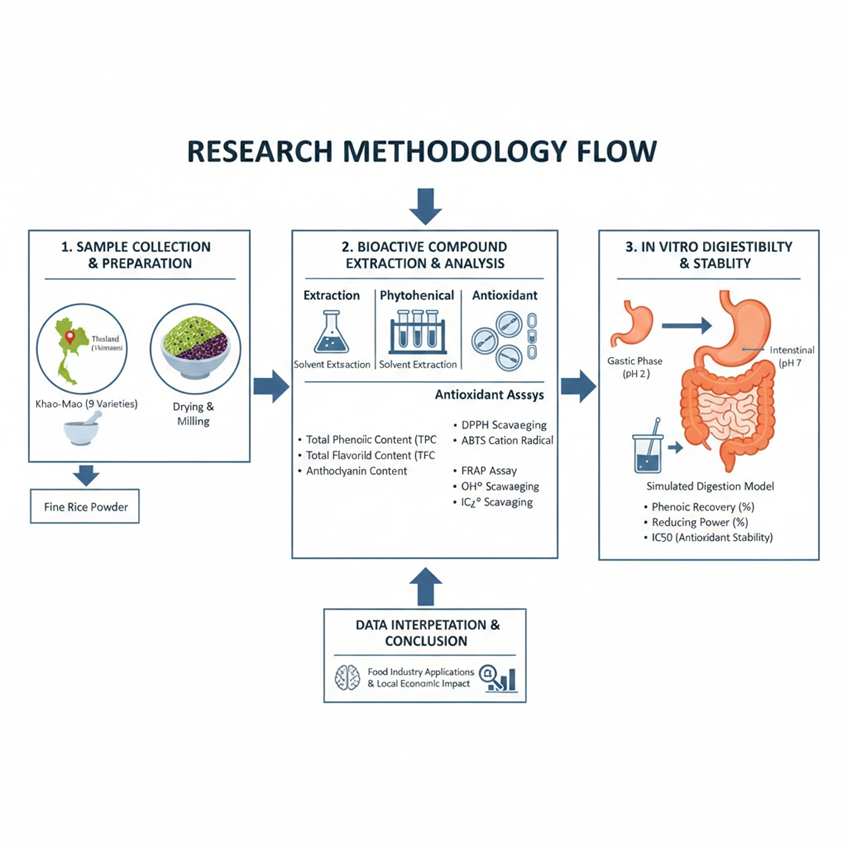
GRAPHICAL ABSTRACT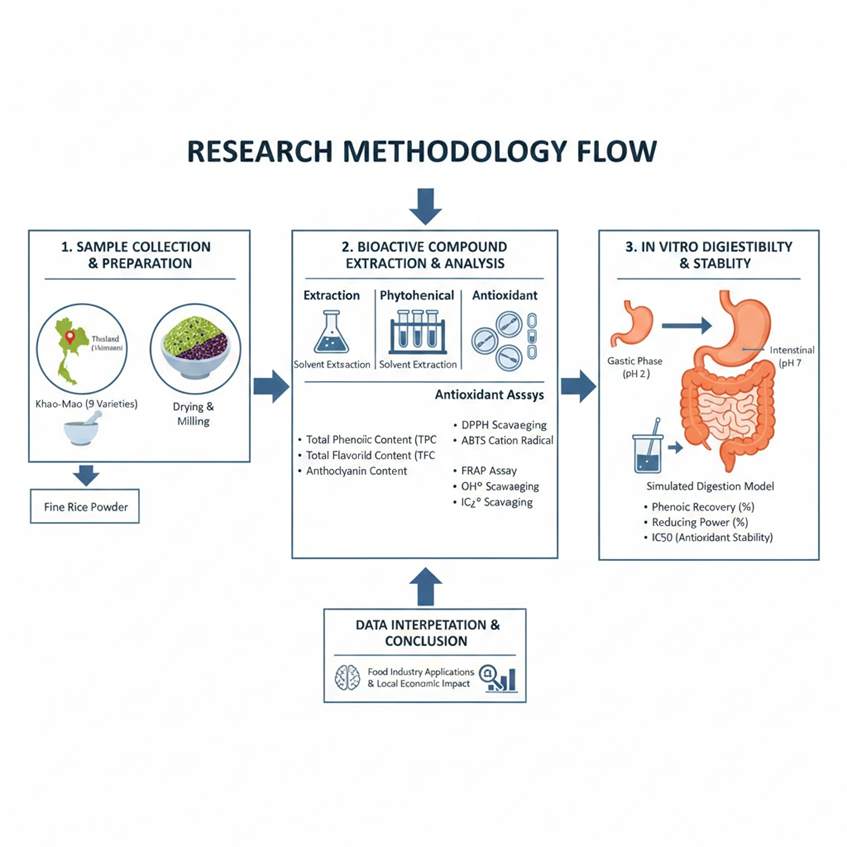
Downloads
References
S Jiamyangyuen, N Nuengchamnong and P Ngamdee. Bioactivity and chemical components of Thai rice in five stages of grain development. Journal of Cereal Science 2017; 74, 136-144.
S Preecharram, S Posoongnoen, T Thummawongsa, T Sripakdee, S Tawil, N Poomsuk and J Jandaruang. Proximate composition and antioxidant activity of Young Flattened Rice (Khao-Mao). Trends in Sciences 2023; 20(4), 6575.
J Teravecharoenchai, P Chalermchaiwat and R Thuwapanichayanan. Principal component analysis application on nutritional, bioactive compound and antioxidant activities of pigmented dough grain. Chiang Mai University Journal of Natural Sciences 2021; 20(2), e2021036.
J Oonmetta-aree, W Phanurak, V Tanamool, R Oonsivilai, J Singthong and C Sukwan. Effects of parboiled immature Rice Starch (Oryza sativa L.) on glucose and lipid metabolisms in high fat Diet-induced obese mice. Tropical Journal of Natural Product Research 2025; 9(9), 4130-4136.
E Onsaard. 2011, Study of physico- chemical properties of Khao-Mao. Complete Research Report. Ubon Ratchathani University, Warin Chamrap, Ubon Ratchathani.
S Moeurng, K Posridee, A Kamkaew, S Thaiudom, A Oonsivilai and R Oonsivilai. Identification of pheophytin a and hydroxy pheophytin a from rang chuet (Thunbergia laurifolia Linn.) as potent NQO-1 inducers in liver cells. Foods 2024; 13(10), 1443.
H Ramesh and P Devasenapathy. Physiological response of cowpea in a rainfed alfisol ecosystem to the impulse of soil moisture conservation practices. General and Applied Plant Physiology 2006; 32(3-4), 181-190.
ESM Abdel-Aal, JC Young and I Rabalski. Anthocyanin composition in black, blue, pink, purple and red cereal grains. Journal of Agricultural and Food Chemistry 2006; 54, 4696-4704.
P Prasongdee, K Posridee, A Oonsivilai and R Oonsivilai. A culinary and medicinal gem: Exploring the phytochemical and functional properties of thai basil. Foods 2024; 13(4), 632.
N Chaicharoenaudomrung, K Posridee, A Oonsivilai and R Oonsivilai. Golden barrel cactus: Unveiling its potential as a functional food and nutraceutical source. Foods 2024; 13(7), 1137.
K Posridee, A Oonsivilai and R Oonsivilai. Acute and sub-chronic toxicity study of Rang Chuet (Thunbergia laurifolia Lindl.) extracts and its antioxidant activities. Toxicology Reports 2022; 9, 2000-2017.
N Singh and PS Rajini. Free radical scavenging activity of an aqueous extract of potato peel. Food Chemistry 2004; 85, 611-616.
R KsouriI, WM Ksouri, I Jallali, A Debez, C Magne, I Hiroko and C Abdelly. Medicinal halophytes: Potent source of health promoting biomolecules with medical, nutraceutical and food applications. Critical Reviews in Biotechnology 2012; 32(4), 289-326.
MG Ferruzzi, ML Failla and SJ Schwartz. Sodium copper chlorophyllin: In vitro digestion stability and accumulation by Caco-2 human intestine and accumulation. Food Chemistry 2002; 50, 2173-2179.
MG Ferruzzi, ML Failla and SJ Schwartz. Assessment of degradation and intestinal cell uptake of carotenoids and chlorophylls derivatives from Spinach Puree using an in vitro digestion and Caco-2 human intestinal cells. Journal of Agricultural and Food Chemistry 2001; 49, 2082-2089.
Study on nutritional value of Land-Race Rice in Land Reform Area of Ampur Kudchum Yasothon Province, Available at: https://www.tei.or.th/file/events/191209-SY-saft_244.pdf, accessed January 2010.
S Kong and J Lee. Antioxidants in milling fractions of black rice cultivars. Food Chemistry 2010; 120(1), 278-281.
W Varanyanond, P Tungtrakul, V Surojanametakul, L Watanasiritham and W Luxiang. Effects of water soaking on -aminobutyric acid (GABA) in germ of different Thai rice varieties. Witthayasan Kasetsat 2005; 39, 411-415.
N Kamatsuzaki, K Tsukahara, H Toyoshima, T Suzuki, N Shimizu and T Kimura. Effect of soaking and gaseous treatment on GABA content in germinated brown rice. Journal of Food Engineering 2005; 78(2), 556-560.
C Juliano, M Cossu, MC Alamanni and L Piu. Antioxidant activity of gamma-oryzanol: Mechanism of action and its effect on oxidative stability of pharmaceutical oils. International Journal of Pharmaceutics 2005; 299, 146-154.
R Sompong, S Siebenhandl-Ehn, G Linsberger-Martin and E Berghofer. Physicochemical and antioxidative properties of red and black rice varieties from Thailand, China and Sri Lanka. Food Chemistry 2011; 124, 132-140.
S Butsat and S Siriamornpun. Antioxidant capacities and phenolic compounds of the husk, bran and endosperm of Thai Rice. Food Chemistry 2010; 119, 606-613.
Office of Agricultural Economics. Sathiti Kan Kaset khong Prathet Thai pi 2567. Office of Agricultural Economics, Bangkok, Thailand, 2025.
Y Ma, Y Yang, J Gao, J Feng, Y Shang and Z Wei. Phenolics and antoxidant activity of bamboo leaves soup as affected by in vitro digestion. Food and Chemical Toxicology 2020; 135, 110941.
P Sirichat, W Srichamnong, P Pitchakarn and S Nanyakkara. Phytochemicals and antioxidant activities of Thai Rice (Oryza sativa L.) at different stages of grain development. Journal of Food and Nutrition Research 2020; 8(1), 1-14.
S Wongpornchai. Analysis of flavonoids in Thai pigmented Rice. Thailand Science Research and Innovation, Bangkok, Thailand, 2005.
M Peanparkdee, J Patrawart and S Iwanmoto. Physicochemical stability and in vitro bioaccessibility of phenolic compounds and anthocyanins from Thai rice bran extracts. Food Chemistry 2020; 329, 127-157.
J Bouayed, L Hoffmann, and T Bohn. Total phenolics, flavonoids, anthocyanins and antioxidant activity following simulated gastro-intestinal digestion and dialysis of apple varieties: Bioaccessibility and potential uptake. Food Chemistry 2011; 128(1), 14-21.
KDPP Gunathilake, KKDS Ranaweera and HPV Rupasinghe. Change of phenolics, carotenoids, and antioxidant capacity following simulated gastrointestinal digestion and dialysis of selected edible green leaves. Food Chemistry 2018; 245, 371-379.
W Quan, Y Tao, M Lu, B Yuan, J Chen, J, M Zeng, F Quin, F Guo and Z He. Stability of the phenolic compounds and antioxidant capacity of five fruits (apple, orange, grape, pomelo and kiwi) juices during in vitro-simulated gastrointestinal digestion. International Journal of Food Science 2018; 53(5), 1131-1139.
J Correa-Betanzo, E Allen-Vercoe, J McDonald, K Schroeter, M Corredig and G Paliyath. Stability and biological activity of wild blueberry (Vaccinium angustifolium) polyphenols during simulated in vitro gastrointestinal digestion. Food Chemistry 2014; 165, 522-531.
SKT Seraglio, AC Valese, H Daguer, G Bergamo, MS Azevedo, P Nehring, LV Gonzaga, R Fett and ACO Costa. Effect of in vitro gastrointestinal digestion on the bioaccessibility of phenolic compounds, minerals, and antioxidant capacity of Mimosa scabrella Bentham honeydew honeys. International Food Research Journal 2017; 99, 670-678.
D Sun, S Huang, S Cai, J Cao and P Han. Digestion property and synergistic effect on biological activity of purple rice (Oryza sativa L.) anthocyanins subjected to a simulated gastrointestinal digestion in vitro. International Food Research Journal 2015; 78, 114-123.
L Cabrita, T Fossen and M Oyvind. Andersen color and stability of the six common anthocyanidin 3-glucosides in aqueous solution. Food Chemistry 2000; 68, 101-107.
NC Cook and S Samman. Flavanoids-chemistry, metabolism, cardioprotective effects, and dietary resourses. Journal of Nutritional Biochemistry 1996; 7(2), 66-76.
Downloads
Published
How to Cite
Issue
Section
License
Copyright (c) 2026 Walailak University

This work is licensed under a Creative Commons Attribution-NonCommercial-NoDerivatives 4.0 International License.





