
Hibiscus sabdariffa Extract-Based, Green-Synthesized Ag-PANI Nanocomposite for Antibacterial, Antioxidant, and Anticancer Activities
DOI:
https://doi.org/10.48048/tis.2026.13505Keywords:
Ag-PANI nanocomposite, Green synthesis, Hibiscus sabdariffa, Breast cancer, Antioxidant activity, Antibacterial activityAbstract
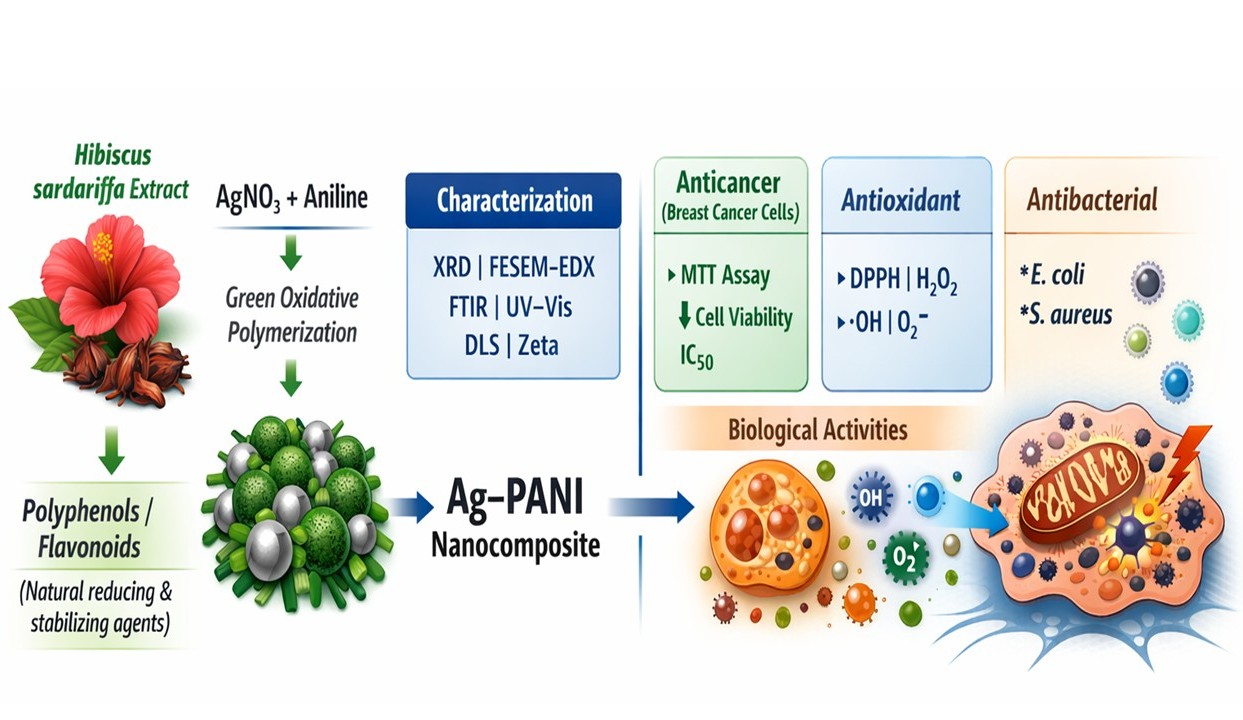
Multifunctional nanocomposites with anticancer, antioxidant, and antibacterial activities are increasingly needed to address cancer progression, oxidative stress, and microbial resistance using biocompatible and eco-friendly materials. In this study, a green-synthesized Ag-PANI nanocomposite was successfully prepared using Hibiscus sabdariffa extract and evaluated for its physicochemical characteristics and biological performance. Structural and morphological analyses confirmed the successful formation of the nanocomposite and the incorporation of Ag nanoparticles within the PANI matrix. The Ag-PANI nanocomposite exhibited improved colloidal behavior, with a reduced hydrodynamic size distribution of about 500 - 600 nm and a positive zeta potential of approximately +22 mV, indicating enhanced dispersion stability compared with pure Ag nanoparticles and pristine PANI. In vitro cytotoxicity against breast cancer cells revealed a clear concentration-dependent reduction in cell viability, with an estimated IC₅₀ in the intermediate concentration range. The nanocomposite also showed notable antioxidant activity, with effective radical scavenging performance in DPPH, H₂O₂, hydroxyl, and superoxide assays. In addition, it demonstrated strong antibacterial activity against Escherichia coli and Staphylococcus aureus, with maximum inhibition zones of 24.0 ± 0.91 and 21.0 ± 0.73 mm, respectively, at 1250 µg/mL. These findings indicate that the green-synthesized Ag-PANI nanocomposite is a stable and promising multifunctional platform for anticancer, antioxidant, and antibacterial biomedical applications.
HIGHLIGHTS
- A biocompatible Ag-PANI nanocomposite was successfully fabricated via a green synthesis route using Hibiscus sabdariffa tea extract.
- The Ag-PANI nanocomposite exhibited significant concentration-dependent cytotoxicity against human breast cancer cells with an estimated IC₅₀ in the intermediate range.
- The nanocomposite demonstrated notable radical-scavenging antioxidant activity and effective antibacterial performance against Escherichia coli and Staphylococcus aureus
- Synergistic interaction between silver nanoparticles and polyaniline matrix enhances biological performance, supporting its potential as a multifunctional anticancer nanoplatform.
GRAPHICAL ABSTRACT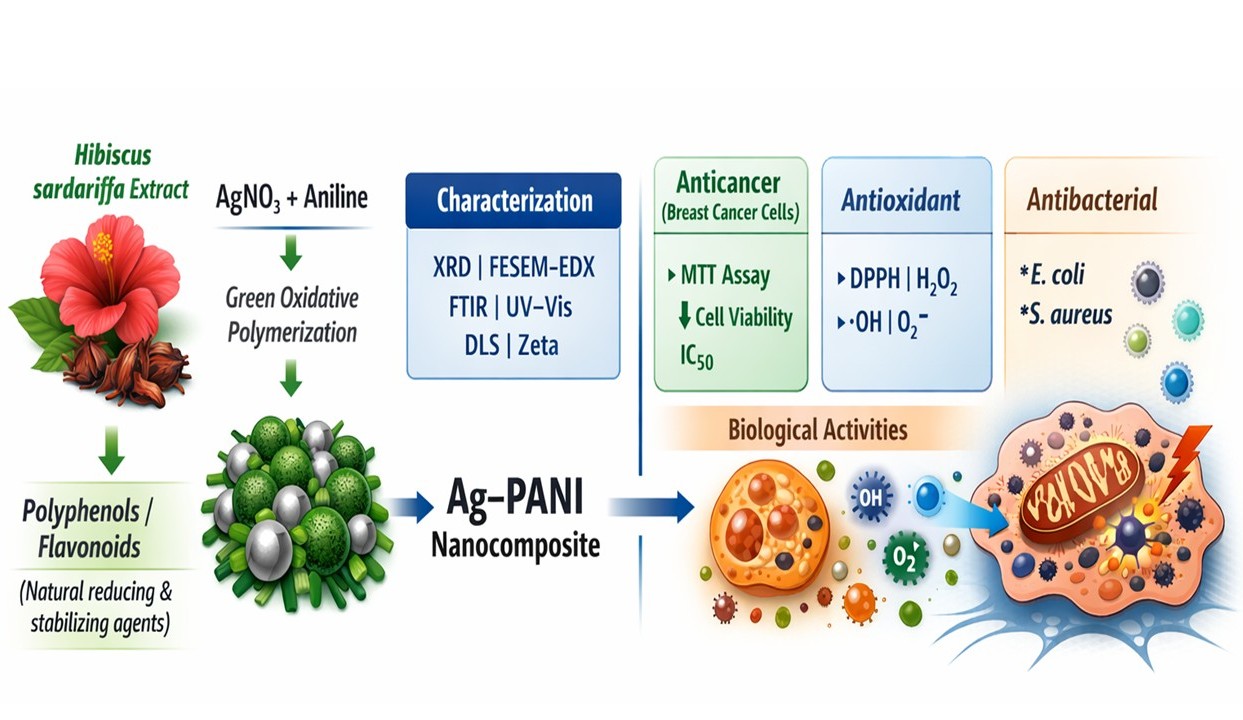
Downloads
References
A Nizam, N Shireen, MR Hasan, J Narang, F Choudhary, A Rizwan, UM Naikoo, U Ahmad, A Kumar and H Farooqi. Harnessing the power of ternary nanocomposites in comprehensive cancer management. Discover Sensors 2025; 1(1), 26.
M Sharon and AP Dubey. CNF a cousin of CNT is offering a new arena for nanomedicine studies. In: R Pisano (Ed.). Nanoscience & nanotechnologies. Springer, Cham, Switzerland, 2025.
D Bouras and M Rasheed. Comparison between CrZO and AlZO thin layers and the effect of doping on the lattice properties of zinc oxide. Optical and Quantum Electronics 2022; 54(12), 824.
P Kush, P Kumar and R Singh. Functionalized carbon nanostructures in cancer diagnosis and therapy. In: A Barhoum and K Deshmukh (Eds.). Handbook of functionalized carbon nanostructures. Springer, Cham, Switzerland, 2024.
B Dey, S Kundu and BK Sundara. Polymeric nanostructures revolutionizing cervical cancer: Diagnostics, therapeutics, and theranostics. BioNanoScience 2024; 14(4), 3906-3933.
P Gong, F Wang, Y Hua, J Ying, J Chen and Y Qiao. Collagenase-mediated extracellular matrix targeting for enhanced drug penetration and therapeutic efficacy in nanoscale delivery systems for cancer therapy. Journal of Nanobiotechnology 2025; 23(1), 733.
P Chaubisa, D Dharmendra, Y Vyas, P Chundawat, C Paliwal and A Ameta. Biological activity of PANI-tetrazole and PANI-pyrazole composites against microbial strains. Discover Chemistry 2025; 2(1), 59.
P Kush, P Kumar and R Singh. Functionalized carbon nanostructures in cancer diagnosis and therapy. In: A Barhoum and K Deshmukh (Eds.). Handbook of functionalized carbon nanostructures. Springer, Cham, Switzerland, 2023.
U Shashikumar, H Goel, I Rana, PC Tsai, KB Manjappa, PV Pham, G Andaluri, KR Ranjan, YC Lin, VK Ponnusamy and PC Huang. Breaking the 'forever' bond: Photocatalytic degradation of per- and polyfluoroalkyl substances using ternary photocatalysts. Reviews in Environmental Science and Bio/Technology 2025; 24(3), 607-659.
M Rasheed, MM Saleem, TR Marzoog, MM Taki, D Bouras and IA Hashim. Effect of caffeine-loaded silver nanoparticles on minerals concentration and antibacterial activity in rats. Journal of Advanced Biotechnology and Experimental Therapeutics 2023; 6(2), 495-509.
TM Rashid, MI Rahmah, WK Mahmood, MQ Fahem, MS Jabir, AK Bidan, S Adbalrazaq, MH Jawad, DM Awaid, MA Qamandar and SM Alsaffar. Eco-friendly laser ablation for synthesis of CNF@Au nanoparticles: Insights into enhancing NO2 gas detection and antibacterial activity. Plasmonics 2025; 20(10), 8461-8472.
MH Jawad and MR Abdulameer. The effect of background argon gas pressure on parameters of plasma produced by DC glow discharge. Iraqi Journal of Science 2023; 64(3), 1210-1218.
A Saif, S Ali, S Jamil, T Kamal, MJ Latif, SR Khan, H Arshad, U Mariam and S Liaqat. Comparison of catalytic applications of CaO-Ag bimetallic nanoparticles and its composite: CaO-Ag/Na-alg/PANI. Journal of Inorganic and Organometallic Polymers and Materials 2025; 35(5), 3344-3365.
HAR Abdullah, MQ Fahem, ZT Turki and MH Jawad. Effect of photothermal therapy using PANI-Fe2O3-Cys nanocomposites on breast cancer cells with antibacterial activity and cytotoxicity study. The European Physical Journal E 2025; 48(6), 40.
AE Dobamo, AA Tsegaye, AM Taddesse, G ShiferaWeldegrum and BA Hussein. Facile synthesis of Ag/PANI/rGO nanocomposite for electrochemical detection of toxic heavy metals in water. Discover Electrochemistry 2025; 2(1), 42.
MH Jawad, AA Assi and AM Hameed. Hydrothermal synthesis of zinc oxide nanostructures using varied reactor designs: A comparative study. Plasmonics 2025; 20(9), 7883-7894.
R Jaswal, D Kumar, CH Park and KH Min. Plasmonic nanoparticle-integrated nanofibers: Advancements in nanobiotechnology for biomedical applications. Journal of Pharmaceutical Investigation 2026; 56(2), 217-255.
APS Raman, M Aslam, Naina, C Verma, A AlFantazi, P Jain and K Kumari. Composite nanoarchitectonics based on graphene oxide in energy storage and conversion: Status, challenges & opportunities. Journal of Inorganic and Organometallic Polymers and Materials 2024; 34(11), 5035-5065.
A Chopra, Y Kumari, S Dudeja, R Sharma, AP Singh and R Bhatia. A comprehensive exploration of Chitosan-based nanoparticles for drug delivery and biosensing applications. Biotechnology for Sustainable Materials 2025; 2(1), 21.
A Aggarwal, D Bose, D Monteiro, K Meyers, N Kapadia and T Asha. Nanomaterials for enhanced detection of some organophosphate and organochlorine pesticides: A comprehensive review of recent advances. Journal of Nanoparticle Research 2025; 27(4), 92.
M Muniyasamy, R Varatharaj and SKK Kannan. Experimental and DFT investigation on the ultra selective determination of Hg2+ ion in water implementing a PAni-RR5B composite modified GCE electrode. Journal of Inorganic and Organometallic Polymers and Materials 2025; 35(5), 3839-3856.
S Paramshetti, SI Angadi and PV Patil. Conductive polymers and their composites for biomedical applications: A review. Biomolecules 2023; 13, 704.
AH Majeed, LA Mohammed, OG Hammoodi, S Sehgal, MA Alheety, KK Saxena, SA Dadoosh, IK Mohammed, MM Jasim and NU Salmaan. A review on polyaniline: Synthesis, properties, nanocomposites, and electrochemical applications. International Journal of Polymer Science 2022; 2022(1), 9047554.
MS Horrocks, KE Zhurenkov and J Malmstrom. Conducting polymer hydrogels for biomedical applications. APL Bioengineering 2024; 8, 031503.
AV Shabalina and others. Nanoparticle-polymer composites for antibacterial biomedical applications. Nanomaterials 2024; 14, 1753.
Z Akbari Kheirabadi, Z Nazemi, M Janmohammadi, F Radmanesh, HR Moslemi and MS Nourbakhsh. Biocompatible and antibacterial co-electrospun tragacanth gum and polyaniline nanofibers for skin tissue engineering. Scientific Reports 2025; 15(1), 38647.
WLV Belino, LC Lieb, JHA Ferreira, DY Tiba, OPL De Souza, TMS Abreu, FWL Silva, RE Santelli, FH Cincotto and T Canevari. Carbon nanomaterial-based sensor for the electrocatalytic detection of water pollutants. Topics in Catalysis 2026; 69(1), 77-94.
A Abdullahi, T Korumilli and KJ Rao. Revolutionizing food packaging with biobased polymers, active and intelligent materials for enhanced food safety and sustainability. Food and Bioprocess Technology 2025; 18(8), 6836-6868.
NMA Hadia, MA Sunny, H Hassan, MW Iqbal, NA Ismayilova, S Bibi, M Alzaid, WS Mohamed, MF Hasaneen and A Alanazi. Synergistic performance of PANI@Sn-MOF/Ag (NPs) for next-generation supercapatteries and hydrogen evolution reaction. Journal of Materials Science: Materials in Electronics 2025; 36(2), 130.
MH Jawad and MR Abdulameer. Eco-friendly laser ablation for synthesis of Al-Ni nanoparticles: Insights into enhancing glucose biosensor performance and antibacterial activity. Lasers in Manufacturing and Materials Processing 2026; 13(1), 1-22.
MH Jawad and KA Aadim. Plasma jet synthesis of Cu-Zn alloy nanoparticles: Characterization and antibacterial evaluation. Iranian Journal of Science 2025. https://doi.org/10.1007/s40995-025-01930-x
IH Ali, RT Kadhim, DFA Alasady, RO Abdulsada and MH Jawad. Green synthesis of CuO nanoparticles and their antibacterial properties. Theoretical and Experimental Chemistry 2025; 61, 148-154.
AS Hussein, FSO Al Jasmi, MH Jawad and MQ Fahem. Fabrication and characterisation of zinc oxide (ZnO) grown on porous silicon (PSi) substrate using different techniques for glucose biosensor. Silicon 2026; 18(2), 739-750.
AJ Hashim, HM Jaafar, HN Mohsion, MH Jawad, TM Rashid and SM Alsaffar. Hydrothermal synthesis of Ti6O11 nanomaterials for urea sensing and antibacterial applications. BioNanoScience 2025; 15(3), 514.
MH Jawad and MR Abdulameer. Study the effect of external voltage on some plasma parameters produced by DC glow xenon gas discharge. AIP Conference Proceedings 2024; 2922(1), 150003.
MQ Fahem, MH Jawad, RO Abdulsada and ZT Turki. The structure and electrical properties of NiFe2O4 and NiMgFe2O4 prepared via sol-gel method. Ionics 2025; 31(6), 6475-6481.
B Shakila, SA Alharbi, TA Alahmadi, M Bharathi, SH Hussein-Al-Ali, K Sukumar and MA Munusamy. Study of characterization, antimicrobial, and anticancer potential of albumin-baicalin nanoparticles in Hep3B liver cancer cell lines. BioNanoScience 2025; 15(1), 180.
A Jalali, IJ Bari and A Salehzadeh. Menthol conjugated magnetic iron oxide nanoparticles induce apoptosis and increase caspase-8 gene expression in gastric cancer cell line. BioNanoScience 2024; 14(5), 5276-5285.
ZT Turki, MQ Fahem, ZA Mankhi and MH Jawad. Magnetic field effect on cadmium oxide plasma properties detected by laser spectroscopy. Russian Physics Journal 2025; 68(5), 804-812.
KH Kumar, S Yallappa, M Revanasiddappa, VS Murthy, S Joseph and YT Ravikiran. Ag@PANI/TeO2 ternary hybrid nanocomposites; Enhanced transport properties and electromagnetic interference shielding performance. Journal of Materials Science: Materials in Electronics 2025; 36(19), 1161.
T Chen, Y Xiao and G Fang. Light- and temperature-responsive copolymer-MOFs for breast cancer therapy. Journal of Inorganic and Organometallic Polymers and Materials 2025; 35, 2456–2465.
X Liu, S Liu, Q Yang, Y Hu, P Ni, B Ren and G Hu. Novel metal complex-based nanomaterials with excellent fluorescence performance and its treatment on lung cancer cells. Journal of Inorganic and Organometallic Polymers and Materials 2024; 34(12), 5760-5769.
GIM Mbaz, TC Lebepe, R Maluleke, A Obonai, N Mgedle, OA Aladesuyi, R Kalimutu, T Kodama, A Komiya and SO Oluwafemi. Photothermal depth profiling of gelatin-stabilised gold nanorods-trastuzumab conjugate as a potential breast cancer photothermal agent. Journal of Inorganic and Organometallic Polymers and Materials 2024; 34(11), 5491-5502.
A Ali, A Madni, N Jan, H Shah, S Khan, A Shafiq, V Torchilin, MI Khan and MA Rahim. Enhanced cytotoxicity of 5-fluorouracil against skin cancer cell lines and 3D spheroid tumor model using solid lipid nanoparticles. BioNanoScience 2025; 15(1), 31.
M Noruzpour, RA Zakaria, N Zare, S Bourang, HA Ebrahimi and S Granados-Principal. Delivery of Moringa oleifera extract via PLA-PEG-FA/chitosan-PLA NPs into breast cancer cell lines. BioNanoScience 2025; 15(2), 287.
T Abiraamavalli, S Namasivayam, M Lavanya and S Priyanka. Mechanistic insights into the anti-cancer activity of nanosulfur-doped zinc oxide-chitosan-PVA-PEG nanocomposite in MDA-MB-231 triple-negative breast cancer cells. BioNanoScience 2025; 15(4), 610.
AS Hussein, MQ Fahem, AJ Ghazai, A Ramizy and MH Jawad. Synthesis and characterization of CdS/Polyaniline composites for Rhodamine B and methylene blue dye degradation under visible light. Journal of Inorganic and Organometallic Polymers and Materials 2025; 36, 2099-2110.
MH Jawad and MR Abdulameer. Spectral analysis of brass plasma generated by a Nd: YAQ laser at λ = 1064 nm. Russian Physics Journal 2025; 68(6), 903-911.
PA Trivedi, JB Naik and PB Patil. Graphene and derivatives for photocatalysis. Chemical Papers 2024; 78, 5705-5722.
R Wang, Z Huang, Y Xiao, T Huang and J Ming. Photothermal therapy of copper incorporated nanomaterials for biomedicine. Biomaterials Research 2023; 27(1), 121.
MQ Fahema, HN Mohsion, ZT Turki, HAR Abdullah and MH Jawad. Preparation and characterization of SiO2-enhanced TiO2 thin films for solar cell applications. Journal of Ovonic Research 2025; 21(4), 419-430.
T Saidani, M Rasheed, I Alshalal, AA Rashed, MA Sarhan and R Barille. Characterization of thin ITO/Au/ITO sandwich films deposited on glass substrates using DC magnetron sputtering. Research on Engineering Structures and Materials 2024; 10(2), 743-770.
WD Hussain, MH Jawad, SF Khaleel and KA Aadim. Effect of laser energy on the properties of SnO:Cd nanoparticles synthesized via pulsed laser ablation in liquid. Russian Physics Journal 2025; 68, 1750-1757.
N Assoudi, A Chaabani, M Rasheed, I Walha, E Dhahri, T Alawsi, D Bouras and R Barille. Comparative examination of the physical parameters of the sol-gel produced compounds La0.5Ag0.1Ca0.4MnO3 and La0.6Ca0.3Ag0.1MnO3. Optical and Quantum Electronics 2022; 54(9), 556.
RKM Al-Ziyadi, N Hayati, MR Rezaei and A Es-haghi. Preparation and characterization of chitosan-coated nanostructured lipid carriers (CS-NLC) containing (6)-gingerol and investigating their toxicity against MCF-7 breast cancer cell line. BioNanoScience 2024; 14(1), 153-163.
FH Santos, DC Ferreira, JR Matheus, AE Fai and FM Pelissari. Antioxidant activity assays for food packaging materials. In: C Toni (Ed.). Food packaging materials: Current protocols. Springer, New York, 2024, p. 293-309.
E Kadri, K Dhahri, R Barille and M Rasheed. Novel method for the determination of the optical conductivity and dielectric constant of SiGe thin films using Kato-Adachi dispersion model. Phase Transitions 2021; 94(2), 65-76.
B Lin and G Huang. The antioxidant activity of shaddock peel polysaccharides. Scientific Reports 2025; 15(1), 9855.
X Zhao, Y Li, X Tang, S Liu, Q Su, P Hu, X Jin, Y Song, J Wang and Y Yang. A major qualitative trait locus increases antioxidant activity in testaless peanut seeds. Theoretical and Applied Genetics 2026; 139(1), 19.
Y Wu, Z Ma, L Jia, F Qiao, J Zhu and C Liu. Preparation and characterization of colored Tofu with high antioxidant activity. Journal of Food Measurement and Characterization 2025; 19(12), 9460-9468.
K Wang, C Wang and C Sun. The antibacterial activity, acute toxicity, and antibacterial mechanism of 2,6-dimethyl-4-aminophenol hydrochloride. Russian Journal of Bioorganic Chemistry 2025; 51(5), 2142-2151.
T Gong, X Wang and Y Yue. Antibacterial activity of medicinal mushroom. In: AS Narayanan and D Dharumadurai (Eds.). Medicinal mushrooms. Humana Press, New York, 2026.
W Alghazzawi. Antibacterial activity of promising nanostructured cesium oxide. Discover Nano 2025; 20(1), 140.
X Li, SM Robinson and A Gupta. Functionalized silver nanoparticles as potent antimicrobial agents. ACS Nano 2011; 5, 6500-6509.
NK Guimard, N Gomez and CE Schmidt. Conducting polymers in biomedical engineering. Progress in Polymer Science 2007; 32(8-9), 876-921.
Published
How to Cite
Issue
Section
License
Copyright (c) 2026 Walailak University

This work is licensed under a Creative Commons Attribution-NonCommercial-NoDerivatives 4.0 International License.





