
Chemometric Evaluation, and LC-MS/MS-Based Phytochemical Identification: Elephant Ginger (Zingiber officinale Roscoe) Ethanolic Extract
Keywords:
Elephant ginger, Ethanol extraction, Phenolics, Antioxidant activity, LC–MS/MS, HPLC, Elephant ginger, Ethanol extraction, Phenolics, Antioxidant activity, LC-MS/MS, HPLCAbstract
This study investigated the effects of solvent concentration and extraction technique on the antioxidant properties and phytochemical profile of elephant ginger (Zingiber officinale Roscoe). Extracts were prepared using maceration and reflux with 70% and 96% ethanol, and their total phenolic content (TPC), total flavonoid content (TFC), and antioxidant activities were evaluated using 2,2-diphenyl-1-hydrazyl (DPPH) radical scavenging assay, ferric reducing antioxidant power (FRAP), cupric ion reducing antioxidant capacity (CUPRAC), β-carotene bleaching (BCB), and phosphomolybdenum (PM) assays. Extracts obtained with 96% ethanol exhibited the highest TPC, TFC, and antioxidant capacities, indicating that less aqueous solvents more effectively extract medium-polar constituents. Correlation analysis showed strong associations between phenolic levels and redox-based assays, supported by thin layer chromatogram (TLC) visualization of phenolic and antioxidant-responsive bands. Liquid chromatography-mass spectrometry/mass spectrometry (LC-MS/MS) profiling identified several bioactive metabolites, including ferulic acid, α-linolenic acid, oleamide, and glyceride derivatives. High performance liquid chromatography (HPLC) analysis confirmed ferulic acid as a key phenolic marker in the optimized maceration extract. These findings demonstrated that high-ethanol concentration enhances the recovery of antioxidant-active compounds in elephant ginger.
HIGHLIGHTS
- Extraction with 96% ethanol enhanced phenolic and flavonoid recovery from Zingiber officinale
- Optimized maceration (96% ethanol, 40 min) produced the highest antioxidant activity across multiple assays.
- Antioxidant responses varied in relation to total phenolic and flavonoid contents.
- LC-MS/MS profiling revealed diverse semi-polar metabolites, including ferulic acid and fatty acid derivatives.
- HPLC enabled quantitative determination of ferulic acid in the optimized maceration extract.
GRAPHICAL ABSTRACT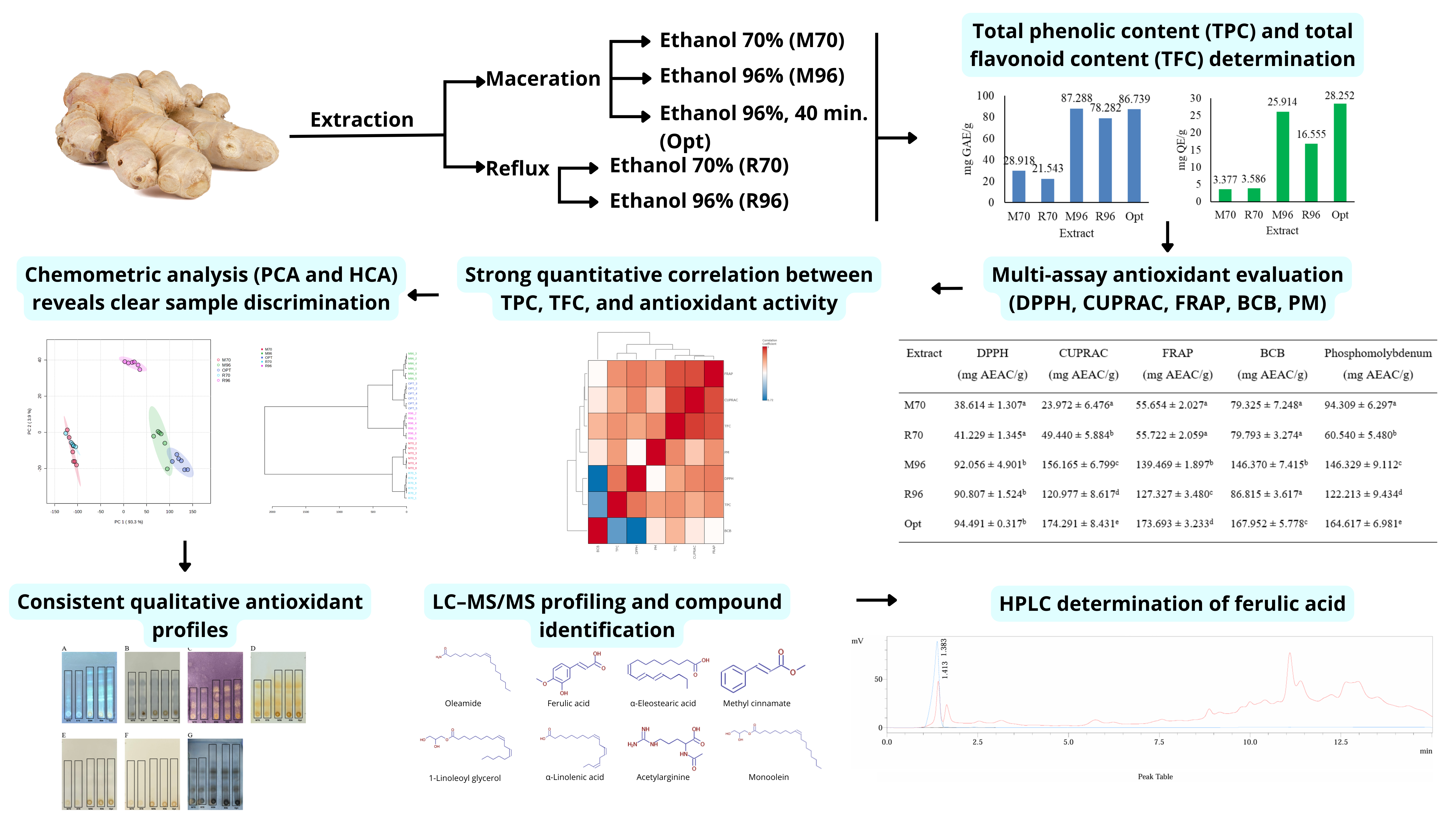
Downloads
References
M Gonzalez-Gonzalez, BJ Yerena-Prieto, C Carrera, M Vazquez-Espinosa, AV Gonzalez-de-Peredo, MA Garcia-Alvarado, M Palma, GC Rodriguez-Jimenes and GF Barbero. Determination of gingerols and shogaols content from ginger (Zingiber officinale Rosc.) through microwave-assisted extraction. Agronomy 2023; 13(9), 2288.
AF Abdul-Majeed and HA Al-Krad. Influence of ginger as an antioxidant on the physiological performance of male quail stressed by hydrogen peroxide. Mesopotamia Journal of Agriculture 2023; 50(1), 141-151.
CP Mungwari, CK King’Ondu, P Sigauke and BA Obadele. Conventional and modern techniques for bioactive compounds recovery from plants. Scientific African 2025; 27, e02509.
JE Lee, JTM Jayakody, JI Kim, JW Jeong, KM Choi, TS Kim, C Seo, I Azimi, JM Hyun and BM Ryu. The influence of solvent choice on the extraction of bioactive compounds from Asteraceae: A comparative review. Foods 2024; 13(19), 3151.
AR Choirunnisa, F Selina, D Rizaldy, H Pramastya, R Hartati and I Fidrianny. Response surface methodology for optimization of antioxidative activity: Elephant ginger (Zingiber officinale Roscoe). Journal of Pharmacy and Pharmacognosy Research 2025; 13(6), 1947-1962.
I Gulcin. Antioxidants: A comprehensive review. Archives of Toxicology 2025; 99(5), 1893-1997.
A Ali, Z Asgher, JJ Cottrell and FR Dunshea. Screening and characterization of phenolic compounds from selected unripe fruits and their antioxidant potential. Molecules 2024; 29(1), 167.
F Pourmorad, SJ Hosseinimehr and N Shahabimajd. Antioxidant activity, phenol and flavonoid contents of some selected Iranian medicinal plants. African Journal of Biotechnology 2006; 5(11), 1142.
CC Chang, MH Yang, HM Wen and JC Chem. Estimation of total flavonoid content in propolis by 2 complementary colorimetric methods. Journal of Food and Drug Analysis 2002; 10(3), 3.
E Celep, M Charehsaz, S Akyuz, ET Acar and E Yesilada. Effect of in vitro gastrointestinal digestion on the bioavailability of phenolic components and the antioxidant potentials of some Turkish fruit wines. Food Research International 2015; 78, 209-215.
M Ozyurek, B Bektasoglu, K Guclu, N Gungor and R Apak. Simultaneous total antioxidant capacity assay of lipophilic and hydrophilic antioxidants in the same acetone-water solution containing 2% methyl-beta-cyclodextrin using the cupric reducing antioxidant capacity (CUPRAC) method. Analytica Chimica Acta 2008; 630(1), 28-39.
P Prieto, M Pineda and M Aguilar. Spectrophotometric quantitation of antioxidant capacity through the formation of a phosphomolybdenum complex: Specific application to the determination of vitamin E 1. Analytical Biochemistry 1999; 269(2), 337.
A Othman, A Ismail, GN Abdul and I Adenan. Antioxidant capacity and phenolic content of cocoa beans. Food Chemistry 2007; 100(4), 1523-1530.
H Suhendy, M Insanu and I Fidrianny. Extracts, fractions, and subfractions from purple-orange sweet potato (Ipomoea batatas L.): Xanthine oxidase inhibitory potential and antioxidant properties. Molecules 2025; 30(11), 2442.
M Sharifi-Rad, NVA Kumar, P Zucca, EM Varoni, L Dini, E Panzarini, J Rajkovic, PVT Fokou, E Azzini, I Peluso, AM Prakash, M Nigam, Y El Rayess, ME Beyrouthy, L Polito, M Iriti, N Martins, M Martorell, AO Docea and J Sharifi-Rad. Lifestyle, oxidative stress, and antioxidants: Back and forth in the pathophysiology of chronic diseases. Frontiers in Physiology 2020; 11, 552535.
R Apak, M Ozyurek, K Guclu and E Capanoglu. Antioxidant activity/capacity measurement. 1. Classification, physicochemical principles, mechanisms, and electron transfer (ET)-based assays. Journal of Agricultural and Food Chemistry 2016; 64(5), 997-1027.
J Rumpf, R Burger and M Schulze. Statistical evaluation of DPPH, ABTS, FRAP, and Folin-Ciocalteu assays to assess the antioxidant capacity of lignins. International Journal of Biological Macromolecules 2023; 233, 123470.
F Imtiaz, D Ahmed, OA Mohammed, U Younas and M Iqbal. Optimized recovery of phenolic and flavonoid compounds from medicinal plant extracts for enhanced antioxidant activity: A mixture design approach. Results in Chemistry 2025; 13, 101960.
E Knez, K Kadac-Czapska and M Grembecka. Evaluation of spectrophotometric methods for assessing antioxidant potential in plant food samples-A critical approach. Applied Sciences 2025; 15(11), 5925.
NH Atta, H Handoussa, I Klaiber, B Hitzmann and RS Hanafi. Chemometric approach for profiling of metabolites of potential antioxidant activity in apiaceae species based on LC-PDA-ESI-MS/MS and FT-NIR. Separations 2023; 10(6), 347.
Q Xie and Z Liu. Chemometrics of the composition and antioxidant capacity of essential oils obtained from 6 Cupressaceae taxa. Scientific Reports 2024; 14(1), 18612.
RE Quero, K Lucas, J Higgins and ERE Mojica. ATR-FTIR characterization and multivariate analysis classification of different commercial propolis extracts. Measurement: Food 2025; 18, 100224.
H Tohma, I Gulcin, E Bursal, AC Goren, SH Alwasel and E Koksal. Antioxidant activity and phenolic compounds of ginger (Zingiber officinale Rosc.) determined by HPLC-MS/MS. Journal of Food Measurement and Characterization 2017; 11(2), 556-566.
A Pande, A Majeed, S Majeed, K Nagabhushanam, M Majeed, M Sengodagounder and SK Thiruppathi. Comparative LC-MS chemical fingerprinting, antioxidant potential, and in silico analysis of anti-emetic and pain modulation activity of dry and fresh white ginger extracts. Natural Product Communications 2025; 20(9), 1934578X251375515.
K Pyrzynska. Ferulic acid - A brief review of its extraction, bioavailability and biological activity. Separations 2024; 11(7), 204.
N Ando, N Nosaka, C Arai and K Kato. The effects of alpha-linolenic acid intake on skin and blood vessel health and subjective fatigue in middle-aged Japanese females: A randomized, double-blind, placebo-controlled, parallel-group comparative trial. The Journal of Nutrition 2025; 155(10), 3304-3320.
M Pandey, J Ganotra, A Singh, P Parchuri and J Giri. Lipid-mediated responses to nutrient and other stresses: roles in plant adaptation and signaling. Journal of Experimental Botany 2025. https://doi.org/10.1093/jxb/eraf482
CY Reyes-Soto, M Villaseca-Flores, EA Ovalle-Noguez, J Nava-Osorio, S Galvan-Arzate, E Rangel-Lopez, M Maya-Lopez, S Retana-Marquez, I Tunez, AA Tinkov, M Aschner and A Santamaria. Oleamide reduces mitochondrial dysfunction and toxicity in rat cortical slices through the combined action of cannabinoid receptors activation and induction of antioxidant activity. Neurotoxicity Research 2022; 40(6), 2167-2178.
R Jan, A Gani, MM Dar and NA Bhat. Bioactive characterization of ultrasonicated ginger (Zingiber officinale) and licorice (Glycyrrhiza glabra) freeze dried extracts. Ultrasonics Sonochemistry 2022; 88, 106048.
EA Shalaby, SM Shanab, RM Hafez and AE El-Ansary. Chemical constituents and biological activities of different extracts from ginger plant (Zingiber officinale). Chemical and Biological Technologies in Agriculture 2023; 10(1), 14.
V Jevtovic, KFS Alabbosh, RA Alyami, MA Alreshidi, MR Alshammari, B Alshammari, J Mitic and M Mitic. Optimization and kinetic modelling of hydroxycinnamic acid extraction from Anethum graveolens leaves. Processes 2025; 13(5), 1297.
JR Purushothaman and MD Rizwanullah. Ferulic acid: A comprehensive review. Cureus Journal of Medical Science 2024; 16(8), e68063.
Published
How to Cite
Issue
Section
License
Copyright (c) 2026 Walailak University

This work is licensed under a Creative Commons Attribution-NonCommercial-NoDerivatives 4.0 International License.





