
Microbial Community, Phytochemical Profile of Indian Gooseberry Water Kefir, and Its Inhibition of lipogenesis in Adipocytes
DOI:
https://doi.org/10.48048/tis.2026.13390Keywords:
Adipocytes, Indian gooseberry water kefir, Inulin, Microbiota, Water kefir grainAbstract
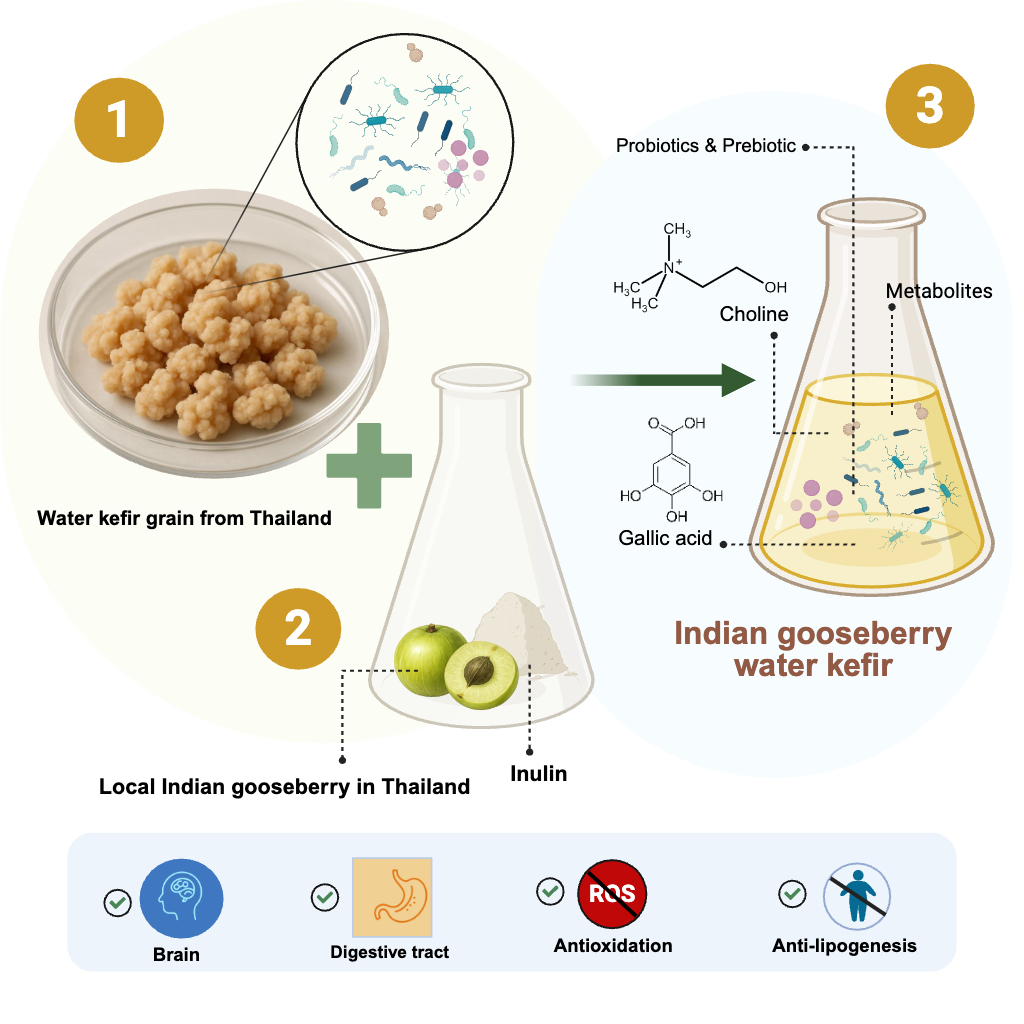
Water kefir grains, a symbiotic culture of bacteria and yeast embedded in a polysaccharide matrix, play a crucial role in the fermentation process. The microbial diversity within water kefir grains is not only extensive but also variable, adapting to different environmental conditions and substrates. In this study, we aim to identify the microbial species present in the kefir grains and to investigate health benefit metabolites of Indian gooseberry water kefir fortified with inulin, which inulin is widely recognized as a prebiotic dietary fiber, serves as an alternative carbon source for the symbiotic microbial community. Our findings indicated that high yield of the kefir grain (140.8 g) was achieved after fermentation and the grain was abundance in Lactobacillus sp., Bacillus sp., Schizosaccharomyces sp., and Saccharomyces sp. The phytochemical profile revealed 65 distinct compounds of Indian gooseberry water kefir formulated with inulin. Many beneficial metabolites including phenolic compounds and choline were detected in the Indian gooseberry water, thereby highlight the potential of Indian gooseberry water kefir as a low-calorie functional beverage.
HIGHLIGHTS
- Identifies the microbial ecology of Thai water kefir grains, with over 78% abundance of Lactobacillus species
- Reveals the phytochemical profile of Thai water kefir fortified with Indian gooseberry and inulin, showing enhanced probiotic activity and increased bioactive compound content
- Demonstrates a significant reduction in intracellular lipid accumulation in adipocytes
- Supports the potential of this beverage as a health-promoting, probiotic-rich, and anti-obesity functional drink
GRAPHICAL ABSTRACT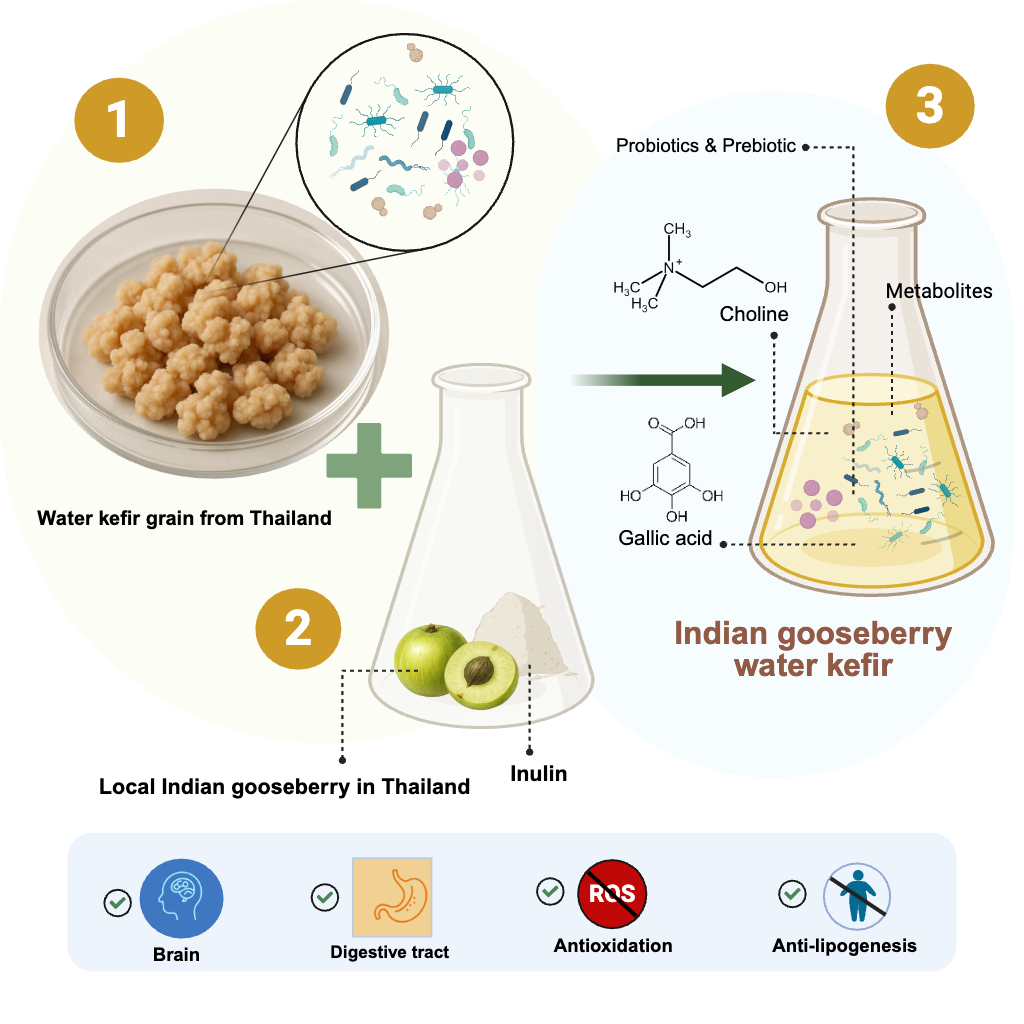
Downloads
References
G Cufaoglu, E Eser and NA Erdinc. The microbial composition of water kefir and the effects of fermentation conditions: A systematic review and Meta-analysis. Food Bioscience 2025; 73, 107778.
G Garmendia, F Gyenes, A Alvarez, E Arbildi, S Giménez, M Gonda and S Vero. Dynamic microbiota in water kefir: Microbial shift and ecological selection during fermentation. BMC Microbiology 2025; 26(1), 271.
MA Rodríguez, LA Fernández, ML Díaz, CA Gallo, M Corona, JD Evans and FJ Reynaldi. Bacterial diversity using metagenomics of 16S rDNA in water kefir, an innovative source of probiotics for bee nutrition. Revista Argentina de Microbiología 2024; 56(2), 191-197.
KM Lynch, S Wilkinson, L Daenen and EK Arendt. An update on water kefir: Microbiology, composition and production. International Journal of Food Microbiology 2021; 345, 109128.
Ł Łopusiewicz, E Drozłowska, P Trocer, P Kwiatkowski, A Bartkowiak, A Gefrom and M Sienkiewicz. The effect of fermentation with kefir grains on the physicochemical and antioxidant properties of beverages from blue lupin (Lupinus angustifolius L.) seeds. Molecules 2020; 25(24), 5791.
S Saentaweesuk, P Chaikham and S Jirasatid. Reduced-calorie mango juice: Quality evaluation of stevia-sweetened and inulin-enriched functional beverage. Food Chemistry Advances 2025; 8, 101097.
S Simsek, L Sánchez-Rivera, S Nehir-El, S Karakaya and I Recio. Characterisation of in vitro gastrointestinal digests from low fat caprine kefir enriched with inulin. International Dairy Journal 2017; 75, 68-74.
AM Richardson, AA Tyuftin, KN Kilcawley, E Gallagher, MG O’Sullivan and JP Kerry. The application of pureed butter beans and a combination of inulin and rebaudioside a for the replacement of fat and sucrose in sponge cake: Sensory and physicochemical analysis. Foods 2021; 10(2), 254.
AT Prananda, A Dalimunthe, U Harahap, Y Simanjuntak, E Peronika, NE Karosekali, PAZ Hasibuan, RA Syahputra, PC Situmorang and F Nurkolis. Phyllanthus emblica: A comprehensive review of its phytochemical composition and pharmacological properties. Frontiers in Pharmacology 2023; 14, 1288618.
JN Ho, JW Choi, WC Lim, MK Kim, IY Lee and HY Cho. Kefir inhibits 3T3-L1 adipocyte differentiation through down-regulation of adipogenic transcription factor expression. Journal of the Science of Food and Agriculture 2013; 93(3), 485-490.
NA Kraus, F Ehebauer, B Zapp, B Rudolphi, BJ Kraus and D Kraus. Quantitative assessment of adipocyte differentiation in cell culture. Adipocyte 2016; 5(4), 351-358.
KT Magalhães, GVDM Pereira, CR Campos, G Dragone and RF Schwan. Brazilian kefir: Structure, microbial communities and chemical composition. Brazilian Journal of Microbiology 2011; 42(2), 693-702.
Ç Gökırmaklım and ZB Güzel-Seydim. Water kefir grains vs. milk kefir grains: Physical, microbial and chemical comparison. Journal of Applied Microbiology 2022; 132(6), 4349-4358.
RS Bueno, JB Ressutte, NN Hata, FC Henrique-Bana, KB Guergoletto, AGD Oliveira and WA Spinosa. Quality and shelf life assessment of a new beverage produced from water kefir grains and red pitaya. LWT 2021; 140, 110770.
H Wang, C Wang and M Guo. Autogenic successions of bacteria and fungi in kefir grains from different origins when sub-cultured in goat milk. Food Research International 2020; 138(B), 109784.
E Birkeland, S Gharagozlian, KI Birkeland, J Valeur, I Måge, I Rud and AM Aas. Prebiotic effect of inulin-type fructans on faecal microbiota and short-chain fatty acids in type 2 diabetes: A randomised controlled trial. European Journal of Nutrition 2020; 59(7), 3325-3338.
M Ma, Y Liu, Y Chen, S Zhang and Y Yuan. Co-Encapsulation: An effective strategy to enhance the synergistic effects of probiotics and polyphenols. Trends in Food Science & Technology 2025; 158, 104927.
N Devipriya, S Marimuthu, AR Sudheer and VP Menon. Effect of ellagic acid, a natural polyphenol, on alcohol-induced prooxidant and antioxidant imbalance: A drug dose dependent study. Singapore Medical Journal 2007; 48(4), 311-318.
A Galano, MF Marquez and A Pérez-González. Ellagic acid: An unusually versatile protector against oxidative stress. Chemical Research in Toxicology 2014; 27(5), 904-918.
A Zeb. Ellagic acid in suppressing in vivo and in vitro oxidative stresses. Molecular and Cellular Biochemistry 2018; 1, 27-41.
AP Rogerio, C Fontanari, É Borducchi, AC Keller, M Russo, EG Soares and H Faccioli. Anti-inflammatory effects of Lafoensia pacari and ellagic acid in a murine model of asthma. European journal of Pharmacology 2008; 580(1-2), 262-270.
LA BenSaad, KH Kim, CC Quah, WR Kim and M Shahimi. Anti-inflammatory potential of ellagic acid, gallic acid and punicalagin A&B isolated from Punica granatum. BMC Complementary and Alternative Medicine 2017; 17(1), 47.
TY Gil, CH Hong and HJ An. Anti-inflammatory effects of ellagic acid on keratinocytes via mapk and stat pathways. International Journal of Molecular Sciences 2021; 22(3), 1277.
M Zahin, I Ahmad, RC Gupta and F Aqil. Punicalagin and ellagic acid demonstrate antimutagenic activity and inhibition of benzo[a]pyrene induced DNA adducts. BioMed Research International 2014; 2014, 467465.
DT Ramadan, MAM Ali, SM Yahya and WM El-Sayed. Correlation between Antioxidant/Antimutagenic and antiproliferative activity of some phytochemicals. Anti-Cancer Agents in Medicinal Chemistry-Anti-Cancer Agents 2019; 19(12), 1481-1490.
Y Wang, F Ren, B Li, Z Song, P Chen and L Ouyang. Ellagic acid exerts antitumor effects via the PI3K signaling pathway in endometrial cancer. Journal of Cancer 2019; 10(15), 3303.
J Duan, Y Li, H Gao, D Yang, X He, Y Famg and G Zhou. Phenolic compound ellagic acid inhibits mitochondrial respiration and tumor growth in lung cancer. Food & Function 2020; 11(7), 6332-6339.
Downloads
Published
How to Cite
Issue
Section
License
Copyright (c) 2026 Walailak University

This work is licensed under a Creative Commons Attribution-NonCommercial-NoDerivatives 4.0 International License.





