
Growth Kinetics, Crude Paramylon-Enriched Carbohydrate Fraction Production, and Glucan Synthase-Like Gene Expression Associated with Protocatechuic Acid Supplementation in Local Strain of Euglena sp. IDN5 Isolated from Glagah Beach, Kulon Progo, Indonesia
DOI:
https://doi.org/10.48048/tis.2026.13335Keywords:
Biofuel, EgGSL, Local Strain, Macronutrient, Mixotroph, Paramylon, Protocatechuic Acid, Biofuel production, EgGSL2, Indonesian local strain, C:N supplementation, Mixotrophic cultivation, Crude paramylon-enriched carbohydrate fraction, Protocatechuic acidAbstract
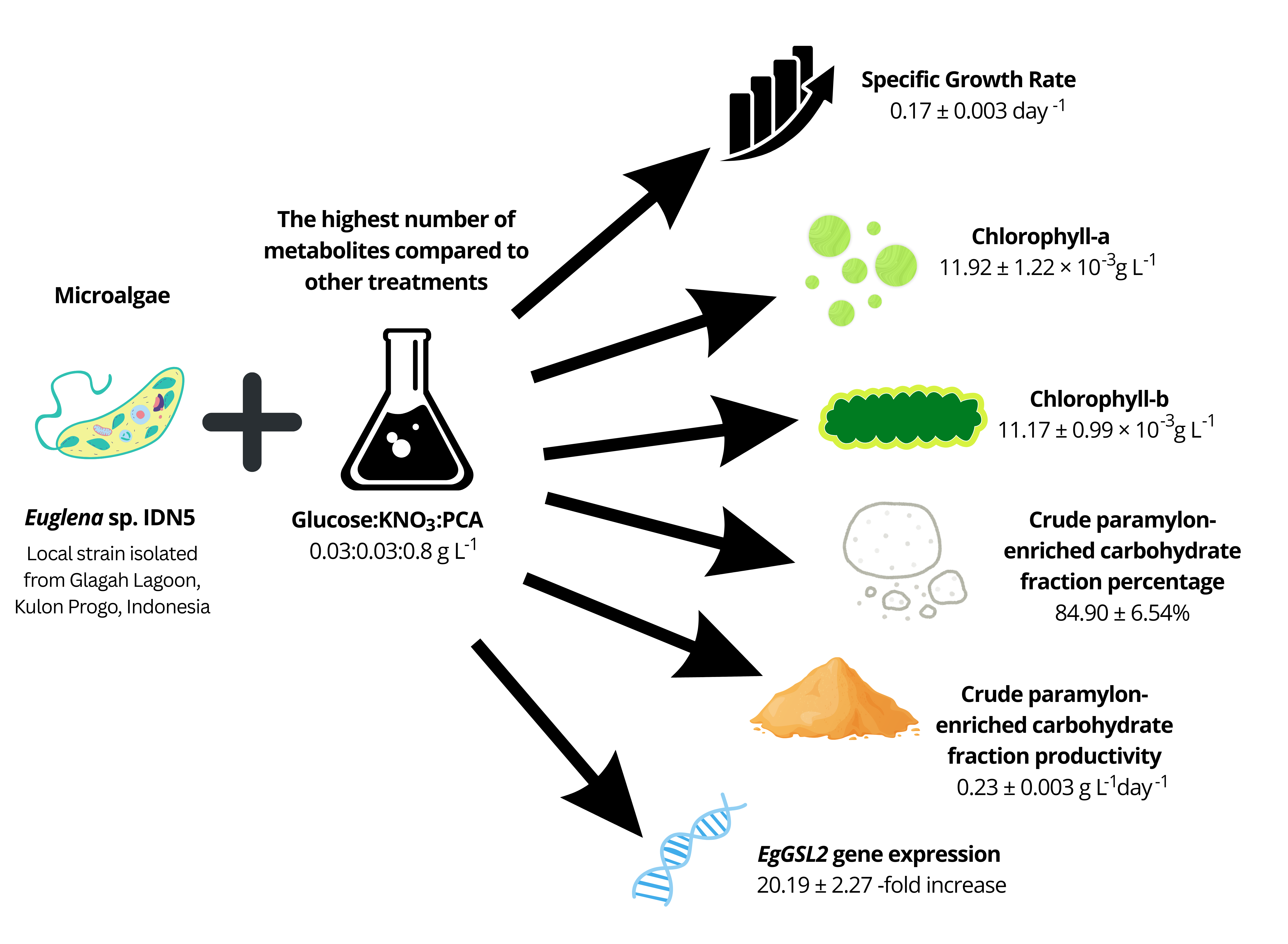
Paramylon, one of the active compounds produced by Euglena sp., has broad application in biofuel, cosmetics, nutraceuticals, and food supplements. One potential strategy to increase paramylon production involves the administration of protocatechuic acid (PCA). Previous studies demonstrated that PCA modulates EgGSL2 expression, a key gene involved in paramylon biosynthesis. However, the expression of this gene had not been evaluated in the Euglena culture when cultivated in combination between photoperiod and macronutrient composition (glucose as carbon sources and KNO3 as nitrogen sources) in variations of 0, 0.01 and 0.03 g L⁻¹, along with PCA addition in variations of 0, 0.01, 0.2 and 0.8 g L⁻¹, especially in local strain from Indonesia. Therefore, in this study, we modify glucose:KNO3 ratio, PCA supplementation in various concentration, added with 16:8 h light–dark photoperiod to evaluate the effect of PCA on gene expression of EgGSL in Euglena sp. IDN5 (Indonesian local strain) that is related in crude paramylon-enriched carbohydrate fraction production. The addition of glucose, KNO3, and PCA in high concentration along with photoperiod was hoped to have correlation in crude paramylon-enriched carbohydrate fraction, pigment, and growth of Euglena sp. IDN5. Gene expression was done through qPCR analysis. Metabolite production of Euglena sp. was measured through analysis of paramylon and pigments measurement. While the growth of microalgae was analysed through the cell count, biomass, and optical density analysis. Our study revealed that the combination of glucose:KNO3:PCA 0.03:0.03:0.8 g L⁻¹ probably associated with several parameters, such as specific growth rate {0.17 ± 0.003 day⁻¹}, chlorophyll-a and chlorophyll-b {11.92 ± 1.22 × 10⁻³ g L⁻¹} and {11.17 ± 0.99 × 10⁻³ g L⁻¹} respectively, crude paramylon-enriched carbohydrate fraction productivity {0.23 ± 0.003 g L⁻¹ day⁻¹}, crude paramylon-enriched carbohydrate fraction percentage {84.90 ± 6.54%}, and EgGSL2 gene expression {20.19 ± 2.27 -fold increase}. Thus, it shows the correlation of this strategy to the growth performance and paramylon productivity in Euglena sp. culture. However, for further exploration and application, detailed research about the mechanism needs to be done. This research serves as the base for potential further research of the effect of combination of glucose, KNO3, and PCA in Euglena sp.
HIGHLIGHTS
- CM media supplemented with additional glucose:KNO3 projected to changes the growth and productivity of Euglena
- Additional glucose:KNO3 sources, combined with protocatechuic acid will be estimated to alter biomass and crude paramylon-enriched carbohydrate fraction production in Euglena
- Protocatechuic acid (PCA) supplementation predicted to have correlation in the changes of the EgGSL2 gene expression related to crude paramylon-enriched carbohydrate fraction synthesis in Euglena under mixotrophic conditions
GRAPHICAL ABSTRACT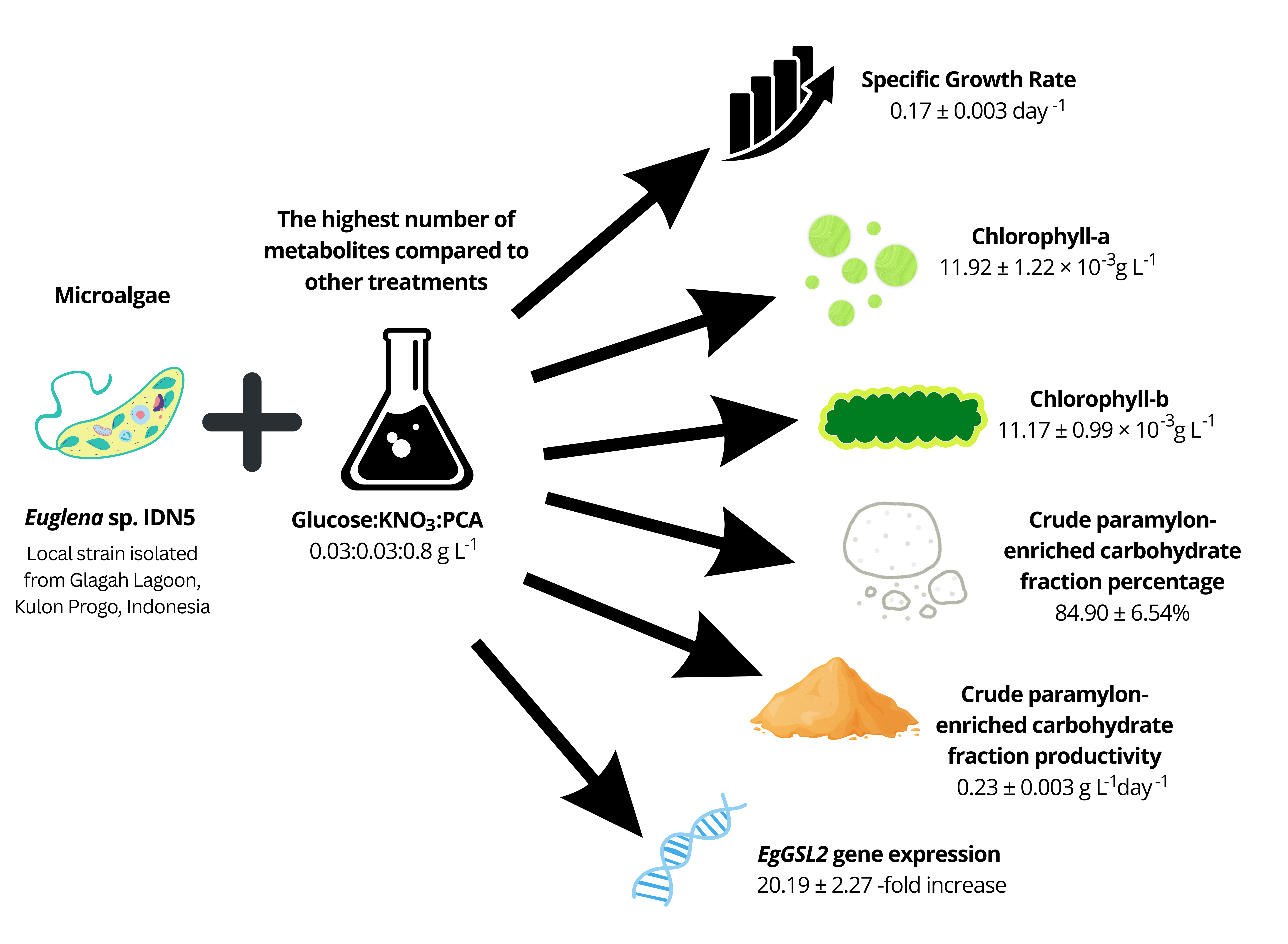
Downloads
References
YJ Chen and GB Huang. Flagellum malfunctions trigger metaboly as an escape strategy in Euglena gracilis. Journal of Eukaryotic Microbiology 2021; 68(3), e12842.
J He, C Liu, M Du, X Zhou, Z Hu, A Lei and J Wang. Metabolic responses of a model green microalga Euglena gracilis to different environmental stresses. Frontiers in Bioengineering and Biotechnology 2021; 9, 662655.
T Bhattad, A Koradiya and G Prakash. Prebiotic activity of paramylon isolated from heterotrophically grown Euglena gracilis. Heliyon 2021; 7(9), e07884.
Y Nagayama, N Isoo, A Nakashima, K Suzuki, M Yamano, T Nariyama, M Yagame and K Matsui. Renoprotective effects of paramylon, a β-1,3-D-Glucan isolated from Euglena gracilis Z in a rodent model of chronic kidney disease. PLoS One 2020; 15(8), e0237086.
R Levine, G Horst, R Tonda, B Lumpkins and G Mathis. Evaluation of the effects of feeding dried algae containing beta-1, 3-glucan on broilers challenged with Eimeria. Poultry Science 2018; 97(10), 3494-3500.
S Aoe, C Yamanaka, K Koketsu, M Nishioka, N Onaka, N Nishida and M Takahashi. Effects of paramylon extracted from Euglena gracilis EOD-1 on parameters related to metabolic syndrome in diet-induced obese mice. Nutrients 2019; 11(7), 1674.
S Kottuparambil, RL Thankamony and S Agusti. Euglena as a potential natural source of value-added metabolites. A review. Algal Research 2019; 37, 154-159.
S Nagappan, P Das, M AbdulQuadir, M Thaher, S Khan, C Mahata, H Al-Jabri, AK Vatland and G Kumar. Potential of microalgae as a sustainable feed ingredient for aquaculture. Journal of Biotechnology 2021; 341, 1-20.
J Zhu and M Wakisaka. Growth promotion of Euglena gracilis by ferulic acid from rice bran. AMB Express 2018; 8(1), 16.
S Kim, R Wirasnita, D Lee, J Yu and T Lee. Enhancement of growth and paramylon production of Euglena gracilis by upcycling of spent tomato byproduct as an alternative medium. Applied Sciences 2021; 11(17), 8182.
X Tan, J Zhu and M Wakisaka. Effect of protocatechuic acid on Euglena gracilis growth and accumulation of metabolites. Sustainability 2020; 12(21), 9158.
WJ Lee and SH Lee. Protocatechuic acid protects hepatocytes against hydrogen peroxide-induced oxidative stress. Current Research in Food Science 2022; 5, 222-227.
BS Yu, YJ Sung, ME Hong and SJ Sim. Improvement of photoautotrophic algal biomass production after interrupted CO2 supply by urea and KH2PO4 injection. Energies 2021; 14(3), 778.
W Lathifah, RA Fikri, NA Hidayati, ID Anggraini, N Putri, B Prabowo and S Marno. Effect of commercial NPK fertilizer on growth and biomass of Navicula sp. and Nannochloropsis sp. IOP Conference Series: Earth and Environmental Science 2021; 762, 012060.
SJ Daines, JR Clark and TM Lenton. Multiple environmental controls on phytoplankton growth strategies determine adaptive responses of the N:P ratio. Ecology Letters 2014; 17(4), 414-425.
ZV Finkel, MJ Follows, JD Liefer, CM Brown, I Benner and AJ Irwin. Phylogenetic diversity in the macromolecular composition of microalgae. PLoS One 2016; 11(5), e0155977.
MK Chai, YH Tan and LS Wong. Macronutrient effect on biomass of Microalgae in biofuel production: A review. Indian Journal of Science and Technology 2020; 13(22), 2245-2263.
YS Pradana, H Sudibyo, EA Suyono and A Budiman. Oil algae extraction of selected microalgae species grown in monoculture and mixed cultures for biodiesel production. Energy Procedia 2017; 105, 277-282.
S Rahmadi. Algae to energy - using and re-using a hemocytometer to count algae cells, Available at: https://www.scribd.com/document/780868586/e-Algae-to-Energy-Counting-Algae-Cells, accessed February 2026.
C Camacho-Fernández, D Hervás, A Rivas-Sendra, MP Marín and JM Seguí-Simarro. Comparison of six different methods to calculate cell densities. Plant Methods 2018; 14(1), 30.
N Phukoetphim, A Salakkam, P Laopaiboon and L Laopaiboon. Kinetic models for batch ethanol production from sweet sorghum juice under normal and high gravity fermentations: Logistic and modified Gompertz models. Journal of Biotechnology 2017; 243, 69-75.
S Hanief, L Prasakti, YS Pradana, RB Cahyono and A Budiman. Growth kinetic of Botryococcus braunii microalgae using Logistic and Gompertz Models. AIP Conference Proceedings 2020; 2296, 020065.
AP Asiandu, AP Nugroho, AS Naser, BR Sadewo, MD Koerniawan, A Budiman, EA Suyono and EA Zulaika. The effect of tofu wastewater and pH on the growth kinetics and biomass composition of Euglena sp. Current Applied Science and Technology 2023; 23(2), 1-16.
MK Lam, KT Lee, CG Khoo, Y Uemura and JW Lim. Growth kinetic study of Chlorella vulgaris using lab-scale and pilot-scale photobioreactor: Effect of CO2 concentration. Journal of Engineering Science and Technology 2016; 11, 73-87.
FJ Richards. A flexible growth function for empirical use. Journal of Experimental Botany 1959; 10(2), 290-301.
F Wang, X Yu, Y Cui, L Xu, S Huo, Z Ding, Q Hu, W Xie, H Xiao and D Zhang. Efficient extraction of phycobiliproteins from dry biomass of Spirulina platensis using sodium chloride as extraction enhancer. Food Chemistry 2023; 406, 135005.
Ş Dere, T Güneş and R Sivaci. Spectrophotometric determination of chlorophyll-A, B and totalcarotenoid contents of some algae species using different solvents. Turkish Journal of Botany 1998; 22(1), 13-18.
L Barsanti, R Vismara, V Passarelli and P Gualtieri. Paramylon (β-1, 3-glucan) content in wild type and WZSL mutant of Euglena gracilis. Effects of growth conditions. Journal of Applied Phycology 2001; 13(1), 59-65.
M DuBois, KA Gilles, JK Hamilton, PA Rebers and F Smith. Colorimetric method for determination of sugars and related substances. Analytical Chemistry 1956; 28(3), 350-356.
KJ Livak and TD Schmittgen. Analysis of relative gene expression data using real-time quantitative PCR and the 2−ΔΔCT method. Methods 2001; 25(4), 402-408.
RB Cain. The metabolism of protocatechuic acid by a vibrio. Biochemical Journal 1961; 79(2), 298-312.
S Kakkar and S Bais. A review on protocatechuic acid and its pharmacological potential. International Scholarly Research Notices 2014; 2014(1), 952943.
J Cai, L Sun and Q Wang. Antibacterial activity and mechanism of Protocatechuic acid against bacterial canker of tomato fruits caused by Clavibacter michiganensis subsp. michiganensis. Food Bioscience 2024; 60, 104437.
A Khanra and MP Rai. Evaluation of mixotrophic cultivation of Euglena gracilis for lipid synthesis and FAME characterization towards biodiesel application. Journal of Scientific & Industrial Research 2018; 77(6), 359-364.
M Ma, C Wei, M Chen, H Wang, Y Gong and Q Hu. Effects of nutritional mode on the physiological and biochemical characteristics of the mixotrophic flagellate Poterioochromonas malhamensis and the potential ecological implications. Microorganisms 2022; 10(5), 852.
KT Yan, IS Hie, EA Samaranayake, JL Chang and AZ Wang. Medium and process optimizations for Euglena gracilis with high biomass production enriched with protein. Algal Research 2023; 75, 103265.
A Farjallah and C Guéguen. Untargeted metabolomic analysis of heterotrophic Euglena gracilis cells in response to the organic carbon source. Algal Research 2023; 76, 103305.
X Li, W Li, J Zhai, H Wei and Q Wang. Effect of ammonium nitrogen on microalgal growth, biochemical composition and photosynthetic performance in mixotrophic cultivation. Bioresource Technology 2019; 273, 368-376.
MA Borowitzka. Chapter 3 - Biology of microalgae. In: IA Levine and J Fleurence (Eds.). Microalgae in health and disease prevention. Academic Press, London, 2018, p. 23-72.
Y Wang, T Seppänen-Laakso, H Rischer and MG Wiebe. Euglena gracilis growth and cell composition under different temperature, light and trophic conditions. PLoS One 2018; 13(4), e0195329.
N Hossain and TMI Mahlia. Progress in physicochemical parameters of microalgae cultivation for biofuel production. Critical Reviews in Biotechnology 2019; 39(6), 835-859.
WT Godbey. Chapter 5 - cell growth. In: WT Godbey (Ed.). Biotechnology and its applications: Using cells to change the world. Academic Press, London, 2022, p. 117-150.
M Ibrahim, A Al-Thukair, S Abdur Razzak, W Farooq and I Ahmad. Isolation of indigenous microalgae: Nitrogen/phosphorous removal and biofuel production. Biofuels 2017; 11(3), 269-276.
EA Suyono, W Haryadi, M Zusron, M Nuhamunada, S Rahayu and AP Nugroho. The effect of salinity on growth, dry weight and lipid content of the mixed microalgae culture isolated from Glagah as biodiesel substrate. Journal of Life Sciences 2015; 9, 229-233.
NR Boyle and JA Morgan. Flux balance analysis of primary metabolism in Chlamydomonas reinhardtii. BMC Systems Biology 2009; 3(1), 4.
F Martinez and MI Orus. Interactions between glucose and inorganic carbon metabolism in Chlorella vulgaris strain UAM 101. Plant Physiology 1991; 95(4), 1150-1155.
M Khan, R Karmakar, B Das, F Diba and MH Razu. Heterotrophic growth of micro algae. In: J Liu, Z Sun and H Gerken (Eds.). Recent advances in microalgal biotechnology. OMICS Group eBooks, California, United States, 2016.
T Matsui, K Mori and T Toyama. Paramylon production by Euglena gracilis via mixotrophic cultivation using sewage effluent and waste organic compounds. Bioresource Technology Reports 2021; 15, 100735.
X Yan, H Xu, Z Yang, Y Yin, W Fang, M Wakisaka and J Zhu. Synergistic enhancement of paramylon production in edible microalga Euglena gracilis via ethanol-guaiacol co-regulation. Foods 2025; 14(14), 2457.
Y Huang, X Wan, Z Zhao, H Liu, Y Wen, W Wu, X Ge and C Zhao. Metabolomic analysis and pathway profiling of paramylon production in Euglena gracilis grown on different carbon sources. International Journal of Biological Macromolecules 2023; 246, 125661.
X Xiao, R He, X Guo, X Zhao, Z Yang, Y Yin, M Wakisaka and J Zhu. Strategic carbon source selection enhances biomass and paramylon yields in mixotrophic Euglena gracilis cultivation. Microorganisms 2025; 13(10), 2339.
Y Yoshida, T Tomiyama, T Maruta, M Tomita, T Ishikawa and K Arakawa. De novo assembly and comparative transcriptome analysis of Euglena gracilis in response to anaerobic conditions. BMC Genomics 2016; 17(1), 182.
Q He, X Zhang, H Xu, X Wang, X Zhang, Y Hao, X Song and X Cao. Cultivation of high-protein Euglena gracilis for enhanced protein production under inorganic nitrogen sources: Mechanisms revealed by proteomics. Bioresource Technology 2025; 430, 132560.
MS Jeon, SI Han, JY Kim and YE Choi. Co-cultivation of Euglena gracilis and Pseudoalteromonas sp. MEBiC 03607 for paramylon production. Journal of Applied Phycology 2020; 32(6), 3679-3686.
M Zeng, W Hao, Y Zou, M Shi, Y Jiang, P Xiao, A Lei, Z Hu, W Zhang, L Zhao and J Wang. Fatty acid and metabolomic profiling approaches differentiate heterotrophic and mixotrophic culture conditions in a microalgal food supplement “Euglena”. BMC Biotechnology 2016; 16(1), 49.
JS Rodríguez‐Zavala, MA Ortiz‐Cruz, G Mendoza‐Hernández and R Moreno‐Sánchez. (2010). Increased synthesis of α‐tocopherol, paramylon and tyrosine by Euglena gracilis under conditions of high biomass production. Journal of Applied Microbiology 2010; 109(6), 2160-2172.
F Matsuda, M Hayashi and A Kondo. Comparative profiling analysis of central metabolites in Euglena gracilis under various cultivation conditions. Bioscience, Biotechnology, and Biochemistry 2011; 75(11), 2253-2256.
H Begum, FM Yusoff, S Banerjee, H Khatoon and M Shariff. Availability and utilization of pigments from microalgae. Critical Reviews in Food Science and Nutrition 2016; 56(13), 2209-2222.
S Kakkar and S Bais. A review on protocatechuic acid and its pharmacological potential. International Scholarly Research Notices 2014; 2014(1), 952943.
JC da Silva and AT Lombardi. Chlorophylls in microalgae: Occurrence, distribution, and biosynthesis. In: E Jacob-Lopes, MI Queiroz and LQ Zepka (Eds.). Pigments from microalgae handbook. Springer International Publishing, Cham, Switzerland, 2020, p. 1–18.
S Liu. Bioprocess engineering: Kinetics, sustainability, and reactor design. 2nd ed. Elsevier, Amsterdam, Netherlands, 2016.
Y Tanaka, T Ogawa, T Maruta, Y Yoshida, K Arakawa and T Ishikawa. Glucan synthase-like 2 is indispensable for paramylon synthesis in Euglena gracilis. FEBS Letters 2017; 591(10), 1360-1370.
D Siebert, J Altenbuchner and B Blombach. A timed off-switch for dynamic control of gene expression in Corynebacterium glutamicum. Frontiers in Bioengineering and Biotechnology 2021; 9, 704681.
T Erfianti, AYF Yusuf, S Handayani, BR Sadewo, BS Daryono, A Budiman and EA Suyono. Enhancing growth and metabolite profiles in indigenous Euglena gracilis through explorative light spectrum effect. Egyptian Journal of Aquatic Research 2024; 50(3), 318-331.
SD Ramadhana, T Erfianti, D Aritonang and EA Suyono. Influence of nitrogen variation and 15% CO2 injection on wax ester production in Euglena gracilis isolated from Dieng Peatland, Indonesia. Applied Phycology 2025; 6(1), 190-209.
T Erfianti, BR Sadewo, BS Daryono, A Budiman and EA Suyono. Evaluating CO2 concentration effects on growth kinetics and fatty acid composition in Euglena gracilis. Applied Phycology 2024; 5(1), 61-71.
KQ Maghfiroh, T Erfianti, I Nurafifah, R Amelia, D Kurnianto, BR Sadewo, R Maggandari, BR Aji, A Budiman and EA Suyono. The effect of photoperiodism on nutritional potency of Euglena sp. Indonesian strains. Malaysian Journal of Nutrition 2023; 29(3), 453.
M Cindiati, T Erfianti, R Adaranyssa, E Putri, D Kurnianto and EA Suyono. The effect of vinasse in various trophic conditions on the growth rate and metabolite contents of Euglena sp. with CO2 aeration. Molecular Biology and Biotechnology 2026; 34, 67-82.
Downloads
Published
How to Cite
Issue
Section
License
Copyright (c) 2026 Walailak University

This work is licensed under a Creative Commons Attribution-NonCommercial-NoDerivatives 4.0 International License.