
Combustion Performance and Water Absorption of Mixed Shrub and Waste Bio-Pellets at Various Molding Temperatures and Durations
DOI:
https://doi.org/10.48048/tis.2026.13286Keywords:
Calorific value, Coffee husk, Combustion rate, Composition, Dimensional swelling, Mixed Bio-Pellet, Molding duration, Molding temperature, Shrub, Water uptakeAbstract
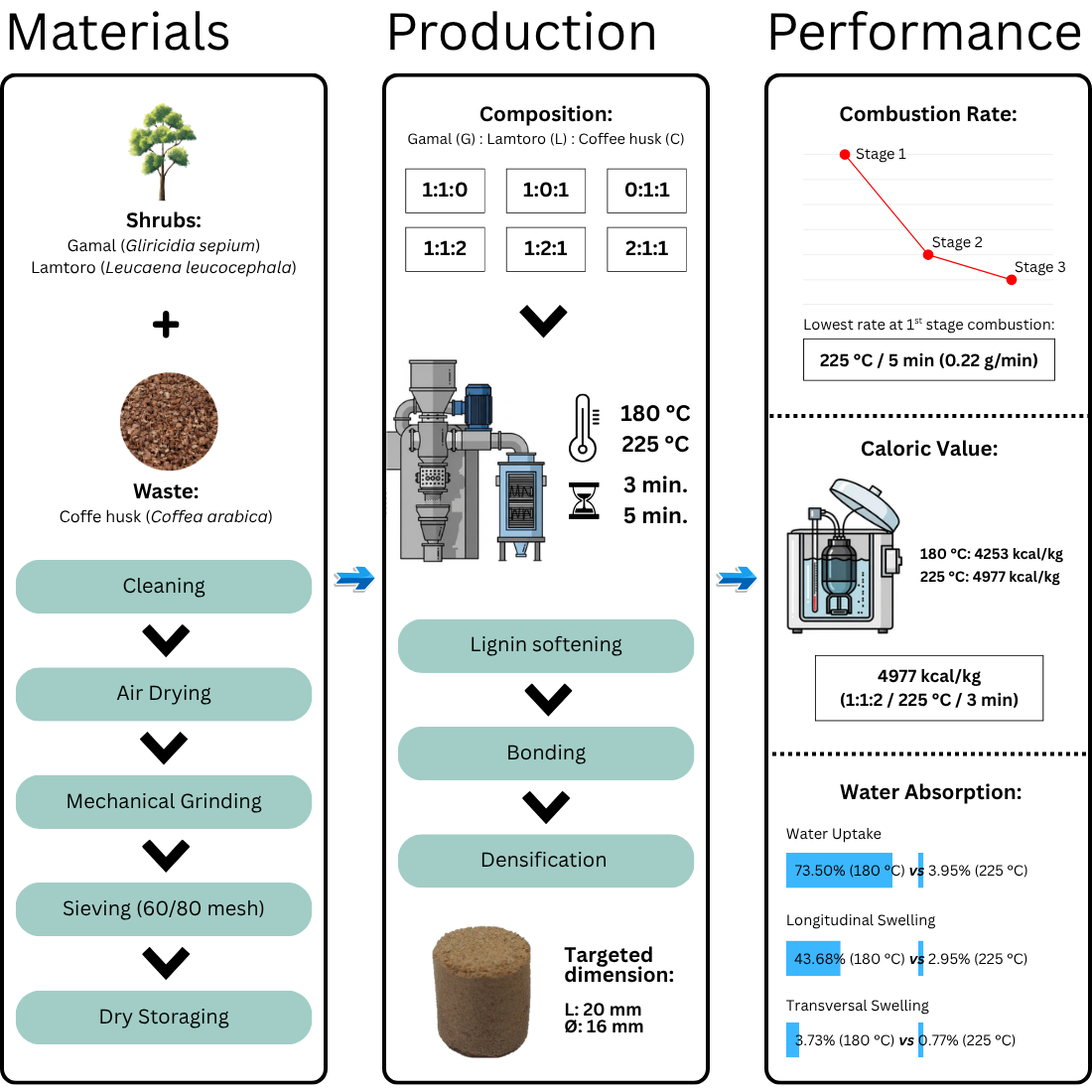
Bio-pellets represent an environmentally sustainable alternative fuel with the potential to supply fossil fuels. Raw materials considered potential for making bio-pellets should have low economic value and be abundantly available. Materials that meet these criteria include shrubs and plantation waste. This study aimed to identify the optimal material composition and molding condition (temperature and duration) in the production of shrubs and waste mixed bio-pellet based on its combustion characteristics (calorific value and burning rate) and water absorption. Bio-pellets produced form mixture of Gamal shrub (Gliricidia sepium), Lamtoro shrub (Leucaena leucocephala), and coffee husk waste (Coffea arabica), utilizing 6 distinct raw material weight ratios of 1:1:2, 1:2:1, 2:1:1, 0:1:1, 1:0:1, and 1:1:0. The bio-pellets were molded at 2 different temperatures, 180 and 225 °C, for durations of 3 and 5 min. The parameters analyzed included the combustion rate, calorific value, water uptake, and dimensional swelling. The findings of this study reveal that molding temperature exerts the most significant influence on the combustion characteristics of bio-pellets. Bio-pellets molded at 225 °C demonstrated the highest calorific value, reaching 4,767 kcal/kg, alongside the lowest combustion rate at 0.22 g/min. In contrast, the bio-pellets molded at 180 °C exhibited lower calorific values and higher combustion rates. The raw material composition and molding duration did not exhibit a significant effect on combustion rate and calorific value, although the combustion rate tended to decrease with increasing molding duration. Moisture response was strongly temperature-dependent. Increasing temperature from 180 to 225 °C reduced longitudinal swelling (43.68% to 2.95%), transversal swelling (3.73% to 0.77%), volume swelling (55.90% to 4.57%), and water uptake (73.50% to 3.95%), with strong uptake-swelling correlations. These findings suggest that the regulation of molding temperature is a critical factor in optimizing bio-pellet quality, particularly in enhancing energy efficiency, reducing combustion rate, and increasing moisture resistance.
HIGHLIGHTS
- Molding temperature has the most significant influence on combustion characteristics of bio-pellets compared to molding duration and raw material composition.
- Bio-pellets molded at 225 °C exhibited the highest calorific value of 4,767 kcal/kg with the lowest combustion rate of 0.22 g/min
- Raw material composition and molding duration did not significantly affect combustion parameters.
- Regulating molding temperature is critical for optimizing bio-pellet quality and energy efficiency.
- Optimizing molding temperature can enhance energy efficiency and reduce combustion rate of bio-pellets.
GRAPHICAL ABSTRACT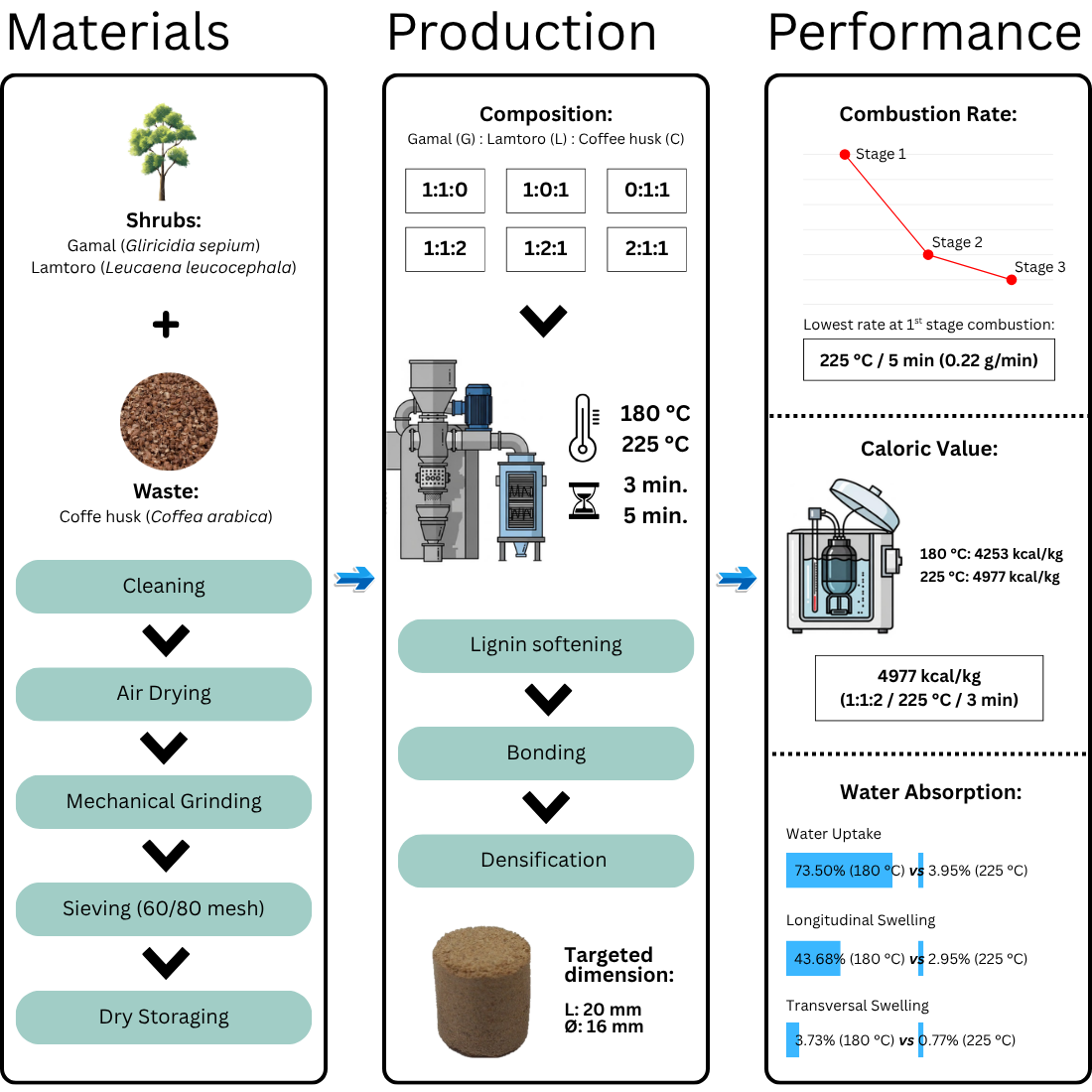
Downloads
References
P Kumar, L Fiori, PMV Subbarao and VK Vijay. Development of an efficient method to blend forest biomass with agricultural residue to produce fuel pellets with improved mechanical properties. Biofuels 2024; 15(8), 1051-1062.
F Ferrari, R Striani, D Fico, MM Alam, A Greco and CE Corcione. An overview on wood waste valorization as biopolymers and biocomposites: Definition, classification, production, properties and applications. Polymer 2022; 14(24), 5519.
S Suhasman, AD Yunianti, S Saad, A Agussalim, KTP Pangestu, H Arisandi and G Pari. The effect of various torrefaction conditions on the quality of bio-pellets from lesser-known shrub species. International Wood Products Journal 2025; 17(1), 283001584.
A Jasinskas, V Kleiza, D Streikus, R Domeika, E Vaiciukevičius, G Gramauskas and MT Valentin. Assessment of quality indicators of pressed biofuel produced from coarse herbaceous plants and determination of the influence of moisture on the properties of pellets. Sustainability 2022; 14(3), 1068.
C Scott, TM Desamsetty and N Rahmanian. Unlocking power: Impact of physical and mechanical properties of biomass wood pellets on energy release and carbon emissions in power sector. Waste and Biomass Valorization 2024; 16, 441-458
JF Peters, D Iribarren and J Dufour. Biomass pyrolysis for biochar or energy applications? A life cycle assessment. Environmental Science & Technology 2015; 49(8), 5195-5202.
MJ Stolarski, P Dudziec, M Krzyżaniak and E Olba-Zięty. Solid biomass energy potential as a development opportunity for rural communities. Energies 2021; 14(12), 3398.
Y Zhang, Y Zhou, R Dong and Z Zhang. The influences of various testing conditions on the evaluation of household biomass pellet fuel combustion. Energies 2018; 11(5), 1131.
MJ Serapiglia, KD Cameron, AJ Stipanovic, LP Abrahamson, TA Volk and LB Smart. Yield and woody biomass traits of novel shrub willow hybrids at two contrasting sites. BioEnergy Research 2012; 6, 533-546.
S Suhasman, YA Detti, PKT Putra, Agussalim, K Ikhlas, A Heru, R Nova, D Saptadi and P Gustan. Biopellets from four shrub species for co-firing in East Indonesia. Journal of the Korean Wood Science and Technology 2024; 52(6), 539-554.
T Kebede, DT Berhe and Y Zergaw. Combustion characteristics of briquette fuel produced from biomass residues and binding materials. Journal of Energy 2022; 2022, 4222205.
S Poyilil, A Palatel and M Chandrasekharan. Physico-chemical characterization study of coffee husk for feasibility assessment in fluidized bed gasification process. Environmental Science and Pollution Research 2021; 29, 51041-51053.
HY Jaramillo, O Vasco-Echeverri and JAG Camperos. Characterization of the coffee husk: A potential alternative for sustainable construction. Civil Engineering and Architecture 2023; 11(4), 1902-1908.
AD Yunianti, KTP Pangestu, Syahidah, F Bastian, G Pari and S Darmawan. Dataset of biopellet characteristics from various lignocellulosic agricultural waste and shrubs produced using different method. Data in Brief 2024; 57, 110879.
C Mock, H Lee, S Choi and V Manovic. Combustion behavior of relatively large pulverized biomass particles at rapid heating rates. Energy & Fuels 2016; 30(12), 10809-10822.
VA Yiga, M Katamba, M Lubwama, KH Adolfsson, M Hakkarainen and E Kamalha. Combustion, kinetics and thermodynamic characteristics of rice husks and rice husk-biocomposites using thermogravimetric analysis. Journal of Thermal Analysis and Calorimetry 2023; 148, 11435-11454.
M Ioelovich. Recent findings and the energetic potential of plant biomass as a renewable source of biofuels – a review. BioResources 2015; 10(1), 1627-1663.
SS Shalini, K Palanivelu, A Ramachandran and R Vijaya. Biochar from biomass waste as a renewable carbon material for climate change mitigation in reducing greenhouse gas emissions—a review. Biomass Conversion and Biorefinery 2020; 11, 2247-2267.
A Palma, F Galucci, S Papandrea, M Carnevale, E Paris, B Vinceti, M Salerno, V Di Stefano and AR Proto. Experimental study of the combustion of and emissions from olive and citrus pellets in a small boiler. Fire 2023; 6(8), 288.
O Ogunkunle and NA Ahmed. Overview of biodiesel combustion in mitigating the adverse impacts of engine emissions on the sustainable human-environment scenario. Sustainability 2021; 13(10), 5465.
A Bala-Litwiniak, D Musiał and M Nabiałczyk. Computational and experimental studies on combustion and co-combustion of wood pellets with waste glycerol. Materials 2023; 16(22), 7156.
L Zhang, Y Li, J Li, R Xing, X Liu, J Zhao, G Shen, B Pan, X Li and S Tao. Pollutant emissions and oxidative potentials of particles from the indoor burning of biomass pellets. Environmental Science & Technology 2024; 58(36), 16016-16027.
A Tesfaye, F Workie and VS Kumar. Production and characterization of coffee husk fuel briquettes as an alternative energy source. Advances in Materials Science and Engineering 2022; 2022, 9139766.
N Cahyani, AD Yunianti, Suhasman, KTP Pangestu and G Pari. Characteristics of bio pellets from spent coffee grounds and pinewood charcoal based on composition and grinding method. Journal of the Korean Wood Science and Technology 2023; 51(1), 23-37.
P Kazimierski, K Januszewicz, W Godlewski, A Fijuk, T Suchocki, P Chaja, B Barczak and D Kardas. The course and the effects of agricultural biomass pyrolysis in the production of high-calorific biochar. Materials 2022; 15(3), 1038.
N Pedišius, M Praspaliauskas, J Pedišius and EF Dzenajavičienė. Analysis of wood chip characteristics for energy production in Lithuania. Energies 2021; 14(13), 3931.
P Niemz, W Sonderegger, T Keplinger, J Jiang and J Lu. Physical Properties of Wood and Wood-Based Materials. Springer Cham, Switzerland, 2023, p. 281-353.
TA Lestander. Water absorption thermodynamics in single wood pellets modelled by multivariate near-infrared spectroscopy. Holzforschung 2008; 62(4), 429-434.
DV Nguyen, CTT Duong, CNM Vu, HM Nguyen, TT Pham, TM Tran-Thuy and LQ Nguyen. Data on chemical composition of coffee husks and lignin microparticles as their extracted product. Data in Brief 2023; 51, 109781.
ADCO Carneiro, AJV Zanuncio, AG Carvalho, JACG Jorge, RJC dos Santos, IF Demuner, LC Peres, SG Winter, VR de Castro, M Branco-Vieira and SDO Araújo. Sustainable production of coffee husk pellets: Applying circular economy in waste management and renewable energy production. Resources 2025; 14(2), 26.
Z Börcsök and Z Pásztory. The role of lignin in wood working processes using elevated temperatures: An abbreviated literature survey. European Journal of Wood and Wood Products 2020; 79, 511-526.
W Stelte, AR Sanadi, L Shang, JK Holm, J Ahrenfeldt and UB Henriksen. Recent developments in biomass pelletization – a review. BioResources 2012; 7(3), 4451-4490.
AA Siyal, Y Liu, X Mao, B Ali, S Husaain, J Dai, T Zhang, J Fu and G Liu. Characterization and quality analysis of wood pellets: Effect of pelletization and torrefaction process variables on quality of pellets. Biomass Conversion and Biorefinery 2021; 11(5), 2201-2217.
W Stelte, C Clemons, JK Holm, J Ahrenfeldt, UB Henriksen and AR Sanadi. Fuel pellets from wheat straw: The effect of lignin glass transition and surface waxes on pelletizing properties. BioEnergy Research 2011; 5, 450-458.
DD Eduardo, B Musa, S Juan R and NE Alga. Thermo-chemical characterization of coffee husk from a new variety (Coffea arabica L. var. Cenicafé 1) for biofuel production. Scientia Agriculturae Bohemica 2025; 1(1), 56.
J Cavailles, G Vaca-Medina, J Wu-Tiu-Yen, J Peydecastaing and PY Pontalier. Influence of thermocompression conditions on the properties and chemical composition of bio-based materials derived from lignocellulosic biomass. Materials 2024; 17(8), 1713.
D Liu, Y Ma, J Li, D Teng, S Qiu, Y Li, X Mau and H Wang. Optimization of parameters associated with pellets made from biomass residue from anaerobic digestion using Box-Behnken design. BioResources 2022; 17(2), 2743-2767.
AT Oyelere and AO Oluwadare. Studies on physical, thermal and chemical properties of wood Gliricidia sepium for potential bioenergy production. International Journal of Biomass & Renewables 2019; 8(2), 28-38.
RM Salim, J Asik, MS Sarjadi and LK Chiang. Chemical composition and potential uses of Leucaena leucocephala stem bark. Wood Research 2023; 68(2), 241-256.
Published
How to Cite
Issue
Section
License
Copyright (c) 2026 Walailak University

This work is licensed under a Creative Commons Attribution-NonCommercial-NoDerivatives 4.0 International License.





