Antioxidant Activity of Quercetin and Quercetin-3-O-Glucoside Isolated from Durian Seed (Durio zibethinus Murr.)
DOI:
https://doi.org/10.48048/tis.2027.13277Keywords:
Flavonoids, Durian seeds, Antioxidant activity, Quercetin, Quercetin-3-O-glucosideAbstract
Durian seeds (Durio zibethinus Murr.), an underutilised agro-industrial by-product, are a promising source of bioactive flavonoids with potential antioxidant uses. However, comprehensive studies that combine extraction optimisation, flavonoid isolation, and structure–activity relationship analysis are scarce. This research examined extraction optimisation using maceration, reflux, and Soxhlet methods with ethanol, methanol, and n-hexane as solvents. The extracts were characterised by proximate analysis, phytochemical screening, and determination of total phenolic and flavonoid contents by UV-Vis spectrophotometry. Flavonoid isolation was carried out by column chromatography, and antioxidant activity was assessed using the DPPH assay to determine IC₅₀ values. Reflux extraction with ethanol yielded the highest phenolic (26.9451 mg GAE/g) and flavonoid (3.6363 mg QE/g) contents. FTIR and HPLC analyses, supported by retention-time comparisons with authentic standards, suggested the presence of quercetin-related and quercetin-3-O-glucoside-related constituents. Quercetin-related concentration estimates ranged from 37.769 to 101.979 ppm, while quercetin-3-O-glucoside-related peaks showed relative chromatographic peak area values of 97.01%–98.81%. Among the three isolated fractions, Isolate 4 had both the highest quercetin-related concentration and the strongest antioxidant activity (IC₅₀ = 92.6346 μg/mL). In contrast, Isolate 3 showed lower antioxidant activity despite having a higher relative peak area for quercetin-3-O-glucoside-related constituents. This pattern indicates that relative chromatographic peak dominance alone did not explain antioxidant performance across the three fractions. The findings support the potential of durian seed biomass as a sustainable source of natural antioxidants for use in functional foods and nutraceuticals.
HIGHLIGHTS
- Durian seeds are an underutilised biomass source of phenolic and flavonoid-rich fractions with antioxidant potential.
- Ethanol reflux extraction produced the highest total phenolic content (26.95 mg GAE/g) and total flavonoid content (3.64 mg QE/g).
- TLC-guided fractionation, FTIR, and HPLC retention-time comparison supported the presence of quercetin-related and quercetin-3-O-glucoside-related constituents.
- Isolate 4 showed the highest quercetin-related concentration and the strongest antioxidant activity among the isolated fractions (IC₅₀ = 92.63 μg/mL).
- Relative chromatographic peak dominance alone did not explain antioxidant performance across the three isolated fractions.
GRAPHICAL ABSTRACT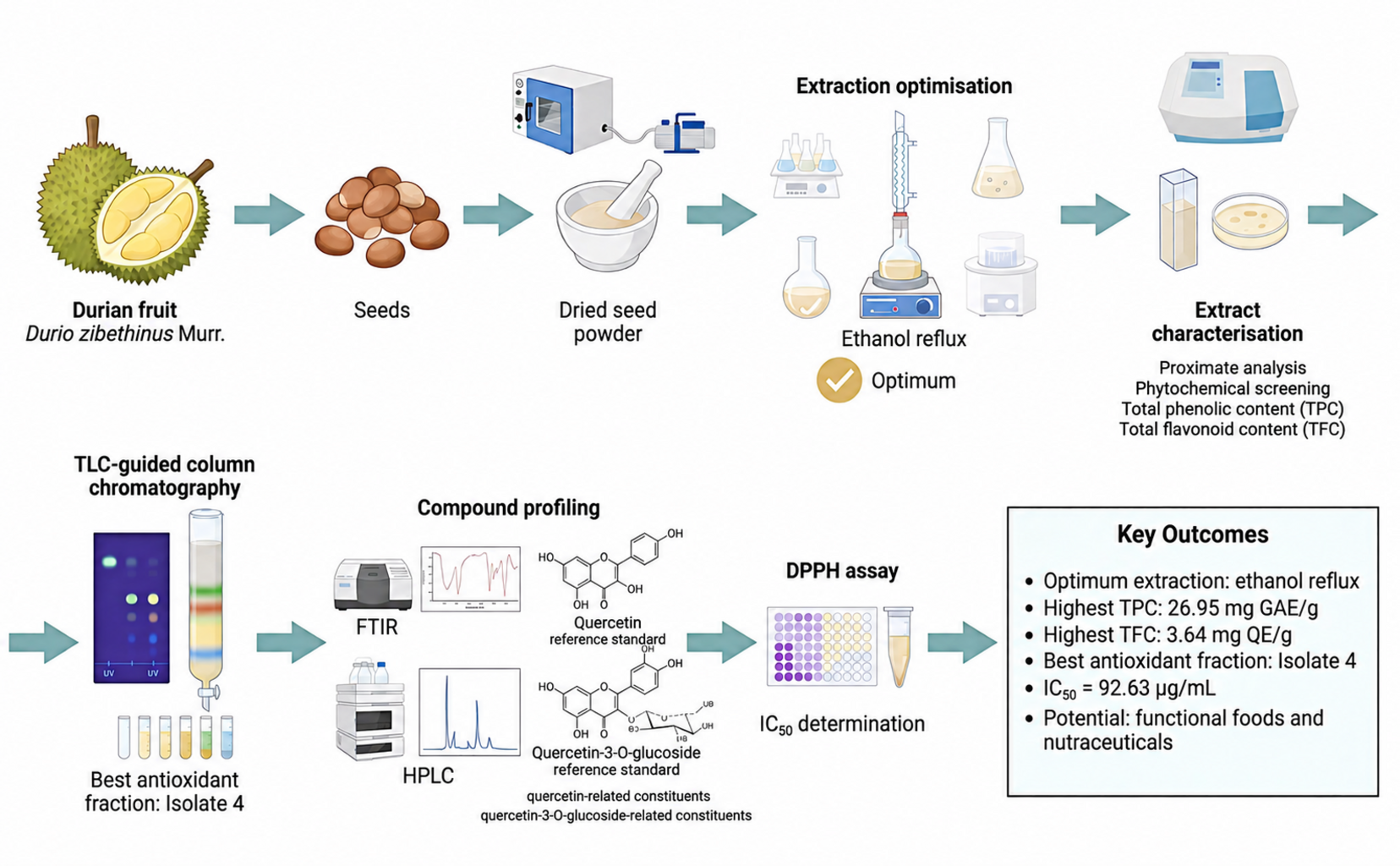
Downloads
References
BPS-Statistic Indonesia, Available at: https://www.bps.go.id, accessed 13 October 2024.
BT Amid, H Mirhosseini and S Kostadinović. Chemical composition and molecular structure of polysaccharide-protein biopolymer from Durio zibethinus seed: Extraction and purification process. Chemistry Central Journal 2012; 6, 117.
S Baraheng and T Karrila. Chemical and functional properties of durian (Durio zibethinus Murr.) seed flour and starch. Food Bioscience 2019; 30, 100412.
RAJ Gamay, PMN Botecario, PDC Sanchez and MC Alvarado. Durian (Durio zibethinus) waste: A promising resource for food and diverse applications—a comprehensive review. Food Production, Processing and Nutrition 2024; 6, 27.
X Fang, Y Li, YL Kua, ZL Chew, S Gan, KW Tan, TZE Lee, WK Cheng and HLN Lau. Insights on the potential of natural deep eutectic solvents (NADES) to fine-tune durian seed gum for use as edible food coating. Food Hydrocolloids 2022; 132, 107861.
H Mirhosseini, NFA Rashid, BT Amid, KW Cheong, M Kazemi and M Zulkurnain. Effect of partial replacement of corn flour with durian seed flour and pumpkin flour on cooking yield, texture properties, and sensory attributes of gluten-free pasta. LWT - Food Science and Technology 2015; 63(1), 184-190.
ZL Chew, QQ Koh, EE Chu, YL Kua, S Gan, KW Tan and TZE Lee. Tunable durian seed gum-derived eutectogel as a novel coating material: Rheological, thermal, textural and barrier properties for enhanced food preservation. International Journal of Biological Macromolecules 2024; 267(1), 131201.
S Bai-Ngew, N Therdthai and W Zhou. Microwave vacuum-dried durian flour and its application in biscuits. Heliyon 2021; 7(11), e08292.
NTH Nguyen, TTT Nguyen, DTC Nguyen and TV Tran. A comprehensive review on the production of durian fruit waste-derived bioadsorbents for water treatment. Chemosphere 2024; 363, 142801.
H Mirhosseini, BT Amid and KW Cheong. Effect of different drying methods on chemical and molecular structure of heteropolysaccharide–protein gum from durian seed. Food Hydrocolloids 2013; 31(2), 210-219.
S Rahmawati, Pathuddin, S Nuryanti, VDA Sangkota, Afadil, Anggraini and N Syawaliah. Characteristics and antioxidants of edible film from durian seeds (Durio zibethinus) with additions of rosella flower extract (Hibiscus sabdariffa L.). Materials Today: Proceedings 2022; 65(7), 3109-3115.
TB Ly, AMH Trinh, HPT Tran, KN Dang, TDT Nguyen, VT Tran and PK Le. Evaluation of an operating durian shell charcoal briquette manufacturing line and development of a biorefinery process for higher value products. Energy 2024; 307, 132727.
Masturi, D Alighiri, P Dwijananti, RD Widodo, SP Budiyanto and A Drastisianti. Bioethanol synthesis from durian seeds using Saccharomyces cerevisiae in aerobic fermenter and bioethanol enrichment by batch vacuum distillation. Jurnal Bahan Alam Terbarukan 2020; 9(1), 36-46.
JY Chua, KM Pen, JV Poi, KM Ooi and KF Yee. Upcycling of biomass waste from durian industry for green and sustainable applications: An analysis review in the Malaysia context. Energy Nexus 2023; 10, 100203.
Masturi, D Alighiri, SS Edie, A Drastisianti, U Khasanah, KA Tanti, Susilawati, RZ Maghfiroh, KGC Kirana and F Choirunnisa. Identification of flavonoid compounds and total flavonoid content from biowaste of local durian shell (Durio zibethinus). Journal of Physics: Conference Series 2020; 1567, 042084.
AM Amin, AS Ahmad, YY Yin, N Yahya and N Ibrahim. Extraction, purification, and characterization of durian (Durio zibethinus) seed gum. Food Hydrocolloids 2007; 21(2), 273-279.
Y Liu, S Feng, L Song, G He, M Chen and D Huang. Secondary metabolites in durian seeds: Oligomeric proanthocyanidins. Molecules 2013, 18(11), 14172-14185.
NAA Aziz and AMM Jalil. Bioactive compounds, nutritional value, and potential health benefits of indigenous durian (Durio zibethinus Murr.): A review. Foods 2019; 8(3), 96.
S Charoenkiatkul, P Thiyajai and K Judprasong. Nutrients and bioactive compounds in popular and indigenous durian (Durio zibethinus Murr.). Food Chemistry 2016; 193, 181-186.
G Khaksar, S Kasemcholathan and S Sirikantaramas. Durian (Durio zibethinus L.): Nutritional composition, pharmacological implications, value-added products, and omics-based investigations. Horticulturae 2024, 10(4), 342.
BT Amid and H Mirhosseini. Optimisation of aqueous extraction of gum from durian (Durio zibethinus) seed: A potential, low cost source of hydrocolloid. Food Chemistry 2012; 132(3), 1258-1268.
P Singcha, G Khaksar, M Sirijan and S Sirikantaramas. Durian (Durio zibethinus L.) fruit: A superior dietary source of natural glutathione and γ-glutamylcysteine. Journal of Food Composition and Analysis 2024; 127, 105975.
N Charoenphun and WK Klangbud. Antioxidant and anti-inflammatory activities of durian (Durio zibethinus Murr.) pulp, seed, and peel flour. PeerJ 2022; 10, e12933.
L Mungmai, C Kanokwattananon, S Thakang, A Nakkrathok, P Srisuksomwong and P Tanamatayarat. Physicochemical properties, antioxidant and anti-tyrosinase activities of Durio zibethinus Murray and value-added for cosmetic product formulation. Cosmetics 2023; 10(3), 87.
YV Rajagukguk and M Arnold. Tempoyak: Fermented durian paste of Malay ethnic and its functional properties. International Journal of Gastronomy and Food Science 2021; 23, 100297.
R Haruenkit, S Poovarodom, S Vearasilp, J Namiesnik, M Sliwka-Kaszynska, YS Park, BG Heo, JY Cho, HG Jang and S Gorinstein. Comparison of bioactive compounds, antioxidant and antiproliferative activities of Mon Thong durian during ripening. Food Chemistry 2010; 118(3), 540-547.
L Fu, BT Xu, XR Xu, RY Gan, Y Zhang, EQ Xia and HB Li. Antioxidant capacities and total phenolic contents of 62 fruits. Food Chemistry 2011; 129(2), 345-350.
LH Ho and R Bhat. Exploring the potential nutraceutical values of durian (Durio zibethinus L.)—An exotic tropical fruit. Food Chemistry 2015; 168, 80-89.
MGL Hertog, D Kromhout, C Aravanis, H Blackburn, R Buzina, F Fidanza, S Giampaoli, A Jansen, A Menotti, S Nedeljkovic, M Pekkarinen, BS Simic, H Toshima, EJM Feskens, PCH Hollman and MB Katan. Flavonoid intake and long-term risk of coronary heart disease and cancer in the seven countries study. Archives of Internal Medicine 1995; 155(4), 381-386.
Masturi, D Alighiri, K Nuzulina, M Rodhiyah and A Drastisianti. Optimization of condition extraction in quantification of total flavonoid content in the seeds of Arummanis (Mangifera indica L.) mango from Indonesia. Journal of Physics: Conference Series 2019; 1321, 022041.
Masturi, D Alighiri, SS Edie, U Hanisyifa and A Drastisianti. Determination of total phenol and flavonoid contents and antioxidant activity from extract fraction of sappan wood (Caesalpinia sappan L.) by liquid–liquid extraction and vacuum liquid chromatography. Asian Journal of Chemistry 2021; 33(8), 1729-1735.
S Priatmoko, D Alighiri, A Drastisianti, D Harjunowibowo, AN Rohman and T Sulistyaningsih. Coagulant preparation from glutaraldehyde-crosslinked durian skin cellulose for treatment of wastewater generated by sugar palm starch industries. Cellulose Chemistry and Technology 2024; 58(1-2), 201-214.
Harjono, INP Wahyuni, A Darmawan and D Alighiri. Isolasi dan karakterisasi senyawa metabolit sekunder dari serbuk kayu mahoni (Swietenia macrophylla King). Journal of Farmasi Sains Indonesia 2020; 3(1), 45-48.
LI Humairoh and D Alighiri. Formulation and evaluation of lozenges from durian peel extract (Durio zibethinus Murr.) as an antioxidant. Journal of Science and Technology Research in Pharmacy 2023; 3(1), 26-34.
C Pramesti and D Alighiri. Formulation of effervescent tablet from extract of durian (Durio zibethinus Murr.) peels and its antioxidant activity. Journal of Science and Technology Research in Pharmacy 2023; 3(1), 35-44.
WT Eden, D Alighiri, N Wijayati and S Mursiti. Synthesis of chalcone derivative from clove leaf waste as a natural antioxidant. Pharmaceutical Chemistry Journal 2021; 55(3), 269-274.
O Abbas, G Compère, Y Larondelle, D Pompeu, H Rogez and V Baeten. Phenolic compound explorer: A mid-infrared spectroscopy database. Vibrational Spectroscopy 2017; 92, 111-118.
DH Mursyidin, MI Makruf, Badruzsaufari and A Noor. Molecular diversity of exotic durian (Durio spp.) germplasm: A case study of Kalimantan, Indonesia. Journal of Genetic Engineering and Biotechnology 2022; 20(1), 39.
X Zhou, H Wu, J Pan, H Chen, B Jin, Z Yan, L Xie and KM Rogers. Geographical traceability of south-east Asian durian: A chemometric study using stable isotopes and elemental compositions. Journal of Food Composition and Analysis 2021; 101, 103940.
A Susila, YA Bety, Y Hindarwati, FD Arianti, D Haskarini, A Malik, B Santoso and IG Cempaka. Characterization of durian (Durio zibethinus) Monthok from Blora, Central Java, Indonesia. E3S Web Conferences 2021; 306, 01003.
K Weerawanich, H Halbwirth and S Sirikantaramas. A novel MYB transcription factor from durian (Durio zibethinus), DzMYB1, regulates flavonoid biosynthesis in fruit pulp. Scientia Horticulturae 2024; 333, 113246.
EHK Ikram, KH Eng, AMM Jalil, A Ismail, S Idris, A Azlan, HSM Nazri, NAM Diton and RAM Mokhtar. Antioxidant capacity and total phenolic content of Malaysian underutilized fruits. Journal of Food Composition and Analysis 2009; 22(5), 388-393.
GL Chen, SG Chen, YY Zhao, CX Luo and YQ Gao. Total phenolic contents of 33 fruits and their antioxidant capacities before and after in vitro digestion. Industrial Crops and Products 2014; 57, 150-157.
P Arancibia-Avila, F Toledo, YS Park, ST Jung, SG Kang, BG Heo, SH Lee, M Sajewicz, T Kowalska and S Gorinstein. Antioxidant properties of durian fruit as influenced by ripening. LWT – Food Science and Technology 2008; 41(10), 2118-2125.
MM Ali, N Hashim, S Abd Aziz and O Lasekan. Exploring the chemical composition, emerging applications, potential uses, and health benefits of durian: A review. Food Control 2020; 113, 107189.
K Csepregi, S Neugart, M Schreiner and E Hideg. Comparative evaluation of total antioxidant capacities of plant polyphenols. Molecules 2016; 21(2), 208.
M Alauhdin, WT Eden and D Alighiri. Application of infrared spectroscopy for the analysis of plants and herbal medicines. Inovasi Sains dan Kesehatan 2021; 4, 4.
P Sarma, B Kashyap, S Gurumayum, S Sarma, P Baruah, D Swargiary, A Saikia, RC Deka and JC Borah. Antihyperglycemic potential of Quercetin-3-glucoside isolated from Leucaena leucocephala seedpods via the SIRT1/AMPK/GLUT4 signaling cascade. ACS Omega 2024; 9(30), 32429-32443.
X Li, Q Jiang, T Wang, J Liu and D Chen. Comparison of the antioxidant effects of quercitrin and isoquercitrin: Understanding the role of the 6″-OH group. Molecules 2016; 21(9), 1246.
Downloads
Published
How to Cite
Issue
Section
License
Copyright (c) 2026 Walailak University

This work is licensed under a Creative Commons Attribution-NonCommercial-NoDerivatives 4.0 International License.