
Blue Emissive Carbon Quantum Dots Derived from Green Tea Leaves Cultivated from Gayo High Land for Quantification of Antibiotics
DOI:
https://doi.org/10.48048/tis.2026.13254Keywords:
Carbon Quantum Dots (CQDs), Matcha leaves, Green tea leaves, Antibiotics sensor, QuantificationAbstract
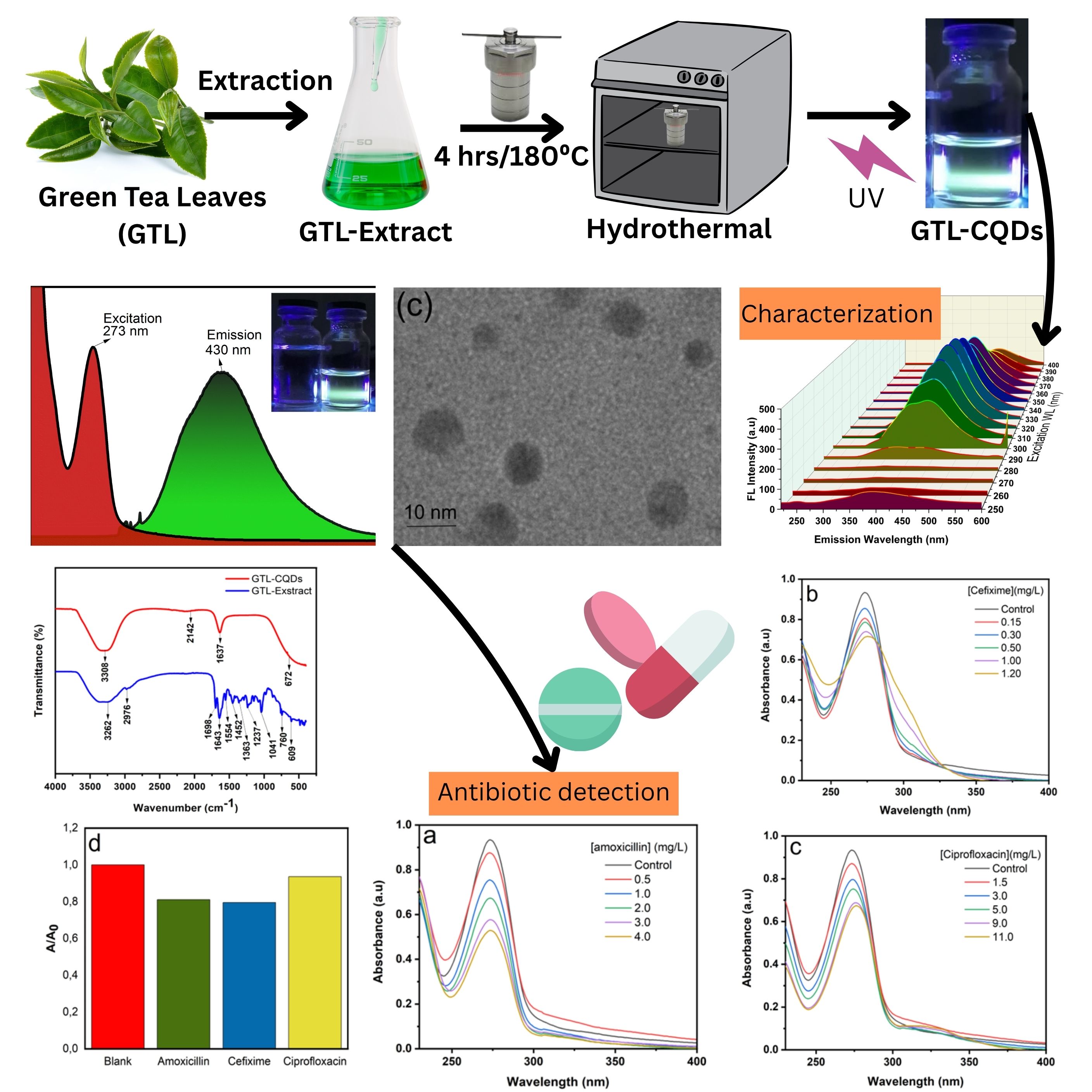
Carbon Quantum Dots (CQDs) have emerged as highly attractive nanomaterials in recent decades due to their rapid, cost-effective performance in chemical detection through fluorescence quenching. This study aims to synthesize CQDs from green tea leaves (GTL-CQDs) and utilize them as sensors for antibiotics. The CQDs were synthesized using a hydrothermal method at 180 °C for 4 in an oven, followed by purification, and characterization. The synthesized GTL-CQDs exhibited an average particle size of approximately 10.5 nm. UV-Vis and fluorescence spectroscopy analyses revealed that the CQDs strongly absorb UV light with a maximum absorption peak at 273 nm, and emit visible light in the wavelength range of 350 - 550 nm, with an emission peak centered at 430 nm. The CQDs were employed to test their selectivity toward the detection of various antibiotics, including amoxicillin, cefixime, and ciprofloxacin. The GTL-CQDs were found to be effective in detecting the selected antibiotics but demonstrated greater selectivity toward cefixime with a limit of detection (LOD) of 0.11 mg·L−1 or equivalent to 243 nM. Sensing application in real samples (tap water and river water) recoveries 98.90% - 113.35% with RSD ≤ 0.19 confirmed the accuracy of cefixime quantification. The developed probe enables reliable, sustainable, and efficient on-site detection of cefixime for environmental monitoring.
HIGHLIGHTS
- High-fluorescence CQDs were hydrothermally synthesized from green tea leaves
- The CQDs persistently exhibit great optical stability after being exposed to intensive UV light (295 nm) for up to 8 h
- A low-cost UV-Vis technique has been successfully employed to detect antibiotics at a significantly low threshold
- The CQDs demonstrate sensory ability to detect cefixime with a limit of detection of 0.11 mg·L−1
GRAPHICAL ABSTRACT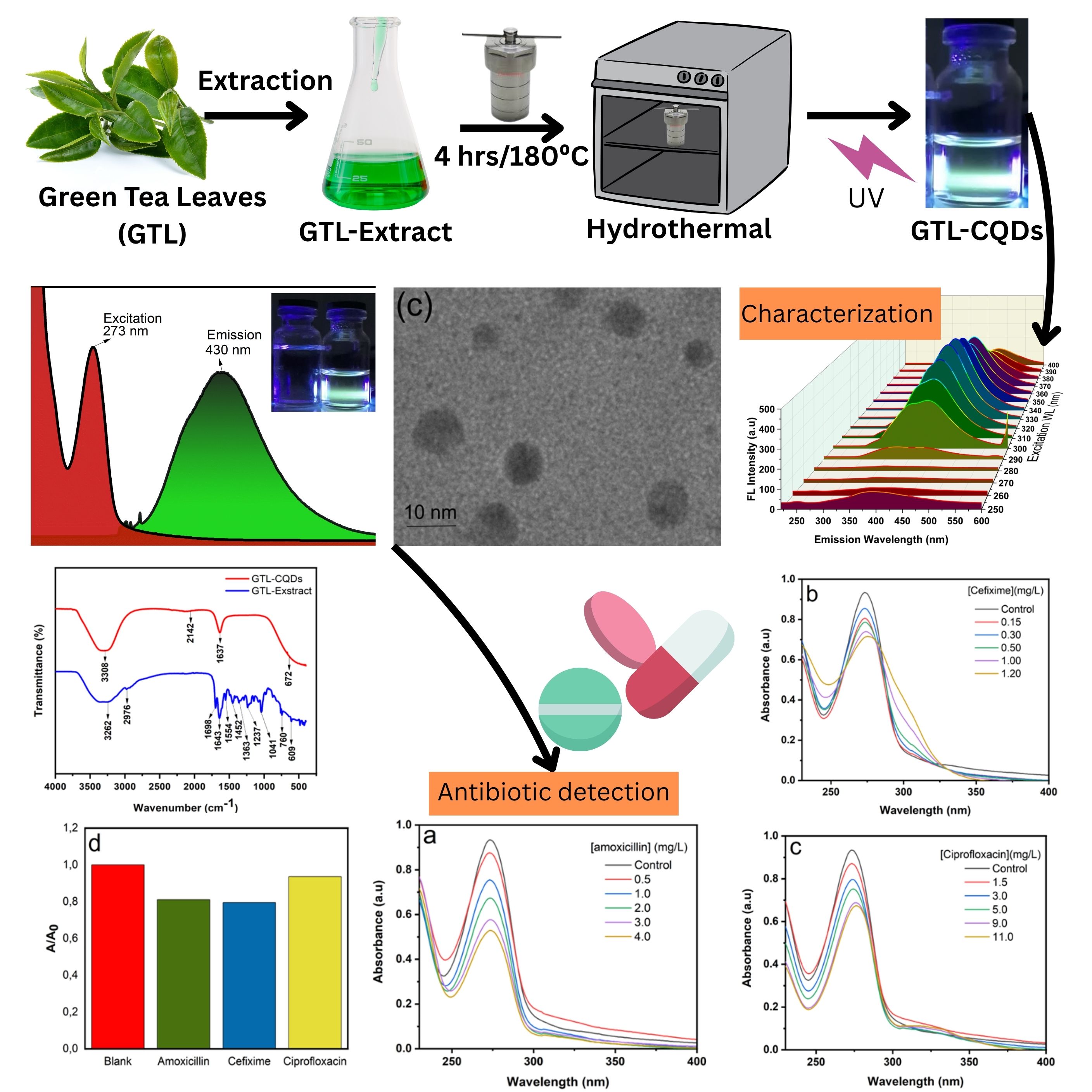
Downloads
References
SY Lim, W Shen and Z Gao. Carbon quantum dots and their applications. Chemical Society Reviews 2015; 44(1), 362-381.
L Liu, Z Mi, Q Hu, C Li, X Li and F Feng. Green synthesis of fluorescent carbon dots as an effective fluorescence probe for morin detection. Analytical Methods 2019; 11(3), 353-358.
R Atchudan, TNJI Edison, KR Aseer, S Perumal and YR Lee. Hydrothermal conversion of Magnolia liliiflora into nitrogen-doped carbon dots as an effective turn-off fluorescence sensing, multi-colour cell imaging and fluorescent ink. Colloids and Surfaces B: Biointerfaces 2018; 169, 321-328.
H Lin, J Huang and L Ding. Preparation of Carbon Dots with high-fluorescence quantum yield and their application in dopamine fluorescence probe and Cellular Imaging. Journal of Nanomaterials 2019; 2019(1), 5037243.
H Liu, Z Li, Y Sun, X Geng, Y Hu, H Meng, J Ge and L Qu. Synthesis of luminescent carbon dots with ultrahigh quantum yield and inherent folate receptor-positive cancer cell targetability. Scientific Reports 2018; 8(1), 1086.
C Yu, T Xuan, Y Chen, Z Zhao, X Liu, G Lian and H Li. Gadolinium-doped carbon dots with high quantum yield as an effective fluorescence and magnetic resonance bimodal imaging probe. Journal of Alloys and Compounds 2016; 688, 611-619.
Z Zhu, H Niu, R Li, Z Yang, J Wang, X Li, P Pan, J Liu and B Zhou. One-pot hydrothermal synthesis of fluorescent carbon quantum dots with tunable emission color for application in electroluminescence detection of dopamine. Biosensors and Bioelectronics: X 2022; 10, 100141.
SA Al-Ghamdi, AAA Darwish, TA Hamdalla, A Pasha, ME Elnair, A Al-Atawi and S Khasim. Biological synthesis of novel carbon quantum dots using Halimeda opuntia green algae with improved optical properties and electrochemical performance for possible energy storage applications. International Journal of Electrochemical Science 2023; 18(5), 100102.
T Yuan, T Meng, P He, YX Shi, Y Li, X Li, L Fan and S Yang. Carbon quantum dots: An emerging material for optoelectronic applications. Journal of Materials Chemistry C 2019; 7(23), 6820-6835.
A Vibhute, T Patil, R Gambhir and AP Tiwari. Fluorescent carbon quantum dots: Synthesis methods, functionalization and biomedical applications. Applied Surface Science Advances 2022; 11, 100311.
J Shen, S Shang, X Chen, D Wang and Y Cai. Facile synthesis of fluorescence carbon dots from sweet potato for Fe3+ sensing and cell imaging. Materials Science and Engineering: C 2017; 76, 856-864.
J Janshongsawang, N Pimsin, D Nugroho, P Nuengmatcha, P Porrawatkul and S Chanthai. Selective fluorescence quenching sensor for trace determination of iron (Fe2+/Fe3+) in water sample using natural Carbon Dots (CDs) synthesized by microorganisms from leech lime (Citrus hystrix DC.) fermentation extract. Trends in Sciences 2025; 22(12), 10639.
M Nazar, M Hasan, B Wirjosentono, BA Gani and CE Nada. Microwave synthesis of carbon quantum dots from arabica coffee ground for fluorescence detection of Fe3+, Pb2+, and Cr3+. ACS Omega 2024; 9(18), 20571-20581.
SA Akbar, M Hasan, M Nazar, I Zulfahmi, E Miswar, M Iqhrammullah and Z Jalil. Fluorescent carbon quantum dots from Syzygium aromaticum as a selective sensor for Fe3+ and Cd2+ detection in aqueous solution. Case Studies in Chemical and Environmental Engineering 2025; 11, 101166.
M Gao and Q Chang. Nonlinear absorption characteristics of carbon quantum dots. Advances in Laser Technology and Applications 2015; 9671, 56-61.
A Kolanowska, G Dzido, M Krzywiecki, MM Tomczyk, D Lukowiec, S Ruczka and S Boncel. Carbon quantum dots from amino acids revisited: Survey of renewable precursors toward high quantum-yield blue and green fluorescence. ACS Omega 2022; 7(45), 41165-41176.
A Nair, JT Haponiuk, S Thomas and S Gopi. Natural carbon-based quantum dots and their applications in drug delivery: A review. Biomedicine & Pharmacotherapy 2020; 132, 110834.
P Namdari, B Negahdari and A Eatemadi. Synthesis, properties and biomedical applications of carbon-based quantum dots: An updated review. Biomedicine & Pharmacotherapy 2017; 87, 209-222.
F Limosani, EM Bauer, D Cecchetti, S Biagioni, V Orlando, R Pizzoferrato, P Prosposito and M Carbone. Top-down N-doped carbon quantum dots for multiple purposes: Heavy metal detection and intracellular fluorescence. Nanomaterials 2021; 11(9), 2249.
KG Nguyen, IA Baragau, R Gromicova, A Nicolaev, SAJ Thomson, A Rennie, NP Power, MT Sajjad and S Kellici. Investigating the effect of N-doping on carbon quantum dots structure, optical properties and metal ion screening. Scientific Reports 2022; 12(1), 13806.
J Dhariwal, GK Rao and D Vaya. Recent advancements towards the green synthesis of carbon quantum dots as an innovative and eco-friendly solution for metal ion sensing and monitoring. RSC Sustainability 2024; 2(1), 11-36.
U Abd Rani, LY Ng, YS Ng, CY Ng, YH Ong and YP Lim. Photocatalytic degradation of methyl green dye by nitrogen-doped carbon quantum dots: Optimisation study by Taguchi approach. Materials Science and Engineering: B 2022; 283, 115820.
M Nazar, M Hasan, M Maghfira, S Mustiqillah, CE Nada, S Syahrial, K Puspita, R Rusman, NHH Abu Bakar and WS Althubaiti. Formulation of peel-off mask loaded with blue emissive carbon dots from Hylocereus polyrhizus peels as a UV-blocking active agent. Results in Engineering 2025; 27, 105848.
A Kaur, K Pandey, R Kaur, N Vashishat and M Kaur. Nanocomposites of carbon quantum dots and graphene quantum dots: Environmental applications as sensors. Chemosensors 2022; 10(9), 367.
MJ Molaei. Principles, mechanisms, and application of carbon quantum dots in sensors: A review. Analytical Methods 2020; 12(10), 1266-1287.
AJ Thibodeau, M Barret, F Mouchet, VX Nguyen and E Pinelli. The potential contribution of aquatic wildlife to antibiotic resistance dissemination in freshwater ecosystems: A review. Environmental Pollution 2024; 350, 123894.
MP Gomes. The convergence of antibiotic contamination, resistance, and climate dynamics in freshwater ecosystems. Water 2024; 16(18), 2606.
C Manyi-Loh, S Mamphweli, E Meyer and A Okoh. Antibiotic use in agriculture and its consequential resistance in environmental sources: potential public health implications. Molecules 2018; 23(4), 795.
MA Salam, MY Al-Amin, MT Salam, JS Pawar, N Akhter, AA Rabaan and MA Alqumber. Antimicrobial resistance: A growing serious threat for global public health. Healthcare 2023; 11(13), 1946.
K Duan, G Pang, Y Duan, H Onyeaka and J Krebs. Current research development on food contaminants, future risks, regulatory regime and detection technologies: A systematic literature review. Journal of Environmental Management 2025; 381, 125246.
LTN Ngoc, JY Moon and YC Lee. Plant extract-derived carbon dots as cosmetic ingredients. Nanomaterials 2023; 13(19), 2654.
MA Mousa, HH Abdelrahman, MA Fahmy, DG Ebrahim and AH Moustafa. Pure and doped carbon quantum dots as fluorescent probes for the detection of phenol compounds and antibiotics in aquariums. Scientific Reports 2023; 13(1), 12863.
P Raji, AV Samrot, DB Rohan, MD Kumar, R Geetika, VK Sharma and D Keerthana. Extraction, characterization and in vitro bioactivity evaluation of alkaloids, flavonoids, saponins and tannins of cassia alata, Thespesia populnea, Euphorbia hirta and Wrightia tinctoria. Rasayan Journal of Chemistry 2019; 12(1), 123-137.
M Usman and S Cheng. Recent trends and advancements in green synthesis of biomass-derived carbon dots. Eng 2024; 5(3), 2223-2263.
N Javed and DM O’Carroll. Long-term effects of impurities on the particle size and optical emission of carbon dots. Nanoscale Advances 2021; 3(1), 182-189.
Y Liu, CY Liu and ZY Zhang. Graphitized carbon dots emitting strong green photoluminescence. Journal of Materials Chemistry C 2013; 1(32), 4902-4907.
S Chahal, JR Macairan, N Yousefi, N Tufenkji and R Naccache. Green synthesis of carbon dots and their applications. RSC Advances 2021; 11(41), 25354-25363.
SS Makone and SN Niwadange. Green chemistry alternatives for sustainable development in organic synthesis. International Advanced Research Journal in Science, Engineering and Technology 2016; 3(6), 114-118.
K Sato, R Katakami, Y Iso and T Isobe. Surface-modified carbon dots with improved photoluminescence quantum yield for color conversion in white-light-emitting diodes. ACS Applied Nano Materials 2022; 5(6), 7664-7669.
M Nazar, CE Nada, S Syahrial, R Rusman, I Khaldun, M Hasan, B Wirjosentono and B Basri. Carbon quantum dots synthesis optimization using response surface methodology. AIP Conference Proceedings 2024; 3082(1), 040016.
L Cao, X Wang, MJ Meziani, F Lu, H Wang, PG Luo, Y Lin, BA Harruff, LM Veca, D Murray, SY Xie and YP Sun. Carbon dots for multiphoton bioimaging. Journal of the American Chemical Society 2007; 129(37), 11318-11319.
Z Peng, X Han, S Li, AO Al-Youbi, AS Bashammakh, MS El-Shahawi and RM Leblanc. Carbon dots: Biomacromolecule interaction, bioimaging and nanomedicine. Coordination Chemistry Reviews 2017; 343, 256-277.
A Hajji, PED Soto Rodriguez, A Souemti, L Wang, IR Martin and A Megriche. Optical ratiometric probes based on photoluminescent core-shell structured carbon dots@silica for temperature sensing. Journal of the American Ceramic Society 2026; 109(1), e70278.
S Parveen, R Misra and SK Sahoo. Nanoparticles: A boon to drug delivery, therapeutics, diagnostics and imaging. In: L Balogh (Ed.). Nanomedicine in cancer. Jenny Stanford Publishing, New York, 2017, p. 47-98.
P Chaudhary, A Verma, A Mishra, D Yadav, K Pal, BC Yadav, E Ranjith Kumar, KB Thapa, S Mishra and DK Dwivedi. Preparation of carbon quantum dots using bike pollutant soot: Evaluation of structural, optical and moisture sensing properties. Physica E: Low-dimensional Systems and Nanostructures 2022; 139, 115174.
BK John, AR Chacko, C Mohan and B Mathew. A review on carbon quantum dot based semiconductor photocatalysts for the abatement of refractory pollutants. ChemPhysChem 2022; 23(12), e202100873.
YP Sun, B Zhou, Y Lin, W Wang, KAS Fernando, P Pathak, MJ Meziani, BA Harruff, X Wang, H Wang, PG Luo, H Yang, ME Kose, B Chen, LM Veca and SY Xie. Quantum-sized carbon dots for bright and colorful photoluminescence. Journal of the American Chemical Society 2006; 128(24), 7756-7757.
A Kolanowska, G Dzido, M Krzywiecki, MM Tomczyk, D Lukowiec, S Ruczka and S Boncel. Carbon quantum dots from amino acids revisited: Survey of renewable precursors toward high quantum-yield blue and green fluorescence. ACS Omega 2022; 7(45), 41165-41176.
A Nair, JT Haponiuk, S Thomas and S Gopi. Natural carbon-based quantum dots and their applications in drug delivery: A review. Biomedicine & Pharmacotherapy 2020; 132, 110834.
T Chatzimitakos and C Stalikas. Antimicrobial properties of carbon quantum dots. In: S Rajendran, A Mukherjee, TA Nguyen, C Godugu and RK Shukla (Eds.). Nanotoxicity. Elsevier, Amsterdam, Netherlands, 2020, p. 301-315.
MS Zaini, LY Jian, JYC Liew and MA Kamarudin. Impact of carbon concentration on optical and zeta potential properties of carbon quantum dots. Fullerenes, Nanotubes and Carbon Nanostructures 2024; 32(11), 1039-1049.
A Navidfar, MI Peker, E Budak, C Unlu and L Trabzon. Carbon quantum dots enhanced graphene/carbon nanotubes polyurethane hybrid nanocomposites. Composites Part B: Engineering 2022; 247, 110310.
NA Nazibudin, MF Zainuddin and CC Abdullah. Hydrothermal synthesis of carbon quantum dots: An updated review. Journal of Advanced Research in Fluid Mechanics and Thermal Sciences 2023; 101(1), 192-206.
J Zheng, Y Xie, Y Wei, Y Yang, X Liu, Y Chen and B Xu. An efficient synthesis and photoelectric properties of green carbon quantum dots with high fluorescent quantum yield. Nanomaterials 2020; 10(1), 82.
K Anpalagan, H Yin, I Cole, T Zhang and DT Lai. Quantum yield enhancement of carbon quantum dots using chemical-free precursors for sensing Cr (VI) ions. Inorganics 2024; 12(4), 96.
D Kumar, K Singh, V Verma and HS Bhatti. Synthesis and characterization of carbon quantum dots from orange juice. Journal of Bionanoscience 2014; 8(4), 274-279.
L Pan, S Sun, A Zhang, K Jiang, L Zhang, C Dong, Q Huang, A Wu and H Lin. Truly fluorescent excitation-dependent carbon dots and their applications in multicolor cellular imaging and multidimensional sensing. Advanced Materials 2015; 27(47), 7782-7787.
MM Mata-Miranda, M Guerrero-Ruiz, JR Gonzalez-Fuentes, CM Hernandez-Toscano, JR Garcia-Andino, M Sanchez-Brito and GJ Vazquez-Zapien. Characterization of the biological fingerprint and identification of associated parameters in stress fractures by FTIR spectroscopy. BioMed Research International 2019; 2019(1), 1241452.
A Debnath, MN Uddin, RA Jahan, AA Rana and MM Karim. Development of methods for quantification and classification of gelatin in capsule shell using chemometric analysis of FTIR spectroscopic data. Bangladesh Journal of Scientific and Industrial Research 2022; 57(2), 91-98.
M Sudolska, M Dubecky, S Sarkar, CJ Reckmeier, R Zboril, AL Rogach and M Otyepka. Nature of absorption bands in oxygen-functionalized graphitic carbon dots. The Journal of Physical Chemistry C 2015; 119(23), 13369-13373.
V Arul and MG Sethuraman. Hydrothermally green synthesized nitrogen-doped carbon dots from Phyllanthus emblica and their catalytic ability in the detoxification of textile effluents. ACS Omega 2019; 4(2), 3449-3457.
E Dhandapani, N Duraisamy and P Periasamy. Highly green fluorescent carbon quantum dots synthesis via hydrothermal method from fish scale. Materials Today: Proceedings 2020; 26, A1-A5.
Y Xie, D Cheng, X Liu and A Han. Green hydrothermal synthesis of N-doped carbon dots from biomass highland barley for the detection of Hg2+. Sensors 2019; 19(14), 3169.
ZM Khan, RS Rahman, S Islam and M Zulfequar. Hydrothermal treatment of red lentils for the synthesis of fluorescent carbon quantum dots and its application for sensing Fe3+. Optical Materials 2019; 91, 386-395.
S Elkun, M Ghali, T Sharshar and MM Mosaad. Green synthesis of fluorescent N-doped carbon quantum dots from castor seeds and their applications in cell imaging and pH sensing. Scientific Reports 2024; 14(1), 27927.
Y Deng, M Chen, G Chen, W Zou, Y Zhao, H Zhang and Q Zhao. Visible-ultraviolet upconversion carbon quantum dots for enhancement of the photocatalytic activity of titanium dioxide. ACS Omega 2021; 6(6), 4247-4254.
C Liu, F Zhang, J Hu, W Gao and M Zhang. A mini review on pH-sensitive photoluminescence in carbon nanodots. Frontiers in Chemistry 2021; 8, 605028.
RJ Murphy, D Pristinski, K Migler, JF Douglas and VM Prabhu. Dynamic light scattering investigations of nanoparticle aggregation following a light-induced pH jump. The Journal of Chemical Physics 2010; 132(19), 194903.
J Li, W Wang, BL An, X Jia, YH Zhang, JR Li, YL Bai and JQ Xu. Luminescence color regulation of carbon quantum dots by surface modification. Journal of Luminescence 2022; 246, 118811.
H Shabbir, E Csapo and M Wojnicki. Carbon quantum dots: The role of surface functional groups and proposed mechanisms for metal ion sensing. Inorganics 2023; 11(6), 262.
DA Hines and PV Kamat. Quantum dot surface chemistry: Ligand effects and electron transfer reactions. The Journal of Physical Chemistry C 2013; 117(27), 14418-14426.
S Masha and O Samuel Oluwafemi. Cost-effective synthesis of red-emitting carbon-based quantum dots and its photothermal profiling. Materials Letters 2022; 325, 132590.
EO Chukwuocha, MC Onyeaju and TS Harry. Theoretical studies on the effect of confinement on quantum dots using the brus equation. World Journal of Condensed Matter Physics 2012; 2(2), 96-100.
WH Melhuish. Quantum efficiencies of fluorescence of organic substances: Effect of solvent and concentration of the fluorescent solute. The Journal of Physical Chemistry 1961; 65(2), 229-235.
D Ni, Q Shang, T Guo, X Wang, Y Wu, H Guan, D Wang and M Zhang. An effective strategy to improve dynamic and cyclic stability of HQC/TiO2 photocatalyst by introducing carbon quantum dots or iron ion via metal-complex. Applied Catalysis B: Environmental 2017; 210, 504-512.
M Ghosh, L Madauss, M Schleberger, H Lebius, A Benyagoub, JA Wood and RG Lammertink. Understanding mono-and bivalent ion selectivities of nanoporous graphene using ionic and bi-ionic potentials. Langmuir 2020; 36(26), 7400-7407.
C Bertei, E Bilotti and JE Gautrot. Anion-and Cation-Specific Response of the Aqueous Conformation of Strong and Weak Polyanionic Brushes. Langmuir 2025; 41(44), 29502-29515.
M Dehghani, N Nasirizadeh and ME Yazdanshenas. Determination of cefixime using a novel electrochemical sensor produced with gold nanowires/graphene oxide/electropolymerized molecular imprinted polymer. Materials Science and Engineering: C 2019; 96, 654-660.
F Zu, F Yan, Z Bai, J Xu, Y Wang, Y Huang and X Zhou. The quenching of the fluorescence of carbon dots: A review on mechanisms and applications. Microchimica Acta 2017; 184(7), 1899-1914.
H Qi, Z Zhai, X Dong and Z Zhang. Nitrogen doped carbon quantum dots (N-CQDs) with high luminescence for sensitive and selective detection of hypochlorite ions by fluorescence quenching. Spectrochimica Acta Part A: Molecular and Biomolecular Spectroscopy 2022; 279, 121456.
CE Enyoh, Q Wang, W Wang, M Suzuki, G Masuda, D Nakajima and S Lu. Green one-step synthesis and characterization of fluorescent carbon quantum dots from PET waste as a dual-mode sensing probe for Pd (II), ciprofloxacin, and fluoxetine via fluorescence quenching and enhancement mechanisms. Surfaces 2025; 8(2), 24.
H Miao, Y Wang and X Yang. Carbon dots derived from tobacco for visually distinguishing and detecting three kinds of tetracyclines. Nanoscale 2018; 10(17), 8139-8145.
RK Sajwan and PR Solanki. Gold@carbon quantum dots nanocomposites based 2-in-one sensor: A novel approach for sensitive detection of aminoglycosides antibiotics in food samples. Food Chemistry 2023; 415, 135590.
L Li, L Yang, D Lin, S Xu, M Mei, S Yu and C Jiang. Hydrogen-bond induced enhanced emission ratiometric fluorescent handy needle for visualization assay of amoxicillin by smartphone sensing platform. Journal of Hazardous Materials 2023; 444, 130403.
H Singh, S Singh, SK Bhardwaj, G Kaur, M Khatri, A Deep and N Bhardwaj. Development of carbon quantum dot-based lateral flow immunoassay for sensitive detection of aflatoxin M1 in milk. Food Chemistry 2022; 393, 133374.
X Lu, Q Gao, L Xu, Y Ren, F Tong, Y Wang, L Wang, N Ge and W Ge. Rapid determination of tetracycline utilizing a ratiometric fluorescence with Co-doped carbon quantum dots. Journal of Food Composition and Analysis 2025; 140, 107252.
L Ma, F Wang, Y Hua, Q Chen, M Zhang, Q Zhao, G Yang and Y Zhao. A ratiometric fluorescent nanoprobe for the specific and portable detection of tetracycline based on Eu/N, S-doped carbon dots. Spectrochimica Acta Part A: Molecular and Biomolecular Spectroscopy 2025; 336, 127063.
M Jie, A Zhu, J He, B Liu, X Yue, Z Xu and Y Bai. Smartphone-based fluorescence Eu/Ce-MOFs hydrogel sensor for sensitive and visual detection of tetracyclines with machine learning-assistance. Food Chemistry 2025; 493(1), 145721.
S Asadi and N Ziraksaz. Dual mode fluorescence and spectrophotometric cefixime sensing using onion juice nitrogen doped carbon dots with smartphone and paper strip readouts. Scientific Reports 2025; 15, 44626.
ST Alsharif, AMBH Ali and MM El-Wekil. Colorimetric and fluorometric dual-mode sensing of cefadroxil based on peroxidase-like activity of iron and nitrogen co-doped carbon dots. Spectrochimica Acta Part A: Molecular and Biomolecular Spectroscopy 2025; 339, 126313.
R Pramudita, S Gea, A Daulay, M Harahap, YZ Tan, R Goei and AIY Tok. Synthesis of fluorescent citric acid carbon dots composites derived from empty fruit bunches of palm oil tree and its anti-bacterial property. Case Studies in Chemical and Environmental Engineering 2022; 6, 100277.
Q Zhang, Y Ao, J Liu, S Tang, F Tian, X Tian, X Luo and M Xie. Red-emissive carbon dot as fluorescent probe for the sensitive detection of sunset yellow in foodstuffs. Food Chemistry 2025; 463, 141477.
B Fu, Q Liu, M Liu, X Chen, H Lin, Z Zheng, J Zhu, C Dai, X Dong and DP Yang. Carbon dots enhanced gelatin/chitosan bio-nanocomposite packaging film for perishable foods. Chinese Chemical Letters 2022; 33(10), 4577-4582.
G Ding, F Yan, S Yang and Y Fu. Recent advances in carbon quantum dots for antibiotics detection. Reviews in Inorganic Chemistry 2025; 45(1), 151-173.
Published
How to Cite
Issue
Section
License
Copyright (c) 2026 Walailak University

This work is licensed under a Creative Commons Attribution-NonCommercial-NoDerivatives 4.0 International License.





