
Methanol-Tolerant Lipase from Newly Isolated Saprochaete clavata 17B: Production, Characterization, and Application in Green Biodiesel Synthesis
DOI:
https://doi.org/10.48048/tis.2026.13231Keywords:
Biocatalyst, Biodiesel, Methanol-tolerant lipase, Saprochaete clavata, Statistical optimizationAbstract
The increasing demand for sustainable energy has driven interest in enzymatic biodiesel production, where lipases offer an eco-friendly alternative to chemical catalysts. This study aimed to optimize methanol-tolerant lipase production from yeast for biodiesel synthesis. Among four yeast strains tested, Saprochaete clavata 17B exhibited the highest extracellular lipase (ECL) activity at 457 U/L. Sequential optimization using the Taguchi method followed by response surface methodology–central composite design (RSM-CCD) was performed. The optimization experiments were conducted in two experiments with two different media formulations, using vegetable and alternative oils, under shaking conditions (200 rpm, 30 ± 2 °C, 120 h). The use of vegetable and alternative oils enhanced the ECL production to 5,277 and 3,260 U/L, respectively. Concentrated ECL obtained through ammonium sulfate saturation at 60-80% (w/v) showed a 7.4-fold increase in specific activity and was stable in the presence of 10% and 30% methanol. The lipase displayed optimal activity at pH 8.0 and room temperature, and its catalytic efficiency was evaluated in the transesterification of palm oil and Jatropha curcas seed oil, yielding 98% and 63% fatty acid methyl esters (FAME), respectively, while esterification of oleic acid produced 62% FAME. In conclusion, S. clavata 17B lipase represents a promising methanol-tolerant biocatalyst for industrial biodiesel applications, offering a sustainable alternative to chemical processes.
HIGHLIGHTS
- Lipase production by Saprochaete clavata 17B was significantly improved through Taguchi design and RSM-CCD optimization.
- Lipase activity increased by 7.4-fold after partial purification, with optimal performance at pH 8.0 and 30 ± 2 °C.
- Lipase remained stable after 3 h of incubation in the presence of 10% and 30% methanol, demonstrating methanol-tolerant properties.
- High biodiesel yields were obtained, reaching 98% from palm oil, 63% from Jatropha curcas seed oil, and 62% from oleic acid, demonstrating strong industrial potential.
GRAPHICAL ABSTRACT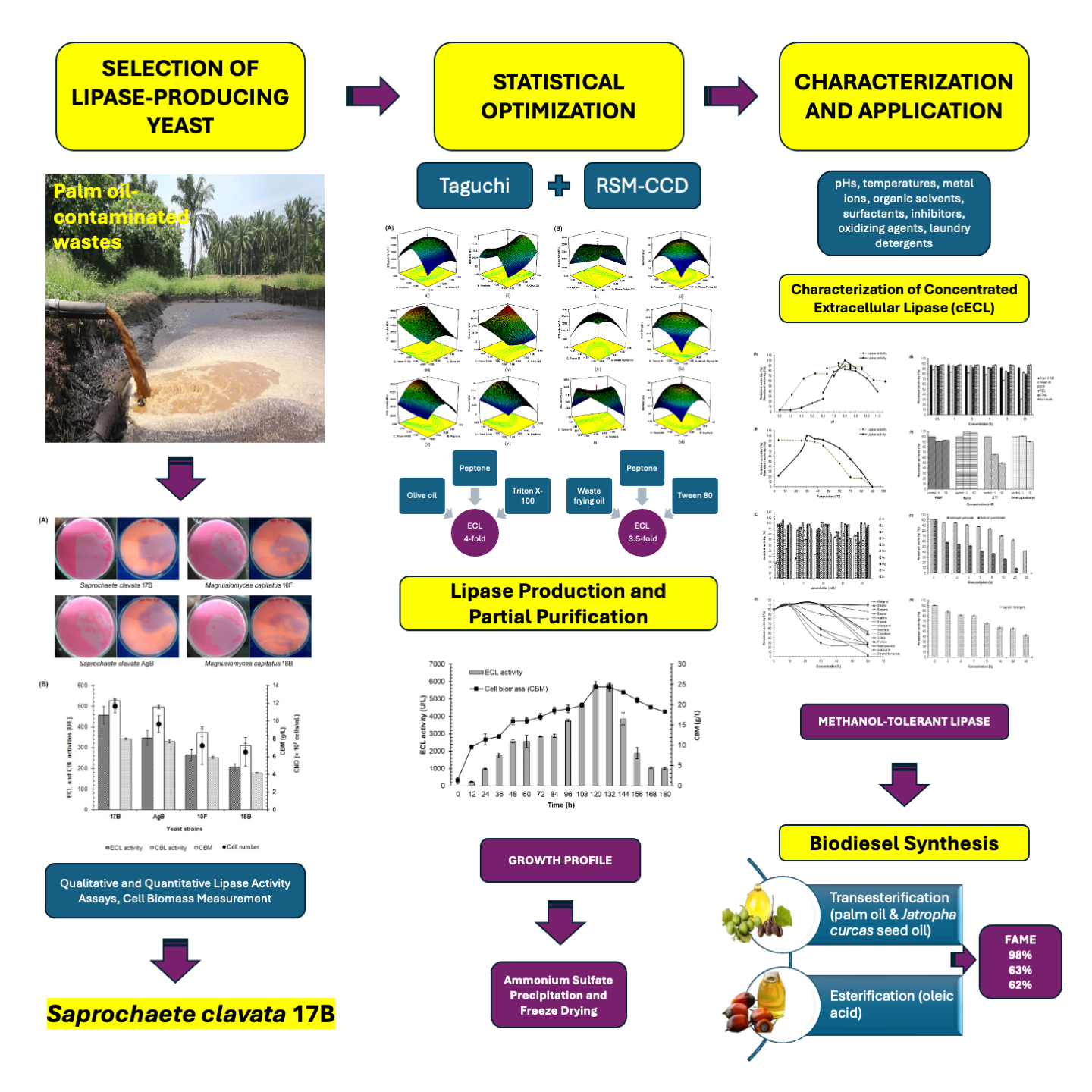
Downloads
References
R Joshi and A Kuila. Lipase and their different industrial applications: A review. Brazilian Journal of Biology 2018; 5(10), 237-247.
X Fan, X Niehus and G Sandoval. Lipases as biocatalyst for biodiesel production. Methods in Molecular Biology 2012; 861, 471-83.
P Chandra, Enespa, R Singh and PK Arora. Microbial lipases and their industrial applications: a comprehensive review. Microbial Cell Factories 2020; 19, 169.
BH Cadirci and I Yasa. An organic solvents tolerant and thermotolerant lipase from Pseudomonas fluorescens P21. Journal of Molecular Catalysis B: Enzymatic 2010; 64(3-4), 155-161.
MM Pérez, ECS Gonçalves, AC Vici, JCS Salgado and MDLTDM Polizeli. Fungal lipases: Versatile tools for white biotechnology. In: A Yadav, S Mishra, S Singh and A Gupta (Eds.). Recent Advancement in White Biotechnology Through Fungi. Fungal Biology. Springer, Cham, 2019.
M Athenaki, C Gardeli, P Diamantopoulou, SS Tchakouteu, D Sarris, A Philippoussis and S Papanikolaou. Lipids from yeasts and fungi: Physiology, production and analytical considerations. Journal of Applied Microbiology 2018; 124(2), 336-367.
J Vakhlu and A Kour. Yeast lipases: Enzyme purification, biochemical properties and gene cloning. Electronic Journal of Biotechnology 2006; 9(1), 69-85.
K Tongboriboon, B Cheirsilp and A H-Kittikun. Mixed lipases for efficient enzymatic synthesis of biodiesel from used palm oil and ethanol in a solvent-free system. Journal of Molecular Catalysis B: Enzymatic 2010. https://doi.org/10.1016/j.molcatb.2010.07.005
ASM Omar, ŽG Sanja, ASM Walid, DL Nevena, LP Olivera, MJ Sonja and ZD Knežević-Jugović. Lipase production by Yarrowia lipolytica using olive oil processing wastes as substrates. Journal of the Serbian Chemical Society 2013; 78(6), 781-794.
KA Baloch, A Upaichit and B Cheirsilp. Use of low-cost substrates for cost-effective production of extracellular and cell-bound lipases by a newly isolated yeast Dipodascus capitatus A4C. Biocatalysis and Agricultural Biotechnology 2019; 19, 101102.
M Desnos-Ollivier, C Blanc, D Garcia-Hermoso, D Hoinard, A Alanio and F Dromer. Misidentification of Saprochaete clavata as Magnusiomyces capitatus in clinical isolates: utility of internal transcribed spacer sequencing and matrix-assisted laser desorption ionization-time of flight mass spectrometry and importance of reliable databases. Journal of Clinical Microbiology 2014; 52(6), 2196-2198.
R Kaushik, RG Marwah, P Gupta, S Saran, L Saso, VS Parmar and RK Saxena. Optimization of lipase production from Aspergillus terreus by response surface methodology and its potential for synthesis of partial glycerides under solvent free conditions. Indian Journal of Microbiology 2010; 50, 456-462.
TK Gündoğdu, I Deniz, G Çalışkan, ES Şahin and N Azbar. Experimental design methods for bioengineering applications. Critical Reviews in Biotechnology 2016; 36(2), 368-388.
VL Pachapur, P Kutty, SK Brar and AA Ramirez. Enrichment of secondary wastewater sludge for production of hydrogen from crude glycerol and comparative evaluation of mono-, co- and mixed-culture systems. International Journal of Molecular Sciences 2016; 17(1), 92.
K Baloch, A Upaichit, B Cheirsilp and F Fibriana. The occurrence of triple catalytic characteristics of yeast lipases and their application prospects in biodiesel production from non-edible Jatropha curcas oil in a solvent-free system. Current Microbiology 2021; 78(5), 1914-1925.
F Fibriana, A Upaichit and B Cheirsilp. Statistical optimization for cost-effective production of yeast-bacterium cell-bound lipases using blended oily wastes and their potential applications in biodiesel synthesis and wastewater bioremediation. Fermentation 2022; 8(8), 411.
SY Lee and JS Rhee. Hydrolysis of triglyceride by the whole cell of Pseudomonas putida 3SK in two-phase batch and continuous reactor systems. Biotechnology and Bioengineering 1994; 44(4), 437-443.
S Javed, F Azeem, S Hussain, I Rasul, MH Siddique, M Riaz, M Afzal, A Kouser and H Nadeem. Bacterial lipases: A review on purification and characterization. Progress in Biophysics &Molecular Biology 2018; 132, 23-34.
F Fibriana, A Upaichit and B Cheirsilp. Low-cost production of cell-bound lipases by pure and co-culture of yeast and bacteria in palm oil mill effluent and the applications in bioremediation and biodiesel synthesis. Biomass Conversion and Biorefinery 2021; 13, 10823-10844.
MM Bradford. A rapid and sensitive method for the quantitation of microgram quantities of protein utilizing the principle of protein-dye binding. Analytical Biochemistry 1976; 72(1-2), 248-254.
GN Jarvis and JH Thiele. Qualitative Rhodamine B assay which uses tallow as a substrate for lipolytic obligately anaerobic bacteria. Journal of Microbiological Methods 1997; 29(1), 41-47.
ADS Pereira, GC Fontes-Sant’Ana and PFF Amaral. Mango agro-industrial wastes for lipase production from Yarrowia lipolytica and the potential of the fermented solid as a biocatalyst. Food and Bioproducts Processing 2019; 115, 68-77.
A Fabiszewska, B Zieniuk, K Jasińska, D Nowak, K Sasa, J Kobus and U Jankiewicz. Extracellular lipases of Yarrowia lipolytica yeast in media containing plant oils—studies supported by the design of experiment methodology. Applied Sciences 2024; 14(23), 11449.
JL Fraga, CPL Souza, ADS Pereira, ECG Aguieiras, LO de Silva, AG Torres, DG Freire and PFF Amaral. Palm oil wastes as feedstock for lipase production by Yarrowia lipolytica and biocatalyst application/reuse. 3 Biotech 2021; 11(4), 191.
JC Moreno-Pirajàn and L Giraldo. Study of immobilized Candida rugosa lipase for biodiesel fuel production from palm oil by flow microcalorimetry. Arabian Journal of Chemistry 2011; 4(1), 55-62.
TC Kuo, JF Shaw and GC Lee. Conversion of crude Jatropha curcas seed oil into biodiesel using liquid recombinant Candida rugosa lipase isozymes. Bioresource Technology 2015; 192, 54-59.
M Aghababaie, M Beheshti, A Razmjou and AK Bordbar. Enzymatic biodiesel production from crude Eruca sativa oil using Candida rugosa lipase in a solvent-free system using response surface methodology. Biofuels 2020; 11(1), 93-99.
WM Correa, WR Osório, AD Bortolozo, E Poloni and GS Padilha. Stability of Burkholderia cepacia lipase immobilized on styrene–divinylbenzene activated with glutaraldehyde, Triton X-100, and polyethylene glycol for the green synthesis of hexyl acetate. Applied Biochemistry and Biotechnology 2025; 197, 5344-5361.
V Dandavate, J Jinjala, H Keharia and D Madamwar. Production, partial purification and characterization of organic solvent tolerant lipase from Burkholderia multivorans V2 and its application for ester synthesis. Bioresource Technology 2009; 100(13), 3374-3381.
V Delorme, R Dhouib, S Canaan, F Fotiadu, F Carrière and JF Cavalier. Effects of surfactants on lipase structure, activity, and inhibition. Pharmaceutical Research 2011; 28, 1831-1842.
A Domínguez, FJ Deive, MA Sanromán and MA Longo. Effect of lipids and surfactants on extracellular lipase production by Yarrowia lipolytica. Journal of Chemical Technology and Biotechnology 2003; 78(11), 1166-1170.
S Hama, H Noda and A Kondo. How lipase technology contributes to evolution of biodiesel production using multiple feedstocks. Current Opinion in Biotechnology 2018; 50, 57-64.
S Papanikolaou, A Dimou, S Fakas, P Diamantopoulou, A Philippoussis, M Galiotou-Panayotou and G Aggelis. Biotechnological conversion of waste cooking olive oil into lipid-rich biomass using Aspergillus and Penicillium strains. Journal of Applied Microbiology 2011; 110(5), 1138-1150.
VMG Lima, N Krieger, MIM Sarquis, DA Mitchell, LP Ramos and JD Fontana. Effect of nitrogen and carbon sources on lipase production by Penicillium aurantiogriseum. Food Technology and Biotechnology 2003; 41(2), 105-110.
Ü Açıkel, M Erşan and YS Açıkel. Optimization of critical medium components using response surface methodology for lipase production by Rhizopus delemar. Food and Bioproducts Processing 2010; 88(1), 31-39.
G Sipiczki, SS Micevic, C Kohari-Farkas, ES Nagy, QD Nguyen, A Gere, and E Bujna. Effects of olive oil and Tween 80 on production of lipase by Yarrowia yeast strains. Processes 2024; 12(6), 1206.
P Thota, BP Kumar, VP Rao and V Srirangam. Studies on optimization of extracellular lipase from potential fungal strain (s) isolated from oil contaminated soil. Journal of Microbiology and Biotechnology Research 2012; 2(3), 418-425.
SM Abdulkarim and HM Ghazali. Fatty acid ratios and their relative amounts as indicators of oil stability and extent of oil deterioration during frying. Journal of Food Agriculture and Environment 2012; 10(2), 33-38.
Y Li, J Chen, DF Liang and SY Lun. Effect of nitrogen source and nitrogen concentration on the production of pyruvate by Torulopsis glabrata. Journal of Biotechnology 2000; 81(1), 27-34.
K Hlavsová, M Zarevúcka, Z Wimmer, M Macková and H Sovová. Geotrichum candidum 4013: Extracellular lipase versus cell-bound lipase from the single strain. Journal of Molecular Catalysis B: Enzymatic 2009; 61(3-4), 188-193.
M Romo-Silva, EO Flores-Camargo, GM Chávez-Camarillo and E Cristiani-Urbina. Production, purification, and characterization of extracellular lipases from Hyphopichia wangnamkhiaoensis and Yarrowia deformans. Fermentation 2024; 10(12), 595.
AA Abdelaziz, AM Abo-Kamar, ES Elkotb and LA Al-Madboly. Microbial lipases: Advances in production, purification, biochemical characterization, and multifaceted applications in industry and medicine. Microbial Cell Factories 2025; 24(1), 40.
MA Dar, MAC Loedji, AT Lunggani, TP Napitupulu, A Kanti and IM Sudiana. Statistical optimization of culture media components for enhanced production of lipase by lipolytic yeasts, Pichia sp. and Trichosporon coremiiforme using response surface methodology. Biomass Conversion and Biorefinery 2025; 15(11), 17869-17885.
TND Rocha, D Carballares, JR Guimarães, J Rocha-Martin, PW Tardioli, LRB Gonçalves and R Fernandez-Lafuente. Determination of immobilized lipase stability depends on the substrate and activity determination condition: Stress inactivations and optimal temperature as biocatalysts stability indicators. Sustainable Chemistry and Pharmacy 2022; 29, 100823.
T Siódmiak, J Dulęba, GG Haraldsson, J Siódmiak and MP Marszałł. The studies of sepharose-immobilized lipases: Combining techniques for the enhancement of activity and thermal stability. Catalysts 2023; 13(5), 887.
KN Ingenbosch, JC Vieyto-Nuñez, YB Ruiz-Blanco, C Mayer, K Hoffmann-Jacobsen and E Sanchez-Garcia. Effect of organic solvents on the structure and activity of a minimal lipase. The Journal of Organic Chemistry 2022; 87(3), 1669-1678.
SCAraujo, MRMF Ramos, ELDE Santo, LHS de Menezes, MS de Carvalho, IMDC Tavares, M Franco and JR de Oliveira. Optimization of lipase production by Penicillium roqueforti ATCC 10110 through solid-state fermentation using agro-industrial residue based on a univariate analysis. Preparative Biochemistry & Biotechnology 2022; 52(3), 325-330.
A Kumar, K Dhar, SS Kanwar and PK Arora. Lipase catalysis in organic solvents: Advantages and applications. Biological Procedures Online 2016; 18, 2.
S Hama, A Yoshida, K Nakashima, H Noda, H Fukuda and A Kondo. Surfactant-modified yeast whole-cell biocatalyst displaying lipase on cell surface for enzymatic production of structured lipids in organic media. Applied Microbiology and Biotechnology 2010; 87(2), 537-543.
ZH Nafaee, B Hajdu, É Hunyadi-Gulyás and B Gyurcsik. Hydrolytic mechanism of a metalloenzyme is modified by the nature of the coordinated metal ion. Molecules 2023; 28(14), 5511.
K Sellami, A Couvert, N Nasrallah, R Maachi, M Abouseoud and A Amrane. Peroxidase enzymes as green catalysts for bioremediation and biotechnological applications: A review. Science of The Total Environment 2022; 806, 150500.
S Sahay and D Chouhan. Study on the potential of cold-active lipases from psychrotrophic fungi for detergent formulation. Journal of Genetic Engineering and Biotechnology 2018; 16(2), 319-325.
SE Helal, HM Abdelhady, KA Abou-Taleb, MG Hassan and MM Amer. Lipase from Rhizopus oryzae R1: In-depth characterization, immobilization, and evaluation in biodiesel production. Journal of Genetic Engineering and Biotechnology 2021; 19(1), 1.
X Li, C Zhang, S Li, H Huang and Y Hu. Improving catalytic performance of Candida rugosa lipase by chemical modification with polyethylene glycol functional ionic liquids. Industrial & Engineering Chemistry Research 2015; 54(33), 8072-8079.
KE Jaeger and T Eggert. Lipases for biotechnology. Current Opinion in Biotechnology 2002; 13(4), 390-397.
Published
How to Cite
Issue
Section
License
Copyright (c) 2026 Walailak University

This work is licensed under a Creative Commons Attribution-NonCommercial-NoDerivatives 4.0 International License.





