
Comparative Study of the Nutritional Composition and Bioactive Characteristics of Low-Grade Fresh Cacao Fruit (Theobroma cacao L.) and Its Anatomical Parts
DOI:
https://doi.org/10.48048/tis.2026.13176Keywords:
Bioactive compounds, Antioxidant, Chemical composition, Tyrosinase inhibition, Low-grade cacao fruit, Proximate composition, Phenolic compounds, Antioxidant activity, Enzyme inhibitory activity, ValorizationAbstract
Large quantities of low-grade fresh cacao fruits (Theobroma cacao L.; pod weight < 250 g) are generated as by-products during cocoa processing and remain largely underutilized, despite their potential as sources of nutrients and bioactive compounds. To address this gap, this study aimed to provide the first comprehensive comparative evaluation of the proximate composition and biological activities of distinct anatomical parts of low-grade cacao fruits, including cocoa beans, pulp, pod husk, and whole fruit. Proximate composition was determined using standard analytical methods, while ethanolic extracts of each fruit part were evaluated for total phenolic content (TPC), total flavonoid content (TFC), antioxidant capacity (DPPH, ABTS, FRAP, and metal chelating assays), as well as hypoglycemic, tyrosinase inhibitory, and antimicrobial activities. The proximate composition varied significantly among the different parts, with carbohydrates (67.12% - 90.03%) being predominant, while fat (1.38% - 20.08%), ash (3.44% - 11.40%), and protein (4.64% - 8.89%) were present in lower and variable proportions. Significant differences in biological activities were observed among fruit parts (p < 0.05). Pod husk showed the highest TPC, ABTS radical scavenging activity, FRAP, metal chelating capacity, and tyrosinase inhibition, whereas cocoa beans had the greatest TFC and DPPH radical scavenging activity (p < 0.05). Pulp and pod husk exhibited strong α-amylase and α-glucosidase inhibitory effects, respectively. Pod husk extract showed the most pronounced tyrosinase inhibitory effect (IC₅₀ = 2.83 mg/mL) and the highest antimicrobial activity against Staphylococcus aureus and Staphylococcus epidermidis. These results highlight the nutritional and functional potential of low-grade cacao fruits, particularly the pod husk, as a valuable source of natural antioxidants and bioactive compounds that may be exploited in the development of functional foods, food-related products, and cosmetic formulations. However, as all biological activities were assessed exclusively under in vitro conditions, further in vivo investigations are necessary to verify their physiological efficacy, bioavailability, and safety. Overall, this study supports the sustainable valorization of cocoa by-products for potential applications in food, nutraceutical, cosmetic, and pharmaceutical sectors.
HIGHLIGHTS
- The study compares nutrients and bioactivities of cacao fruit components.
- Carbohydrates dominate, while other nutrients vary across fruit parts.
- Pod husk shows highest phenolics; beans contain the most flavonoids.
- Pod husk and beans exhibit strong antioxidant activities in all assays.
- Pod husk shows potent antidiabetic, tyrosinase, and antimicrobial effects.
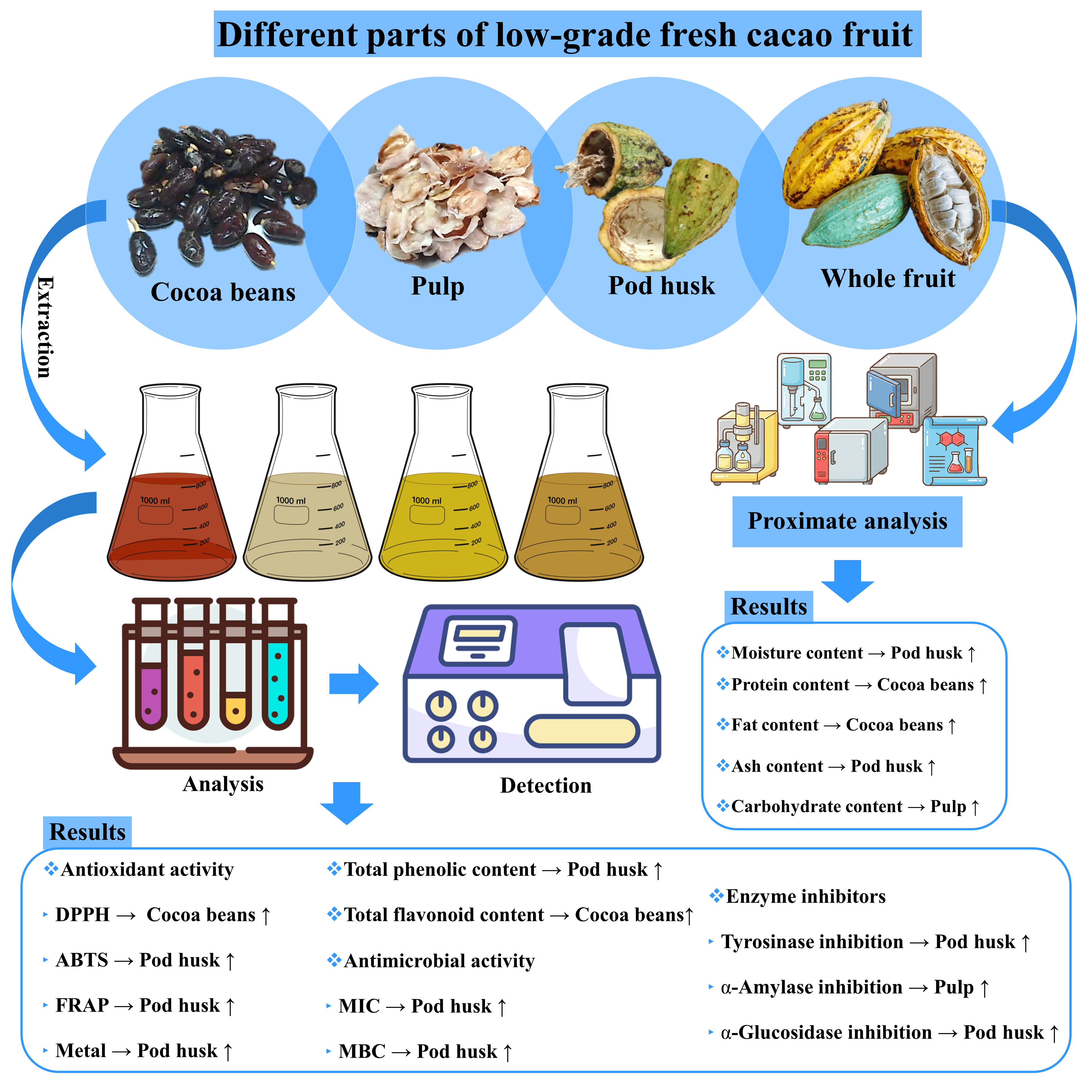
GRAPHICAL ABSTRACT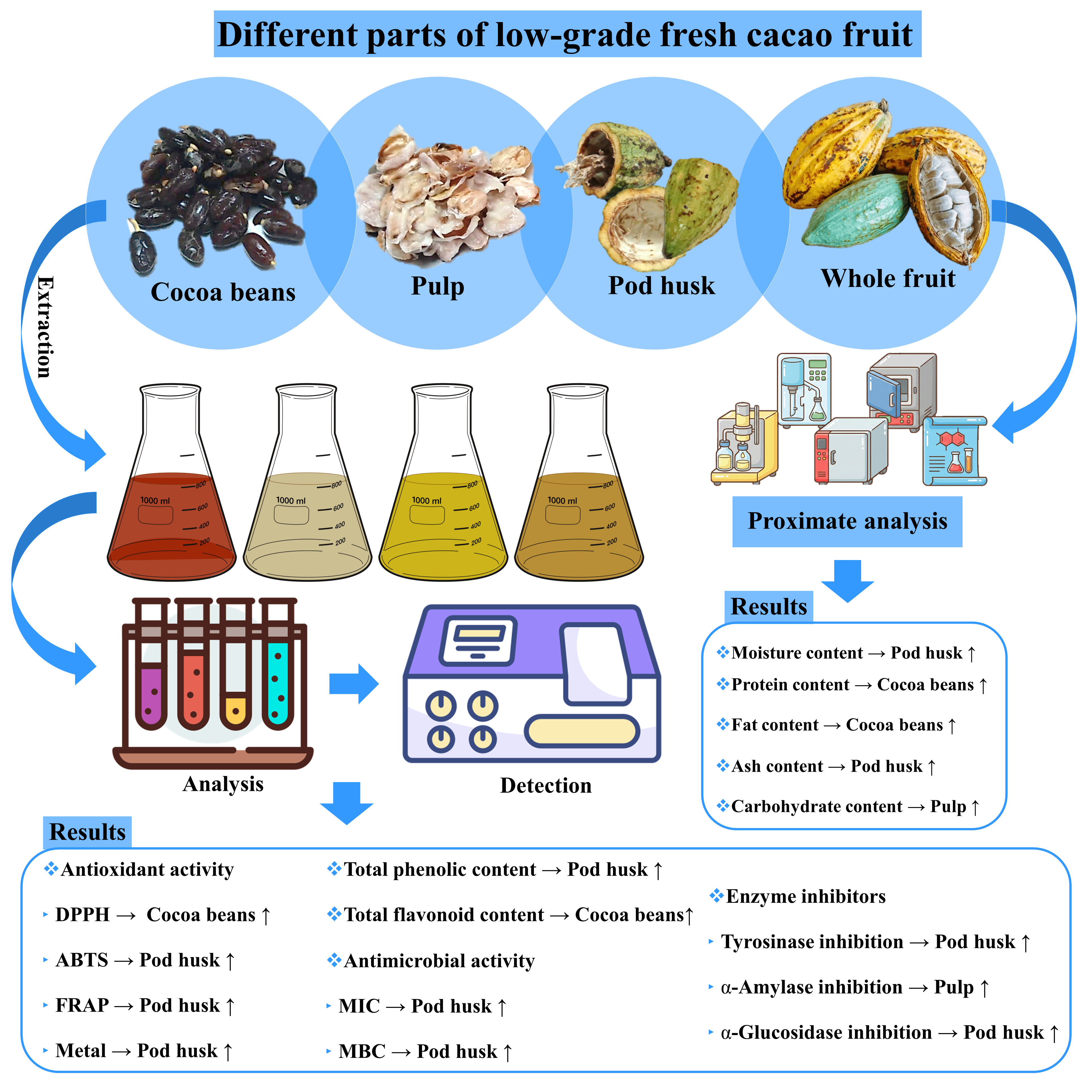
Downloads
References
JE Kongor, M Owusu and C Oduro-Yeboah. Cocoa production in the 2020s: Challenges and solutions. CABI Agriculture and Bioscience 2024; 5(1), 102.
MÁ Martín and S Ramos. Impact of cocoa flavanols on human health. Food and Chemical Toxicology 2021; 151, 112121.
ABT Sari, Y Andriana, MF Abdurrahman, D Kurnianto, AR Sefrienda, F Setiyoningrum, D Wibowo and TN Minh. Differentiation of Indonesian specialty cocoa (Theobroma cacao) varieties and origins using phenolic contents, antioxidant activities, and spectrometric fingerprints for traceability. Food Bioscience 2024; 62, 105434.
AE Irondi, AD Olawuyi, BS Lawal, AA Boligon, F Olasupo and SI Olalekan. Comparative inhibitory effects of cocoa bean and cocoa pod husk extracts on enzymes associated with hyperuricemia and hypertension in vitro. International Food Research Journal 2019; 26(2), 557-564.
TN Nan, P Tiyayon, T Weeplian, P Tomjai, P Baiya, S Thongpan, A Feepakpro, W Nortao, T Kakham, A Phanphuet, A Chuamor and S Sangsuk. Development of a fresh cacao grading system using participatory mechanisms in nan province. Area Based Development Research Journal 2023; 15(3), 188-189.
S Estarriaga-Navarro, T Valls, D Plano, C Sanmartín and N Goicoechea. Potential application of plant by-products in biomedicine: From current knowledge to future opportunities. Antioxidants 2025; 14(8), 942.
MM Rahman, MS Rahaman, MR Islam, F Rahman, FM Mithi, T Alqahtani, AA Almikhlafi, SQ Alghamdi, AS Alruwaili, MS Hossain, M Ahmed, R Das, TB Emran and MS Uddin. Role of phenolic compounds in human disease: Current knowledge and future prospects. Molecular 2021; 27(1), 233.
E Alvarez-Yanamango, D Obregon and A Ibañez. A comprehensive review of the development of green extraction methods and encapsulation of theobromine from cocoa bean shells for nutraceutical applications. Food Engineering Reviews 2025; 17(4), 1083-1104.
DFF Araújo, DDP Farias, IA Neri-Numa and GM Pastore. Polyphenols and their applications: An approach in food chemistry and innovation potential. Food Chemistry 2021; 338, 127535.
E Jurado-Beizaga, E Alvarez-Yanamango, O Herrera-Calderon and A Ibañez. Optimisation of the microwave-assisted extraction process of bioactive compounds with antioxidant activity from cocoa pod husk (Theobroma cacao L.). Sustainable Food Technology 2026. https://doi.org/10.1039/D5FB00924C
GW Latimer and Association of Official Analytical Chemists International. Official methods of analysis of AOAC International. 21st ed. AOAC International Gaithersburg, Maryland, United States, 2019.
A Thuanthong, J Patchimpet, W Visessanguan, J Panyo, S Benjakul, Y Zhang and S Klomklao. Antioxidant properties of sacha inchi (Plukenetia volubilis) shell extracts as affected by solvents used for prior decolorization. ASEAN Journal of Scientific and Technological Reports 2021; 24(3), 1-8.
A Thuanthong, S Klomklao, J Panyo and Y Zhang. In-vitro screenings for biological and antioxidant activities of aqueous extract from sacha inchi (Plukenetia volubilis L.) husks. Trends in Sciences 2023; 20(11), 6815-6815.
S Wonghirundecha, S Benjakul and P Sumpavapol. Total phenolic content, antioxidant and antimicrobial activities of stink bean (Parkia speciosa Hassk.) pod extracts. Songklanakarin Journal of Science & Technology 2014; 36(3), 302
S Klomklao and S Benjakul. Protein hydrolysates prepared from the viscera of skipjack tuna (Katsuwonus pelmamis): Antioxidative activity and functional properties. Turkish Journal of Fisheries and Aquatic Sciences 2018; 18(1), 69-79.
SM Boue, KW Daigle, MH Chen, H Cao and ML Heiman. Antidiabetic potential of purple and red rice (Oryza sativa L.) bran extracts. Journal of Agricultural and Food Chemistry 2016; 64(26), 5345-5353.
Clinical and Laboratory Standards Institute. Methods for dilution antimicrobial susceptibility tests for bacteria that grow aerobically; approved standard in Clinical and Laboratory Standards Institute Document M07-A8. Clinical and Laboratory Standards Institute, Pennsylvania, United States, 2009.
RGD Steel, JH Torrie and DA Dickey. Principles and procedures of statistics: A biometrical approach. McGraw-Hill, New York, 1997.
R Indiarto, Z Raihani, M Dewi and A Zsahra. A review of innovation in cocoa bean processing by-products. International Journal 2021; 9, 1162-1169.
BM Yapo, V Besson, BB Koubala and KL Koffi. Adding value to cacao pod husks as a potential antioxidant-dietary fiber source. American Journal of Food and Nutrition 2013; 1(3), 38-46.
M Grassia, G Salvatori, M Roberti, D Planeta and L Cinquanta. Polyphenols, methylxanthines, fatty acids and minerals in cocoa beans and cocoa products. Journal of Food Measurement and Characterization 2019; 13(3), 1721-1728.
D Sirbu, A Grimbs, M Corno, MS Ullrich and N Kuhnert. Variation of triacylglycerol profiles in unfermented and dried fermented cocoa beans of different origins. Food Research International 2018; 111, 361-370.
JA Ariza-Ortega, EA García and CT Rodríguez-Meléndez. Proximal chemical evaluation, antioxidant content and fatty acids in fermented and dried cocoa beans, roasted cocoa beans and cocoa pulp bar (Theobroma cacao L. Criollo cultivar). Revista Chilena de Nutrición 2021; 48(4), 500-506.
N Kumari, A Grimbs, RN D’Souza, SK Verma, M Corno, N Kuhnert and MS Ullrich. Origin and varietal based proteomic and peptidomic fingerprinting of Theobroma cacao in non-fermented and fermented cocoa beans. Food Research International 2018; 111, 137-147.
E Scollo, DC Neville, MJ Oruna-Concha, M Trotin and R Cramer. UHPLC-MS/MS analysis of cocoa bean proteomes from four different genotypes. Food Chemistry 2020; 303, 125244.
R Martínez, P Torres, MA Meneses, JG Figueroa, JA Pérez-Álvarez and M Viuda-Martos. Chemical, technological and in vitro antioxidant properties of cocoa (Theobroma cacao L.) co-products. Food Research International 2012; 49(1), 39-45.
RM Lamuela-Raventós, AI Romero-Pérez, C Andrés-Lacueva and A Tornero. Health effects of cocoa flavonoids. Food Science and Technology International 2005; 11(3), 159-176.
J Wollgast and E Anklam. Review on polyphenols in Theobroma cacao: Changes in composition during the manufacture of chocolate and methodology for identification and quantification. Food Research International 2000; 33, 423-447.
SOSB Rocha, MPSP Vilhena, JNS de Souza, CR Balcázar-Zumaeta, EM Castro-Alayo, AJ Pajuelo-Muñoz, BSFD Silva, MJD Trindade, GCA Chagas-Junior and NR Ferreira. Can different fermentation boxes improve the nutritional composition and the antioxidant activity of fermented and dried floodplain cocoa beans in the Brazilian amazon? Foods 2025; 14(8), 1391
N Deng, B Zheng, T Li and RH Liu. Assessment of the phenolic profiles, hypoglycemic activity, and molecular mechanism of different highland barley (Hordeum vulgare L.) varieties. International Journal of Molecular Sciences 2020; 21(4), 1175.
S Sukhikh, O Babich, A Prosekov, O Kalashnikova, S Noskova, A Bakhtiyarova, O Krol, E Tsvetkova and S Ivanova. Antidiabetic properties of plant secondary metabolites. Metabolites 2023; 13, 513.
M Tomaru, H Takano, N Osakabe, A Yasuda, KI Inoue, R Yanagisawa, T Ohwatari and H Uematsu. Dietary supplementation with cacao liquor proanthocyanidins prevents elevation of blood glucose levels in diabetic obese mice. Nutrition 2007; 23(4), 351-355.
D Grassi, C Lippi, S Necozione, G Desideri and C Ferri. Short-term administration of dark chocolate is followed by a significant increase in insulin sensitivity and a decrease in blood pressure in healthy persons. The American Journal of Clinical Nutrition 2005; 81(3), 611-614.
PA Riley. The great DOPA mystery: The source and significance of DOPA in phase I melanogenesis. Cellular and Molecular Biology 1999; 45(7), 951-960.
L Nieuweboer‐Krobotova. Hyperpigmentation: Types, diagnostics and targeted treatment options. Journal of the European Academy of Dermatology and Venereology 2013; 27, 2-4.
A Anatachodwanit, S Chanpirom, T Tree-Udom, S Kitthaweesinpoon, S Jiamphun, O Aryuwat, C Tantapakul, M P Vinardell and T Sripisut. Upcycled cocoa pod husk: A sustainable source of phenol and polyphenol ingredients for skin hydration. Whitening, and Anti-Aging Life 2025; 15(7), 1126.
AA Karim, A Azlan, A Ismail, P Hashim, SS Abd Gani, BH Zainudin and NA Abdullah. Phenolic composition, antioxidant, anti-wrinkles and tyrosinase inhibitory activities of cocoa pod extract. BMC Complementary and Alternative Medicine 2014; 14(1), 381.
L Sun, Y Guo, Y Zhang and Y Zhuang. Antioxidant and anti-tyrosinase activities of phenolic extracts from rape bee pollen and inhibitory melanogenesis by cAMP/MITF/TYR pathway in B16 mouse melanoma cells. Frontiers in Pharmacology 2017; 8, 104.
K Kulik-Siarek, M Klimek-Szczykutowicz, E Błońska-Sikora, E Zarembska and MWrzosek. Exploring the antimicrobial potential of natural substances and their applications in cosmetic formulations. Cosmetics 2024; 12(1), 1.
P Akbary. In vitro inhibitory activity of the leaf methanol extract of green tea (Camellia sinensis) against Lactococcus garvieae and Aeromonas hydrophila isolated of rainbow trout (Oncorhynchus mykiss). Advances in Microbiology 2014; 4(12), 829.
A Díaz-González, MYP Luna, ER Morales, S Saldaña-Trinidad, LR Blanco, SDL Cruz-Arreola, BY Pérez-Sariñana and JB Robles-Ocampo. Assessment of the pretreatments and bioconversion of lignocellulosic biomass recovered from the husk of the cocoa pod. Energies 2022; 15(10), 3544.
MM Cowan. Plant products as antimicrobial agents. Clinical microbiology reviews 1999; 12(4), 564-582.
E Abdollahzadeh, M Rezaei and H Hosseini. Antibacterial activity of plant essential oils and extracts: The role of thyme essential oil, nisin, and their combination to control Listeria monocytogenes inoculated in minced fish meat. Food Control 2014; 35(1), 177-183.
S Palamae, W Suyapoh, O Boonrat, B Zhang, M Amin, J Buatong and S Benjakul. Activity of Bambara groundnut seed coat extract against Shewanella species: Efficacy and mechanisms of action. Foods 2024; 13(21), 3516.
S D’Arcangelo, PD Fermo, F Diban, V Ferrone, S D’Ercole, MD Giulio and SD Lodovico. Staphylococcus aureus/Staphylococcus epidermidis from skin microbiota are balanced by Pomegranate peel extract: An eco-sustainable approach. Plos One 2024; 19(8), e0308211.
Published
How to Cite
Issue
Section
License
Copyright (c) 2026 Walailak University

This work is licensed under a Creative Commons Attribution-NonCommercial-NoDerivatives 4.0 International License.





