
Multigrain Beverage Quality Evaluation: Effects of Stabilizer Type and Sieve Size on Physical, Physicochemical, Functional, Sensory, and Nutritional Properties
DOI:
https://doi.org/10.48048/tis.2026.13153Keywords:
Cereals, Functional Characterization, Legume, Multigrain beverages, Physcial quality stability, Quality evaluation, Xanthan gumAbstract
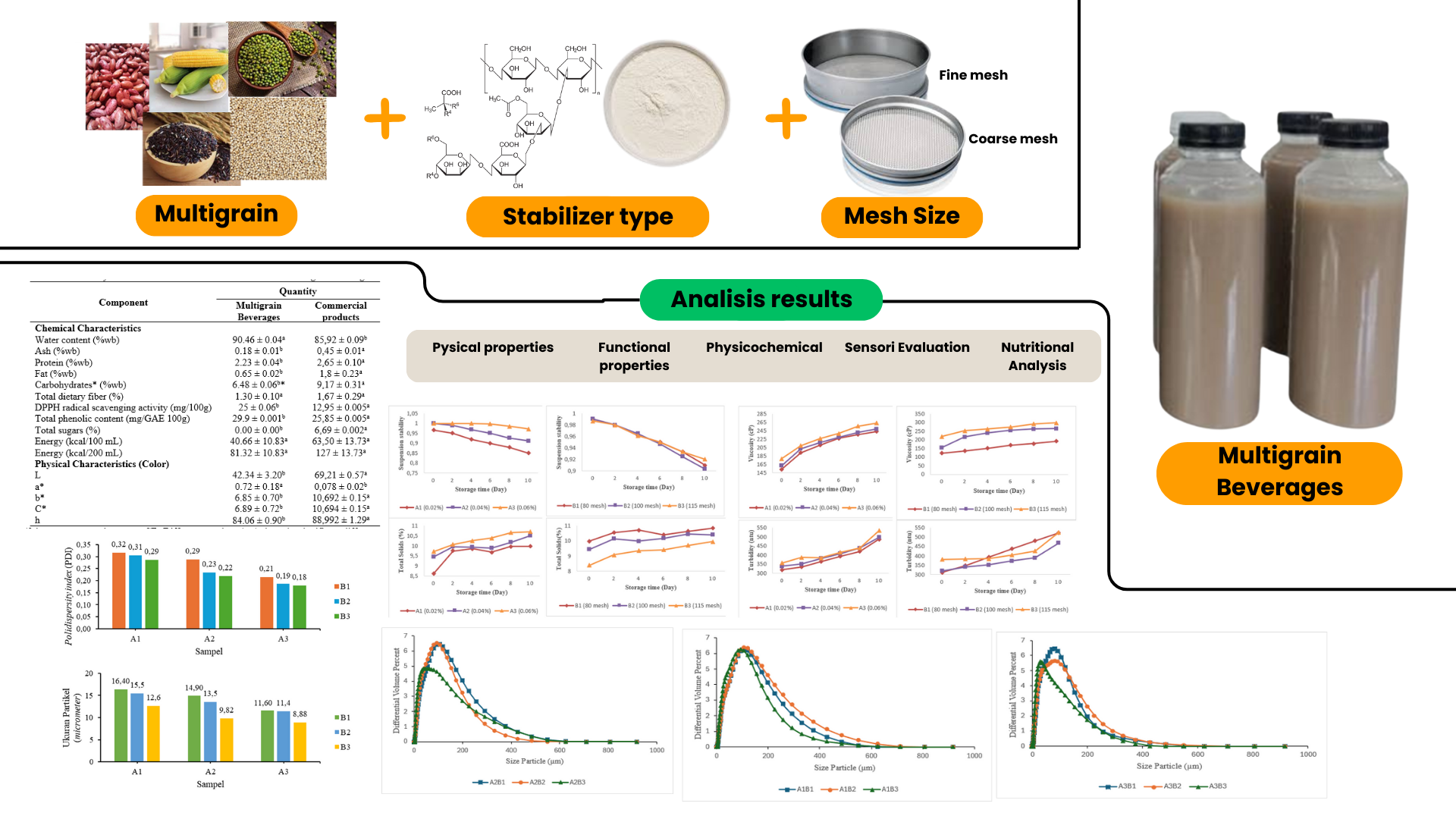
The rising consumption of packaged sweetened beverages contributes to high sugar intake among Indonesians, increasing the risk of obesity and diabetes. As lifestyle awareness improves, consumers are shifting toward functional plant-based beverages, such as multigrain beverages. These drinks combine cereals and legumes, including sorghum, red beans, mung beans, black rice, and sweet corn, providing soluble fiber, phenolics, vegetable protein, and antioxidants that support metabolic health and help stabilize blood sugar. However, developing multigrain beverages remains challenging due to physical stability issues, particularly particle size, which affects product homogeneity and overall performance. Therefore, this study aims to highlight the effect of xanthan gum stabilizer concentration and sieve size on the physical, physicochemical, functional, sensory, and nutritional quality of multigrain beverages. The formula used consists of 19.75% sweet corn, 20% red beans, 25% mung beans, 10.25% black rice, and 25% sorghum. The results showed that adding 0.06% xanthan gum and using 115-mesh sieves produced the smallest, most homogeneous particle size, thereby increasing physical stability during storage. The product also achieved a sensory acceptance level of “quite favorable” due to its cereal and nut flavors. Nutritional analysis showed an air content of 90.46%, ash 0.18%, protein 2.23%, fat 0.65%, carbohydrate 6.48%, dietary fiber 1.30%, total phenolics 29.9 mg GAE/100 g, antioxidant activity 25% inhibition, and total sugar 0%. With a sugar content of 0 g/100 mL and a dietary fiber content of 10.40% RDA, this multigrain beverage has the potential to be a low-sugar RTD alternative with a “less sugar” claim and high functional value.
HIGHLIGHTS
- Optimized multigrain beverage formulation using 0.06% xanthan gum and 115-mesh sieve achieved superior particle uniformity and suspension stability.
- Fine particle size (≈8.88 µm; PDI < 0.3) significantly improved physical stability by minimizing sedimentation and enhancing homogeneity.
- Developed beverage exhibits zero sugar content (0 g/100 mL) with appreciable dietary fiber and antioxidant activity, supporting low-glycemic functional claims.
- Integrated evaluation of physical, physicochemical, functional, sensory, and nutritional properties provides a comprehensive quality assessment approach.
- Product demonstrates promising potential as a plant-based, low-sugar RTD alternative, with acceptable sensory properties and enhanced functional value.
GRAPHICAL ABSTRACT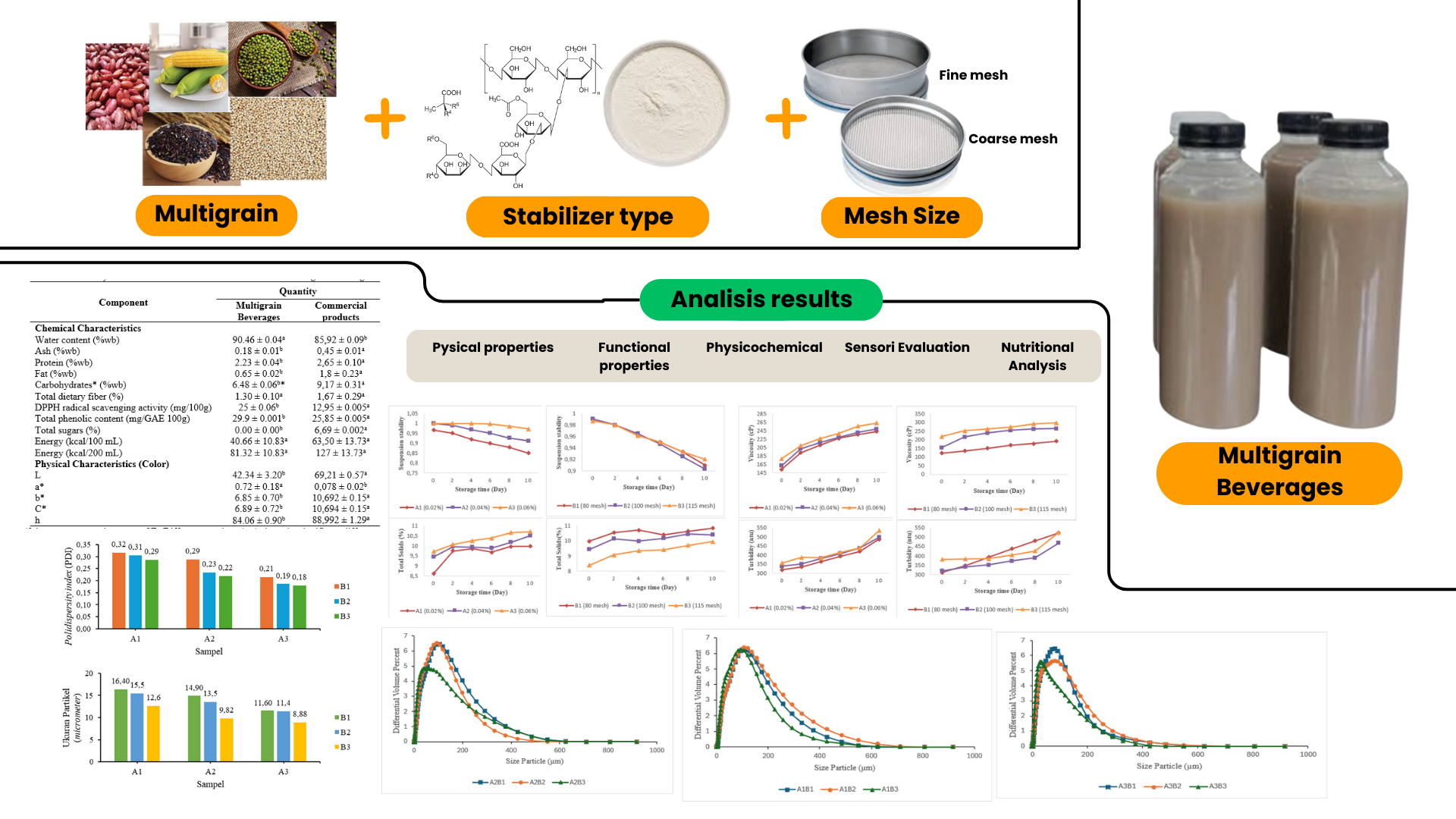
Downloads
References
TS Tseng, WT Lin, GV Gonzalez, YH Kao, LS Chen and HY Lin. Sugar intake from sweetened beverages and diabetes: A narrative review. World Journal of Diabetes 2021; 12(9), 1530-1538.
KR Santosa and I Yuadi. Analisis bibliometrik pajak minuman berpemanis dalam kemasan (MBDK). Transparansi: Jurnal Ilmiah Ilmu Administrasi 2023; 6(1), 95-109.
ML Hambali. The Urgency of sugar sweetened beverages excise policy: A literature study for implementation in Indonesia. BISNIS & BIROKRASI: Jurnal Ilmu Administrasi dan Organisasi 2022; 29(1), 20-31.
Atmarita, AB Jahari, Sudikno and M Soekatri. Asupan gula, garam dan lemak di Indonesia: Analisis survei konsumsi makanan individu (SKMI) 2014. Journal of the Indonesian Nutrition Association 2016; 39(1), 1-14.
A Budreviciute, S Damiati, DK Sabir, K Onder, P Schuller-Goetzburg, G Plakys, A Katileviciute, S Khoja and R Kodzius. Management and prevention strategies for non-communicable diseases (NCDS) and their risk factors. Frontiers in Public Health 2020; 8, 574111.
SS Wachyuni and K Wiweka. The changes in food consumption behavior: A rapid observational study of covid-19 pandemic. International Journal of Management, Innovation & Entrepreneurial Research 2020; 6(2), 77-87.
SS Arya and NK Shakya. High fiber, low glycaemic index (GI) prebiotic multigrain functional beverage from barnyard, foxtail and kodo millet. LWT 2021; 135, 109991.
FA Afandi, CH Wijaya, DN Faridah, NE Suyatma and A Jayanegara. Evaluation of various starchy foods: A systematic review and meta-analysis on chemical properties affecting the glycemic index values based on in vitro and in vivo experiments. Foods 2021; 10(2), 364.
ID Cahyani and Purbowati. Nilai indeks glikemik sereal jagung dengan penambahan kacang hijau dan kacang merah. Sport and Nutrition Journal 2022; 4(1), 13-19.
S Harini. 2013, Perbedaan nilai indeks glikemik beras hitam (Oryza Sativa L.Indica), beras merah (Oryza Nivara) dan beras putih (Oryza Sativa). Master Thesis. Universitas Brawijaya Malang, Jawa Timur, Indonesia.
E Daniels, N Wulandari and DN Faridah. Glycemic index of sweet corn and the characteristics of their flakes by adding the red bean. Jurnal Teknologi dan Industri Pangan 2023; 34(2), 233-241.
CG Fernandes, SK Sonawane and SS Arya. Cereal based functional beverages: A review. Journal of Microbiology, Biotechnology and Food Sciences 2018; 8(3), 914-919.
A Satija and FB Hu. Plant-based diets and cardiovascular health. Trends in Cardiovascular Medicine 2018; 28(7), 437-441.
A Gupta, N Sanwal, MA Bareen, S Barua, N Sharma, OJ Olatunji, NP Nirmal and JK Sahu. Trends in functional beverages: Functional ingredients, processing technologies, stability, health benefits, and consumer perspective. Food Research International 2023; 170, 113046.
GC Dacanal. Particle size and morphology in food science and technology: A review. International Journal of Food Science and Technology 2024; 59(10), 6821-6833.
A Durand, GV Franks and RW Hosken. Particle sizes and stability of UHT bovine, cereal and grain milks. Food Hydrocolloids 2003; 17(5), 671-678.
S Sethi, SK Tyagi and RK Anurag. Plant-based milk alternatives an emerging segment of functional beverages: A review. Journal of Food Science and Technology 2016; 53(9), 3408-3423.
S Akkarachaneeyakorn and S Tinrat. Effects of types and amounts of stabilizers on physical and sensory characteristics of cloudy ready-to-drink mulberry fruit juice. Food Science & Nutrition 2015; 3(3), 213-220.
IT Anova, K Kamsina, F Firdausni, YH Diza and Y Yurnita. Pengaruh ukuran saringan dan konsentrasi gula terhadap sifat fisika kimia konsentrat sari buah kundur (Benincasa Hispida (Thunb.) Cogn). Jurnal Litbang Industri 2021; 11(2), 145-150.
LA Wickramaarachchi, DU Rajawardana, MMNP Gunasekara, HMT Herath and MA Jayasinghe. Development and evaluation of physico-chemical, sensorial, and shelf- life of grain-milk beverages. Journal of Cereal Science 2024; 116, 103875.
CG Fernandes, SK Sonawane and SS Arya. Optimization and modeling of novel multigrain beverage: Effect of food additives on physicochemical and functional properties. Journal of Food Processing and Preservation 2019; 43(10), 14151.
I Kusumawaty, D Fardiaz, N Andarwulan, S Widowati and S Budijanto. Stabilisasi bekatul dengan ekstruder ulir ganda menggunakan response surface methodology. Jurnal Penelitian Pascapanen Pertanian 2013; 10(1), 27-37.
IP Wardani, Sumardi and B Hermanto. Pengaruh penambahan lidah buaya (Aloevera Sp) terhadap sifat fisik dan kimia susu sapi segar dan susu kedelai. Jurnal Bioproses Komoditas Tropis 2013; 1(1), 80-87.
Q Wang, Y Zhu, Z Ji and J Chen. Lubrication and sensory properties of emulsion systems and effects of droplet size distribution. Foods 2021; 10(12), 3024.
E Winarno, R Widyasaputra and M Ulfah. Pembuatan minuman sari beras dengan kombinasi rempah jahe putih. Agroforetech 2023; 1(1), 591-604.
S Sonawane and SS Arya. Antioxidant activity of jambhul, wood apple, ambadi and ambat chukka: An indigenous lesser known fruits and vegetables of India. Advance Journal of Food Science and Technology 2013; 5(3), 270-275.
SN Amalia, Rimbawan and M Dewi. Glycemic index values of sweet corn (Zea Mays Saccharata Sturt) with some kind of processing. Journal of Nutrition and Food 2011; 6(1), 36-41.
S El-Safy, F Rabab, HA Salem and E Mukhtar. The impact of soaking and germination on chemical composition, carbohydrate fractions, digestibility, antinutritional factors and minerals content of some legumes and cereals grain seeds. Alexandria Science Exchange Journal 2013; 34(4), 499-513.
BA Susila. Keunggulan mutu gizi dan sifat fungsional sorgum (Sorghum vulgare). IPB University Scientific Repository, Indonesia, 2005, 527-534.
HA Pangastuti, DR Affandi and D Ishartani. Karakterisasi sifat fisik dan kimia tepung kacang merah (Phaseolus Vulgaris L.) dengan beberapa perlakuan pendahuluan. Jurnal Teknosains Pangan 2013; 2(1), 20-29.
TK Dewi, DM Margana and S Buchturi. Padi Hitam Jawa Barat. Polsub Press, Indonesia, 2018.
S Ahmad, G Nasir, ZRAA Azad, ZA Khan, K Jan and K Bashir. Optimisation of multigrain seera from sorghum, green gram and finger millet: Effect of ingredients on functional, structural and thermal properties. Journal of Food Science and Technology 2024; 61,471-480.
E Dickinson. Hydrocolloids at interfaces and the influence on the properties of dispersed systems. Food Hydrocolloids 2003; 17(1), 25-39.
JN BeMiller. Carbohydrate chemistry for food scientists. Elsevier 2019; 16(1), 159-189.
T Schmid, M Kinner, L Stäheli, S Steinegger, L Hollenstein, D de la Gala and N Müller. Effect of press cake-based particles on quality and stability of plant oil emulsions. Foods 2024; 13(18), 2969.
A Arif, A Budiyanto and H Hoerudin. Glicemic Index of foods and its affecting factors. Jurnal Penelitian dan Pengembangan Pertanian 2013; 32(3), 91-99.
MM Asty and M Gumilar. Development of enteral formula ‘nutrigrain’ based on multigrain flour for diabetes mellitus patients. Jurnal Gizi dan Dietetik 2025; 4(1), 44-56.
P Pontieri, J Troisi, M Calcagnile, SR Bean, M Tilley, F Aramouni, A Boffa, G Pepe, P Campiglia, FD Giudice, AL Chessa, D Smolensky, M Aletta, P Alifano and LD Giudice. Chemical composition, fatty acid and mineral content of food-grade white, red and black sorghum varieties grown in the mediterranean environment. Foods 2022; 11(3), 436.
I Jonuškienė, E Davicijonaitė, M Vaškevičiūtė, I Kala, R Stankevičienė, K Kantminienė and I Tumosienė. Sustainable production and antioxidant activity of bacterial xanthan gum. Molecules 2025; 30(13), 2734.
Yunida, M. Totong Kamaluddin, Theodorus, and S. Mangunsong. Formulasi dan karakterisasi nanopartikel kafein hasil isolasi dari biji kopi robusta (Coffea Canephora var. Robusta). Jurnal Mandala Pharmacon Indonesia 2021; 7(1), 47-59.
B Milovanovic, I Djekic, J Miocinovic, V Djordjevic, JM Lorenzo, FJ Barba, D Mörlein and I Tomasevic. What is the color of milk and dairy products and how is it measured? Foods 2020; 9(11), 1629.
MT Veronica, IMB Ilmi and YC Octaria. Kandungan gula sangat tinggi dalam minuman teh susu dengan Topping boba. Amerta Nutrition 2022; 6(1) 171-176.
SG Anggrahini, DS Rosdiana, SF Syihab and HM Insani. Analisis jalur penggunaan label gizi, konsumsi minuman kemasan, dan status gizi remaja di Kecamatan Pasirkaliki, Kota Bandung. Jurnal SAGO Gizi dan Kesehatan 2025; 6(2), 403-410.
Published
How to Cite
Issue
Section
License
Copyright (c) 2026 Walailak University

This work is licensed under a Creative Commons Attribution-NonCommercial-NoDerivatives 4.0 International License.





