
Comparative study of Sugarcane Bagasse Pyrolysis Methods on Phosphate Ion Adsorption Efficiency: Optimization with BBD-RSM
DOI:
https://doi.org/10.48048/tis.2026.13079Keywords:
Adsorption, Waste, Sugarcane bagasse, Phosphate, Pyrolysis, Differential Pulse Voltammetry (DPV), Response Surface Methodology (RSM)Abstract
Utilization of sugarcane bagasse waste as an adsorbent because it has a high silica content, is environmentally friendly, and has a high surface area. Sugarcane bagasse is used as an adsorbent with oxygen pyrolysis (SB@PO) and N2 (SB@PN) methods, both of which are applied to reduce phosphate waste in water. The adsorption method was chosen to reduce phosphate levels in wastewater. Adsorption parameters include adsorbent mass, contact time, and initial concentration of phosphate solution. Response Surface Methodology (RSM) and Box-Behnken design (BBD) methods are used to optimize the process. Phosphate levels are measured using Differential Pulse Voltammetry (DPV). The characterizations carried out include: FTIR, XRD, FESEM-EDX, and N2 adsorption-desorption. SB@PO obtained material with a crystalline structure and rich in silica while SB@PN obtained material rich in carbon and amorphous structure. The adsorption optimization results showed that SB@PO was superior to SB@PN, namely the percentage removal and adsorption capacity were 95.97% and 43.48 mg/g for SB@PO, while SB@PN was optimal with the percentage removal and adsorption capacity of 65.75% and 2.2×10⁻⁴ mg/g, respectively.
HIGHLIGHTS
- Sugarcane bagasse was transformed into SB@PO and SB@PN adsorbent for phosphate adsorption.
- The different pyrolysis method with variations in oxygen (SB@PO) at 500 °C and nitrogen (SB@PN) at 400 °C.
- The specific surface area of SB@PO at 236.971 m2/g and SB@PN at 0.139 m2/g.
- The phosphate removal uses the adsorption method with measurements using the voltammetry method, optimized using the BBD-RSM approach.
- The phosphate recovery with SB@PO adsorbent of 95.97% and SB@PN adsorbent of 65.75%.
- SB@PO provides the best adsorption performances with an adsorption capacity of 43.48 mg/g compared to SB@PN of 2.2×10⁻⁴ mg/g.
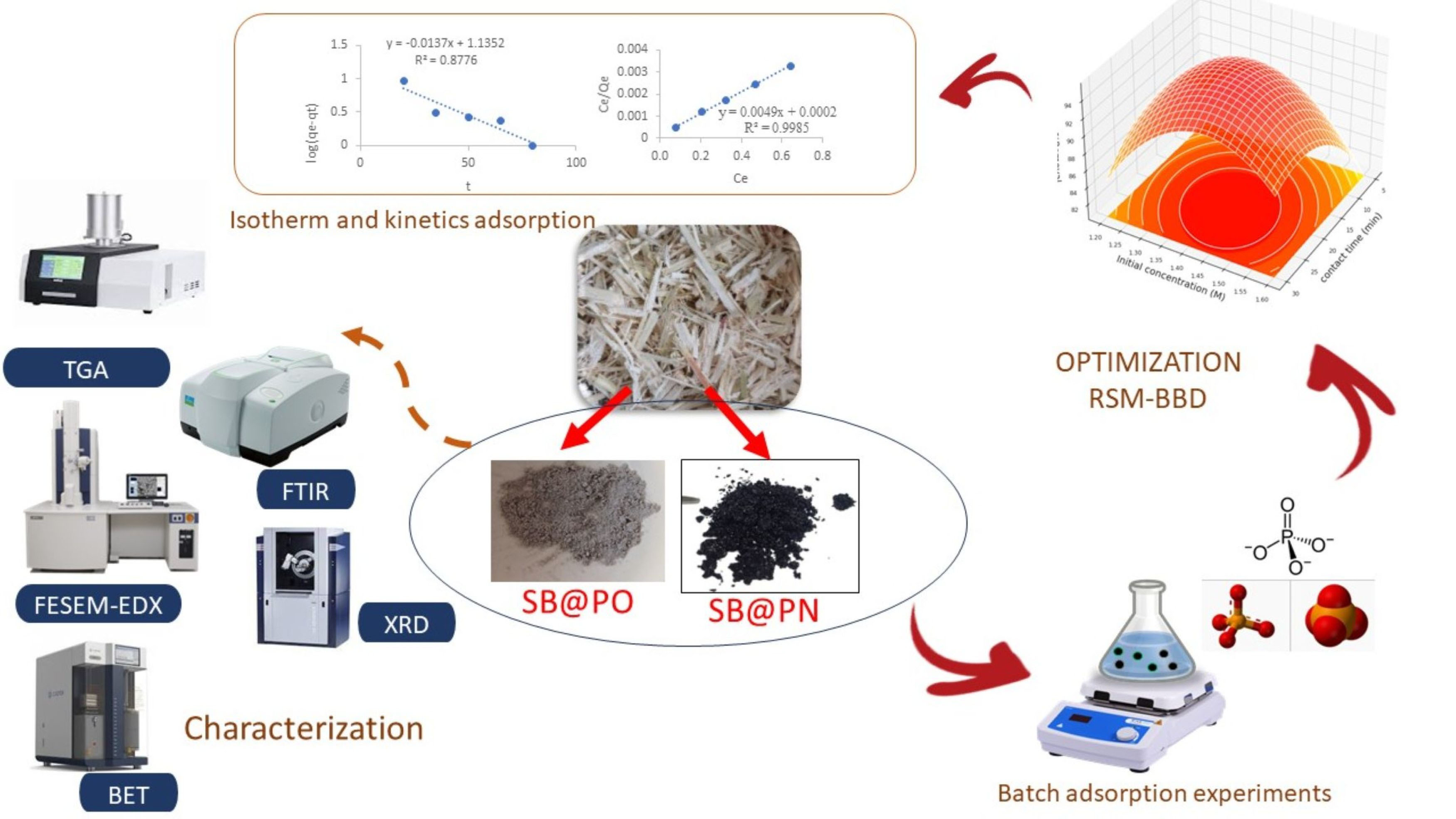
GRAPHICAL ABSTRACT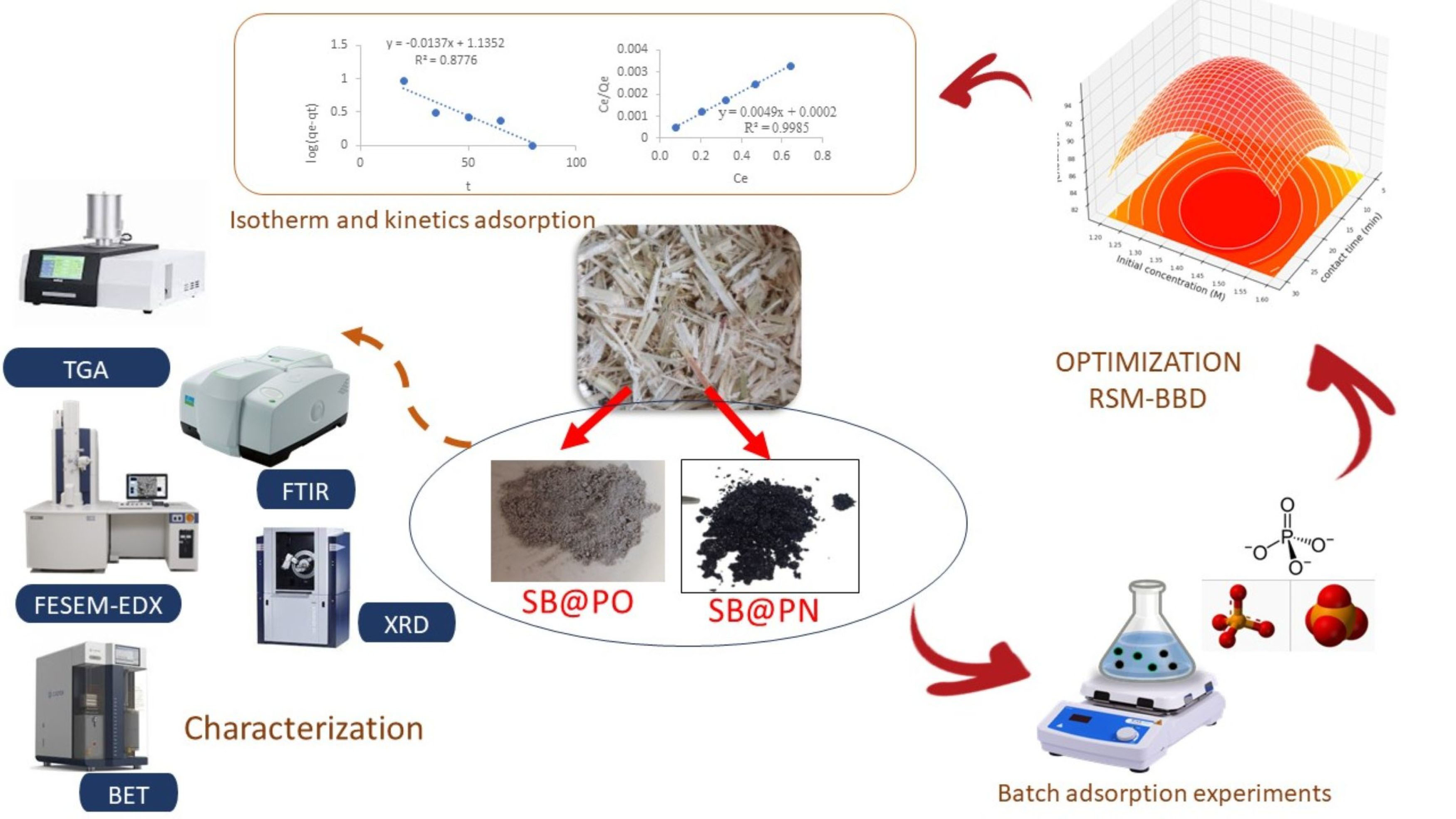
Downloads
References
SM Beyan, SV Prabhu, TT Sissay and AA Getahun. Sugarcane bagasse based activated carbon preparation and its adsorption efficacy on removal of BOD and COD from textile effluents: RSM based modeling, optimization and kinetic aspects. Bioresource Technology Reports 2021; 14, 100664.
AND Nasti. Carbon composite of NiO hydrothermal impregnation from sugarcane bagasse and its electrochemical properties. Jurnal Rekayasa Proses 2023; 17(2), 236-244.
PN Onwuachi-Iheagwara. Bio-adsorbent of Jatropha curcus oil in sugar cane bagasse ash for the synthesis of biodiesel catalyzed by calcined Sartaj maize stalk powder (CSMSP). Case Studies in Chemical and Environmental Engineering 2024; 10, 100879.
F Mohamed. Activated carbon derived from sugarcane and modified with natural zeolite for efficient adsorption of methylene blue dye: Experimentally and theoretically approaches. Scientific Reports 2022; 12(1), 18031.
J Sarkar, D Mridha, J Sarkar, JT Orasugh, B Gangopadhyay, D Chattopadhyay, T Roychowdhury and K Acharya. Synthesis of nanosilica from agricultural wastes and its multifaceted applications: A review. Biocatalysis and Agricultural Biotechnology 2021; 37, 102175.
N Divyangkumar and NL Panwar. Optimizing high performance biochar from sugarcane bagasse and corncob via vacuum pyrolysis. Energy 360 2025; 3, 100014. .
SC Pinheiro, OA Paiva, RDT Filho and GC Cordeiro. Minimizing heterogeneity of sugarcane bagasse ash by silica extraction via sol gel process. Next Materials 2025; 9, 101171.
MB Bahrodin, NS Zaidi, A Kadier, N Hussein, A Syafiuddin and R Boopathy. A novel natural active coagulant agent extracted from the sugarcane bagasse for wastewater treatment. Applied Sciences 2022; 12(16), 7972.
CA Okonkwo, MC Menkiti, IA Obiora-Okafo and ON Ezenwa. Controlled pyrolysis of sugarcane bagasse enhanced mesoporous carbon for improving capacitance of supercapacitor electrode. Biomass Bioenergy 2021; 146, 105996.
NT Miranda, IL Motta, RM Filho and MRW Maciel. Sugarcane bagasse pyrolysis: A review of operating conditions and products properties. Renewable and Sustainable Energy Reviews 2021; 149, 111394.
A Manyatshe, ZED Cele, MO Balogun, TTI Nkambule and TAM Msagati. Chitosan modified sugarcane bagasse biochar for the adsorption of inorganic phosphate ions from aqueous solution. Journal of Environmental Chemical Engineering 2022; 10(5), 108243.
TC Malone and A Newton. The globalization of cultural eutrophication in the coastal ocean: Causes and consequences. Frontiers in Marine Science 2020; 7, 670.
G Xin, X Zhou, P Zuo, W Ma, C Liu and Y Zhao. Enhanced the simultaneous removal and recovery of phosphorus in induced crystallization coupled biological phosphorus removal process. Green Technologies and Sustainability 2024; 2(2), 100088.
W Gong, C Qi, L Huang, Z Tian, Z Huang, C Tao, H Lin, L Guo and Z Yu. Adsorption of phosphorus in wastewater by lanthanum-modified magnetic sewage sludge biochar. Desalination and Water Treatment 2024; 320, 100603.
S Sawasdee and Watcharabundit. Mechanistic insights into adsorption of methylene blue and methyl orange using cassava rhizome activated carbon: Adsorption, characterization and reusability. Trends in Sciences 2025; 22(12), 10751.
Q Wu, J Zhang and S Wang. Preparation and application of modified activated carbon for effective removal of phosphorus from glyphosate by-product salt. Desalination and Water Treatment 2023; 313, 152-161.
YL Ni’mah, S Suprapto, APK Subandi, NE Yuningsih and AC Pertiwi. The optimization of silica gel synthesis from chemical bottle waste using response surface methodology. Arabian Journal of Chemistry 2022; 15(12), 104329.
S Inna, MDD Ornella, B Arthur and K Richard. Phophorus and potassium recovery from cotton shell and sugarcane bagasse ashes. Sustainable Chemistry One World 2025; 5, 100037.
NE Yuningsih. Adsorption of malachite green using activated carbon from mangosteen peel: Optimization using box-Behnken design. Journal of Renewable Materials 2024; 12(5), 981-992.
YL Ni’mah, AC Pertiwi and S Suprapto. Adsorption of Cu(II) on silica gel synthesized from chemical bottle glass waste: Response surface methodology-Box Behnken design optimization. South African Journal of Chemical Engineering 2024; 48, 55-62.
YL Ni’mah, NE Yuningsih and S Suprapto. The adsorption of Pb(II) using silica gel synthesized from chemical bottle waste: Optimization using box-Behnken design. Journal of Renewable Materials 2023; 11(6), 2913-2924.
HA El-Raheem, R Helim, RYA Hassan, AFA Youssef, HK Youssoufi and C Kraiya. Electrochemical methods for the detection of heavy metal ions: From sensors to biosensors. Microchemical Journal 2024; 207, 112086.
D Li. Selective adsorption of phosphate by 2D thin-bladed ZIF-L in phosphate mining wastewater: An investigation of single phosphorus and phosphorus-chromium composite systems. Chemical Engineering Research and Design 2025; 223, 209-219.
GF David. Coupled effect of pyrolysis temperature and HNO3 pretreatment on sugarcane bagasse fast pyrolysis for levoglucosan production. Biomass Bioenergy 2025; 203, 108372.
A Boonmee and K Jarukumjorn. Preparation and characterization of silica nanoparticles from sugarcane bagasse ash for using as a filler in natural rubber composites. Polymer Bulletin 2020; 77(7), 3457-3472.
E Marguí, I Queralt and E De Almeida. X-ray fluorescence spectrometry for environmental analysis: Basic principles, instrumentation, applications and recent trends. Chemosphere 2022; 303, 135006.
SM Torres, VED Lima, PDA Basto, NTDA Júnior and AAM Neto. Assessing the pozzolanic activity of sugarcane bagasse ash using X-ray diffraction. Construction and Building Materials 2020; 264, 120684.
M Yadav, V Dwibedi, S Sharma and N George. Biogenic silica nanoparticles from agro-waste: Properties, mechanism of extraction and applications in environmental sustainability. Journal of Environmental Chemical Engineering 2022; 10(6), 108550.
JSD Jeremias, JY Lin, MLP Dalida and MC Lu. Abatement technologies for copper containing industrial wastewater effluents - A review. Journal of environmental chemical engineering 2023; 11(2), 109336.
YL Ni’mah, S Suprapto, APK Subandi, NE Yuningsih and AC Pertiwi. The optimization of silica gel synthesis from chemical bottle waste using response surface methodology. Arabian Journal of Chemistry 2022; 15(12), 104329.
SS Rawat and A Sharma. Sugarcane bagasse ash - The future composite material: A literature review. Materials Today: Proceedings 2023; 75, 14-22.
B Biswas. Phosphorus adsorption using chemical and metal chloride activated biochars: Isotherms, kinetics and mechanism study. Heliyon 2023; 9(9), e19830.
WY El-Nazer, TE Farrag, MS Beheary and RA Mansour. Biosynthesis, characterization, and utilization of rice husk nanosilica in the adsorption of heavy metals from simulated wastewater. Next Materials 2025; 9, 101219.
Published
How to Cite
Issue
Section
License
Copyright (c) 2026 Walailak University

This work is licensed under a Creative Commons Attribution-NonCommercial-NoDerivatives 4.0 International License.





