
Process Optimization and Kinetics Study of Metals Leaching from Spent Hydrocracking Catalysts by Cell-free Medium Filtrate of Aspergillus aculeatus
DOI:
https://doi.org/10.48048/tis.2026.13063Keywords:
Fungal leaching, Heavy metal, Box-behnken experimental design, Spent hydrocracking catalyst, Shrink core modelAbstract
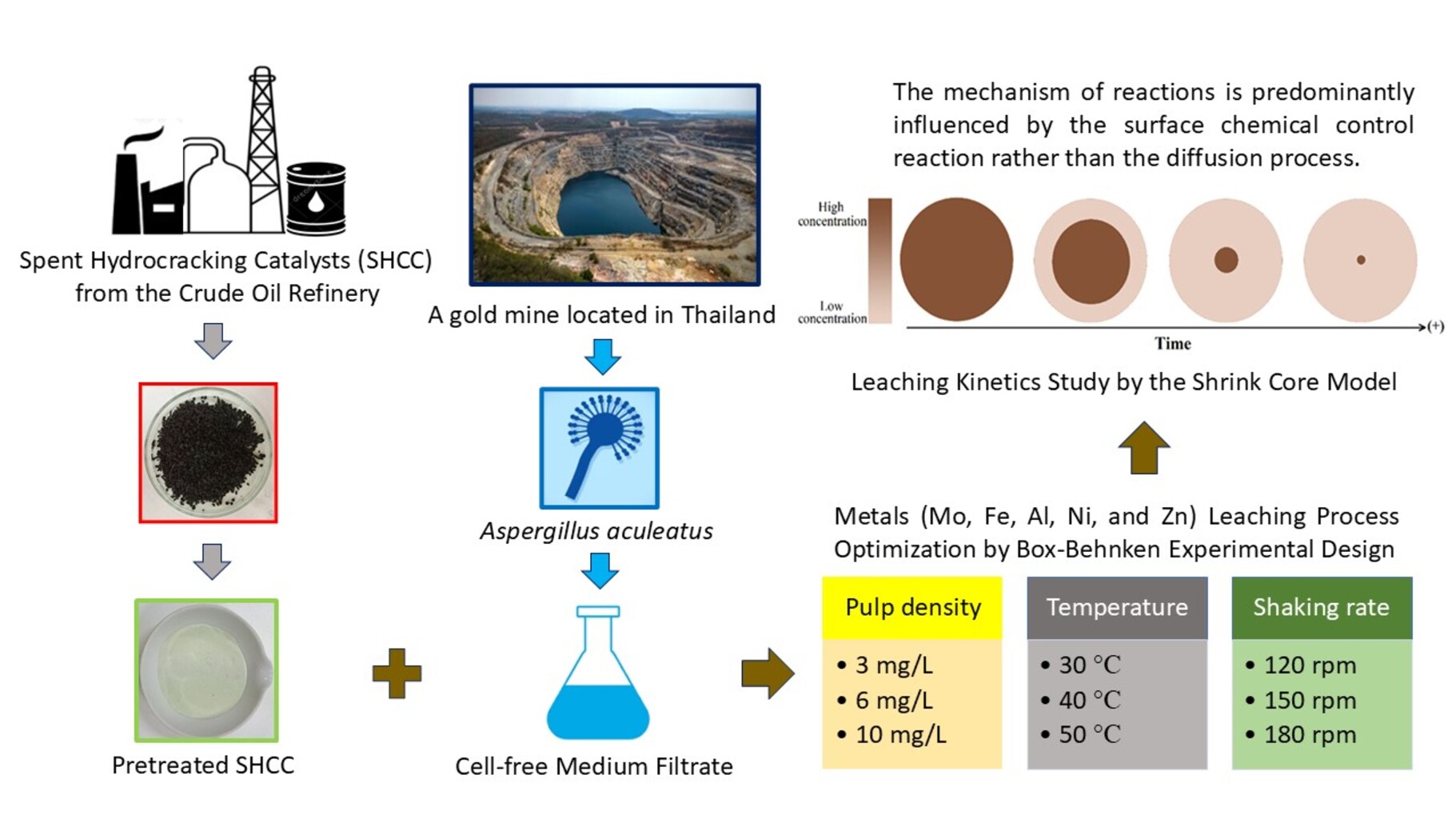
Hydrocracking catalysts (HCC) are widely used in petrochemical refinery catalytic processes. Although these catalysts are frequently reusable, the efficacy of HCC gradually declines. This procedure leads to the production of a large amount of spent hydrocracking catalyst (SHCC), which contains valuable metals as well as hazardous chemical wastes. The pyro-hydro-metallurgical approach for metal restoration from catalyst waste is insufficient for environmental sustainability. The application of biological techniques is a more environmentally friendly strategy. Fungal leaching has emerged as an alternative method for the recovery of metals. Although metal recoveries were moderate, the use of cell-free fungal filtrate enabled rapid leaching under mild conditions, highlighting its potential as a greener and operationally simpler alternative to conventional whole-cell bioleaching. Aspergillus aculeatus was isolated from contaminated soil of a gold mine located in Thailand. The filtrate of the fungal culture medium was utilized for metal leaching, and this experiment was carried out using a Box-Behnken experimental design. The optimum processes included a spent catalyst density of 10% (w/v), a temperature of 50 °C, and a shaking rate of 148 rpm for 180 min, with the catalyst powder size being less than 150 µm. The predicted highest metal recovery rates of 7.98% for Al, 5.27% for Ni, 24.55% for Mo, 11.92% for Fe, and 0.93% for Zn aligned precisely with the actual experimental results. The comprehension of kinetics through the application of the shrink core model indicates that the mechanism of reactions is predominantly influenced by the surface chemical control reaction rather than the diffusion process. The leaching rates of Mo, Fe, Al, Ni, and Zn followed a descending order from highest to lowest.
HIGHLIGHTS
- Aspergillus aculeatus culture filtrate provided an environmentally friendly alternative for metal leaching from hazardous spent hydrocracking catalysts.
- Organic acids (citric and oxalic acids) produced by fungal metabolism promoted metal dissolution through acidolysis and complexolysis mechanisms.
- Response surface methodology optimized leaching conditions and validated reliable prediction of multi-metal recovery.
- The process offers potential as a sustainable pre-treatment strategy for refinery catalyst waste valorization.
GRAPHICAL ABSTRACT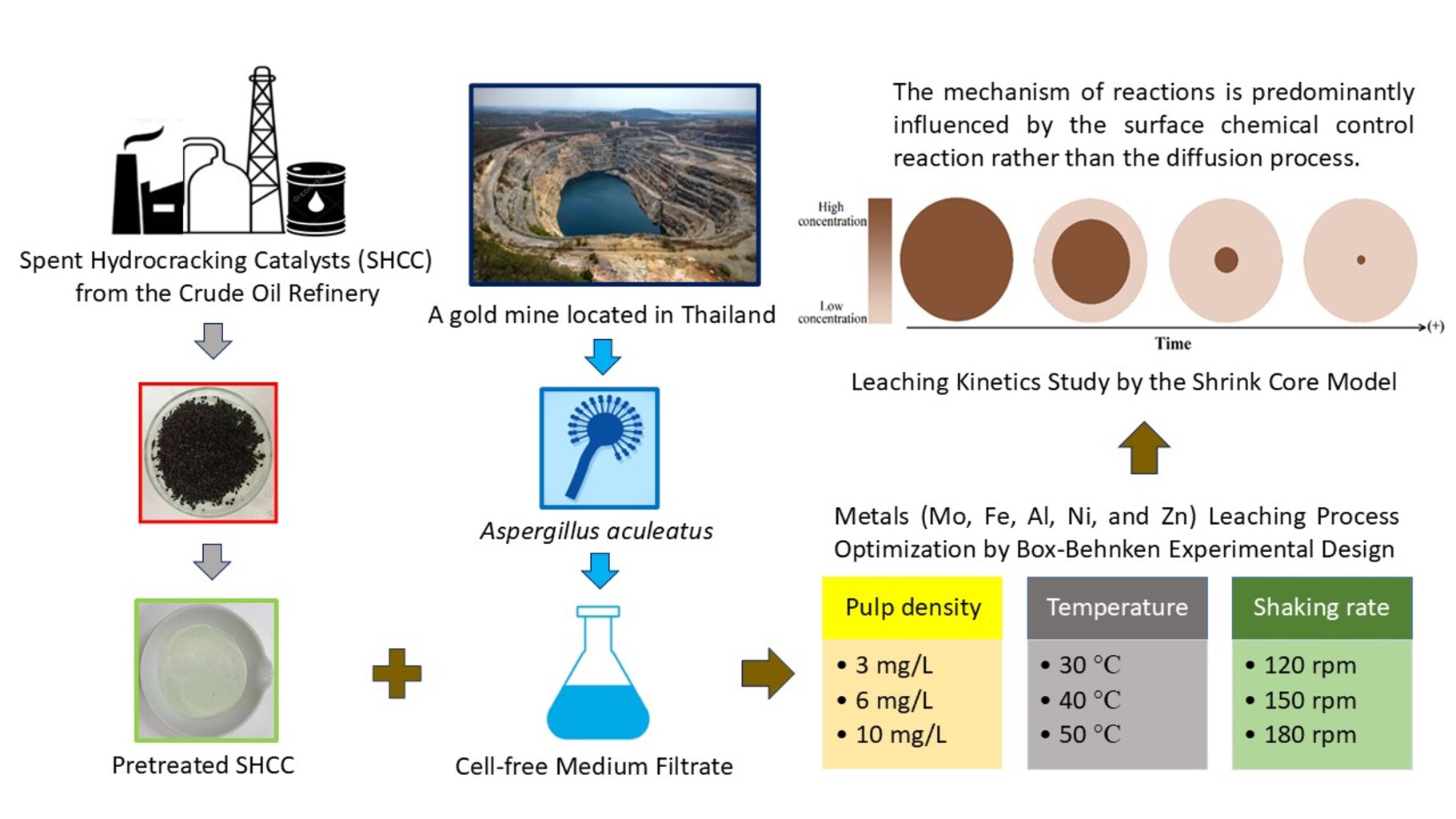
Downloads
References
International Energy Agency, Available at: https://iea.blob.core.windows.net/assets/c00d5f19-f52f-47c1-82aa-6a464a688593/-16MAY2023_OilMarketReport.pdf, accessed March 2023.
P Miao, X Zhu, Y Guo, J Miao, M Yu and C Li. Combined mild hydrocracking and fluid catalytic cracking process for efficient conversion of light cycle oil into high-quality gasoline. Fuel 2021; 292, 120364.
A Pathak, M Vinoba and R Kothari. Emerging role of organic acids in leaching of valuable metals from refinery-spent hydroprocessing catalysts, and potential techno-economic challenges: A review. Critical Reviews in Environmental Science and Technology 2020; 51(1), 1-43.
M Marafi and A Stanislaus. Spent catalyst waste management: A review Part I-Developments in hydroprocessing catalyst waste reduction and use. Resources, Conservation and Recycling 2008; 52(6), 859-873.
S Das, NN Deshavath, VV Goud and VV Dasu. Bioleaching of Al from spent fluid catalytic cracking catalyst using Aspergillus species. Biotechnology Reports 2019; 23, e00349.
N Nagar, H Garg and CS Gahan. Integrated bio-pyro-hydro-metallurgical approach to recover metal values from petroleum refinery spent catalyst. Biocatalysis and Agricultural Biotechnology 2019; 20, 101252.
T Sutjaritvorakul, GM Gadd, K Suntornvongsagul, AJS Whalley, S Roengsumran and P Sihanonth. Solubilization and transformation of insoluble zinc compounds by fungi isolated from a zinc mine. EnvironmentAsia 2013; 6(2), 42-46.
T Sutjaritvorakul, GM Gadd, AJS Whalley, K Suntornvongsagul and P Sihanonth. Zinc oxalate crystal formation by Aspergillus nomius. Geomicrobiology Journal 2016; 33, 289-293.
P Phogat, S Kumar and M Wan. A scientometrics study of advancing sustainable metal recovery from e-waste: Processes, challenges, and future directions. RSC Sustainability 2025; 3, 2434-2454.
H Malekian, M Salehi and D Biria. Investigation of platinum recovery from a spent refinery catalyst with a hybrid of oxalic acid produced by Aspergillus niger and mineral acids. Waste Management 2019; 85, 264-271.
MH Muddanna and SS Baral. A comparative study of the extraction of metals from the spent fluid catalytic cracking catalyst using chemical leaching and bioleaching by Aspergillus niger. Journal of Environmental Chemical Engineering 2019; 7(5), 103335.
MH Muddanna and SS Baral. Leaching of nickel and vanadium from the spent fluid catalytic cracking catalyst by reconnoitering the potential of Aspergillus niger associating with chemical leaching. Journal of Environmental Chemical Engineering 2019; 7(2), 103025.
F Amiri, SM Mousavi, S Yaghmaei and M Barati. Bioleaching kinetics of a spent refinery catalyst using Aspergillus niger at optimal conditions. Biochemical Engineering Journal 2012; 67, 208-217.
F Amiri, SM Mousavi and S Yaghmaei. Enhancement of bioleaching of a spent Ni/Mo hydroprocessing catalyst by Penicillium simplicissimum. Separation Purification Technology 2011; 80(3), 566-576.
F Amiri, S Yaghmaei, SM Mousavi and S Sheibani. Recovery of metals from spent refinery hydrocracking catalyst using adapted Aspergillus niger. Hydrometallurgy 2011; 109(1-2), 65-71.
D Santhiya and YP Ting. Use of adapted Aspergillus niger in the bioleaching of spent refinery processing catalyst. Journal of Biotechnology 2006; 121(1), 62-74.
D Santhiya and YP Ting. Bioleaching of spent refinery processing catalyst using Aspergillus niger with high-yield oxalic acid. Journal of Biotechnology 2005; 116(2), 171-184.
KHM Aung and YP Ting. Bioleaching of spent fluid catalytic cracking catalyst using Aspergillus niger. Journal of Biotechnology 2005; 116(2), 159-170.
M Islam and YP Ting. Fungal bioleaching of spent hydroprocessing catalyst: Effect of decoking and particle size. Advanced Material Research 2009; 71-73, 665-668.
NH Aziz and N Zainol. Isolation and identification of soil fungi isolates from forest soil for flooded soil recovery. IOP Conference Series: Materials Science and Engineering 2018; 342, 012028.
JA Sayer, SL Raggett and GM Gadd. Solubilization of insoluble metal compounds by soil fungi: Development of a screening method for solubilizing ability and metal tolerance. Mycological Research 1995; 99(8), 987-993.
MA Formina, IJ M., Alexander, JV Colpaert and GM Gadd. Solubilization of toxic metal minerals and metal tolerance of mycorrhizal fungi. Soil Biology Biochemistry 2005; 37(5), 851-866.
HL Barnett and BB Hunter. Illustrated genera of imperfect fungi. 4th ed. APS Press, Minnesota, 1998.
CR Lefevre, MN Diouf, A Brauman and M Neyra. Phylogenetic relationships in Termitomyces (Family agaricaceae) based on the nucleotide sequence of ITS: A first approach to elucidate the evolutionary history of the symbiosis between fungus-growing termites and their fungi. Molecular Phylogenetics and Evolution 2002; 22(3), 423-429.
LT Vargas, MER Carmona and YV Salazar. Determination of citric and oxalic acid in fungi fermentation broth through HPLC-DAD and solid-phase extraction. DYNA 2020; 87, 26-30.
T Junhuathoen, T Somdee and C Aiyathiti. Isolation and selection of copper bioleaching bacteria and optimization using response surface methodology on copper recovery from discarded printed circuit boards. KKU Science Journal 2021; 49(1), 7-18.
L Ren, B Liu, S Bao, W Ding, Y Zhang, X Hou, C Lin and B Chen. Recovery of Li, Ni, Co and Mn from spent lithium-ion batteries assisted by organic acids: Process optimization and leaching mechanism. International Journal of Minerals, Metallurgy and Materials 2024; 31, 518-530.
RJ Graham, H Bhatia and S Yoon. Consequences of trace metal variability and supplementation on Chinese hamster ovary (CHO) cell culture performance: A review of key mechanism and considerations. Biotechnology and Bioengineering 2019; 116(12), 3446-3456.
P Hannaker, M Uaunu and SK Sen. Comparative study of ICP-AES and XRF analysis of major and minor constituents on geological materials. Chemical Geology 1984; 42(1-4), 319-324.
CLVăcar, E Covaci, S Chakraborty, B Li, DC Weindorf, T Frențiu, M Pârvu and D Podar. Heavy metal-resistant filamentous fungi as potential mercury bioremediators. Journal of Fungi 2021; 7(5), 386.
R Nofiani, R Mu’in, Hafizah and P Ardiningsih. Bioremoval of Pb2+ by Aspergillus niger D1RA, A heavy metal-resistant fungus isolated from an illegal gold mining site. Biodiversitas Journal of Biological Diversity 2024; 25(8), 2504-2511.
T Chandakhiaw, N Teaumroong, P Piromyou, P Songwattana, W Tanthanuch, S Tancharakorn and S Khumkoa. Efficiency of Penicillium sp. and Aspergillus sp. for bioleaching lithium cobalt oxide from battery wastes in potato dextrose broth and sucrose medium. Results Engineering 2024; 24, 103170.
A Trivedi and S Hait. Fungal bioleaching of metals from WPCBs of mobile phones employing mixed Aspergillus spp.: Optimization and predictive modelling by RSM and AI models. Journal of Environmental Management 2024; 394, 119565.
GM Gadd. Fungal production of citric and oxalic acid: Importance in metal speciation, physiology and biogeochemical processes. Advances Microbial Physiology 1999; 41, 47-92.
W Burgstaller and F Schinner. Leaching of metals with fungi. Journal of Biotechnology 1993; 27(2), 91-116.
E Książek. Citric acid: Properties, microbial production, and applications in industries. Molecules 2024; 29(1), 22.
CP Kubicek, G Schreferl-Kunar, W Wöhrer and M Röhr. Evidence for a cytoplasmic pathway of oxalate biosynthesis in Aspergillus niger. Applied and Environmental Microbiology 1988; 54(3), 633-637.
GM Gadd, J Bahri-Esfahani, Q Li, YJ Rhee, Z Wei, M Fomina and X Liang. Oxalate production by fungi: Significance in geomycology, biodeterioration and bioremediation. Fungal Biology Reviews 2014; 28(2-3), 36-55.
T Watanabe, N Shitan, S Suzuki, T Umezawa, M Shimada, K Yazaki and T Hattori. Oxalate efflux transporter from the brown rot fungus Fomitopsis palustris. Applied and Environmental Microbiology 2010; 76, 23.
L Dusengemungu, G Kasali, C Gwanama and B Mubemba. Overview of fungal bioleaching of metals. Environmental Advances 2021; 5, 100083.
F Faraji, R Golmohammadzadeh, F Rashchi and N Alimardani. Fungal bioleaching of WPCBs using Aspergillus niger: Observation, optimization and kinetics. Journal of Environmental Management 2018; 217, 775-787.
BJ Seh-Bardan, R Othman, SA Wahid, A Husin and F Sadegh-Zadeh. Bioleaching of heavy metals from mine tailings by Aspergillus fumigatus. Bioremediation Journal 2012; 16(2), 57-65.
NR Draper and H Smith. Applied regression analysis. John Wiley & Sons, New York, 1998.
AH Al-Marshadi, M Aslam and A Abdullah. Uncertainty-based trimmed coefficient of variation with application. Journal of Mathematics 2021; 2021, 6.
KP Bowman. An introduction to programming with IDL interactive data language. Elsevier Academic Press, Amsterdam, 2005.
RM Gholami, SM Mousavi and SM Borghei. Process optimization and modeling of heavy metals extraction from a molybdenum-rich spent catalyst by Aspergillus niger using response surface methodology. Journal of Industrial and Engineering Chemistry 2012; 18(1), 218-224.
S Keshavarz, F Faraji, F Rashchi and M Mokmeli. Bioleaching of manganese from a low-grade pyrolusite ore using Aspergillus niger: Process optimization and kinetic studies. Journal of Environmental Management 2021; 285, 112153.
M Saldaña, M Jeldres, FMG Madrid, S Gallegos, I Salazar, P Robles and N Toro. Bioleaching Modeling: A review. Materials 2023; 16, 3812.
Published
How to Cite
Issue
Section
License
Copyright (c) 2026 Walailak University

This work is licensed under a Creative Commons Attribution-NonCommercial-NoDerivatives 4.0 International License.





