
Evaluation of Antioxidant and Antihyperglycemic Activities in Kombucha Made from Black Turmeric (Curcuma aeruginosa Roxb.) Rhizome Extract
DOI:
https://doi.org/10.48048/tis.2026.13030Keywords:
Antihyperglycemic, Antioxidant, Curcuma aeruginosa, Curcuminoid, KombuchaAbstract
Kombucha, a fermented beverage, has gained increasing attention because of its health benefits, particularly when it is combined with medicinal plants. One such plant with promising properties is black turmeric rhizome (Curcuma aeruginosa Roxb.), which is known for its various pharmacological effects. This study aimed to determine the total phenolic, flavonoid, and curcuminoid contents of kombucha produced from black turmeric rhizome and evaluate its in vitro antioxidant and antihyperglycemic activities. After kombucha fermentation at 25 - 30 °C for 10 days, the extract of black turmeric rhizome resulted in 85.538 mg GAE/L of phenolic content and 20.063 mg QE/L of flavonoid content, which was significantly higher (p < 0.05) than that of the unfermented black turmeric. UFLC spectrophotometry analysis showed an increase in curcumin (61.307 ppm), whereas bisdemethoxycurcumin and demethoxycurcumin contents were lower after kombucha fermentation of black turmeric rhizome. The IC50 values for DPPH antioxidant activity was 34.46 ± 0.34 µg/mL (using ascorbic acid as control) and for α-glucosidase inhibition was 9.41 ± 0.76 µg/mL (using acarbose as a control). Significant increases (p < 0.05) were observed in the antioxidant capacities of kombucha fermentation compared to that of unfermented black turmeric rhizome (ABTS: 167%, FRAP: 742%, and CUPRAC: 93%). The elevated total phenolic, flavonoid, and curcumin contents of kombucha were significantly correlated (p < 0.01) with the increase in antioxidant activity and capacity after the fermentation of black turmeric. These findings suggest that kombucha fermentation enhances the potential of black turmeric as a functional food in vitro. Further research should be conducted to optimize its efficacy, such as in vivo or bioavailability studies.
HIGHLIGHTS
- This study aimed to increase the potential of black turmeric rhizome (Curcuma aeruginosa ) extract by utilizing it as a substrate for kombucha fermentation in functional food.
- Kombucha fermentation increased the total phenolic and flavonoid content, as well as the curcumin content of the black turmeric rhizome extract.
- Kombucha prepared from black turmeric rhizome extract showed higher antioxidant activity by DPPH, higher antioxidant capacities by ABTS, FRAP, and CUPRAC, and higher antihyperglycemic activity by α-glucosidase inhibition.
GRAPHICAL ABSTRACT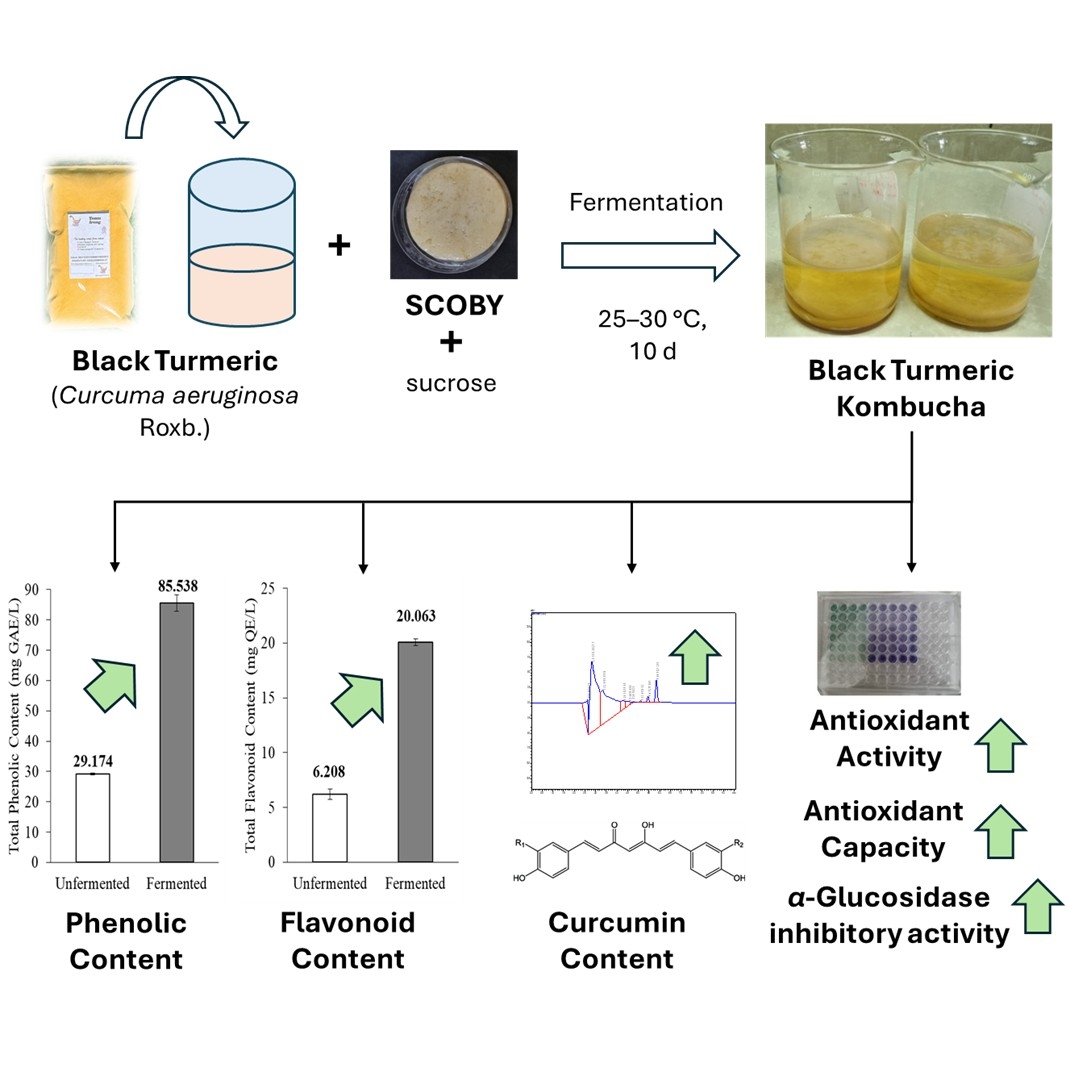
Downloads
References
DFM Farid, S Abdullah and MFA Bakar. Review of the benefits of kombucha tea: Chemical components and pharmacological activities. Food Research 2024; 8(S5), 70-83.
LM Nyhan, KM Lynch, AW Sahin and EK Arendt. Advances in kombucha tea Fermentation: A review. Applied Microbiology 2022; 2(1), 73-103.
JFD Miranda, LF Ruiz, CB Silva, TM Uekane, KA Silva, AGM Gonzalez, FF Fernandes and AR Lima. Kombucha: A review of substrates, regulations, composition, and biological properties. Journal of Food Science 2022; 87(2), 503-527.
B Bastian, N Nurhidayanti and J Trianes. The role of kombucha in health: Bibliometrics analysis. Jurnal Riset Kesehatan Poltekkes Depkes Bandung 2025; 17(2), 718-730.
N Martihandini and I Rochimat. Characteristics of four variants of kombucha tea as candidate of functional health drink. Jurnal Mandala Pharmacon Indonesia 2024; 10(1), 227-237.
YL Lau and PL Tang. Exploring the effects of fermentation time and the addition of paraprobiotic strain K-1 on the physicochemical, chemical, and antioxidant properties of black and green tea kombuchas sweetened with different sugars. International Journal of Gastronomy and Food Science 2025; 40, 101152.
R Jayabalan, P Subathradevi, S Marimuthu, M Sathishkumar and K Swaminathan. Changes in free-radical scavenging ability of kombucha tea during fermentation. Food Chemistry 2008; 109(1), 227-234.
J Su, Q Tan, Q Tang, Z Tong and M Yang. Research progress on alternative kombucha substrate transformation and the resulting active components. Frontiers in Microbiology 2023; 14, 1254014.
RR Cardoso, LPD Moreira, MAC Costa, RCL Toledo, M Grancieri, TPD Nascimento, MSL Ferreira, SLPD Matta, MR Eller, HSD Martino and FARD Barros. Kombuchas from green and black teas reduce oxidative stress, liver steatosis and inflammation, and improve glucose metabolism in Wistar rats fed a high-fat high-fructose diet. Food & Function 2021; 12(21), 10813-10827.
AB Barroso Filho, LA Barros, KR Ribeiro, CA Silva and BD Koike. Efficiency of daily kombucha consumption in reducing glycemic levels and hypercholesterolemia. Brazilian Journal of Health Review 2024; 7(2), e68785.
G Ecklu-Mensah, R Miller, MG Maseng, V Hawes, D Hinz, C Kim and JA Gilbert. Modulating the human gut microbiome and health markers through kombucha consumption: A controlled clinical study. Scientific Reports 2024; 14(1), 31647.
GM Fraiz, DB Bonifácio, RSD Paulo, CM Teixeira, HSD Martino, FARD Barros, FI Milagro and J Bressan. Benefits of kombucha consumption: A systematic review of clinical trials focused on microbiota and metabolic health. Fermentation 2025; 11(6), 353.
E Zubaidah, EC Dea and H Sujuti. Physicochemical and microbiological characteristics of kombucha based on various concentration of Javanese turmeric (Curcuma xanthorrhiza). Biocatalysis and Agricultural Biotechnology 2022; 44, 102467.
E Zubaidah, Y Hasfiani and H Sujuti. Physicochemical properties and anti-cancer activity of Javanese turmeric kombucha (Curcuma xanthorrhiza) against T47D cell line. Trends in Sciences 2025; 22(9), 10417.
MI Khazi, F Liaqat, X Liu, Y Yan and D Zhu. Fermentation, functional analysis, and biological activities of turmeric kombucha. Journal of the Science of Food and Agriculture 2024; 104(2), 759-768.
J Su, Q Tan, S Wu, F Zhou, C Xu, H Zhao, C Lin, X Deng, L Xie, X Lin, H Ye and M Yang. Administration of turmeric kombucha ameliorates lipopolysaccharide-induced sepsis by attenuating inflammation and modulating gut microbiota. Frontiers in Microbiology 2024; 15, 1452190.
Z Nisa, S Jusuf and R Yudhani. Curcumin compounds and total microorganisms in turmeric kombucha as a potential therapy in rats obesity model. Indonesian Journal of Nutrition and Dietetics 2025; 13(2), 114-124.
F Tunnisa, DN Faridah, A Afriyanti, D Rosalina, MA Syabana, N Darmawan and ND Yuliana. Antioxidant and antidiabetic compounds identification in several Indonesian underutilized Zingiberaceae spices using SPME-GC/MS-based volatilomics and in silico methods. Food Chemistry: X 2022; 14, 100285.
T Awin, A Mediani, Maulidiani, SW Leong, SMM Faudzi, K Shaari and F Abas. Phytochemical and bioactivity alterations of Curcuma species harvested at different growth stages by NMR-based metabolomics. Journal of Food Composition and Analysis 2019; 77, 66-76.
Association of Official Agricultural Chemists. Official method of analysis of the association of official analytical of chemist. 18th ed. The Association of Official Agricultural Chemists, Inc., Maryland, 2005.
Association of Official Agricultural Chemists. Official method of analysis by the association of official analytical of chemist. 17th ed. The Association of Official Agricultural Chemists, Inc., Maryland, 2000.
SD Rale, Hasim and S Falah. Antioxidant activity, inhibition α-glucosidase of ethanol extract of Strychnos nitida G. Don and identification of active compounds. Current Biochemistry 2018; 5(3), 11-20.
S Sancheti, S Sandesh and SY Seo. Chaenomeles sinensis: A potent α-and β-glucosidase inhibitors. American Journal of Pharmacology and Toxicology 2009; 4(1), 8-11.
Indonesian Ministry of Health. Farmakope Indonesia Edisi II. Indonesian Ministry of Health, Jakarta, Indonesian, 2017.
Food and Drug Administration, Available at: http://www.fda.gov/Food/GuidanceRegulation/RetailFoodProtection/FoodCode/UCM2019396.htm, accessed January 2026.
T Aung and J Eun. Impact of time and temperature on the physicochemical, microbiological, and nutraceutical properties of laver kombucha (Porphyra dentata) during fermentation. LWT 2022; 154, 112643.
R Kushargina, R Rimbawan, M Dewi and E Damayanthi. Metagenomic analysis, safety aspects, and antioxidant potential of kombucha beverage produced from telang flower (Clitoria ternatea L.) tea. Food Bioscience 2024; 59, 104013.
ED Wijayanti, NC Setiawan and JP Cristi. Effect of lactic acid fermentation on total phenolic content and antioxidant activity of fig fruit juice (Ficus carica). Advances in Health Sciences Research 2017; 2, 282-289.
S Tan, J Tang, W Shi, Z Wang, Y Xiang, T Deng, X Gao, W Li and S Shi. Effects of three drying methods on polyphenol composition and antioxidant activities of Litchi chinensis Sonn. Food Science and Biotechnology 2020; 29, 351-358.
K Dogan and F Tornuk. Improvement of bioavailability of bioactive compounds of medicinal herbs by drying and fermentation with Lactobacillus plantarum. Functional Foods in Health and Disease 2019; 9(12), 735-748.
N Liu, M Song, N Wang, Y Wang, R Wang, X An and J Qi. The effects of solid-state fermentation on the content, composition and in vitro antioxidant activity of flavonoids from dandelion. PLoS One 2020; 15(9), e0239076.
W Nurcholis, N Khumaida, M Syukur and M Bintang. Variability of curcuminoid content and lack of correlation with cytotoxicity in ethanolic extracts from 20 accessions of Curcuma aeruginosa RoxB. Asian Pacific Journal of Tropical Disease 2016; 6(11), 887-891.
RV Salve, R Chavan, P Pawase, N Kelapure, R Jaju, H Wadatkar and M Kadam. The impact of the fermentation process on bioactive compounds in turmeric: A review. Journal of Food Chemistry and Nanotechnology 2023; 9(S1), S367-S374.
FAO Duarte, KK Ramos, C Gini, RM Morasi, NCC Silva and P Efraim. Microbiological characterization of kombucha and biocellulose film produced with black tea and cocoa bean shell infusion. Food Research International 2024; 190, 114568.
S Hu, W Ma, L Fu, X He, G Wang, J Fu and M Yang. Biochemical component changes of Curcuma longa - Black tea triggered by kombucha fermentation using metabolomics analysis. LWT 2025; 219, 117553.
IG Munteanu and C Apetrei. Analytical methods used in determining antioxidant activity: A review. International Journal of Molecular Sciences 2021; 22, 3380.
O Bozkurt, B Kocaadam-Bozkurt and H Yildiran. Effects of curcumin, a bioactive component of turmeric, on type 2 diabetes mellitus and its complications: An updated review. Food & Function 2022; 13(23), 11999-12010.
FK Hartati, D Kurnia, W Nafisah and IB Haryanto. Potential anticancer agents of Curcuma aeruginosa-based kombucha: In vitro and in silico study. Food Chemistry Advances 2024; 4, 100606.
HK Permatasari, F Nurkolis, PS Augusta, N Mayulu, M Kuswari, NA Taslim, DS Wewengkang, SC Batubara and WB Gunawan. Kombucha tea from seagrapes (Caulerpa racemosa) potential as a functional anti-ageing food: In vitro and in vivo study. Heliyon 2021; 7(9), e07944.
Published
How to Cite
Issue
Section
License
Copyright (c) 2026 Walailak University

This work is licensed under a Creative Commons Attribution-NonCommercial-NoDerivatives 4.0 International License.





