
Passage Culture to Assemble A Ganoderma-Suppressive Microbiome from Turmeric (Curcuma Longa) Root Exudates
DOI:
https://doi.org/10.48048/tis.2026.13022Keywords:
Passage culture, Ganoderma boninense, Turmeric root exudates, Suppressive microbiome, Antagonistic bacteriaAbstract
Ganoderma boninense, the causative agent of basal stem rot (BSR), poses a significant threat to global oil palm cultivation. Turmeric (Curcuma longa) rhizome is recognized as a potential source of a suppressive microbiome for biocontrol applications. This study aimed to investigate the efficacy of passage culture in assembling a highly suppressive microbiome from turmeric root exudates against G. boninense. The initial microbiome, collected as turmeric root exudate (T0), was used to inoculate sucrose medium, which was then supplemented with fresh turmeric rhizome (T), chitin powder (C), T plus G. boninense culture (TG), or TG plus chitin (TGC). This inoculation process constituted the 1st passage, and the culture was continuously passaged up to 10 or 20 times by transferring the harvested culture filtrate into fresh medium. The results revealed that bacteria isolated from the 5th passage cultures of both the TG5 and TGC5 treatments exhibited the strongest antagonism, causing 46% and 45% inhibition of Ganoderma colony growth, respectively. Ganoderma mycelia treated with these bacteria experienced thinning and lysis of the cell wall. Furthermore, treatment with the passage bacteria induced Ganoderma cell leakage, as indicated by the increased electrical conductivity (EC) values of the inhibitory Ganoderma colonies. 16S rRNA gene amplicon sequencing identified Gluconacetobacter sacchari, Nguyenibacter vanlangensis, and Novosphingobium humi as the dominant species in the TG5 and TGC5 passage cultures. In conclusion, pathogen-driven assembly of a suppressive microbiome via in vitro passage culture offers a promising host-independent strategy for G. boninense biocontrol.
HIGHLIGHTS
- Passage culture successfully assembles a Ganoderma-suppressive microbiome.
- Pathogen-driven selection significantly enhances microbial antagonism.
- Gluconacetobacter, Nguyenibacter, and Novosphingobium identified as key taxa.
- Mechanism involves membrane disruption and electrolyte leakage.
GRAPHICAL ABSTRACT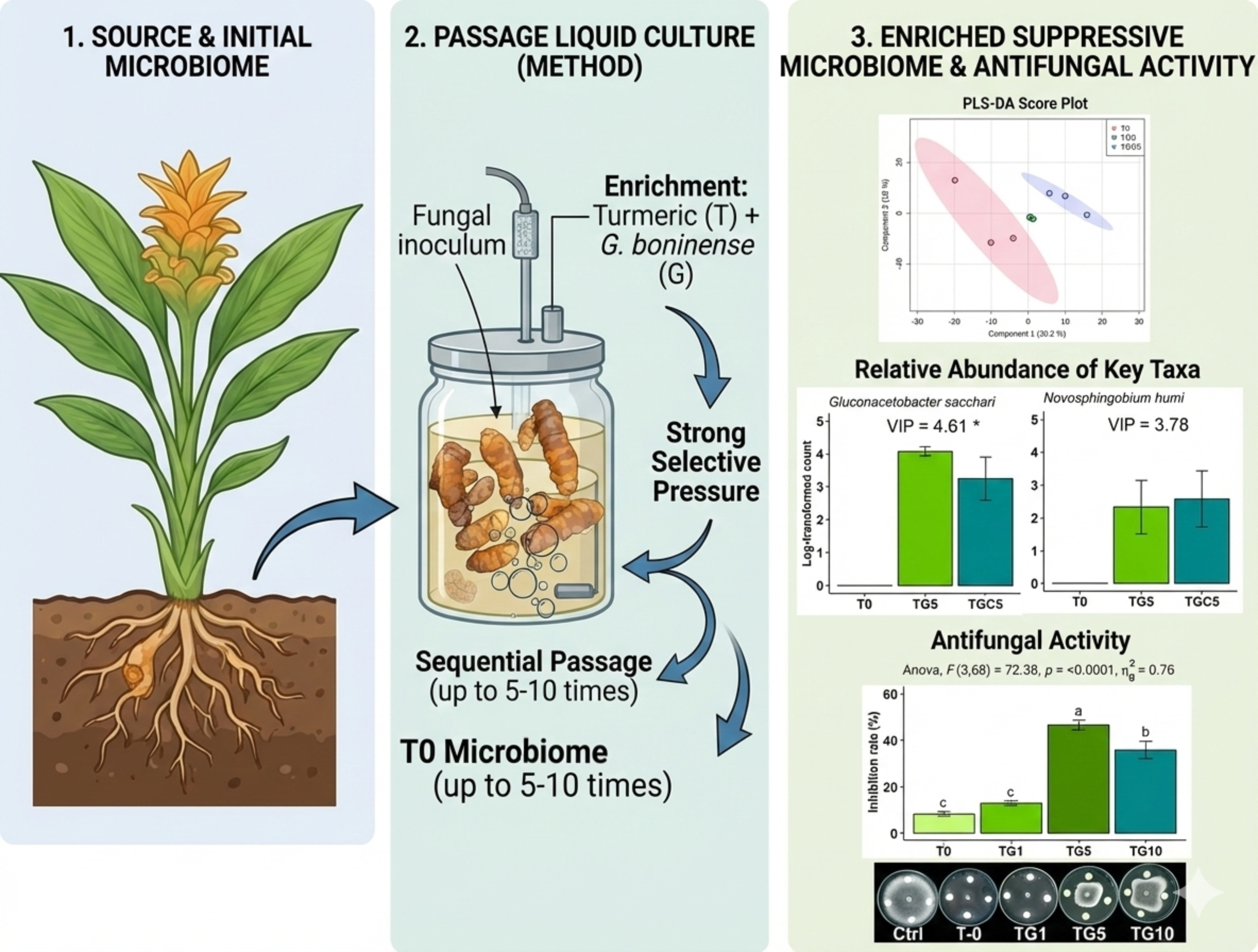
Downloads
References
L Zakaria. Basal stem rot of oil palm: The pathogen, disease incidence, and control methods. Plant Disease 2023; 107(3), 603-615.
A Kamu, CK Phin, IA Seman, D Gabda and HC Mun. Estimating the yield loss of oil palm due to Ganoderma basal stem rot disease by using Bayesian model averaging. Journal of Oil Palm Research 2021; 33(1), 46-55.
YW Khoo and KP Chong. Ganoderma boninense: General characteristics of pathogenicity and methods of control. Frontiers in Plant Science 2023; 14, 1156869.
H Priwiratama, AE Prasetyo and A Susanto. Incidence of basal stem rot disease of oil palm in converted planting areas and control treatments. IOP Conference Series: Earth and Environmental Science 2020; 468, 012036.
MS Ibrahim, IA Seman, MH Rusli, MA Izzuddin, N Kamarudin, K Hasyim and ZA Manaf. Surveillance of Ganoderma disease in oil palm planted by participants of the smallholders replanting incentive scheme in Malaysia. Journal of Oil Palm Research 2020; 32(2), 237-244.
I Virdiana, BP Forster and L Zakaria. Basal stem rot of oil palm: Disease development in mineral and peat soils. IOP Conference Series: Earth and Environmental Science 2024; 1308, 012025.
S Suwandi, M Alesia, RP Munandar, R Fadli, S Suparman, C Irsan and A Muslim. The suppression of Ganoderma boninense on oil palm under mixed planting with taro plants. Biodiversitas 2024; 25(3), 1143-1150.
S Suwandi, RP Munandar, S Suparman, C Irsan and A Muslim. Mixed planting with rhizomatous plants interferes with Ganoderma disease in oil palm. Journal of Oil Palm Research 2023; 35(2), 354-364.
J Sun, J Yang, S Zhao, Q Yu, L Weng and C Xiao. Root exudates influence rhizosphere fungi and thereby synergistically regulate Panax ginseng yield and quality. Frontiers in Microbiology 2023; 14, 1194224.
M Gu, J Jin, P Lu, S Yu, H Su, H Shang, Z Yang, J Zhang, P Cao and J Tao. Regulation of root-associated microbiomes and root exudates by different tobacco species. Chemical and Biological Technologies in Agriculture 2024; 11, 151.
C Li, Q Tian, MK Rahman and F Wu. Effect of anti-fungal compound phytosphingosine in wheat root exudates on the rhizosphere soil microbial community of watermelon. Plant and Soil 2020; 456, 223-240.
S Peng, F Shu, Y Lu, D Fan, D Zheng and G Yuan. Quasi-targeted metabolomics revealed isoliquiritigenin and lauric acid associated with resistance to tobacco black shank. Plant Signaling and Behavior 2024; 19(1), 2332019.
L Karlina, S Suwandi, R Fadli, A Muslim, H Hamidson and C Irsan. Metabolomic profiling and antifungal potential of turmeric (Curcuma longa) root exudates against Ganoderma boninense. Biodiversitas 2025; 26(7), 3600-3609.
CX Yang, SJ Chen, XY Hong, LZ Wang, HM Wu, YY Tang, YY Gao and GF Hao. Plant exudates-driven microbiome recruitment and assembly facilitates plant health management. FEMS Microbiology Reviews 2025; 49, fuaf008.
D Schlatter, L Kinkel, L Thomashow, D Weller and T Paulitz. Disease suppressive soils: New insights from the soil microbiome. Phytopathology 2017; 107(11), 1284-1297.
H Ehau-Taumaunu and KL Hockett. Passaging phyllosphere microbial communities develop suppression towards bacterial speck disease in tomato. Phytobiomes Journal 2023; 7(2), 233-243.
P Lovecká, G Kroneislová, Z Novotná, J Röderová and K Demnerová. Plant growth-promoting endophytic bacteria isolated from Miscanthus giganteus and their antifungal activity. Microorganisms 2023; 11, 2710.
KR Arendt, KL Hockett, SJ Araldi-Brondolo, DA Baltrus and AE Arnold. Isolation of endohyphal bacteria from foliar ascomycota and in vitro establishment of their symbiotic associations. Applied and Environmental Microbiology 2016; 82(10), 2943-2949.
H Ashraf, T Anjum, IS Ahmad, R Ahmed, ZH Aftab and H Rizwana. Phytofabricated silver nanoparticles unlock new potential in tomato plants by combating wilt infection and enhancing plant growth. Scientific Reports 2025; 15, 10527.
YS Chan and KP Chong. Bioactive compounds of Ganoderma boninense inhibited methicillin-resistant Staphylococcus aureus growth by affecting their cell membrane permeability and integrity. Molecules 2022; 27, 838.
S Chen, Y Zhou, Y Chen and J Gu. Fastp: An ultra-fast all-in-one FASTQ preprocessor. Bioinformatics 2018; 34, i884-i890.
T Rognes, T Flouri, B Nichols, C Quince and F Mahé. VSEARCH: A versatile open source tool for metagenomics. PeerJ 2016; 4, e2584.
BJ Callahan, PJ McMurdie, MJ Rosen, AW Han, AJA Johnson and SP Holmes. DADA2: High-resolution sample inference from Illumina amplicon data. Nature Methods 2016; 13, 581-583.
SC Park and S Won. Evaluation of 16S rRNA databases for taxonomic assignments using a mock community. Genomics and Informatics 2018; 16, e24.
Y Wang and KAL Cao. PLSDA-batch: A multivariate framework to correct for batch effects in microbiome data. Briefings in Bioinformatics 2023; 24(2), bbac622.
Y Jin, Z Chen, JF White, K Malik and C Li. Interactions between Epichloë endophyte and the plant microbiome impact nitrogen responses in host Achnatherum inebrians plants. Microbiology Spectrum 2024; 12(4), e02574-23.
J Pelto, K Auranen, JV Kujala and L Lahti. Elementary methods provide more replicable results in microbial differential abundance analysis. Briefings in Bioinformatics 2025; 26(2), bbaf130.
F Abegaz, D Abedini, F White, A Guerrieri, A Zancarini, L Dong, JA Westerhuis, FV Eeuwijk, H Bouwmeester and AK Smilde. A strategy for differential abundance analysis of sparse microbiome data with group-wise structured zeros. bioRxiv 2023. https://doi.org/10.1101/2023.07.24.549296
JA Kimbrel, TJ Samo, C Ward, D Nilson, MP Thelen, A Siccardi, P Zimba, TW Lane and X Mayali. Host selection and stochastic effects influence bacterial community assembly on the microalgal phycosphere. Algal Research 2019; 40, 101489.
MR Gloria, JS Oscar, MM Sandra, FG Narmer and T Gonzalo. Evaluation of plant-growth promoting properties of Gluconacetobacter diazotrophicus and Gluconacetobacter sacchari isolated from sugarcane and tomato in West Central region of Colombia. African Journal of Biotechnology 2017; 16(30), 1619-1629.
N Pitiwittayakul, D Wongsorn and S Tanasupawat. Characterisation of plant growth-promoting endophytic bacteria from sugarcane and their antagonistic activity against Fusarium moniliforme. Tropical Life Sciences Research 2021; 32(3), 97-118.
A Belmok, FMD Almeida, RT Rocha, CS Vizzotto, MR Tótola, MHS Ramada, RH Krüger, CM Kyaw and GJ Pappas. Genomic and physiological characterization of Novosphingobium terrae sp. nov., an alphaproteobacterium isolated from Cerrado soil containing a mega-sized chromid. Brazilian Journal of Microbiology 2023; 54(1), 239-258.
S Raja, P Subhashini and T Thangaradjou. Differential methods of localisation of fungal endophytes in the seagrasses. Mycology 2016; 7(3), 112-123.
T Wen, Z Ding, LS Thomashow, L Hale, S Yang, P Xie, X Liu, H Wang, Q Shen and J Yuan. Deciphering the mechanism of fungal pathogen‐induced disease‐suppressive soil. New Phytologist 2023; 238(6), 2634-2650.
Published
How to Cite
Issue
Section
License
Copyright (c) 2026 Walailak University

This work is licensed under a Creative Commons Attribution-NonCommercial-NoDerivatives 4.0 International License.





