
Marine Collagen–Chitosan Composite from Fishery By-Products for Wound Dressing: Characterization and Antibacterial Activity
DOI:
https://doi.org/10.48048/tis.2026.13021Keywords:
Fishery by-product utilization, Marine collagen–chitosan composite, Acid-soluble collagen, Antibacterial biomaterials, Wound dressing materialsAbstract
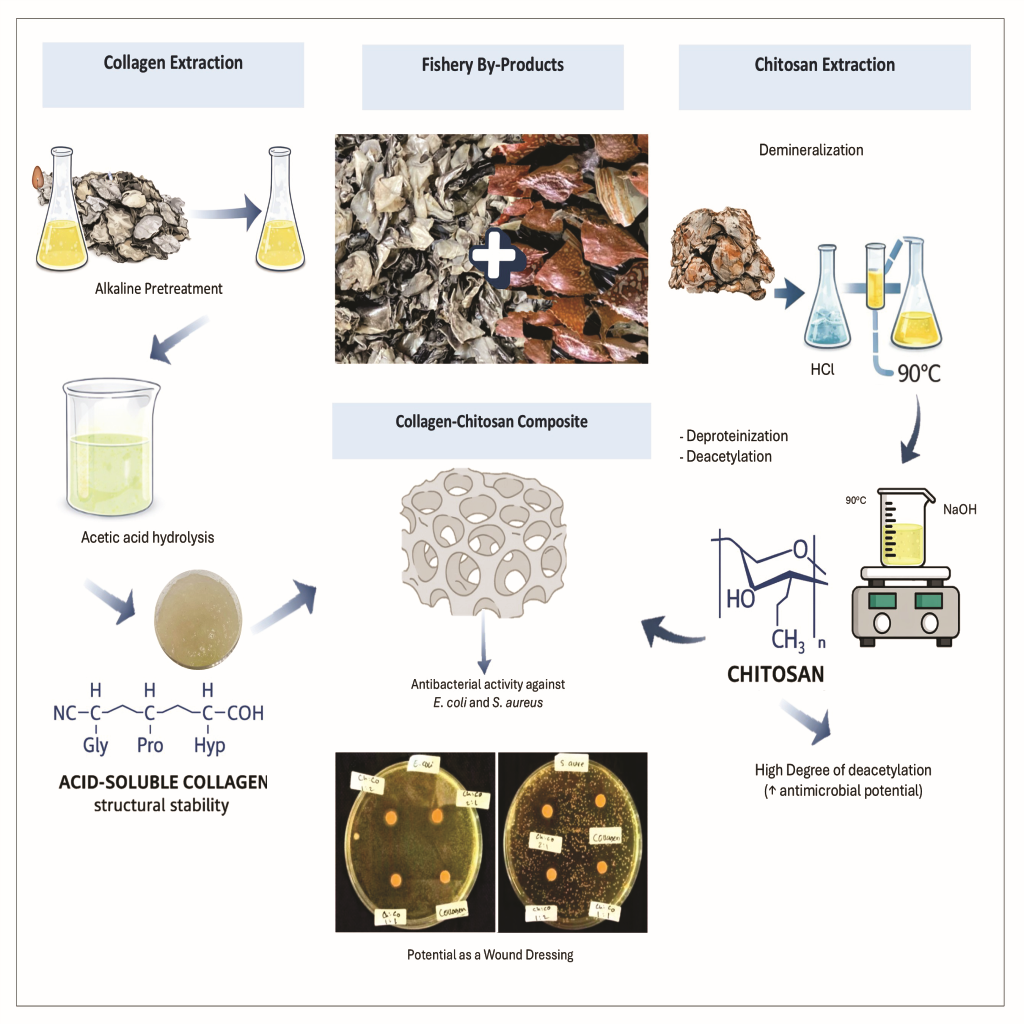
Fishery by-products represent a sustainable source of marine biomaterials with significant potential for wound dressing applications. This study investigates a marine collagen–chitosan composite derived from Spanish mackerel skin and blue swimming crab shells as a candidate wound dressing material, with a focus on structural characterization and antibacterial activity. Acid-soluble collagen (ASC) was extracted through alkaline pretreatment followed by acetic acid hydrolysis, yielding 3.125%, and the freeze-dried product exhibited a porous white morphology with well-preserved amide bands. SEM–EDX analysis revealed a distinct transformation from the dense dermal matrix of raw skin to a layered ASC structure dominated by carbon and oxygen elements, indicating improved collagen purity. Chitosan obtained from blue swimming crab shells achieved a 19.3% yield, moderate viscosity (65.3 mPa·s), and a high degree of deacetylation (92.57%). FTIR and EDX characterization confirmed the successful removal of acetyl groups and a substantial reduction in mineral elements. Antibacterial assays demonstrated that pure chitosan exhibited inhibitory activity against Escherichia coli (18.23 ± 0.20 mm) and Staphylococcus aureus (15.80 ± 1.65 mm), while collagen–chitosan composites retained activity against E. coli but showed reduced effectiveness against S. aureus. These results demonstrate the feasibility of utilizing locally derived marine collagen and chitosan as a composite biomaterial, with antibacterial performance influenced by chitosan proportion and requiring further formulation optimization.
HIGHLIGHTS
- Marine by-products were valorized into collagen and chitosan, providing a sustainable source for biomaterial development.
- The extracted chitosan exhibited a high degree of deacetylation (92.57%), enhancing its functional and antimicrobial potential.
- A porous fibrillar collagen structure with preserved functional groups was observed, supporting its suitability for wound dressing applications.
- Pure chitosan exhibited effective antibacterial activity, particularly against coli.
- Collagen–chitosan composites showed reduced antibacterial performance, highlighting the need for formulation optimization.
GRAPHICAL ABSTRACT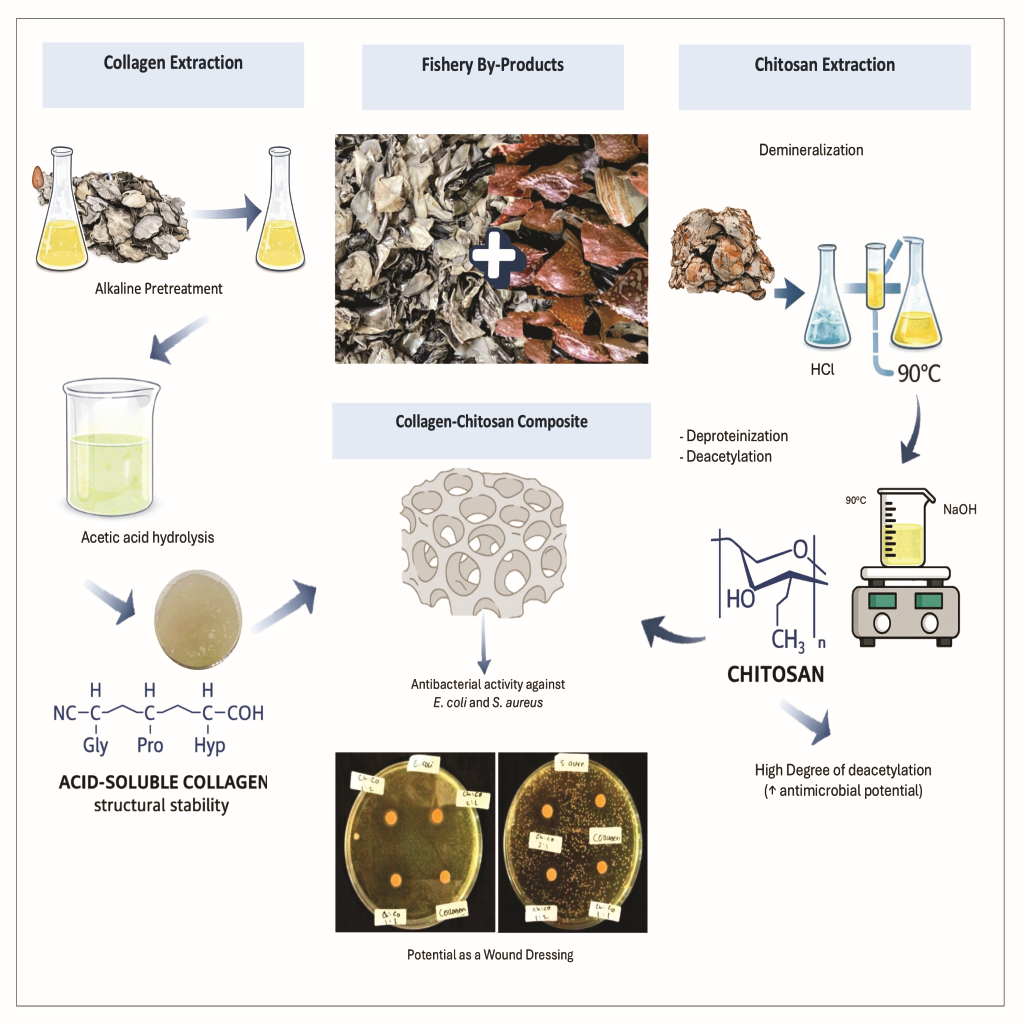
Downloads
References
RD Valenzuela-Rojo, J López-Cervantes, DI Sánchez-Machado, AA Escárcega-Galaz and MDR Martínez-Macias. Antibacterial, mechanical and physical properties of collagen - chitosan sponges from aquatic source. Sustainable Sustainable Chemistry and Pharmacy 2020; 15, 100218.
MP Pimenta, N Fernández, ARC Duarte, R Bronze, J Marto and FB Gaspar. Collagen–chitosan composites enhanced with hydroxytyrosol for prospective wound healing uses. Pharmaceutics 2025; 17, 618.
S Sharma, V Kumar, RK Narang and TS Markandeywar. Collagen-based formulations for wound healing: A literature review. Life Sciences 2022; 290, 120096.
M Furtado, L Chen, Z Chen, A Chen and W Cui. Development of fish collagen in tissue regeneration and drug delivery. Engineered Regeneration 2022; 3(3), 217-231.
KS Silvipriya, KK Kumar, AR Bhat, BD Kumar and A John. Collagen: Animal sources and biomedical application. Journal of Applied Pharmaceutical Science 2015; 5(3), 123-127.
CF Chi, ZH Cao, B Wang, FY Hu, ZR Li and B Zhang. Antioxidant and functional properties of collagen hydrolysates from Spanish mackerel skin as influenced by average molecular weight. Molecules 2015; 19(8), 11211-11230.
JB Zhang, YQ Zhao, YM Wang, CF Chi and B Wang. Eight collagen peptides from hydrolysate fraction of Spanish mackerel skins: Isolation, identification, and in vitro antioxidant activity evaluation. Marine Drugs 2019; 17(4), 224.
ZR Li, B Wang, CF Chi, QH Zhang, YD Gong, JJ Tang, HY Luo and GF Ding. Isolation and characterization of acid-soluble and pepsin-soluble collagens from the skin and bone of Spanish mackerel (Scomberomorus niphonius). Food Hydrocolloids 2013; 31(1), 103-113.
P Purnomo and J Suhanda. Long time curing process of Spanish mackerel skin (Scomberomorus commersonii) as raw material. Fish Scientiae 2017; 7(1), 83.
H Rahmawati, TW Agustini, EN Dewi and A Trianto. Characteristics of Spanish mackerel dry skin collagen hydrolysate with papain enzyme. Jurnal Pengolahan Hasil Perikanan Indonesia 2024; 27(12), 1156-1171.
MA Matica, FL Aachmann, A Tøndervik, H Sletta and V Ostafe. Chitosan as a wound dressing starting material: Antimicrobial properties and mode of action. International Journal of Molecular Sciences 2019; 20(23), 5889.
I Aranaz, AR Alcántara, MC Civera, C Arias, B Elorza, AH Caballero and N Acosta. Chitosan: An overview of its properties and applications. Polymers 2021; 13(19), 3256.
H Xie, X Chen, X Shen, Y He, W Chen, Q Luo, W Ge, W Yuan, X Tang, D Hou, D Jiang, Q Wang, Y Liu, Q Liu and K Li. Preparation of chitosan–collagen–alginate composite dressing and its promoting effects on wound healing. International Journal of Biological Macromolecules 2017; 107, 93-104.
N Naghshineh, K Tahvildari and M Nozari. Preparation of chitosan, sodium alginate, gelatin and collagen biodegradable sponge composites and their application in wound healing and curcumin delivery. Journal of Polymers and the Environment 2019; 27, 2819-2830.
A Sionkowska and K Musiał. Fish collagen and chitosan mixtures as a promising biomaterial for potential use in medicine and engineering of biomaterials. Engineering of Biomaterials 2022; 164, 16-24.
A Martínez, MD Blanco, N Davidenko and RE Cameron. Tailoring chitosan/collagen scaffolds for tissue engineering: Effect of composition and different crosslinking agents on scaffold properties. Carbohydrate Polymers 2015; 132, 606-619.
AC Ferreira, MRQ Bomfim, CHBDC Sobrinho, DTL Boaz, RLDS Lira, VC Fontes, MO Arruda, PMW Zago, CAAD Filho, CJM Dias, MOBDR Borges, RM Ribeiro, CWB Bezerra and RS Penha. Characterization, antimicrobial and cytotoxic activity of polymer blends based on chitosan and fish collagen. AMB Express 2022; 12(1), 102.
J Li, M Wang, Y Qiao, Y Tian, J Liu, S Qin and W Wu. Extraction and characterization of type I collagen from skin of tilapia (Oreochromis niloticus) and its potential application in biomedical scaffold material for tissue engineering. Process Biochemistry 2018; 74, 156-163.
N Luthfiyana, S Bija, E Anwar, DR Laksmitawati and GL Rosalinda. Characteristics and activity of chitosan from mud crab shells on acne bacteria: Staphylococcus aureus, S. epidermidis and Propionibacterium acnes. Biodiversitas 2022; 23, 6645-6651.
MM Bradford. A rapid and sensitive method for the quantitation of microgram quantities of protein utilizing the principle of protein–dye binding. Analytical Biochemistry 1976; 72, 248-254.
Widiyanto, Uju, SH Rachman and M Nurilmala. Preliminary study on hydroxyproline content of purple-spotted bigeye (Priacanthus tayenus) scaly skin and its gelatin quality. Tropical Life Sciences Research 2025; 36(1), 93.
AOAC. Official methods of analysis of AOAC International. Association of Official Analytical Chemists, Washington DC, 1995.
J Brugnerotto, J Lizardi, FM Goycoolea, W Argüelles-Monal, J Desbrières and M Rinaudo. An infrared investigation in relation with chitin and chitosan characterization. Polymer 2001; 42(8), 3569-3580.
AOAC. Official methods of analysis of the Association of Official Analytical Chemistry. AOAC International, Washington DC, 1995.
E Mirda, R Idroes, K Khairan, TE Tallei, M Ramli, N Earlia, A Maulana, GM Idroes, M Muslem and Z Jalil. Synthesis of chitosan–silver nanoparticle composite spheres and their antimicrobial activities. Polymers 2021; 13(22), 3990.
PK Jha, C Pokhum, P Soison, KA Techato and C Chawengkijwanich. Comparative study of zinc oxide nanocomposites with different noble metals synthesized by biological method for photocatalytic disinfection of Escherichia coli present in hospital wastewater. Water Science & Technology 2023; 88(6), 1564-1577.
P Basnet, PK Jha, A Gupta and S Chatterjee. Synergistic effect of tea phytochemicals, noble metals and ZnO nano-photo-composites for combating resistance of bacterial growth. Journal of Nano Research 2021; 70, 53-66.
V Girsang, J Reveny and M Nainggolan. Isolation and characterization of collagen from patin fish skin (Pangasius sp.). Asian Journal of Pharmaceutical Research and Development 2020; 8(1), 47-51.
F Gunawan, P Suptijah and Uju. Extraction and characterization of gelatin from mackerel skin (Scomberomorus commersonii) from Bangka Belitung Province. Jurnal Pengolahan Hasil Perikanan Indonesia 2017; 20, 568-581.
M Nurilmala, H Suryamarevita, HH Husein Hizbullah, AM Jacoeb and Y Ochiai. Fish skin as a biomaterial for halal collagen and gelatin. Saudi Journal of Biological Sciences 2022; 29(2), 1100-1110.
N Muralidharan, RJ Shakila, D Sukumar and G Jeyasekaran. Skin, bone and muscle collagen extraction from the trash fish, leather jacket (Odonus niger) and their characterization. Journal of Food Science and Technology 2013; 50, 1106-1113.
P Patmawati, AR Ergion, L Sulmartiwi, S Raseetha, D Nirmala, Y Waiprib and S Wijayanti. Effect of acetic acid pre-treatment on hydro-extraction of water-soluble collagen from skin of Alaska pollock (Theragra chalcogramma). Jurnal Ilmiah Perikanan dan Kelautan 2023; 15(2), 468-477.
E Kuprina, A Yakkola, A Kopylov, M Zashikhin and A Kuznetsova. Development of functional product enriched with collagen hydrolysate from fish processing waste. E3S Web of Conferences 2020; 164(3), 06026.
K Chantakun, L Chotphruethipong and S Benjakul. Development of hydrolysis and defatting processes for production of low fishy odor hydrolyzed collagen from fatty skin of sockeye salmon (Oncorhynchus nerka). Foods 2021; 10(10), 2257.
M Danu, B Simionescu, C Ibanescu and SA Ibanescu. Dynamic rheological behavior of chitosan/collagen mixtures. Revista de Chimie 2020; 71, 193-200.
S Kendler, A Sasidharan and T Rustad. Extraction of proteinaceous components and biominerals from cold-water fish filleting side streams: A review. Frontiers in Sustainable Food Systems 2023; 7, 1331113.
D Meng, H Tanaka, T Kobayashi, H Hatayama, X Zhang, K Ura, S Yunoki and Y Takagi. Effect of alkaline pretreatment on biochemical characteristics and fibril-forming abilities of type I and II collagens extracted from bester sturgeon by-products. International Journal of Biological Macromolecules 2019; 131, 572-580.
T Nurhayati, N Nurjanah and I Astiana. Characteristics of papain-soluble collagen from redbelly yellowtail fusilier (Caesio cuning). IOP Conference Series: Earth and Environmental Science 2018; 196, 012034.
M Rahaman, S Das, S Sahu, A Karmakar and B Debnath. Extraction, isolation and characterization of collagen peptide from fish and recent biological activities of collagen peptides. Journal of Survey in Fisheries Sciences 2023; 10, 1450-1465.
M Meyer. Processing of collagen-based biomaterials and the resulting materials properties. Biomedical Engineering Online 2019; 18, 24.
TT Heng, JY Tey, KS Soon and KK Woo. Utilizing fish skin of ikan belida (Notopterus lopis) as a source of collagen: Production and rheological properties. Marine Drugs 2022; 20(8), 525.
BFD Zaelani, M Safithri, K Tarman, I Setyaningsih and M Meydia. Collagen isolation with acid-soluble method from the skin of red snapper (Lutjanus sp.). IOP Conference Series: Earth and Environmental Science 2019; 241, 012033.
SZ Ramle, SNH Oslan, R Shapawi, RAM Mokhtar, WNM Noordin and N Huda. Biochemical characteristics of acid-soluble collagen from food processing by-products of needlefish skin (Tylosurus acus melanotus). Applied Sciences 2022; 12(24), 12695.
L Devita, M Nurilmala, HN Lioe and MT Suhartono. Chemical and antioxidant characteristics of skin-derived collagen obtained by acid–enzymatic hydrolysis of bigeye tuna (Thunnus obesus). Marine Drugs 2021; 19(4), 222.
S Xu, H Yang, L Shen and G Li. Purity and yield of collagen extracted from southern catfish (Silurus meridionalis Chen) skin through improved pretreatment methods. International Journal of Food Properties 2017; 20(S1), S141-S153.
E Martins, R Fernandes, AL Alves, RO Sousa, RL Reis and TH Silva. Skin by-products of Reinhardtius hippoglossoides (Greenland halibut) as an ecosustainable source of marine collagen. Applied Sciences 2022; 12(21), 11282.
AA Abbas, KA Shakir and MK Walsh. Functional properties of collagen extracted from catfish (Silurus triostegus) waste. Foods 2022; 11, 633.
T Maschmeyer, R Luque and M Selva. Upgrading of marine (fish and crustaceans) biowaste for high added-value molecules and bio(nano)-materials. Chemical Society Reviews 2020; 49, 4527-4563.
O Kaewdang, S Benjakul, T Kaewmanee and H Kishimura. Characteristics of collagens from the swim bladders of yellowfin tuna (Thunnus albacares). Food Chemistry 2014; 155, 264-270.
DN Carolina, MH Satari, BP Priosoeryanto, A Susanto, C Sukotjo and RE Kartasasmita. Exploring carp scales (Cyprinus carpio L.) as a novel source of collagen for dental use: Extraction and characterization. Journal of Applied Pharmaceutical Science 2024; 14, 204-209.
HH Abd-Elrahman, WAM Omar and HA Elnashar. Characterization of biochemical and optical properties of Nile tilapia (Oreochromis niloticus) corneal collagen. Future Journal of Pharmaceutical Sciences 2024; 10, 39.
RO Sousa, E Martins, DN Carvalho, AL Alves, C Oliveira, ARC Duarte, TH Silva and RL Reis. Collagen from Atlantic cod (Gadus morhua) skins extracted using CO₂-acidified water with potential application in healthcare. Journal of Polymer Research 2020; 27, 73.
K Periyannan, H Selvaraj, B Subbu, M Pallikondaperumal, P Karuppiah, JR Rajabathar, H Al-Lohedan and S Thangarasu. Green fabrication of chitosan from marine crustaceans and mushroom waste toward sustainable resource utilization. Green Processing and Synthesis 2023; 12(1), 0093.
R Ismail, DF Fitriyana, AP Bayuseno, Jamari, PY Pradiptya, RC Muhamadin, FW Nugraha, Rusiyanto, A Setiyawan, A Bahatmaka, HN Firmansyah, S Anis, AP Irawan, JP Siregar and T Cionita. Effect of deacetylation temperature on the characterization of chitosan from crab shells as a candidate for organic nanofluids. Journal of Advanced Research in Fluid Mechanics and Thermal Sciences 2023; 103, 55-67.
A Ewais, RA Saber, AG Abdel Ghany, A Sharaf and M Sitohy. High-quality, low-molecular-weight shrimp and crab chitosans obtained by short-time holistic high-power microwave technology. SN Applied Sciences 2023; 5, 365.
RA Salman and NK Zedain. Chitosan sources and extraction: A review. Kufa Journal of Engineering 2025; 16, 615-631.
MA Ibrahim, SM Mostafa and SM Ibrahim. Effect of extraction techniques on properties and economics of chitosan obtained from shrimp shell waste. Egyptian Journal of Aquatic Biology and Fisheries 2019; 23, 138-142.
S Fadlaoui, O El-Asri, L Mohammed, S Ait Sihame, A Omari and M Melhaoui. Isolation and characterization of chitin from shells of the freshwater crab Potamon algeriense. Progress on Chemistry and Application of Chitin and Its Derivatives 2019; 24, 23-35.
A Aberoumand and M Hoseinian. Extraction of chitosan from shells of crab (Liocarcinus vernalis). Applied Food Research 2025; 5(1), 100964.
N Luthfiyana, S Bija, CD Nugraeni, MS Lembang, E Anwar, DR Laksmitawati, PW Nusaibah, P Ratrinia and M Mukmainna. Characteristics and antibacterial activity of chitosan nanoparticles from mangrove crab shell (Scylla sp.) in Tarakan Waters, North Kalimantan, Indonesia. Biodiversitas 2022; 23, 4018-4025.
MA Razi, R Wakabayashi, M Goto and N Kamiya. Formation and characterization of caseinate–chitosan nanocomplexes for encapsulation of curcumin. Journal of Chemical Engineering of Japan 2018; 51, 445-453.
E Fakhri, H Eslami, P Maroufi, F Pakdel, S Taghizadeh, K Ganbarov, M Yousefi, A Tanomand, B Yousefi, S Mahmoudi and HS Kafil. Chitosan biomaterials application in dentistry. International Journal of Biological Macromolecules 2020; 162, 956-974.
N Alimatul, H Narudin and AH Mahadi. Chitin, chitosan, and submicron-sized chitosan particles prepared from Scylla serrata shells. Materials International 2020; 2(2), 0139-0149.
MRA Hanan, AK Nasution, R Hussain and S Saidin. Fabrication of poly(lactic-co-glycolic acid)/calcium phosphate bone cement composite: Synthesization of calcium phosphate from crab shells. Jurnal Teknologi 2018; 80, 103-109.
G Hao, Y Hu, L Shi, J Chen, A Cui, W Weng and K Osako. Physicochemical characteristics of chitosan from swimming crab (Portunus trituberculatus) shells prepared by subcritical water pretreatment. Scientific Reports 2021; 11, 1646.
MM Sundari, A Jegatheesan, R Mohan, MSA Raj, NA Devi, P Ravikumar, M Ayyanar and K Ravichandran. Exploring the bioactive potential of chitosan extracted from Portunus trituberculatus crab shell for multifaceted applications: Antioxidant, antidiabetic, anti-inflammatory and cytotoxic activities. Materials Letters 2025; 393, 138581.
RS Dongre. Chitosan-derived synthetic ion exchangers: Characteristics and applications. InTech, Houston TX, 2018.
B Li, X Wu, B Bao, R Guo and W Wu. Evaluation of α-chitosan from crab shell and β-chitosan from squid gladius based on biochemical performance. Applied Sciences 2021; 11(7), 3183.
MMA Elsoud and EM El Kady. Current trends in fungal biosynthesis of chitin and chitosan. Bulletin of the National Research Centre 2019; 43, 59.
M Zhang, W Zhao, Q Fang, X Wang, C Chen, B Shi, B Zheng, S Wang, W Tan and L Wu. Effects of chitosan–collagen dressing on wound healing in vitro and in vivo assays. Journal of Applied Biomaterials & Functional Materials 2021; 19, 2280800021989698.
IM Helander, E Nurmiaho-Lassila, R Ahvenainen, J Rhoades and S Roller. Chitosan disrupts the barrier properties of the outer membrane of Gram-negative bacteria. International Journal of Food Microbiology 2001; 71, 235-244.
EI Rabea, MET Badawy, CV Stevens, G Smagghe and W Steurbaut. Chitosan as antimicrobial agent: Applications and mode of action. Biomacromolecules 2003; 4, 1457-1465.
MP Batista, M Pimenta, N Fernández, ARC Duarte, R Bronze, J Marto and FB Gaspar. Collagen–chitosan composites enhanced with hydroxytyrosol for prospective wound healing uses. Pharmaceutics 2025; 17(5), 618.
J Pradhan, B Baisakhi, BK Das, K Jena, S Ananta and D Mohanty. Chitosan extracted from Portunus sanguinolentus (three-spot swimming crab) shells: Its physicochemical and biological potentials. Journal of Environmental Biology 2025; 46(2), 319-328.
C Metin, Y Alparslan and T Baygar. Physicochemical, microstructural and thermal characterization of chitosan from blue crab shell waste and its bioactivity characteristics. Journal of Polymers and the Environment 2019; 27(11), 2552-2561.
Z Kassim, WNAW Murni, MRM Razak, WSW Omar and SB Adam. Chitosan isolated from horseshoe crab Tachypleus gigas from the Malay Peninsula. Oriental Journal of Chemistry 2018; 34(2), 928-933.
Hartatiek, F Fathurochman, MI Wuriantika, Yudyanto, Masruroh, DJH Santjojo and M Nurhuda. Mechanical, degradation rate, and antibacterial properties of a collagen–chitosan/PVA composite nanofiber. Materials Research Express 2023; 10, 025401.
M Rohde. The Gram-positive bacterial cell wall. Microbiology Spectrum 2019; 7(3), 10.
B Aragón, L Alberto, J Mejía, L Meza, J Edmundo and P Damián. Composites of silver–chitosan nanoparticles: A potential source for new antimicrobial therapies. Revista Mexicana de Ciencias Farmacéuticas 2016; 47(1), 7-25.
F Shahidi, VVaratharajan, H Peng and R Senadheera. Utilization of marine by-products for the recovery of value-added products. Journal of Food Bioactives 2019; 6(6), 10-61.
G Dolete, TM Bianca, O Tutunari, IC Mocanu, C Balas, IL Ardelean, DS Dragan, CM Kamerzan and SS Maier. Development and sequential analysis of a collagen–chitosan wound management biomaterial. Romanian Biotechnology Letters 2019; 24(1), 108-117.
W Wei, YH Zhou, HJ Chang and JT Yeh. Antibacterial and miscibility properties of chitosan/collagen blends. Journal of Macromolecular Science, Part B: Physics 2015; 54(2), 143-158.
Published
How to Cite
Issue
Section
License
Copyright (c) 2026 Walailak University

This work is licensed under a Creative Commons Attribution-NonCommercial-NoDerivatives 4.0 International License.





