
Enhancement of Paclitaxel Efficacy by Tectona grandis Leaves Extract: Synergistic Antiproliferative and Antimigratory Actions in Triple-Negative Breast Cancer Cells
DOI:
https://doi.org/10.48048/tis.2026.12987Keywords:
Triple negative breast cancer, Tectona grandis, Antiproliferative, AntimigratoryAbstract
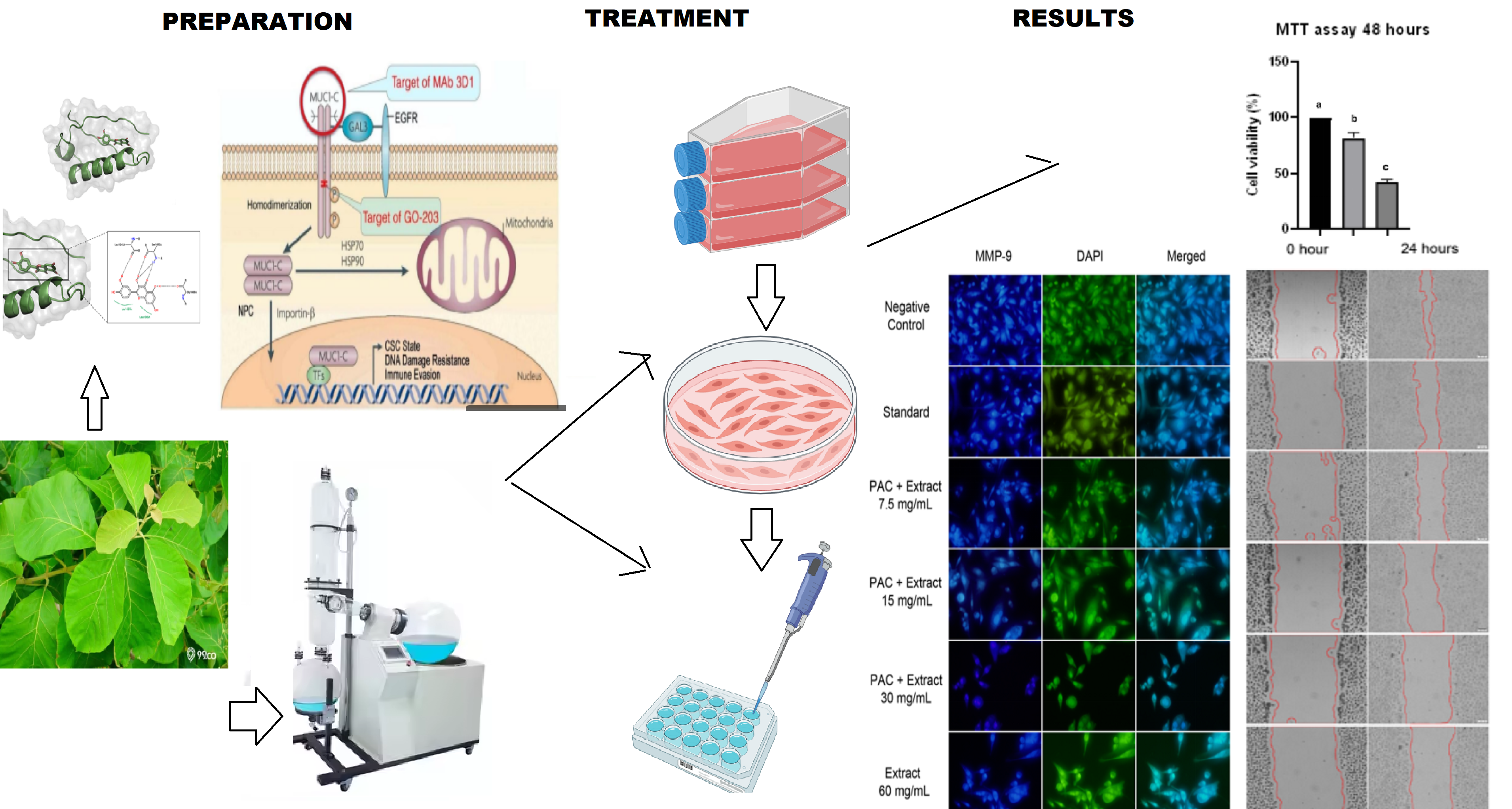
Triple negative breast cancer (TNBC) lacks ER, PR, and HER2 expression, leading to poor prognosis. Tectona grandis contains bioactive compounds with anticancer properties. This study investigated antiproliferative and antimigratory effect of T. grandis leaves extract (TGLE) and paclitaxel. This study involved computational study to determine the binding affinity of Mucin-1 and TGLE and in vitro study to examine the antiproliferative and antimigratory effect of TGLE and paclitaxel as well as the Mucin 1 (MUC1) and Matrix Metalloproteinase-9 (MMP9) expression in MDA-MB-231 cells. This study identified quercetin in TGLE as the strongest compound to bind with MUC1. In vitro study confirmed the inhibitory effect of TGLE and paclitaxel on MUC1 expression and cell proliferation. Furthermore, TGLE and paclitaxel exhibited a significant reduction in MMP-9 expression and cell migration. These findings suggest that TGLE and paclitaxel has promising antiproliferative and antimigratory properties against TNBC through its inhibition on MUC1 and MMP-9.
HIGHLIGHTS
- Paclitaxel causes severe side effect s, highlighting need for combination therapies
- The combination of Paclitaxel and T grandis Extract (TGE) reduced MMP9 expression.
- The combination of Paclitaxel and T grandis Extract (TGE) reduced MUC1 expression.
- The combination of Paclitaxel and T grandis Extract (TGE) inhibited MDA-MB-231 cell migration.
GRAPHICAL ABSTRACT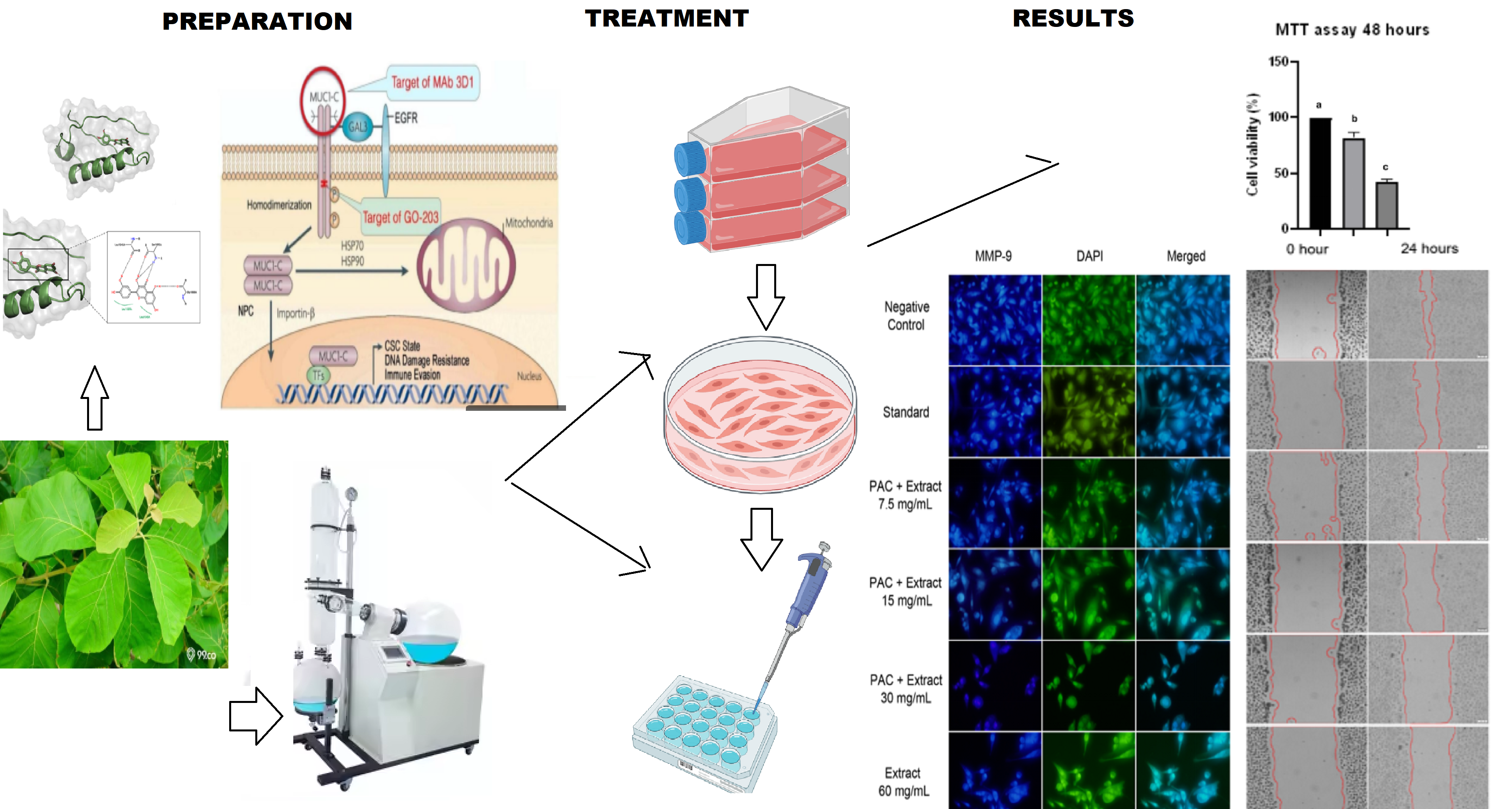
Downloads
References
L Yin, JJ Duan, XW Bian and SC Yu. Triple-negative breast cancer molecular subtyping and treatment progress. Breast Cancer Research 2020; 22(1), 61.
AC Wolff, MEH Hammond, KH Allison, BE Harvey, PB Mangu, JMS Bartlett, M Bilous, IO Ellis, P Fitzgibbons, W Hanna, RB Jenkins, MF Press, PA Spears, GH Vance, G Viale, LM McShane and M Dowsett. Human epidermal growth factor receptor 2 testing in breast cancer: American Society of Clinical Oncology/College of American Pathologists clinical practice guideline focused update. Archives of Pathology & Laboratory Medicine 2018; 142(11), 1364-1382.
JW Chang, Y Ding, M Tahir ul Qamar, Y Shen, J Gao and LL Chen. A deep learning model based on sparse auto-encoder for prioritizing cancer-related genes and drug target combinations. Carcinogenesis 2019; 40(5), 624-632.
KA Won and C Spruck. Triple-negative breast cancer therapy: Current and future perspectives. International Journal of Oncology 2020; 57(6), 1245-1261.
MA Clark, R Finkel, JA Rey and K Whalen. Lippincott’s illustrated reviews: Pharmacology. 5th ed. Wolters Kluwer, Philadelphia, United States, 2012.
T Maeda, M Hiraki, C Jin, H Rajabi, A Tagde, M Alam, A Bouillez, X Hu, Y Suzuki, M Miyo, T Hata, K Hinohara and D Kufe. MUC1-C induces PD-L1 and immune evasion in triple-negative breast cancer. Cancer Research 2018; 78(1), 205-215.
G Goode, V Gunda, NV Chaika, V Purohit, F Yu and PK Singh. MUC1 facilitates metabolomic reprogramming in triple-negative breast cancer. PLoS One 2017; 12(5), e0176820.
H Huang. Matrix metalloproteinase-9 (MMP-9) as a cancer biomarker and MMP-9 biosensors: Recent advances. Sensors 2018; 18(10), 3249.
G Barillari. The impact of matrix metalloproteinase-9 on the sequential steps of the metastatic process. International Journal of Molecular Sciences 2020; 21(12), 4526.
Y Li, J He, F Wang, X Wang, F Yang, C Zhao, C Feng and T Li. Role of MMP-9 in epithelial-mesenchymal transition of thyroid cancer. World Journal of Surgical Oncology 2020; 18(1), 181.
SMB Asdaq, N Nayeem, MT Alam, SI Alaqel, M Imran, EWE Hassan and SI Rabbani. Tectona grandis Lf: A comprehensive review on its patents, chemical constituents, and biological activities. Saudi Journal of Biological Sciences 2022; 29(3), 1456-1464.
RB Kilaru, KR Valasani, NK Yellapu, HP Osuru, CS Kuruva, B Matcha and NR Chamarthi. Design, synthesis, in silico and in vitro studies of novel 4-methylthiazole-5-carboxylic acid derivatives as potent anti-cancer agents. Bioorganic & Medicinal Chemistry Letters 2014; 24(18), 4580-4585.
V Suryanti, T Kusumaningsih, SD Marliyana, HA Setyono and EW Trisnawati. Identification of active compounds and antioxidant activity of teak (Tectona grandis) leaves. Biodiversitas 2020; 21(3), 946-952.
AV Ponce Bobadilla, J Arévalo, E Sarró, HM Byrne, PK Maini, T Carraro, S Balocco, A Meseguer and T Alarcón. In vitro cell migration quantification method for scratch assays. Journal of the Royal Society Interface 2019; 16(151), 20180709.
A Hosseinzadeh, P Merikhian, N Naseri, MR Eisavand and L Farahmand. MUC1 is a potential target to overcome trastuzumab resistance in breast cancer therapy. Cancer Cell International 2022; 22(1), 110.
R Patil, S Das, A Stanley, L Yadav, A Sudhakar and AK Varma. Optimized hydrophobic interactions and hydrogen bonding at the target-ligand interface leads the pathways of drug-designing. PLoS One 2010; 5(8), e12029.
D Chen, N Oezguen, P Urvil, C Ferguson, SM Dann and TC Savidge. Regulation of protein-ligand binding affinity by hydrogen bond pairing. Science Advances 2016; 2(3), e1501240.
RF De Freitas and M Schapira. A systematic analysis of atomic protein–ligand interactions in the PDB. MedChemComm 2017; 8(10), 1970-1981.
M Alamoodi. Factors affecting pathological complete response in locally advanced breast cancer cases receiving neoadjuvant therapy: A comprehensive literature review. European Journal of Breast Health 2024; 20(1), 8.
CD Hamdin, D Galanova, DC Saputro, IM Munir, A Nurrochmad and I Puspitasari. Safety concerns of Tectona grandis Lf leaf extract as a natural food colorant: evidence of irreversible organ pathology in subchronic toxicity study. The Indonesian Biomedical Journal 2025; 17(1), 78-89.
R Wang, L Yang, S Li, D Ye, L Yang, Q Liu, Z Zhao, Q Cai, J Tan and X Li. Quercetin inhibits breast cancer stem cells via downregulation of aldehyde dehydrogenase 1A1 (ALDH1A1), chemokine receptor type 4 (CXCR4), mucin 1 (MUC1), and epithelial cell adhesion molecule (EpCAM). Medical Science Monitor 2018; 24, 412-420.
M Hiraki, T Maeda, N Mehrotra, C Jin, M Alam, A Bouillez, T Hata, A Tagde, A Keating, S Kharbanda, H Singh and D Kufe. Targeting MUC1-C suppresses BCL2A1 in triple-negative breast cancer. Signal Transduction and Targeted Therapy 2018; 3(1), 13.
C Jakobušić Brala, A Karković Marković, A Kugić, J Torić and M Barbarić. Combination chemotherapy with selected polyphenols in preclinical and clinical studies - An update overview. Molecules 2023; 28(9), 3746.
MA Ghareeb, AH Hussein, MFM Hassan, AR Laila, AM Mona and MS Amal. Antioxidant and cytotoxic activities of Tectona grandis Linn leaves. International Journal of Phytopharmacology 2014; 5(2), 143-157.
B Lin, Q Wang, K Liu, X Dong, M Zhu and M Li. Alpha-fetoprotein binding mucin and scavenger receptors: an available bio-target for treating cancer. Frontiers in Oncology 2021; 11, 625936.
PK Kolli, S Obbalareddy, RP Yejella, LD Athili and S Ponnada. A review on Tectona grandis. International Journal of Research in Pharmaceutical and Biomedical Sciences 2022; 12, 359-366.
NA Rudin and R Rahmawati. The potential utilization of young teak leaves (Tectona grandis Linn. f.) as basic ingredients on producing anti-cancer herbal tea. Jurnal Pendidikan Biologi Undiksha 2022; 9(1), 10-23.
HL Lee, CS Lin, SH Kao and MC Chou. Gallic acid induces G1 phase arrest and apoptosis of triple-negative breast cancer cell MDA-MB-231 via p38 mitogen-activated protein kinase/p21/p27 axis. Anti-Cancer Drugs 2017; 28(10), 1150-1156.
S Lin, HZ Qin, ZY Li, H Zhu, L Long and LB Xu. Gallic acid suppresses the progression of triple-negative breast cancer HCC1806 cells via modulating PI3K/AKT/EGFR and MAPK signaling pathways. Frontiers in Pharmacology 2022; 13, 1049117.
A Pal, P Tapadar and R Pal. Exploring the molecular mechanism of cinnamic acid-mediated cytotoxicity in triple negative MDA-MB-231 breast cancer cells. Anti-Cancer Agents in Medicinal Chemistry 2021; 21(9), 1141-1150.
E Sieniawska and T Baj. Tannins. In: S Badal and R Delgoda (Eds.). Pharmacognosy. Academic Press, Massachusetts, United States, 2017.
WH Talib, A Abuawad, S Thiab, A Alshweiat and AI Mahmod. Flavonoid-based nanomedicines to target tumor microenvironment. OpenNano 2022; 8, 100081.
National Center for Biotechnology Information. Ellagic acid, Available at: https://pubchem.ncbi.nlm.nih.gov/compound/Ellagic-Acid, accessed November 2025.
Published
How to Cite
Issue
Section
License
Copyright (c) 2026 Walailak University

This work is licensed under a Creative Commons Attribution-NonCommercial-NoDerivatives 4.0 International License.





