
Circadian Rhythm Disruption Modulates Plasma Melatonin, Aortic Senescence, and Blood Pressure Homeostasis in Rats
DOI:
https://doi.org/10.48048/tis.2026.12912Keywords:
Circadian rhythm disruption, Melatonin, blood pressure, Oxidative stress, Vascular senescenceAbstract
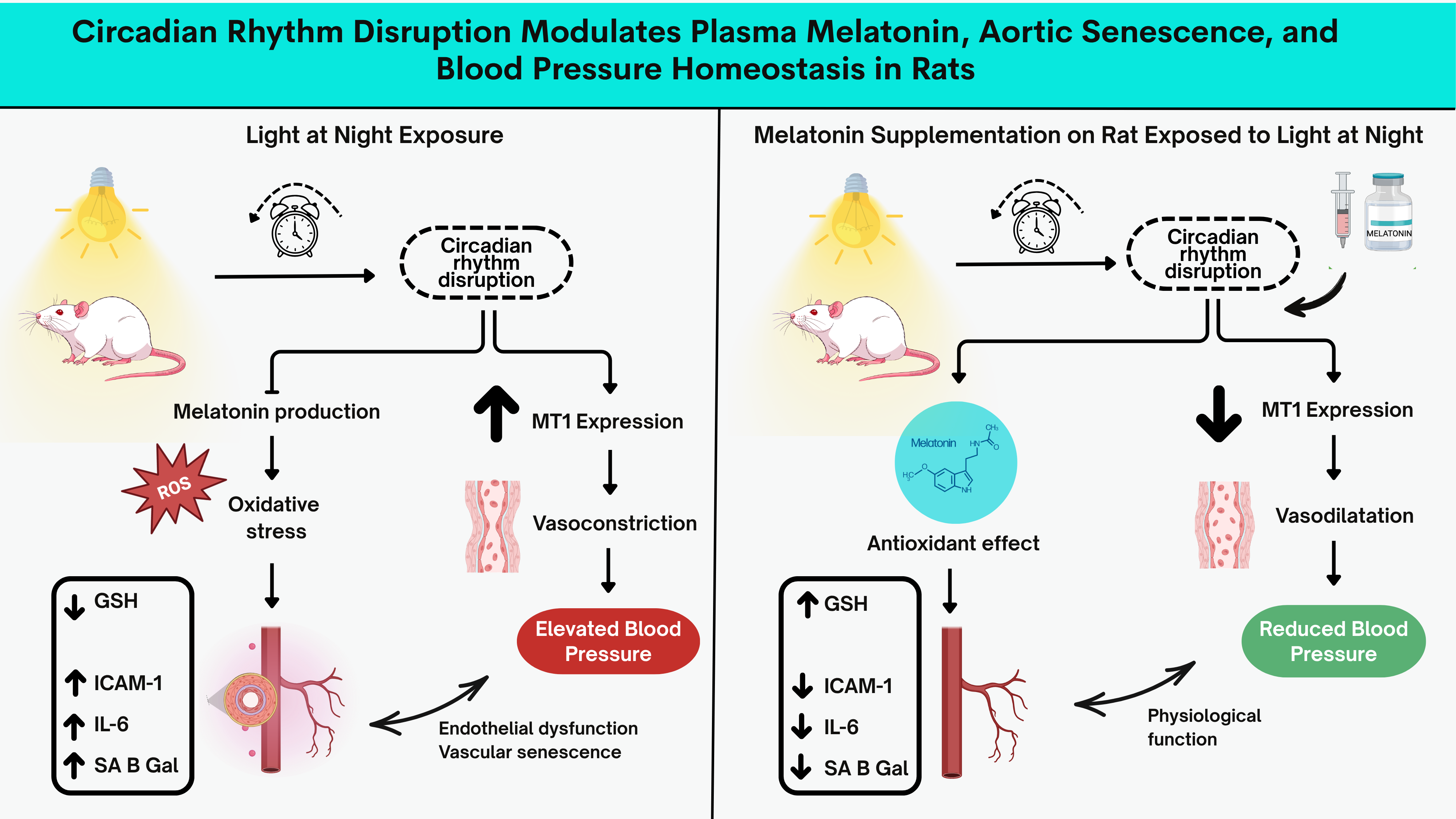
Exposure to light at night disrupts circadian homeostasis and suppresses endogenous melatonin production. Melatonin is crucial for blood pressure regulation and exhibits potent antioxidant properties. Sustained oxidative stress in the aorta contributes to endothelial dysfunction and premature aging. This study investigated the effect of nighttime light exposure on plasma melatonin levels, blood pressure, and molecular markers of vascular stress and senescence in rats. Sprague–Dawley rats were assigned to five groups: Control, Dim light (DL), DL with melatonin (DL + Mel), continuous light exposure (CLE), and CLE plus Melatonin (CLE + Mel). Melatonin (10 mg/kg) was administered orally. ELISA quantified plasma melatonin concentrations, and aortic tissue was analyzed to measure glutathione (GSH) content, intercellular adhesion molecule-1 (ICAM-1), interleukin-6 (IL-6), senescence-associated β-galactosidase (SA-β-Gal) activity, and melatonin receptor type 1 (MT1) gene expression. Nighttime light exposure was associated with a marked reduction in circulating melatonin and an elevation in blood pressure. Melatonin supplementation partially restored melatonin levels and attenuated both systolic and diastolic hypertension. In the aorta, DL and CLE exhibited increased ICAM-1 and IL-6 expression, enhanced SA-β-Gal activity, upregulated MT1 expression, and depleted GSH levels. These molecular alterations were mitigated by melatonin treatment. Collectively, these findings demonstrate that nighttime light exposure induces circadian disruption that drives hypertension, endothelial dysfunction, and premature vascular senescence, whereas melatonin supplementation confers significant protective effects.
HIGHLIGHTS
- Sprague-Dawley Rats were subjected to dim and continuous light at night, and treated with melatonin compared to the untreated group.
- Exposure to light at night reduced melatonin levels and increased blood pressure in rats.
- Oxidative stress, inflammation, and senescence markers increased in the aorta.
- Melatonin treatment restored melatonin levels and lowered blood pressure.
- Melatonin reduced ICAM-1, IL-6, SA β-Gal activity, and preserved GSH content.
GRAPHICAL ABSTRACT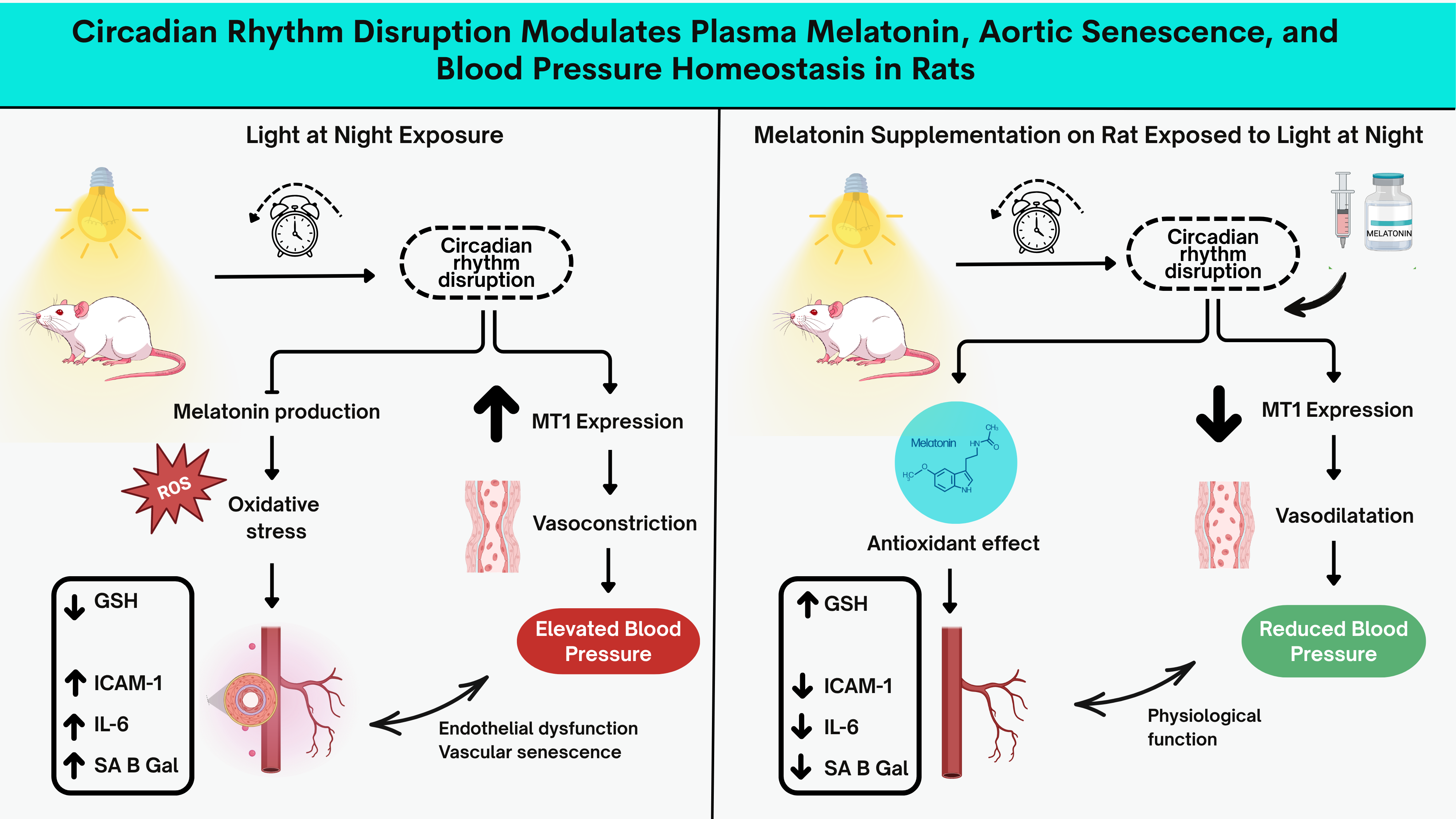
Downloads
References
Danish MZ, Saleem M. A Literature Review On ― Biological clock : biological rhythms and human circadian rhythms. World Journal of Pharmaceutical Research 2020. https://doi:10.20959/wjpr20205-17460
Stewart D, Albrecht U. Beyond vision: effects of light on the circadian clock and mood-related behaviours. npj Biol Timing Sleep 2025. https://doi:10.1038/s44323-025-00029-1
Andreadi A, Andreadi S, Todaro F, et al. Modified Cortisol Circadian Rhythm: The Hidden Toll of Night-Shift Work. Int J Mol Sci 2025. https://doi:10.3390/ijms26052090
Qi J, Pu F, Wang J, et al. Effects of different light intensities on the transcriptome changes of duck retina and pineal gland. Poult Sci 2022. https://doi:10.1016/j.psj.2022.101819
Rumanova VS, Okuliarova M, Zeman M. Differential effects of constant light and dim light at night on the circadian control of metabolism and behavior. Int J Mol Sci 2020. https://doi:10.3390/ijms21155478
Mendes L, Queiroz M, Sena CM. Melatonin and Vascular Function. Antioxidants 2024. https://doi:10.3390/antiox13060747
Xie Y, Lou D, Zhang D. Melatonin Alleviates Age-Associated Endothelial Injury of Atherosclerosis via Regulating Telomere Function. J Inflamm Res 2021. https://doi:10.2147/JIR.S329020
Meng R, Cao Y, Kong Y, et al. Effects of circadian rhythm disorder on body composition in women aged 31–40 years. Ann Palliat Med 2021. https://doi:10.21037/apm-20-2267
Toffoli B, Tonon F, Giudici F, et al. Preliminary study on the effect of a night shift on blood pressure and clock gene expression. Int J Mol Sci 2023. https://doi:10.3390/ijms24119309
Debora HS, Widanarko B. The association between night shift work and hypertension among workers at a construction company in jakarta. Malaysian J Med Heal Sci. 2020;16(3):100-105.
Xiao Z, Xu C, Liu Q, et al. Night shift work, genetic risk, and hypertension. Mayo Clin Proc 2022. https://doi.org/10.1016/j.mayocp.2022.04.007
Boini S, Bourgkard E, Ferrières J, Esquirol Y. What do we know about the effect of night-shift work on cardiovascular risk factors? An umbrella review. Front Public Heal 2022. https://doi:10.3389/fpubh.2022.1034195
Pechanova O, Paulis L, Simko F. Peripheral and central effects of melatonin on blood pressure regulation. Int J Mol Sci 2014. https://doi:10.3390/ijms151017920
Zhang X, Zheng Y, Wang Z, et al. Melatonin as a therapeutic agent for alleviating endothelial dysfunction in cardiovascular diseases: Emphasis on oxidative stress. Biomed Pharmacother 2023. https://doi:10.1016/j.biopha.2023.115475
Smolensky MH, Hermida RC, Portaluppi F. Circadian mechanisms of 24-hour blood pressure regulation and patterning. Sleep Med Rev 2017. https://doi:10.1016/j.smrv.2016.02.003
Kaur R, Singh V, Kumari P, Singh R, Chopra H, Emran T Bin. Novel insights on the role of VCAM-1 and ICAM-1: Potential biomarkers for cardiovascular diseases. Ann Med Surg 2022. https://doi:10.1016/j.amsu.2022.104802
Huang W, Hickson LTJ, Eirin A, Kirkland JL, Lerman LO. Cellular senescence: the good, the bad and the unknown. Nat Rev Nephrol 2022. https://doi:10.1038/s41581-022-00601-z
Zhang L, Zhang HQ, Liang XY, Zhang HF, Zhang T, Liu FE. Melatonin ameliorates cognitive impairment induced by sleep deprivation in rats: Role of oxidative stress, BDNF and CaMKII. Behav Brain Res 2013. https://doi:10.1016/j.bbr.2013.07.051
Fatima G, Sharma VP, Verma NS. Circadian variations in melatonin and cortisol in patients with cervical spinal cord injury. Spinal Cord 2016. https://doi:10.1038/sc.2015.176
No C. Elabscience ® Rat MT ( Melatonin ) ELISA Kit Website : https://www.elabscience.com/p/rat-mt-melatonin-elisa-kit--e-el-r0031?srsltid=AfmBOooiO-p0X_MFfkHBvib9Dbqb1GY1YNDkRPl6B-Vgd6lsLG4fUWVU
Wang R, Pan J, Han J, et al. Melatonin Attenuates Dasatinib-Aggravated Hypoxic Pulmonary Hypertension via Inhibiting Pulmonary Vascular Remodeling. Front Cardiovasc Med 2022. https://doi:10.3389/fcvm.2022.790921
Kubacka M, Kotańska M, Szafarz M, et al. Beneficial effects of non-quinazoline ± alpha1-adrenolytics on hypertension and altered metabolism in fructose-fed rats. Acomparison with prazosin. Nutr Metab Cardiovasc Dis 2019. https://doi:10.1016/j.numecd.2019.04.003
Gao L, Shi Q, Sun B, et al. c-FLIP Protects Cardiac Microcirculation in Sepsis-Induced Myocardial Dysfunction Via FUNDC1-Mediated Regulation of Mitochondrial Autophagy 2025. https://doi:10.1016/j.jacbts.2025.02.016
Kruger NJ. The Bradford Method For Protein Quantitation BT - The Protein Protocols Handbook. In: Walker JM, ed. Humana Press; 2009:17-24. https://doi:10.1007/978-1-59745-198-7_4
Hu G, Zhou H, Yuan Z, Wang J. Vascular cellular senescence in human atherosclerosis : The critical modulating roles of CDKN2A and CDK4 / 6 signaling pathways. Biochem Pharmacol 2025. https://doi:10.1016/j.bcp.2025.116916
Liu Y, Wang L, Liu Z, et al. Durable immunomodulatory nanofiber niche for the functional remodeling of cardiovascular tissue. ACS Nano 2024. https://doi:10.1021/acsnano.3c09692
Livak KJ, Schmittgen TD. Analysis of relative gene expression data using real-time quantitative PCR and the 2-ΔΔCT method. Methods 2001. https://doi:10.1006/meth.2001.1262
Ahn SK, Khalmuratova R, Hah YS, et al. Immunohistochemical and biomolecular identification of melatonin 1a and 1b receptors in rat vestibular nuclei. Auris Nasus Larynx 2012. https://doi:10.1016/j.anl.2011.09.007
Xiong X, Lin Y, Lee J, et al. Chronic circadian shift leads to adipose tissue inflammation and fibrosis. Mol Cell Endocrinol 2021. https://doi:10.1016/j.mce.2020.111110
Duez H, Staels B. Circadian disruption and the risk of developing obesity. Curr Obes Rep 2025. https://doi:10.1007/s13679-025-00610-6
Zhong J, Lu Z, Zhou Z, et al. Melatonin biosynthesis and regulation in reproduction. Frontiers in Endocrinology 2025. https://doi:10.3389/fendo.2025.1630164
Begemann K, Rawashdeh O, Olejniczak I, et al. Endocrine regulation of circadian rhythms. npj Biol Timing Sleep 2025. https://doi:10.1038/s44323-025-00024-6
Yıldız K, Tahiroğlu V, Boy F, Koç S, Yıldız V, Demirel E. An investigation of the effects of melatonin administration on biochemical parameters in rats with experimental cartilage damage. Med Sci Discov 2021. https://doi:10.36472/msd.v8i4.507
Zhao M, Song X, Chen H, et al. Melatonin Prevents Chondrocyte Matrix Degradation in Rats with Experimentally Induced Osteoarthritis by Inhibiting Nuclear Factor-κB via SIRT1. Nutrients 2022. https://doi:10.3390/nu14193966
Bazrgar M, Goudarzi I, Lashkarbolouki T, Elahdadi Salmani M. Melatonin ameliorates oxidative damage induced by maternal lead exposure in rat pups. Physiol Behav 2015. https://doi:10.1016/j.physbeh.2015.06.040
Szewczyk-Golec K, Rajewski P, Gackowski M, et al. Melatonin Supplementation Lowers Oxidative Stress and Regulates Adipokines in Obese Patients on a Calorie-Restricted Diet. Oxid Med Cell Longev 2017. https://doi:10.1155/2017/8494107
Moustafa A. Chronic Exposure to Continuous Brightness or Darkness Modulates Immune Responses and Ameliorates the Antioxidant Enzyme System in Male Rats. Frontiers in Veterinary Science 2021. https://doi:10.3389/fvets.2021.621188
Stenvers DJ, Dorp R Van, Foppen E, et al. Dim light at night disturbs the daily sleep-wake cycle in the rat. Nat Publ Gr 2016. https://doi:10.1038/srep35662
Huang YS, Ka SM, Lu KC, Chen A, Wu CC. Therapeutic insights and molecular mechanism linking melatonin signaling and membranous nephropathy (Review). Biomed Reports. 2025. https://doi:10.3892/br.2025.2017
Dominguez-Rodriguez A. Melatonin in cardiovascular disease. Expert Opin Investig Drugs 2012. https://doi:10.1517/13543784.2012.716037
Ozkalayci F, Kocabas U, Altun BU, Pandi-Perumal S, Altun A. Relationship Between Melatonin and Cardiovascular Disease. Cureus 2021. https://doi:10.7759/cureus.12935
Venegas C, García JA, Doerrier C, et al. Analysis of the daily changes of melatonin receptors in the rat liver. J Pineal Res 2013. https://doi:10.1111/jpi.12019
Molcan L, Maier A, Zemančíková A, et al. Expression of Melatonin Receptor 1 in Rat Mesenteric Artery and Perivascular Adipose Tissue and Vasoactive Action of Melatonin. Cell Mol Neurobiol 2021. https://doi:10.1007/s10571-020-00928-w
Schepelmann M, Molcan L, Uhrova H, Zeman M, Ellinger I. The presence and localization of melatonin receptors in the rat aorta. Cell Mol Neurobiol 2011. https://doi:10.1007/s10571-011-9727-9
Lecacheur M, Ammerlaan DJM, Dierickx P. Circadian rhythms in cardiovascular (dys)function: approaches for future therapeutics. npj Cardiovasc Heal 2024. https://doi:10.1038/s44325-024-00024-8
Simko F, Reiter RJ, Paulis L. Melatonin as a rational alternative in the conservative treatment of resistant hypertension. Hypertens Res 2019. https://doi:10.1038/s41440-019-0318-3
Carvalho R. Melatonin Membrane Receptors in the Vascular System : Function , Modulation and Clinical Relevance. Published online 2025. https://doi:10.1111/jpi.70090
Ting KN, Blaylock NA, Sugden D, Delagrange P, Scalbert E, Wilson VG. Molecular and pharmacological evidence for MT 1 melatonin receptor subtype in the tail artery of juvenile Wistar rats. Published online 1999:987-995.
Pekovic-vaughan V, Gibbs J, Yoshitane H, et al. The circadian clock regulates rhythmic activation of the NRF2 / glutathione- mediated antioxidant defense pathway to modulate pulmonary fibrosis. Published online 2014:548-560. https://doi:10.1101/gad.237081.113.
Li YS, Fujihara H, Fujisawa K, Kawai K. Effect of Circadian rhythm disruption induced by time-restricted feeding and exercise on oxidative stress and immune in mice. J Clin Biochem Nutr. 2025;76(1):35-41.
Wilking M, Ndiaye M, Mukhtar H, Ahmad N. Circadian rhythm connections to oxidative stress: Implications for human health. Antioxidants Redox Signal 2013. https:// doi:10.1089/ars.2012.4889
Tchekalarova J, Nenchovska Z, Kortenska L, Uzunova V, Georgieva I, Tzoneva R. Impact of Melatonin Deficit on Emotional Status and Oxidative Stress-Induced Changes in Sphingomyelin and Cholesterol Level in Young Adult, Mature, and Aged Rats. Int J Mol Sci 2022. https://doi:10.3390/ijms23052809
Salbitani G, Bottone C, Carfagna S, et al. www.bio-protocol.org/e2372. 2017;7:2-6. https://doi:10.21769/BioProtoc.2372
Nuhu F, Gordon A, Sturmey R, Seymour A marie, Bhandari S. Measurement of Glutathione as a Tool for Oxidative Stress Studies by High Performance Liquid Chromatography. Molecules 2020.https://doi:10.3390/molecules25184196
Zhang X, Zheng Y, Wang Z, et al. Biomedicine & Pharmacotherapy Melatonin as a therapeutic agent for alleviating endothelial dysfunction in cardiovascular diseases : Emphasis on oxidative stress. Biomed Pharmacother 2023. https://doi:10.1016/j.biopha.2023.115475
Torres F, González-Candia A, Montt C, et al. Melatonin reduces oxidative stress and improves vascular function in pulmonary hypertensive newborn sheep. J Pineal Res 2015. https://doi:10.1111/jpi12222
Galano A. Melatonin and its metabolites vs oxidative stress : From individual actions to collective protection. J Pineal Res 2018. https://doi:10.1111/jpi.12514
Turhan H, Saydam GS, Erbay AR, et al. Increased plasma soluble adhesion molecules; ICAM-1, VCAM-1, and E-selectin levels in patients with slow coronary flow. Int J Cardiol 2006. https://doi:10.1016/j.ijcard.2005.05.008
Katsuumi G, Shimizu I, Yoshida Y, Minamino T. Vascular Senescence in Cardiovascular and Metabolic Diseases. Front Cardiovasc Med 2018. https://doi:10.3389/fcvm.2018.00018
Childs BG, Durik M, Baker DJ, Van Deursen JM. Cellular senescence in aging and age-related disease: From mechanisms to therapy. Nat Med 2015. https://doi:10.1038/nm.4000
Yue Z, Nie L, Zhao P, Ji N. Senescence-associated secretory phenotype and its impact on oral immune homeostasis. Frontiers in Immunology 2022. https://doi:10.3389/fimmu.2022.1019313
Akgun Y. Apheresis for senescence: Targeting the senescence-associated secretory phenotype to delay aging and age-related diseases. Ageing Res Rev 2025. https://doi:https://doi.org/10.1016/j.arr.2025.102832
Published
How to Cite
Issue
Section
License
Copyright (c) 2026 Walailak University

This work is licensed under a Creative Commons Attribution-NonCommercial-NoDerivatives 4.0 International License.





