
Diversity of Bioactive Compounds from Sphagnum junghuhnianum and Their Antimicrobial Potential: An In-Vitro and In-Silico Assessment
DOI:
https://doi.org/10.48048/tis.2026.12909Keywords:
Antimicrobial activity, Bioactive metabolites, Molecular docking, Penicillin-Binding Protein 1, Sphagnum junghuhnianumAbstract
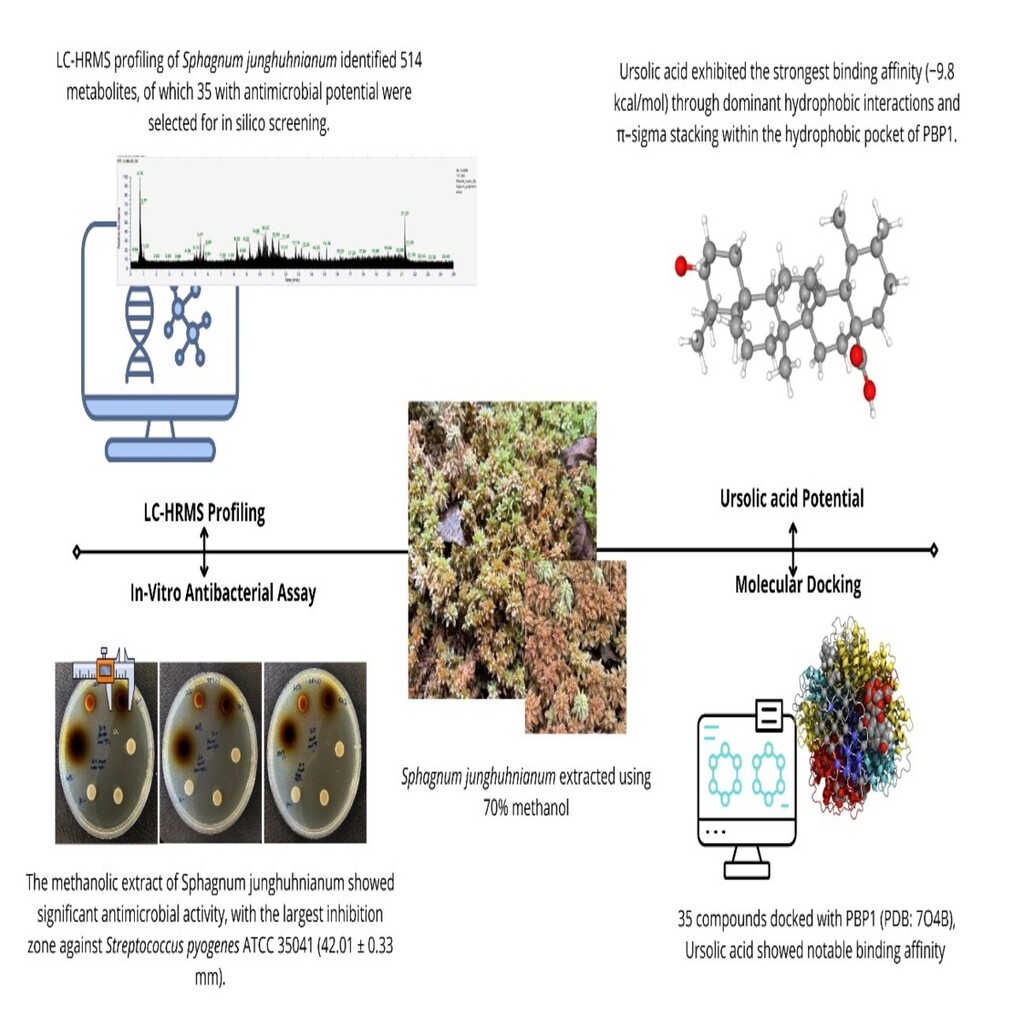
Sphagnum junghuhnianum is a moss species that has attracted attention as a potential natural source of antimicrobial agents. This study aimed to evaluate the antimicrobial activity of the methanolic extract of S. junghuhnianum and to explore its chemical profile using LC-HRMS combined with in silico approaches. Antimicrobial activity was assessed using disk diffusion assays against Gram-positive and Gram-negative bacteria, as well as pathogenic fungi. The extract exhibited notable antibacterial activity in preliminary screening, particularly against Streptococcus pyogenes (42.01 ± 0.33 mm) and Staphylococcus aureus (34.62 ± 2.21 mm), while no antifungal activity was observed under the tested conditions. LC-HRMS profiling revealed 514 putatively identified metabolites, of which 35 compounds were selected for further biological activity prediction and molecular docking analysis. PASS prediction suggested that several compounds may possess antimicrobial relevance. Molecular docking against Penicillin-Binding Protein 1 (PBP1) indicated that ursolic acid showed the most favorable binding affinity (−9.8 kcal/mol) compared to the reference ligand, suggesting a possible antibacterial mode of action. Overall, this study provides preliminary evidence supporting the antibacterial potential of S. junghuhnianum and highlights its relevance for future investigations involving quantitative bioassays and compound validation.
HIGHLIGHTS
- The methanolic extract of Sphagnum junghuhnianumexhibited notable antibacterial activity in preliminary disk diffusion assays, particularly against Streptococcus pyogenes and Staphylococcus aureus.
- LC-HRMS profiling revealed 514 putatively identified metabolites, several of which were predicted to possess antimicrobial relevance.
- Molecular docking analysis suggested that ursolic acid may interact favorably with PBP1, indicating a potential antibacterial mode of action that requires further experimental validation.
GRAPHICAL ABSTRACT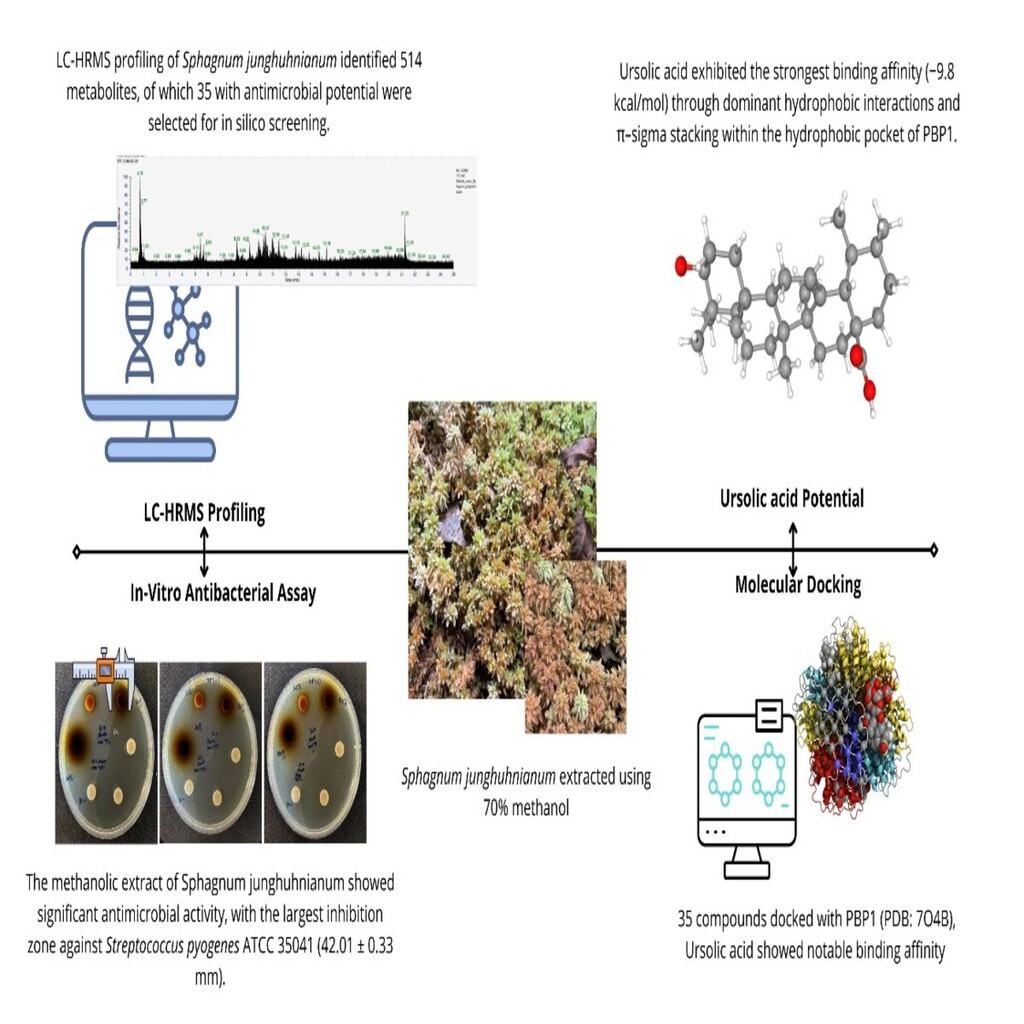
Downloads
References
GV Naumova, AE Tomson, NA Zhmakova, NL Makarova and TF Ovchinnikova. Biologically active compounds of different sphagnum peat species. Solid Fuel Chemistry 2015; 49, 135-140.
F Chen, A Ludwiczuk, G Wei, X Chen, B Crandall-Stotler and JL Bowman. Terpenoid secondary metabolites in bryophytes: Chemical diversity, biosynthesis and biological functions. Critical Reviews in Plant Sciences 2018; 37(2-3), 210-231.
G Montenegro, MC Portaluppi, FA Salas and MF Díaz. Biological properties of the chilean native moss Sphagnum magellanicum. Biological Research 2009; 42(2), 233-237.
D Stenitzer, R Mócsai, H Zechmeister, R Reski, EL Decker and F Altmann. O-methylated N-glycans distinguish mosses from vascular plants. Biomolecules 2022; 12(1), 136.
M Hymas, I Casademont-Reig, S Poigny and VG Stavros. Characteristic photoprotective molecules from the sphagnum world: A solution-phase ultrafast study of sphagnic acid. Molecules 2023; 28(16), 6153.
JD Fudyma, J Lyon, R AminiTabrizi, H Gieschen, RK Chu, DW Hoyt, JE Kyle, J Toyoda, N Tolic, HM Heyman, NJ Hess, TO Metz and MM Tfaily. Untargeted metabolomic profiling of Sphagnum fallax reveals novel antimicrobial metabolites. Plant Direct 2019; 3(10), e00179.
L Bryan, R Shaw, E Schoonover, A Koehl, S DeVries-Zimmerman and M Philben. Sphagnan in Sphagnum-dominated peatlands: Bioavailability and effects on organic matter stabilization. Biogeochemistry 2024; 167, 665-680.
RS Shete, HV Wangikar, JJ Chavan, MB Kanade and SJ Chavan. Bioactive compounds of bryophytes: Unveiling antimicrobial properties and therapeutic potential. International Journal of Plant and Environment 2024, 10(3), 1-15.
TA Çelik, ÖS Aslantürk, G Aslan and M Kirmaci. Determination of phytochemical content and antioxidant activities of Sphagnum divinum Flatberg & K. Hassel and Sphagnum girgensohnii Russow (Sphagnopsida). Anatolian Bryology 2022; 9(2), 58-69.
M Singh, AKS Rawat and R Govindarajan. Antimicrobial activity of some Indian mosses. Fitoterapia 2007; 78(2), 156-158.
DR Chhetri, S Yonzone and R Mukhia. Bioprospecting for enzymes in bryophytes: Extraction of L-Myo-inositol-1-phosphate synthase from Sphagnum junghuhnianum Doz. et Molk. and its characterization. South African Journal of Botany 2023; 136, 692-702.
K Wacnik, VA Rao, X Chen, L Lafage, M Pazos, S Booth, W Vollmer, JK Hobbs, RJ Lewis and SJ Foster. Penicillin-binding protein 1 (PBP1) of Staphylococcus aureus has multiple essential functions in cell division. mBio 2022; 13(4), 0066922.
DPM Sethuvel, YD Bakthavatchalam, MKM Irulappan, R Sherivastava, H Periasamy and V Veeraghavan. β-Lactam resistance in ESKAPE pathogens mediated through modifications in penicillin-binding proteins: An overview. Infectious Diseases and Therapy 2023; 12, 829-841.
S Martinez-Caballero, KV Mahasenan, C Kim, R Molina, R Feltzer, M Lee, R Bouley, D Hesek, JF Fisher, IG Muñoz, M Chang, S Mobashery and JA Hermoso. Integrative structural biology of the penicillin-binding protein-1 from Staphylococcus aureus, an essential component of the divisome machinery. Computational and Structural Biotechnology Journal 2021; 19, 5392-5405.
L Wu, Y Zhang, J Yang, H Liu and S Wang. Diversity and correlation analysis of microbiomes and metabolites of Sphagnum palustre in various microhabitats. BMC Plant Biology 2025; 25, 761.
J Hudzicki. Kirby-Bauer disk diffusion susceptibility test protocol. ASM 2019; 15(1), 1-23.
LR Valeeva, AL Dague, MH Hall, AE Tikhonova, MR Sharipova, MA Valentovic, LM Bogomolnaya and EV Shakirov. Antimicrobial activities of secondary metabolites from moss: A review. Antibiotics 2022; 11, 1004.
L Klavina, G Springe, V Nikolajeva, I Martsinkevich, I Nakurte, D Dzabijeva and I Steinberga Chemical composition analysis, antimicrobial activity and cytotoxicity screening of moss extracts (Moss phytochemistry). Molecules 2015; 20(9), 17221-17243.
S Xu, Y Li, H Wang, J Chen, L Liu and F Zhao. Plant flavonoids with antimicrobial activity against methicillin resistant Staphylococcus aureus (MRSA). ACS Infectious Diseases 2024; 10(8), 1594-1612.
L Krunova, L Valeeva, A Ivanova, D Petrova, S Smirnov and E Fedorova. Antimicrobial activities of secondary metabolites from model mosses. Antibiotics 2022; 11(8), 1004.
ML Astolfi, A Bianchi, F Rossi, G Conti, L Marino, P Santini and R De Luca. Sphagnum moss and peat comparative study: Metal release, binding properties and antioxidant activity. PLoS One 2024; 19(8), e0307210.
A Lagunin, A Stepanchikova, D Filimonov and V Poroikov. PASS: prediction of activity spectra for biologically active substances. Bioinformatics 2000; 16(8), 747-748.
CA Lipinski, F Lombardo, BW Dominy and PJ Feeney. Experimental and computational approaches to estimate solubility and permeability in drug discovery and development settings. Advanced Drug Delivery Reviews 1997; 23(1 3), 3-25.
V Ivanović, M Rančić, B Arsić and A Pavlović. Lipinski's rule of five, famous extensions and famous exceptions. Chemia Naissensis 2020; 3(1), 171-177.
TK Karami, S Hailu, S Feng, R Graham and HJ Gukasyan. Eyes on Lipinski's rule of five: A new “rule of thumb” for physicochemical design space of ophthalmic drugs. Journal of Ocular Pharmacology and Therapeutics 2022; 38(1), 43-55.
Published
How to Cite
Issue
Section
License
Copyright (c) 2026 Walailak University

This work is licensed under a Creative Commons Attribution-NonCommercial-NoDerivatives 4.0 International License.





