
Low-Cost Activated Carbon from Cassava Rhizome Waste via Hydrothermal Method for Methylene Blue and Community Wastewater Treatment: Isotherm and Kinetic Studies
DOI:
https://doi.org/10.48048/tis.2026.12900Keywords:
Cassava rhizome, Activated carbon, Methylene blue, Wastewater, Hydrothermal, Cassava rhizome, Activated carbon, Methylene blue, Wastewater, HydrothermalAbstract
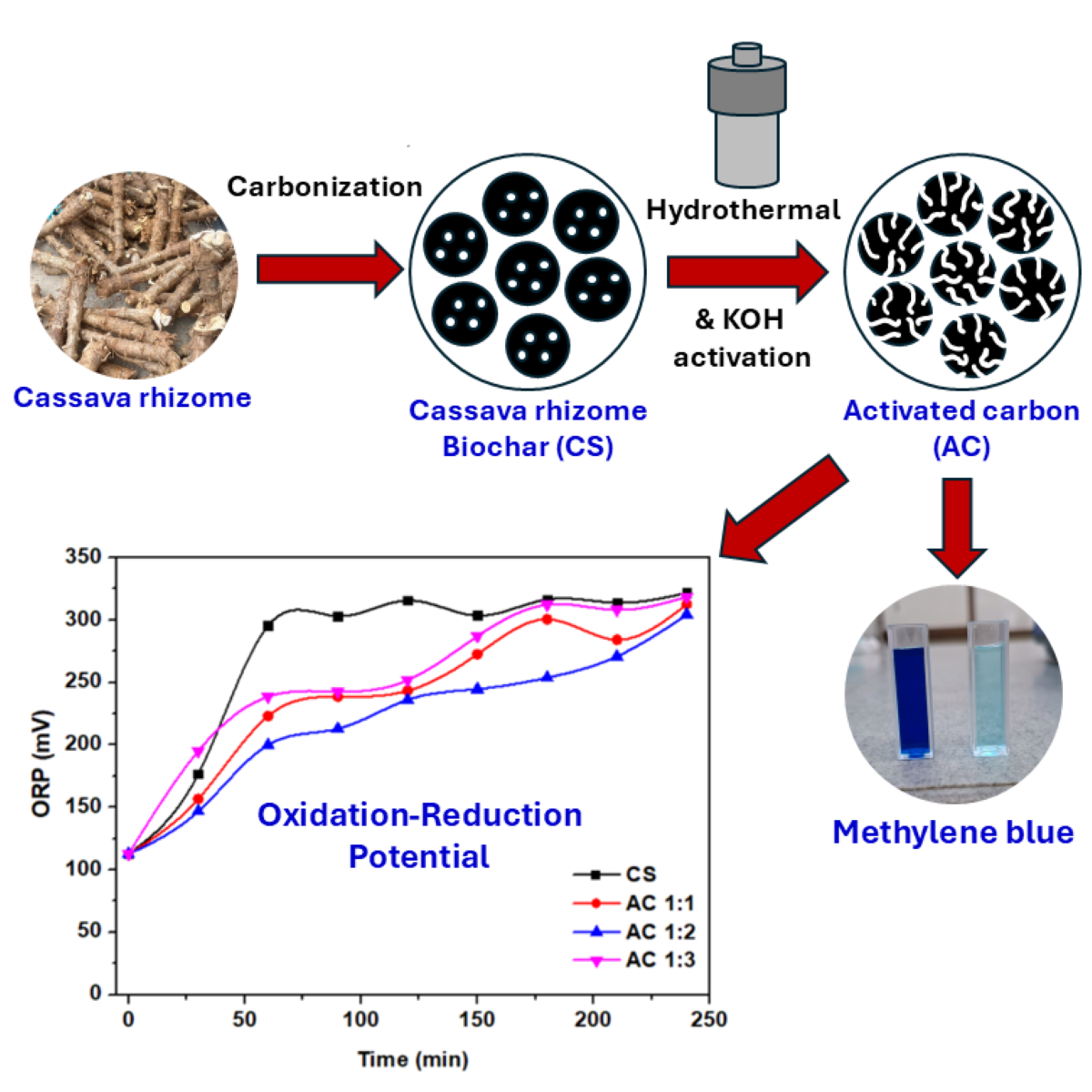
Current pollution of natural water sources led to the utilization of agricultural waste, such as cassava rhizome, for conversion into activated carbon in order to reduce waste, promote a circular economy, and enhance the absorption of pollutants, particularly dyes, in wastewater treatment. In this study, the activated carbon was prepared through a hydrothermal process and potassium hydroxide (KOH) activation at 1:1, 1:2, and 1:3 ratios. The resulting activated carbon exhibited increased porosity, smaller pore sizes, and a higher surface area compared to cassava rhizome biochar, especially at a KOH 1:2 ratio. The surface area reached 42.68 m²/g. In the methylene blue adsorption test, the activated carbon showed better adsorption efficiency than cassava rhizome biochar, achieving a maximum removal percentage of 98.35%. Moreover, the results were consistent with the Langmuir adsorption model, with maximum adsorption capacities of 16.08, 81.97, 100, and 96.15 mg/g for biochar and activated carbon prepared with KOH at the respective ratios of 1:1, 1:2, and 1:3, respectively. The kinetic adsorption study aligned with pseudo-second-order kinetic modeling, suggesting that chemisorption may contribute to the adsorption process. In addition, when activated carbon and cassava rhizome biochar are used for natural wastewater treatment, the oxidation-reduction potential (ORP) and dissolved oxygen (DO) are enhanced, which suggests activated carbon and cassava rhizome biochar could effectively be used in real-world applications.
HIGHLIGHTS
- Preparation of Activated Carbon from cassava rhizome, an agricultural waste for minimization of waste and effective treatment of wastewater.
- The hydrothermal activation method with a KOH ratio of 1:2 is most effective; the surface area of 68 m²/g was 8.82 times higher than that of cassava rhizome biochar.
- The activated carbon with a KOH ratio of 1:2 is capable of adsorbing 35% of methylene blue at initial concentration is 30 mg/L.
- Adsorption followed the Langmuir adsorption model with Qmax = 100 mg/g and KL= 33 L/mg and pseudo-second-order kinetic model with k2 = 0.0006 g/mg·min, R² = 0.9961, and h = 2.7 mg/g·min.
- Both cassava rhizome biochar and activated carbon show potential for natural wastewater treatment.
GRAPHICAL ABSTRACT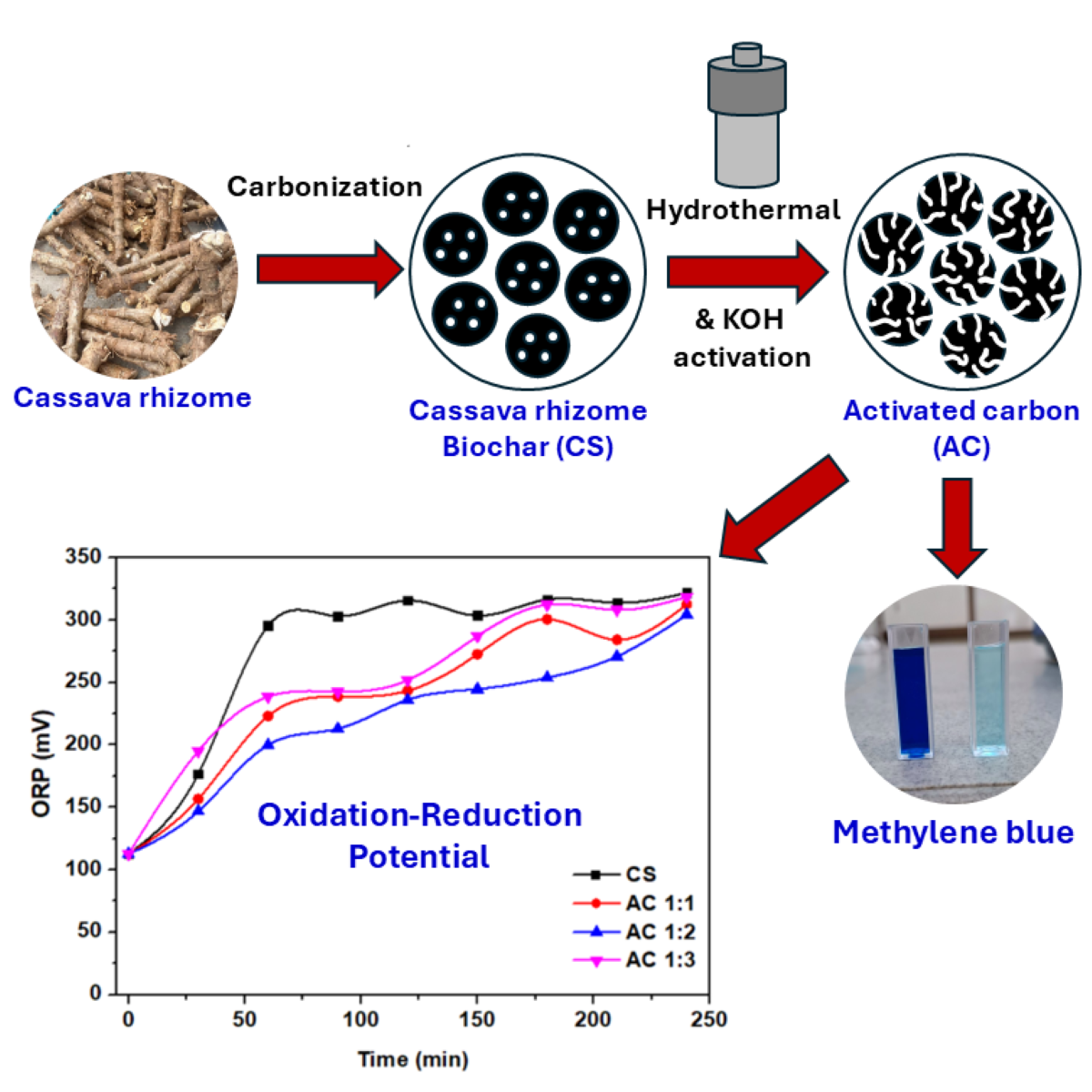
Downloads
References
H Ouaddari, B Abbou, I Lebkiri, A Habsaoui, M Ouzzine and RF Allah. Removal of methylene blue by adsorption onto natural and purified clays: Kinetic and thermodynamic study. Chemical Physics Impact 2024; 8, 100405.
AJ Tóth, D Fózer, P Mizsey, PS Varbanov and JJ Klemeš. Physicochemical methods for process wastewater treatment: powerful tools for circular economy in the chemical industry. Reviews in Chemical Engineering 2023; 39(7), 1123-1151.
Z Liu and SR Smith. Enzyme recovery from biological wastewater treatment. Waste and Biomass Valorization 2021; 12(8), 4185-4211.
S Ihaddaden, D Aberkane, A Boukerroui and K Robert. Removal of methylene blue (basic dye) by coagulation-flocculation with biomaterials (bentonite and Opuntia ficus indica). Journal of Water Process Engineering 2022; 49, 102952.
R Jiao, T Lou, H Zhang and X Wang. Preparation of starch-acrylic acid-carboxymethyl cellulose copolymer and its flocculation performance towards methylene blue. Biochemical Engineering Journal 2022; 187, 108635.
MR Samarghandi, A Dargahi, A Shabanloo, H Nasab, Y Vaziri and A Ansari. Electrochemical degradation of methylene blue dye using a graphite doped PbO2 anode: Optimization of operational parameters, degradation pathway and improving the biodegradability of textile wastewater. Arabian Journal of Chemistry 2020; 13, 6847-6864.
C Liang, D Wei, S Zhang, Q Ren, J Shi and L Liu. Removal of antibiotic resistance genes from swine wastewater by membrane filtration treatment. Ecotoxicology and Environmental Safety 2021; 210, 111885.
W Singsang, P Suttiwattana, K Nakaravarayut, N Prasoetsopha, P Kongsong and I Sittitanadol. Comparison of photocatalytic degradation performance of TiO2-polymer based composites in wastewater treatment. Indochina Applied Science 2025; 14, 260765.
DR Bernstein, GDE Glasgow, MC Lay and M Manley-Harris. Examining how media age affects organic matter removal in activated carbon filtration. AWWA Water Science 2024; 6(4), e1383.
HM El-Bery, M Saleh, RA El-Gendy, MR Saleh and SM Thabet. High adsorption capacity of phenol and methylene blue using activated carbon derived from lignocellulosic agriculture wastes. Scientific Reports 2022; 12(1), 5499.
T Bakalár, M Kaňuchová, A Girová, H Pavolová, R Hromada and Z Hajduová. Characterization of Fe(III) adsorption onto zeolite and bentonite. International Journal of Environmental Research and Public Health 2020; 17(16), 5718.
S Khan, S Ajmal, T Hussain and MU Rahman. Clay-based materials for enhanced water treatment: adsorption mechanisms, challenges, and future directions. Journal of Umm Al-Qura University for Applied Sciences 2025; 11(2), 219-234.
MA Kaczorowska and D Bożejewicz. The application of chitosan-based adsorbents for the removal of hazardous pollutants from aqueous solutions - A review. Sustainability 2024; 16(7), 2615.
O İsmail and GK Özlem. Absorption and adsorption studies of polyacrylamide/sodium alginate hydrogels., Colloid and Polymer Science 2021; 299(5), 783-796.
P Pavithran, RM John, SC George and NM Raju. Highly efficient removal of chromium, methylene blue and methyl orange using electrospun polyurethane as a support in heterogeneous Fenton reaction. Environmental Processes 2024; 11(1), 17.
M Sajid, M Asif, N Baig, M Kabeer, I Ihsanullah and AW Mohammad. Carbon nanotubes-based adsorbents: Properties, functionalization, interaction mechanisms, and applications in water purification. Journal of Water Process Engineering 2022; 47, 102815.
AP Melchor-Durán, MR Moreno-Virgen, A Bonilla-Petriciolet, HE Reynel-Ávila, EL Ortiz and OF González-Vázquez. Heavy metal removal from water using graphene oxide in magnetic-assisted adsorption systems: Characterization, adsorption properties, and modelling. Separations 2024; 11(10), 294.
H Rasouli Sadabad, HM Coleman, JSG Dooley, WJ Snelling, B O’Hagan, YA Ganin and J Arnscheidt. Desorption of antibiotics from granular activated carbon during water treatment by adsorption. Environmental Processes 2024; 11(4), 64.
M Akter, FBA Rahman, MZ Abedin and SMF Kabir. Adsorption characteristics of banana peel in the removal of dyes from textile effluent. Textiles 2021; 1(2), 361-375.
D Ramutshatsha-Makhwedzha, A Mavhungu, ML Moropeng and R Mbaya. Activated carbon derived from waste orange and lemon peels for the adsorption of methyl orange and methylene blue dyes from wastewater. Heliyon 2022; 8(8), e09930.
N Jagadeesh and B Sundaram. Adsorption of pollutants from wastewater by biochar: A review. Journal of Hazardous Materials Advances 2023; 9, 100226.
A Larasati, GD Fowler and NJD Graham. Insights into chemical regeneration of activated carbon for water treatment. Journal of Environmental Chemical Engineering 2021; 9(4), 105555.
H Yi, K Nakabayashi, SH Yoon and J Miyawaki. Pressurized physical activation: A simple production method for activated carbon with a highly developed pore structure. Carbon 2021; 183, 735-742.
CH Tsai and WT Tsai. Optimization of physical activation process by CO2 for activated carbon preparation from honduras mahogany pod husk. Materials 2023; 16(19), 6558.
SK Shahcheragh, MM Bagheri Mohagheghi and A Shirpay. Effect of physical and chemical activation methods on the structure, optical absorbance, band gap and urbach energy of porous activated carbon. SN Applied Sciences 2023; 5(12), 313.
EH Sujiono, D Zabrian, Zurnansyah, Mulyati, V Zharvan, Samnur and NA Humairah. Fabrication and characterization of coconut shell activated carbon using variation chemical activation for wastewater treatment application. Results in Chemistry 2022; 4, 100291.
F Zhang, S Zhang, L Chen, Z Liu and J Qin. Utilization of bark waste of Acacia mangium: The preparation of activated carbon and adsorption of phenolic wastewater. Industrial Crops and Products 2021; 160, 113157.
HS Jahin, AI Khedr and HE Ghannam. Banana peels as a green bioadsorbent for removing metals ions from wastewater. Discover Water 2024; 4(1), 36.
RM Mohamed, N Hashim, S Abdullah, N Abdullah, A Mohamed, MA Asshaary Daud and KF Aidil Muzakkar. Adsorption of heavy metals on banana peel bioadsorbent. Journal of Physics: Conference Series 2020; 1532(1), 012014.
K Tawatbundit and S Mopoung. Activated carbon preparation from sugarcane leaf via a low temperature hydrothermal process for aquaponic treatment. Materials 2022; 15(6), 2133.
MN Prandini, Pranoto and SD Marliyana. A comparative study of kinetics of methylene blue dye using adsorbent andisol and humic acid from lighnite by KOH-hydrothermal method. Journal of Physics: Conference Series 2022; 2190(1), 012019.
M Adame-Pereira, CJ Durán-Valle and C Fernández-González. Hydrothermal carbon coating of an activated carbon - A new adsorbent. Molecules 2023; 28(12), 4769.
K Nakason, P Khemthong, W Kraithong, S Mahasandana and B Panyapinyopol. Effect of alkaline pretreatment on the properties of cassava rhizome. Chiang Mai Journal of Science 2021; 48, 1511-1523.
A Cressoni De conti, G Antonio, F Yamaji, M Brienzo, C Conti and MP Granado. Co-densification and torrefaction of biomass blends to produce durable solid biofuels. Biomass and Bioenergy 2025; 206, 108656.
U Meka, JA Kumar and S Sivamani. Carbon nanomaterials from cassava rhizome for efficient toluene removal from aqueous solutions: Continuous adsorption studies using local and global optimization. South African Journal of Chemical Engineering 2025; 53, 462-475.
N Prasoetsopha, P Somdee, N Srakaew, K Nuilek, W Singsang, P Masakul, P Chumsamrong and I Sittitanadol, Strengthening natural rubber with activated carbon from cassava rhizome waste: Cure characteristics, physical, thermal, and mechanical properties. Applied Science and Engineering Progress 2025; 18(2), 7710.
MFM Yusop, MA Ahmad, NA Rosli and MEA Manaf. Adsorption of cationic methylene blue dye using microwave-assisted activated carbon derived from acacia wood: Optimization and batch studies. Arabian Journal of Chemistry 2021; 14(6), 103122.
C Phaenark, T Jantrasakul, P Paejaroen, S Chunchob and W Sawangproh. Sugarcane bagasse and corn stalk biomass as a potential sorbent for the removal of Pb(II) and Cd(II) from aqueous solutions. Trends in Sciences 2022; 20(2), 6221.
JM Monteagudo, A Durán, M Alonso and A Stoica. Investigation of effectiveness of KOH-activated olive pomace biochar for efficient direct air capture of CO2. Separation and Purification Technology 2025; 352, 127997.
NL Panwar and A Pawar. Influence of activation conditions on the physicochemical properties of activated biochar: A review. Biomass Conversion and Biorefinery 2022; 12(3), 925-947.
C Wang, X Li, W Wu, G Chen and J Tao. Removal of cadmium in water by potassium hydroxide activated biochar produced from Enteromorpha prolifera. Journal of Water Process Engineering 2021; 42, 102201.
A Ateş. The effect of microwave and ultrasound activation on the characteristics of biochar produced from tea waste in the presence of H3PO4 and KOH. Biomass Conversion and Biorefinery 2023; 13(10), 9075-9094.
J Xiao, R Hu and G Chen. Micro-nano-engineered nitrogenous bone biochar developed with a ball-milling technique for high-efficiency removal of aquatic Cd(II), Cu(II) and Pb(II). Journal of Hazardous Materials 2020; 387, 121980.
GW Hyeon, GB Lee, DJ Kang, SE Lee, KM Seong and JE Park. Optimization of activated carbon synthesis from spent coffee grounds for enhanced adsorption performance. Molecules 2025; 30(12), 2557.
MM Rahman, AZ Shafiullah, A Pal, MA Islam, I Jahan and BB Saha. Study on optimum IUPAC adsorption isotherm models employing sensitivity of parameters for rigorous adsorption system performance evaluation. Energies 2021; 14(22), 7478.
S Shimizu and N Matubayasi. Sorption hysteresis: A statistical thermodynamic fluctuation theory. Langmuir 2024; 40(22), 11504-11515.
S Sawasdee and P Watcharabundit. Mechanistic insights into adsorption of methylene blue and methyl orange using cassava rhizome activated carbon: Adsorption, characterization and reusability. Trends in Sciences 2025; 22, 10751.
R Kumar Mishra, B Singh and B Acharya. A comprehensive review on activated carbon from pyrolysis of lignocellulosic biomass: An application for energy and the environment. Carbon Resources Conversion 2024; 7(4), 100228.
Y Guo and Q Wang. Fabrication and characterization of activated carbon from phyllostachys edulis using single-step KOH Activation with different temperatures. Processes 2022; 10(9), 1712.
NAM Barakat, OM Irfan and HM Moustafa. H3PO4/KOH activation agent for high performance rice husk activated carbon electrode in acidic media supercapacitors. Molecules 2022, 28(1), 296.
R Nandi, MK Jha, SK Guchhait, D Sutradhar and S Yadav. Impact of KOH activation on rice husk derived porous activated carbon for carbon capture at flue gas alike temperatures with high CO2/N2 selectivity. ACS Omega 2023; 8(5), 4802-4812.
NL Bih, MJ Rwiza, AS Ripanda, AA Mahamat, RL Machunda and JW Choi. Adsorption of phenol and methylene blue contaminants onto high-performance catalytic activated carbon from biomass residues. Heliyon 2025; 11(1), e41150.
P Hariharan, K Sakthiuma, K Agilandeswari and M Nitheshlee. Statistical optimization and kinetic studies of water hyacinth stem-based activated carbon adsorbent for synthetic textile dye effluent treatment. Water Conservation Science and Engineering 2024; 9(1), 14.
N Vasiljević, S Panić, G Tadić, J Vuković, N Novaković and V Mićić. Investigation of the kinetics of the adsorption of methylene blue on activated carbon. Engineering Proceedings 2025; 99(1), 4.
NS Sulaiman, MH Mohamad Amini, M Danish, O Sulaiman and R Hashim. Kinetics, thermodynamics, and isotherms of methylene blue adsorption study onto cassava stem activated carbon. Water 2021; 13(20), 2936.
S Sutar and J Jadhav. A comparative assessment of the methylene blue dye adsorption capacity of natural biochar versus chemically altered activated carbons. Bioresource Technology Reports 2024; 25, 101726.
I Kurnia, S Karnjanakom, I Irkham, H Haryono, Y Situmorang, A Indarto, AR Noviyanti, YW Hartati and G Guan. Enhanced adsorption capacity of activated carbon over thermal oxidation treatment for methylene blue removal: Kinetics, equilibrium, thermodynamic, and reusability studies. RSC Advances 2023, 13(1), 220-227.
M Andrade-Guel, CA Ávila-Orta, C Cabello-Alvarado, G Cadenas-Pliego, SC Esparza-González, M Pérez-Alvarez and ZV Quiñones-Jurado. Non-woven fabrics based on nanocomposite Nylon 6/ZnO obtained by ultrasound-assisted extrusion for improved antimicrobial and adsorption methylene blue dye properties. Polymers 2021; 13(11), 1888.
A Pimsawat, A Tangtrakarn, N Pimsawat, A Khamkongkaeo and S Daengsakul. Super activated carbon-silica composite from silkworm excrement by microwave-assisted KOH activation for adsorption and supercapacitor. Environmental Technology & Innovation 2025; 37, 104034.
Kalsoom, A Ali, S Khan, N Ali and MA Khan. Enhanced ultrasonic adsorption of pesticides onto the optimized surface area of activated carbon and biochar: adsorption isotherm, kinetics, and thermodynamics. Biomass Conversion and Biorefinery 2024; 14(14), 15519-15534.
N Prasoetsopha, I Soonsook, A Panyayaw, P Nanon, W Singsang and I Sittitanadol. Adsorption of methylene blue and ferrous metal solution by using coconut shell charcoal. Journal of Materials Science and Applied Energy 2023; 12(2), 248672.
I Ortiz-Anaya and Y Nishina. Refined surface area determination of graphene oxide using methylene blue as a probe molecule: A comparative approach. Bulletin of the Chemical Society of Japan 2024; 97, uoae118.
L Chen, C Batchelor-McAuley, B Rasche, C Johnston, N Hindle and RG Compton. Surface area measurements of graphene and graphene oxide samples: Dopamine adsorption as a complement or alternative to methylene blue? Applied Materials Today 2020; 18, 100506.
R Agüero-Quiñones, Z Ávila-Sánchez, S Rojas-Flores, L Cabanillas-Chirinos, M De La Cruz-Noriega, R Nazario-Naveda and W Rojas-Villacorta. Activated carbon electrodes for bioenergy production in microbial fuel cells using synthetic wastewater as substrate. Sustainability 2023; 15(18), 13767.
SM Khumalo, BF Bakare, S Rathilal and EK Tetteh. Characterization of south african brewery wastewater: Oxidation-reduction potential variation. Water 2022; 14(10), 1604.
MA Salinas-Toledano, RW Thring and FY Garcia-Becerra. High-resolution monitoring reveals treatment wetland resilience across temperature and loading conditions: Factorial analysis of operational parameters in domestic wastewater treatment. Journal of Water Process Engineering 2025; 74, 107851.
Published
How to Cite
Issue
Section
License
Copyright (c) 2025 Walailak University

This work is licensed under a Creative Commons Attribution-NonCommercial-NoDerivatives 4.0 International License.





