
Optimization of DSPE-Based Graphene Oxide from Empty Fruit Bunches Using Response Surface Methodology for Determining Ciprofloxacin Antibiotic Residue
DOI:
https://doi.org/10.48048/tis.2026.12859Keywords:
Antibiotic residue, Ciprofloxacin, Dispersive solid phase extraction, Graphene oxide, Response surface methodologyAbstract
Water contamination by antibiotic residues, especially ciprofloxacin (CIP), poses a significant environmental issue due to its role in antimicrobial resistance and adverse impacts on aquatic ecosystems. This study investigated the synthesis of graphene oxide (GO) from empty fruit bunches (EFB) and assessed its efficacy as an adsorbent in the Dispersive Solid Phase Extraction (DSPE) method for the quantification of CIP. The synthesized graphene oxide (GO) underwent thorough characterization through FTIR, XRD, SEM-EDX, and UV-Vis spectrophotometry, validating the presence of oxygen-containing functional groups and structural characteristics associated with GO. The optimization of the GO-based DSPE process using Response Surface Methodology (RSM) determined the optimal extraction conditions at pH 3, an adsorbent mass of 22.5 mg, and a contact time of 35 min, resulting in a predicted CIP adsorption efficiency of 90.592%. ANOVA results confirmed the statistical significance of the quadratic model (p < 0.0001), with a high coefficient of determination (R² = 0.9856) and a non-significant lack-of-fit (p > 0.05), indicating strong model reliability. Experimental validation yielded an adsorption efficiency of 90.129%, closely matching the predicted value with a minimal error of 0.005%, demonstrating excellent agreement between the model and experimental results. The method showed excellent linearity (R² = 0.9989 - 0.9999), with an LOD of 0.0874 mg/L and LOQ of 0.2914 mg/L. Precision was satisfactory, with %RSD ranging from 0.71% to 2.89%. The findings demonstrate that EFB-derived GO serves as an effective and sustainable adsorbent, showing considerable potential for analytical applications, wastewater treatment, and broader environmental remediation.
HIGHLIGHTS
- GO successfully synthesized from EFB and verified through FTIR, XRD, SEM-EDX, and UV-Vis.
- RSM-BBD optimized CIP adsorption using GO-based DSPE.
- Optimal conditions achieved 90.592% adsorption (pH 3, 22.5 mg GO, 35 min).
- Validation showed strong model accuracy with 90.129% adsorption and 0.005% error.
GRAPHICAL ABSTRACT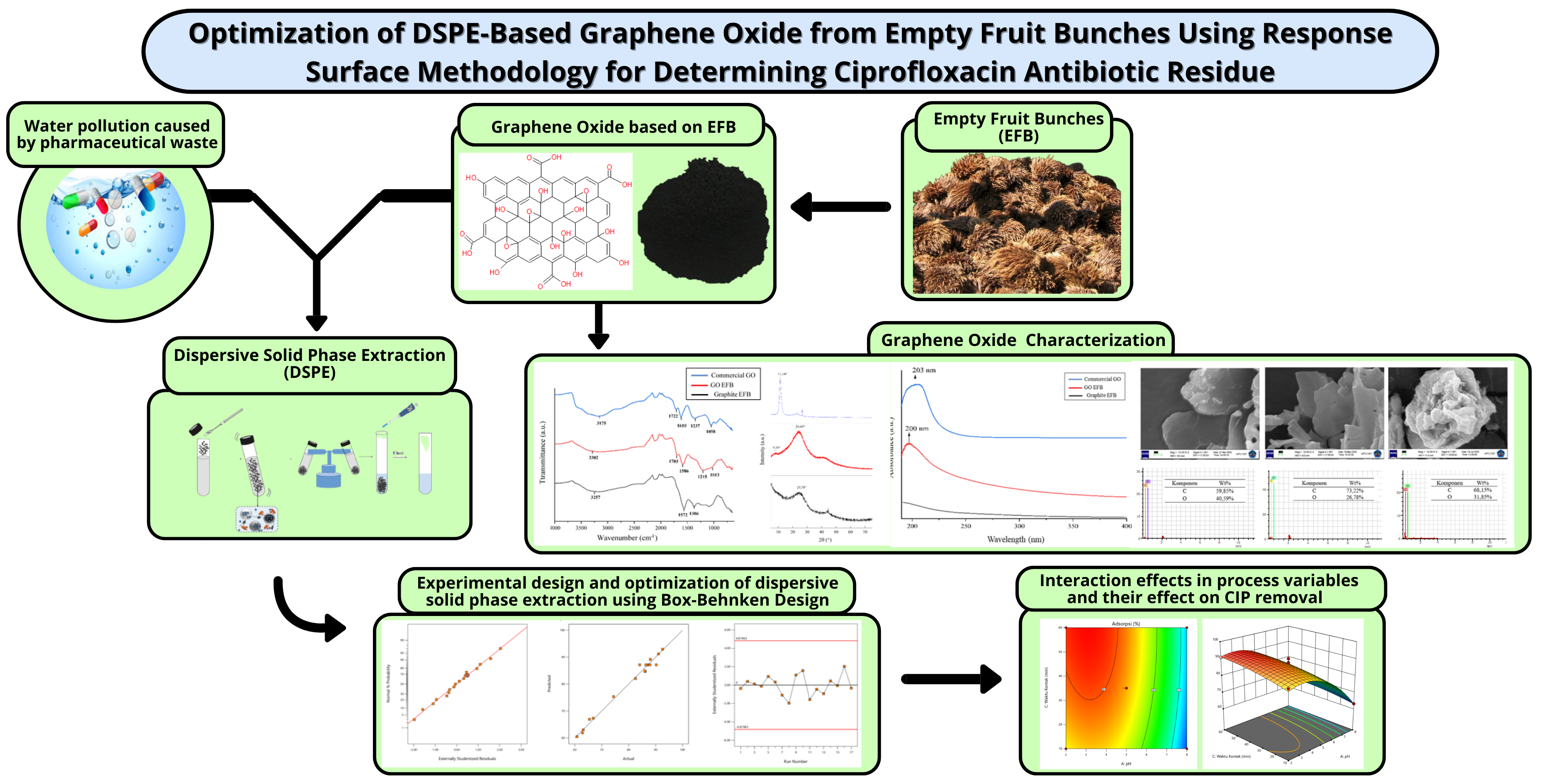
Downloads
References
G Feng, H Huang and Y Chen. Effects of emerging pollutants on the occurrence and transfer of antibiotic resistance genes: A review. Journal of Hazardous Materials 2021; 420, 126602.
RY Krishnan, S Manikandan, R Subbaiya, M Biruntha, M Govarthanan and N Karmegam. Removal of emerging micropollutants originating from pharmaceuticals and personal care products (PPCPs) in water and wastewater by advanced oxidation processes: A review. Environmental Technology & Innovation 2021; 23, 101757.
NZ Arman, S Salmiati, A Aris, MR Salim, TH Nazifa, MS Muhamad and M Marpongahtun. A review on emerging pollutants in the water environment: Existences, health effects and treatment processes. Water 2021; 13(22), 3258.
M Rigoletto, P Calza, E Gaggero and E Laurenti. Hybrid materials for the removal of emerging pollutants in water: Classification, synthesis, and properties. Chemical Engineering Journal Advances 2022; 10, 100252.
GG Hacıosmanoğlu, C Mejías, J Martín, JL Santos, I Aparicio and E Alonso. Antibiotic adsorption by natural and modified clay minerals as designer adsorbents for wastewater treatment: A comprehensive review. Journal of Environmental Management 2022; 317, 115397.
J Dutta and AA Mala. Removal of antibiotic from the water environment by the adsorption technologies: A review. Water Science & Technology 2020; 82, 401-426.
SF Aden, LA Mahmoud, EH Ivanovska, LR Terry, VP Ting, MG Katsikogianni and S Nayak. Controlled delivery of ciprofloxacin using zirconium-based MOFs and poly-caprolactone composites. Journal of Drug Delivery Science and Technology 2023; 88, 104894.
K Velusamy, S Periyasamy, PS Kumar, T Jayaraj, R Krishnasamy, J Sindhu, D Sneka, B Subhashini and DVN Vo. Analysis on the removal of emerging contaminant from aqueous solution using biochar derived from soap nut seeds. Environmental Pollution 2021; 287, 117632.
E Yakamercan, A Aygün and H Simsek. Antibiotic ciprofloxacin removal from aqueous solutions by electrochemically activated persulfate process: Optimization, degradation pathways, and toxicology assessment. Journal of Environmental Sciences 2024; 143, 85-98.
N Nakhonchai, N Prompila, K Ponhong, W Siriangkhawut, J Vichapong and S Supharoek. Green hairy basil seed mucilage biosorbent for dispersive solid phase extraction enrichment of tetracyclines in bovine milk samples followed by HPLC analysis. Talanta 2024; 271, 125645.
J Chen, G Mei, X Zhang, D Huang, P He and D Xu. Dispersive solid-phase extraction and ultra-performance liquid chromatography-tandem mass spectrometry - a rapid and accurate method for detecting 10 macrolide residues in aquatic products. Foods 2024; 13(6), 866.
A Niroumandpassand, A Javadi, MR A Mogaddam and I Fathollahi. Dispersive solid phase extraction of fluoroquinolone antibiotic residues in raw cow milk samples using bimetallic organic frameworks and investigating the effect of UV irradiation on antibiotics decontamination. Microchemical Journal 2024; 206, 111564.
A Jiříčková, O Jankovský, Z Sofer and D Sedmidubský. Synthesis and applications of graphene oxide. Materials 2022; 15(3), 920.
R Soni, AK Pal, P Tripathi, JA Lal, K Kesari and V Tripathi. An overview of nanoscale materials on the removal of wastewater contaminants. Applied Water Science 2020; 10(8), 189.
KZ Donato, HL Tan, VS Marangoni, MV Martins, PR Ng, MC Costa, P Jain, SJ Lee, GK Koon, RK Donato and AH Castro Neto. Graphene oxide classification and standardization. Scientific Reports 2023; 13(1), 6064.
Badan Pusat Statistik. Produksi tanaman perkebunan Provinsi Lampung, BPS, Lampung, Indonesia, 2022.
EH Sujiono, D Zabrian, MY Dahlan, BD Amin and J Agus. Graphene oxide based coconut shell waste: Synthesis by modified Hummers method and characterization. Heliyon 2020; 6(8), e04568.
R Rinawati, B Buhani, W Widiarti, A Isro, E Fitrianingsih, A Rahmawati, AA Kiswandono and F Nitti. Enhancing ciprofloxacin removal: Unveiling the potential of graphene oxide synthesized from cassava peels through Box-Behnken design optimization. Journal of Sustainable Development of Energy, Water and Environment Systems 2024; 12(4), 1-20.
Y Sun, Y Yang, M Yang, F Yu and J Ma. Response surface methodological evaluation and optimization for adsorption removal of ciprofloxacin onto graphene hydrogel. Journal of Molecular Liquids 2019; 284, 124-130.
P Hongsawat, S Bungokule, N Boonchouy, P Prarat and P Punyapalakul. Response surface methodology approach for optimization of norfloxacin by the graphene oxide under the presence of tannic acid and its adsorption mechanism. Desalination and Water Treatment 2021; 217, 272-285.
HM Kifayatullah, H Tahir and AR Shah. Modeling and optimization of ultrasound-assisted adsorption of crystal violet dye by graphene oxide nanoparticles using response surface methodology. International Journal of Environmental Analytical Chemistry 2022; 102(16), 4678-4694.
A Ibrahim, MS Vohra, SA Bahadi, SA Onaizi, MH Essa and T Mohammed. Heavy metals adsorption onto graphene oxide: Effect of mixed systems and response surface methodology modeling. Desalination and Water Treatment 2022; 266, 78-90.
O Akhavan, K Bijanzad and A Mirsepah. Synthesis of graphene from natural and industrial carbonaceous wastes. RSC Advances 2014; 4(39), 20441-20448.
S Nasir, MZ Hussein, NA Yusof and Z Zainal. Oil palm waste-based precursors as a renewable and economical carbon sources for the preparation of reduced graphene oxide from graphene oxide. Nanomaterials 2017; 7(7), 182.
DC Marcano, DV Kosynkin, JM Berlin, A Sinitskii, Z Sun, A Slesarev, LB Alemany, W Lu and JM Tour. Improved synthesis of graphene oxide. ACS Nano 2010; 4(8), 4806-4814.
F Li, DL Zhao, LZ Bai and DD Zhang. Fabrication of nano hollow graphene oxide spheres via water-in-oil emulsion. Applied Mechanics and Materials 2013; 320, 540-543.
A Alkhouzaam, H Qiblawey, M Khraisheh, M Atieh and M Al-Ghouti. Synthesis of graphene oxides particle of high oxidation degree using a modified Hummers method. Ceramics International 2020; 46(15), 23997-24007.
L Zhu, T Shi and Y Chen. Preparation and characteristics of graphene oxide from the biomass carbon material using fir powder as precursor. Fullerenes, Nanotubes and Carbon Nanostructures 2015; 23(11), 961-967.
NFBM Ithnin and WW Liu. Exfoliation of graphite into graphene oxide and reduction by plant extract to synthesize graphene. International Journal of Nanoelectronics and Materials 2024; 17(2), 284-287.
NA Karim, CMR Ghazali, MM Ramli, DRY Marniati, Tb, MD Payana and MFM Zulfadhly. Graphitization of empty fruit bunch (EFB) waste at lower heating temperature. AIP Conference Proceedings 2023; 2484(1), 040006.
CD Liyanage, H Kumar, I Perera, PG Abeykoon, F Chen, JS Joya, SL Suib and DH Adamson. Synthesis of graphene oxide: Effect of sonication during oxidation. Carbon 2024; 223, 119047.
PN Khanam, A Popelka, M Alejji and MA AlMaadeed. Biotechnological production process and life cycle assessment of graphene. Journal of Nanomaterials 2017; 2017(1), 5671584.
MS Akhtar, DSR Jutt, S Aslam, R Nawaz, MA Irshad, M Khan, M Khairy, A Irfan, SA Al-Hussain and MEA Zaki. Green synthesis of graphene oxide and magnetite nanoparticles and their arsenic removal efficiency from arsenic contaminated soil. Scientific Reports 2024; 14(1), 23094.
AH Handayani, F Amalia, EV Noviantana, TR Mulyaningsih, A Waris and A Dimyati. Atmospheric plasma-assisted preparation of graphene oxide from biomass: Characterization and elemental analysis. Atom Indonesia 2025; 51(2), 89-96.
KO Olumurewa, B Olofinjana, O Fasakin, MA Eleruja and EOB Ajayi. Characterization of high yield graphene oxide synthesized by simplified hummers method. Graphene 2017; 6(4), 85-98.
AKM Chiang, LY Ng, CY Ng, YP Lim, E Mahmoudi, LS Tan and SK Mah. Conversion of palm oil empty fruit bunches to highly stable and fluorescent graphene oxide quantum dots: An eco-friendly approach. Materials Chemistry and Physics 2023; 309, 128433.
F Fauzi, F Azizi, MM Musawwa and WSB Dwandaru. Synthesis and characterisations of reduced graphene oxide prepared by microwave irradiation with sonication. Journal of Physical Science 2021; 32(2), 1-13.
U Baruah and D Chowdhury. Functionalized graphene oxide as an electrochemical sensing platform for detection of bisphenol A. Advanced Materials Letters 2018; 9(7), 516-525.
YT Zewide, TA Yemata, AA Ayalew, et al. Application of response surface methodology (RSM) for experimental optimization in biogenic silica extraction from rice husk and straw ash. Scientific Reports 2025; 15(1), 132.
SAS Amin and N Sobhi. Process optimization in poultry feed mill. Scientific Reports 2023; 13(1), 9897.
R Rostamian and H Behnejad. A comprehensive adsorption study and modeling of antibiotics as a pharmaceutical waste by graphene oxide nanosheets. Ecotoxicology and Environmental Safety 2018; 147, 117-123.
F Gamon, M Tomaszewski, G Cema and A Ziembinska-Buczynska. Adsorption of oxytetracycline and ciprofloxacin on carbon-based nanomaterials as affected by pH. Archives of Environmental Protection 2022; 48(2), 34-41.
S Yasmin, MG Azam, MS Hossain, US Akhtar and MH Kabir. Efficient removal of ciprofloxacin from aqueous solution using Zn-C battery derived graphene oxide enhanced by hydrogen bonding, electrostatic and π-π interaction. Heliyon 2024; 10(12), e33317.
R Zainul, EU Rahmad, RO Ramadhani, MS Ahmad and AP Lubis. Optimizing hydrogen gas concentration using response surface methodology (RSM) with design expert 6.0.9 application. IOP Conference Series: Earth and Environmental Science 2023; 1281(1), 012025.
SON Yudiastuti, W Handayani, EKN Sari, R Wijaya, A Brilliantina and AHH Slamet. The utilization of Trichoderma viride in optimising xylanase production from coffee cherry processing waste. International Journal of Islamic Education, Research and Multiculturalism 2024; 6(1), 102-122.
JR Spence and DJ Stanley. Tempered expectations: A tutorial for calculating and interpreting prediction intervals in the context of replications. Advances in Methods and Practices in Psychological Science 2024; 7(1), 25152459231217932.
N Zaini, NSM Hanapi, WNW Ibrahim, R Osman, S Kamaruzaman, N Yahaya and AL Anis. Dispersive micro-solid-phase extraction (D-µ-SPE) with polypyrrole-graphene oxide (PPy-GO) nanocomposite sorbent for the determination of tetracycline antibiotics in water samples. Malaysian Journal of Analytical Sciences 2022; 26(5), 953-964.
E Öztürk. Graphene oxide as a highly efficient and reusable adsorbent for simultaneous removal of parabens: Optimization by response surface methodology, adsorption isotherms and reusability studies. Adsorption 2025; 31(1), 24.
F Fauzi, F Azizi, MM Musawwa and WSB Dwandaru. Synthesis and characterisations of reduced graphene oxide prepared by microwave irradiation with sonication. Journal of Physical Science 2021; 32(2), 1-13.
Published
How to Cite
Issue
Section
License
Copyright (c) 2026 Walailak University

This work is licensed under a Creative Commons Attribution-NonCommercial-NoDerivatives 4.0 International License.





