
Toothpaste Containing Green-synthesized Silver Nanoparticle using Moringa oleifera Leaf Extract and Ulvan: Formulation, Characterization, Antifungal Activity and Stability Test
DOI:
https://doi.org/10.48048/tis.2026.12838Keywords:
Alginate beads, Green synthesis, Moringa oleifera, Silver nanoparticle, Toothpaste, UlvanAbstract
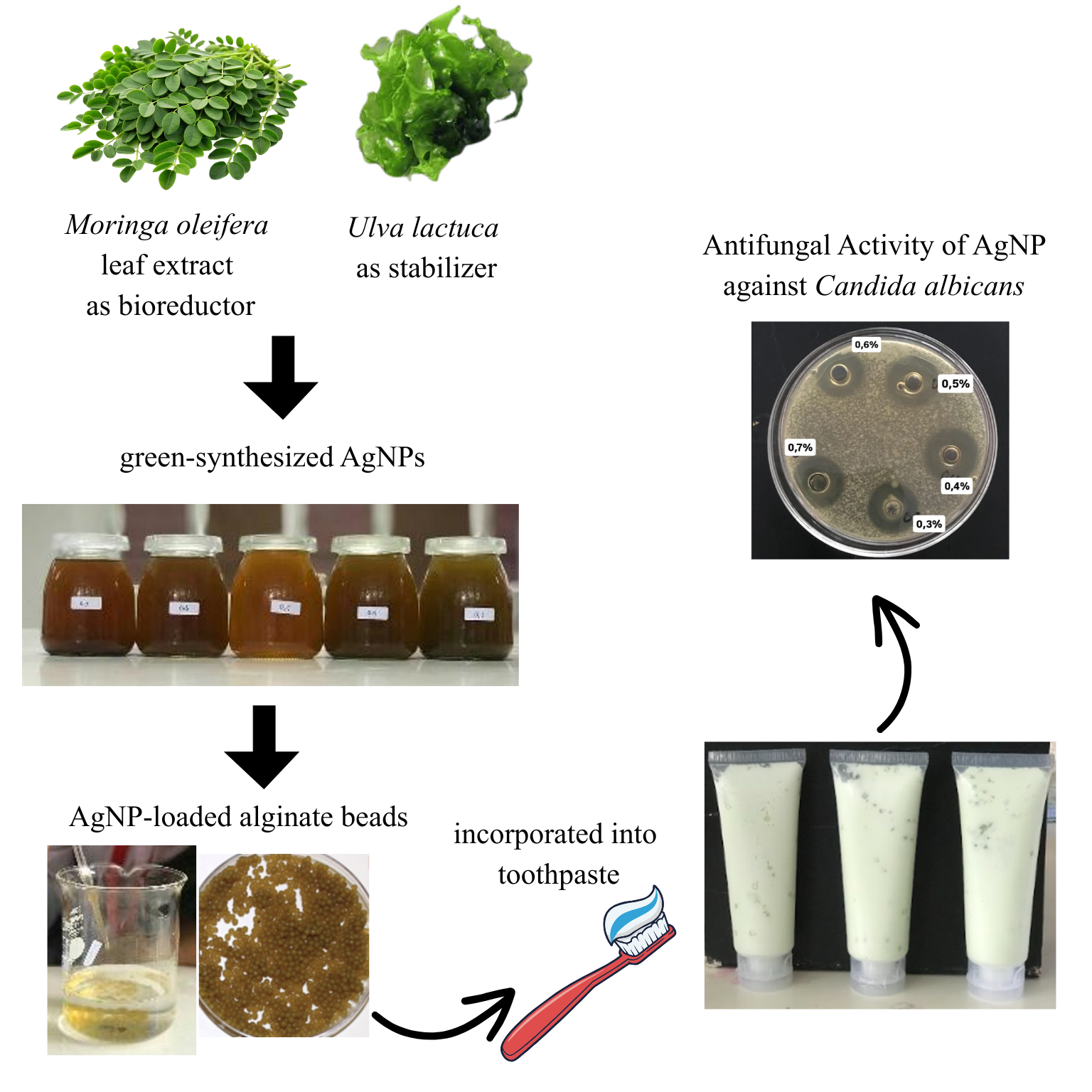
This study addresses the need to enhance the antifungal activity of toothpaste formulations while ensuring the use of safe and biocompatible synthesis approaches. Therefore, this study aimed to develop silver nanoparticles (AgNPs) via a green approach to improve antifungal performance in toothpaste formulations, using Moringa oleifera leaf extract as a safe bioreductor and ulvan as a stabilizing agent. Moringa oleifera leaves were extracted by maceration using 96% ethanol, while ulvan was isolated from Ulva lactuca through acid extraction and enzymatic treatment. AgNPs were synthesized at varying extract concentrations (0.3% - 0.7%), labeled as E1 - E5, and characterized using UV-Vis spectroscopy, particle size analysis, zeta potential measurement, FTIR, and PXRD. The AgNP formation was confirmed by a color change to reddish-brown and a distinct SPR band, with λmax shifting with increasing extract concentration. Particle size ranged from 438 - 699 nm, indicating aggregation, while zeta potential values (−4.9 to −12.6 mV) suggested moderate colloidal stability. FTIR analysis of alginate beads containing AgNPs revealed characteristic O–H, COO⁻, and C–O–C bands, confirming metal-carboxylate interactions, whereas PXRD showed crystalline Ag peaks. Toothpaste formulations (F1 - F5) incorporating the beads were evaluated for physical properties, antifungal activity, and stability. All formulas exhibited acceptable organoleptic characteristics, homogeneous texture, and the physical properties meeting SNI standards. Antifungal testing demonstrated inhibition zones of 19 - 22 mm, with higher AgNP concentrations yielding stronger activity. Stability testing over 14 days indicated no significant changes in color, odor, homogeneity, pH, foaming, or spreadability, with slight decreases in viscosity. In conclusion, F3 showed the most favorable balance of physical stability, AgNP incorporation (6.01 ± 0.08 mg/L), and antifungal performance. These findings demonstrate that green-synthesized AgNPs encapsulated in alginate beads have strong potential for incorporation into safe and effective antifungal toothpaste formulations.
HIGHLIGHTS
- Silver nanoparticles (AgNPs) were successfully synthesized via an eco-friendly green synthesis method using Moringa oleifera leaf extract as a bioreductant and ulvan as a natural stabilizing agent.
- Characterization (UV–Vis, FTIR, PXRD, particle size, zeta potential) confirmed AgNP formation, metal–carboxylate interactions, and crystalline FCC silver structure, validating the success of the synthesis and encapsulation process.
- AgNP-loaded alginate beads demonstrated strong antifungal activity (19 - 22 mm inhibition zones) against Candida albicans ATCC 10231 and the toothpaste formulation exhibited excellent physicochemical performance and 14-day stability, meeting SNI standards for viscosity, pH, spreadability, foamability, and overall organoleptic quality.
GRAPHICAL ABSTRACT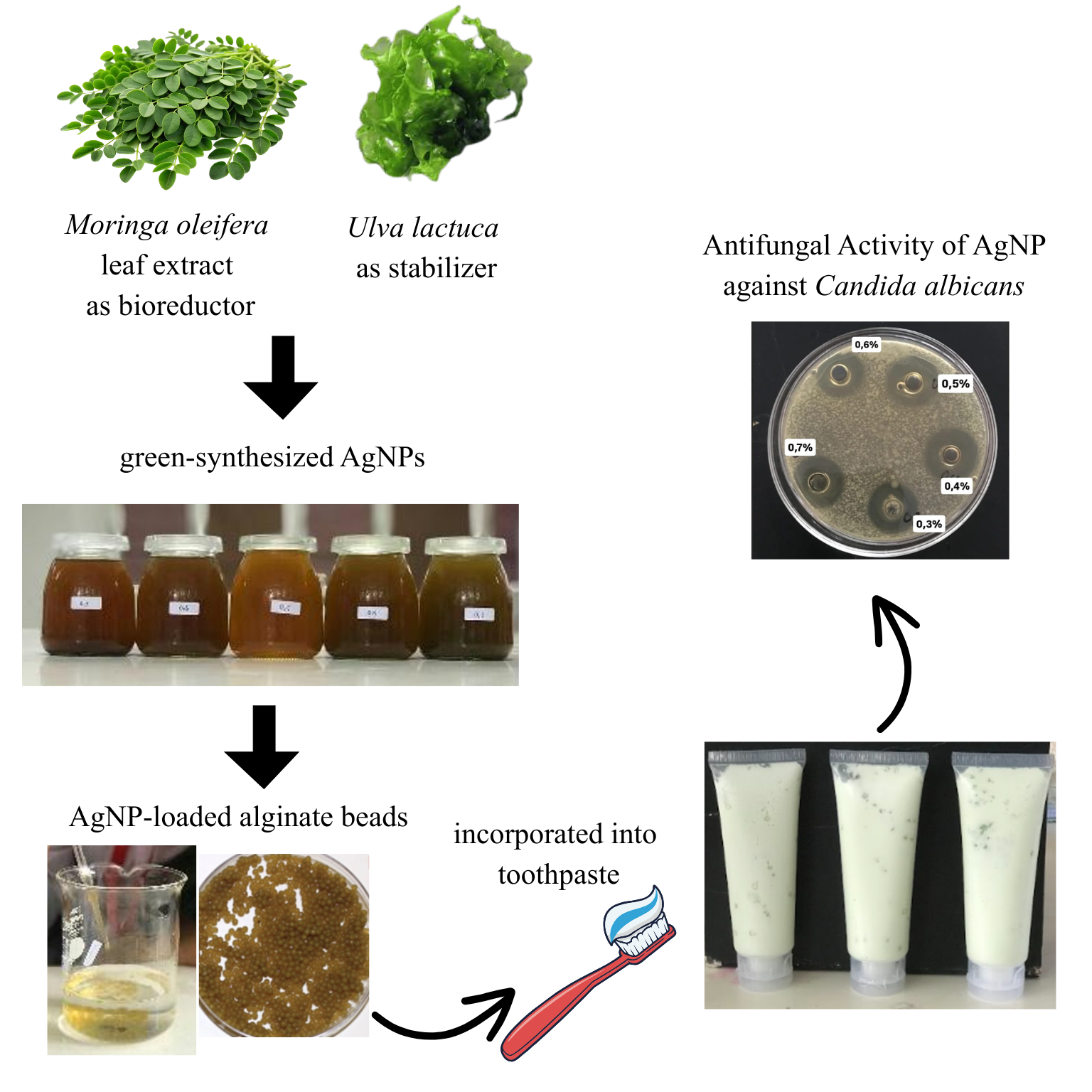
Downloads
References
A Naganthran, G Verasoundarapandian, FE Khalid, MJ Masarudin, A Zulkharnain, NM Nawawi, M Karim, CAC Abdullah and SA Ahmad. Synthesis, characterization and biomedical application of silver nanoparticles. Materials 2022; 15(2), 427.
S Lin, R Huang, Y Cheng, J Liu, BL Lau and MR Wiesner. Silver nanoparticle-alginate composite beads for point-of-use drinking water disinfection. Water Research 2013; 47(12), 3959-3965.
OAK Ahmed, NRS Sibuyi, AO Fadaka, E Maboza, A Olivier, AM Madiehe, M Meyer and G Geerts. Prospects of using gum arabic silver nanoparticles in toothpaste to prevent dental caries. Pharmaceutics 2023; 15(3), 871.
A Sevagaperumal, JR Joel and S Periyasamy. Formulation and evaluation of characteristics, remineralization potential, and antimicrobial properties of toothpaste containing nanohydroxyapatite and nanosilver particles: An in vitro study. International Journal of Clinical Pediatric Dentistry 2024; 17(6), 630-636.
MMJ Arsène, PI Viktorovna, M Alla, M Mariya, SA Nikolaevitch, AKL Davares, ME Yurievna, M Rehailia, AA Gabin, KA Alekseevna, YN Vyacheslavovna, ZA Vladimirovna, O Svetlana and D Milana. Antifungal activity of silver nanoparticles prepared using Aloe vera extract against Candida albicans. Veterinary World 2023; 16(1), 18-26.
C Wang, YJ Kim, P Singh, R Mathiyalagan, Y Jin and DC Yang. Green synthesis of silver nanoparticles by Bacillus methylotrophicus, and their antimicrobial activity. Artificial Cells, Nanomedicine, and Biotechnology 2016; 44(4), 1127-1132.
M Bindhu, M Umadevi, GA Esmail, NA Al-Dhabi and MV Arasu. Green synthesis and characterization of silver nanoparticles from Moringa oleifera flower and assessment of antimicrobial and sensing properties. Journal of Photochemistry and Photobiology B: Biology 2020; 205, 111836.
HM El-Rafie, MH El-Rafie and MK Zahran. Green synthesis of silver nanoparticles using polysaccharides extracted from marine macro algae. Carbohydrate Polymers 2013; 96(2), 403-410.
H Perumalsamy, SR Balusamy, J Sukweenadhi, S Nag, D MubarakAli, M El-Agamy Farh, H Vijay and S Rahimi. A comprehensive review on Moringa oleifera nanoparticles: Importance of polyphenols in nanoparticle synthesis, nanoparticle efficacy and their applications. Journal of Nanobiotechnology 2024; 22, 71.
A Nicolae-Maranciuc, D Chicea and LM Chicea. Ag nanoparticles for biomedical applications—Synthesis and characterization—A review. International Journal of Molecular Sciences 2022; 23(10), 5778.
M Asif, R Yasmin, R Asif, A Ambreen, M Mustafa and S Umbreen. Green synthesis of silver nanoparticles (AgNPs), structural characterization, and their antibacterial potential. Dose-Response 2022; 20(2), 15593258221088709.
A Massironi, A Morelli, L Grassi, D Puppi, S Braccini, G Maisetta, S Esin, G Batoni, CD Pina and F Chiellini. Ulvan as novel reducing and stabilizing agent from renewable algal biomass: Application to green synthesis of silver nanoparticles. Carbohydrate Polymers 2019; 203, 310-321.
DP Mahasawat, S Mudtaleb and P Eaidprap. The influence of silver nanoparticle sizes on antibacterial activity, cytotoxicity and genotoxicity of alginate hydrogel beads containing silver nanoparticles. Applied Mechanics and Materials 2019; 886, 70-77.
FA Puspitasari, NB Kartikasari, S Mutiyastika, R Purnamasari, N Lusiana and E Agustina. Effect of different solvents in the extraction process of Kelor (Moringa oleifera) leaves on bioactive resources and phenolic acid content. International Conference on Sustainable Health Promotion 2023; 3(1), 167-178.
E Sulastri, MS Zubair, R Lesmana, AFA Mohammed and N Wathoni. Development and characterization of ulvan polysaccharides-based hydrogel films for potential wound dressing applications. Drug Design, Development and Therapy 2021; 2021, 4213-4226.
Z Haris and I Ahmad. Green synthesis of silver nanoparticles using Moringa oleifera and its efficacy against gram-negative bacteria targeting quorum sensing and biofilms. Journal of Umm Al-Qura University for Applied Sciences 2024; 10, 156-167.
B Sadeghi and F Gholamhoseinpoor. A study on the stability and green synthesis of silver nanoparticles using Ziziphora tenuior (Zt) extract at room temperature. Spectrochimica Acta Part A: Molecular and Biomolecular Spectroscopy 2015; 134, 310-315.
E Sulastri, R Lesmana, MS Zubair, AFA Mohammed, KM Elamin and N Wathoni. Ulvan/Silver nanoparticle hydrogel films for burn wound dressing. Heliyon 2023; 9(7), 18044.
RM Galazzi, EDB Santos, T Caurin, GDS Pessôa, IO Mazali and MAZ Arruda. The importance of evaluating the real metal concentration in nanoparticles post-synthesis for their applications: A case-study using silver nanoparticles. Talanta 2016; 146, 795-800.
N Kaur, B Singh and S Sharma. Hydrogels for potential food application: Effect of sodium alginate and calcium chloride on physical and morphological properties. The Pharma Innovation Journal 2018; 7(7), 142-148.
D Marlina and N Rosalini. Formulasi pasta gigi gel ekstrak daun sukun (Artocarpus altilis) dengannatrium cmc sebagai Gelling agent dan uji kestabilan fisiknya. Portal Jurnal Poltekkes Palembang 2017; 12(1), 36-50.
J Ogboji, IY Chindo, A Jauro, DEA Boryo and NM Lawal. Formulation, physicochemical evaluation and antimicrobial activity of green toothpaste on streptococcus mutans. International Journal of Advanced Chemistry 2018; 6(1), 108-113.
I Solihah, M Mardiyanto, S Fertilita, H Herlina and O Charmila. The standardization of ethanolic extract of Tahongai leaves (Kleinhovia hospita L.). Science and Technology Indonesia 2018; 3(1), 14-18.
S Kwon and S Ko. Colorimetric freshness indicator based on cellulose nanocrystal–silver nanoparticle composite for Intelligent Food Packaging. Polymers 2022; 14(17), 3695.
NS Alharbi, NS Alsubhi and AI Felimban. Green synthesis of silver nanoparticles using medicinal plants: Characterization and application. Journal of Radiation Research and Applied Sciences 2022; 15(3), 109-124.
V Sharma, D Verma and GS Okram. Influence of surfactant, particle size and dispersion medium on surface plasmon resonance of silver nanoparticles. Journal of Physics: Condensed Matter 2020; 32(14), 145302.
EO Dare, CO Oseghale, AH Labulo, ET Adesuji, EE Elemike, JC Onwuka and JT Bamgbose. Green synthesis and growth kinetics of nanosilver under bio-diversified plant extracts influence. Journal of Nanostructure in Chemistry 2015; 5, 85-94.
R Singh, A Gupta, V Patade, G Balakrishna, H Pandey and A Singh. Synthesis of silver nanoparticles using extract of Ocimum kilimandscharicum and its antimicrobial activity against plant pathogens. SN Applied Sciences 2019; 1, 1652.
PS Jassal, D Kaur, R Prasad and J Singh. Green synthesis of titanium dioxide nanoparticles: Development and applications. Journal of Agriculture and Food Research 2022; 10, 100361.
DJ Pochapski, C Carvalho dos Santos, GW Leite, SH Pulcinelli and CV Santilli. Zeta potential and colloidal stability predictions for inorganic nanoparticle dispersions: Effects of experimental conditions and electrokinetic models on the interpretation of results. Langmuir 2021; 37(45), 13379-13389.
S Karmakar. Particle size distribution and zeta potential based on dynamic light scattering: Techniques to characterize stability and surface charge distribution of charged colloids. Recent Trends in Materials: Physics and Chemistry 2019; 28, 117-159.
AH Hashem, E Saied, BH Amin, FO Alotibi, AA Al-Askar, AA Arishi, FM Elkady and MA Elbahnasawy. Antifungal activity of biosynthesized silver nanoparticles (AgNPs) against Aspergilli causing aspergillosis: Ultrastructure study. Journal of Functional Biomaterials 2022; 13(4), 242.
PC Pandey, AK Tiwari, MK Gupta, G Pandey and RJ Narayan. Effect of the organic functionality on the synthesis and antimicrobial activity of silver nanoparticles. Nano LIFE 2020; 10(3), 2050002.
MA Alam, SI Sadia, MKH Shishir, RK Bishwas, S Ahmed, SM Al-Reza and SA Jahan. Crystallinity integration and crystal growth behavior study of preferred oriented (111) cubic silver nanocrystal. Inorganic Chemistry Communications 2025; 173, 113834.
B Gratia, P Veronika, Y Yamlean, K Lifie and R Mansauda. Formulation of toothpaste of nutmeg ethanol extract (Myristica fragrans Houtt.). Pharmacon 2021; 10(3), 968-974.
Published
How to Cite
Issue
Section
License
Copyright (c) 2025 Walailak University

This work is licensed under a Creative Commons Attribution-NonCommercial-NoDerivatives 4.0 International License.





