
Valorization of Desalted Duck Egg White through Enzymatic Hydrolysis: Gas-tric Digestion Behavior and Antioxidant Responses
DOI:
https://doi.org/10.48048/tis.2026.12767Keywords:
Desalted duck egg white, Enzymatic hydrolysis, in vitro gastric digestion, Protein valorization, Antioxidant activ-ity, Food ingredient developmentAbstract
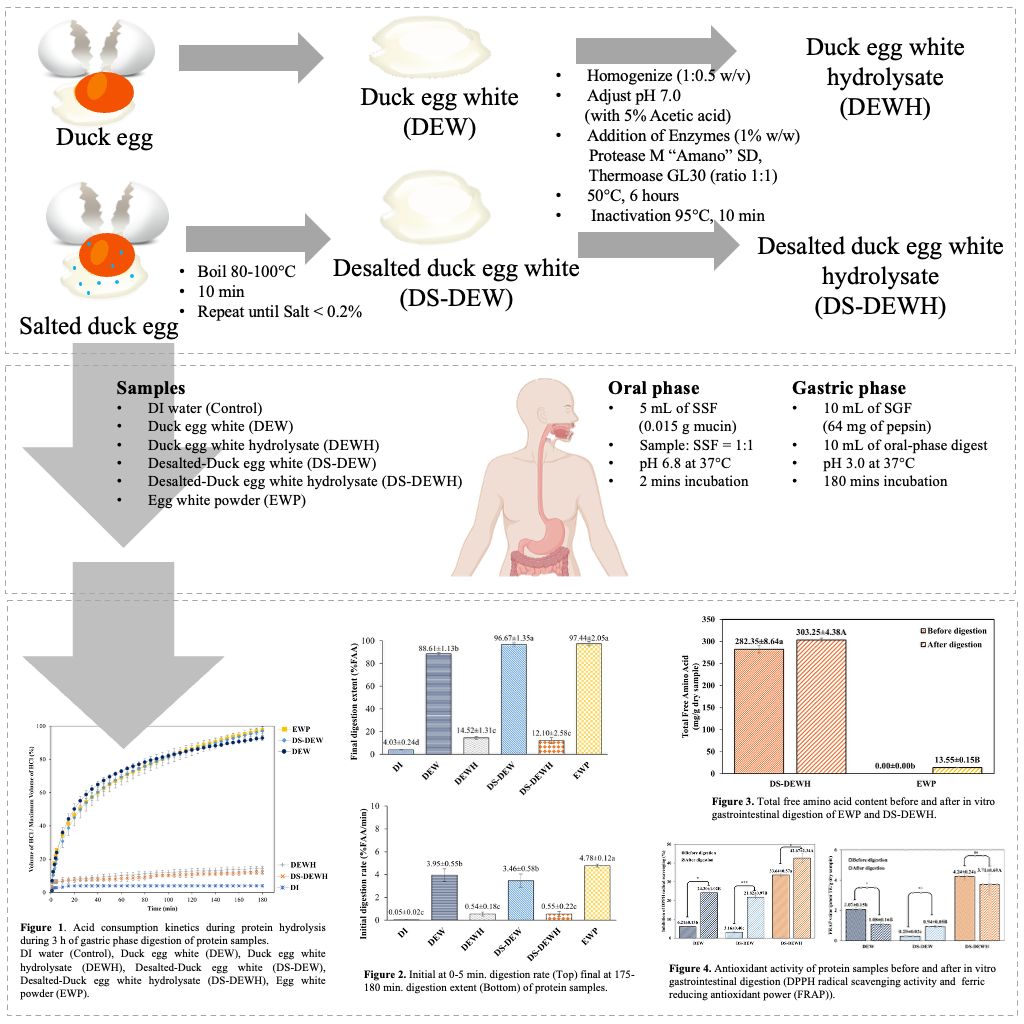
This study investigated the gastric-phase digestion behavior and antioxidant responses of enzymatic protein hydrolysates produced from desalted duck egg white (DS-DEW) and evaluated their potential for value-added food ingredient development. Duck egg white proteins were subjected to enzymatic hydrolysis, and a modified INFOGEST static in vitro digestion model focusing exclusively on the gastric phase was applied to native duck egg white (DEW), desalted duck egg white (DS-DEW), duck egg white hydrolysate (DEWH), desalted duck egg white hydrolysate (DS-DEWH), and commercial egg white powder (EWP). Proteolysis during digestion was assessed by acid consumption kinetics, while free amino acid (FAA) release and antioxidant responses were evaluated using HPLC, DPPH radical-scavenging, and ferric-reducing antioxidant power (FRAP) assays. Native and non-hydrolyzed samples (DEW, DS-DEW, and EWP) exhibited high acid uptake during gastric digestion (90% - 95%), whereas pre-hydrolyzed samples (DEWH and DS-DEWH) showed markedly lower acid consumption (< 20%), reflecting extensive peptide bond cleavage prior to gastric digestion rather than reduced digestibility. DS-DEWH exhibited the highest absolute FAA content after digestion (303.25 ± 4.38 mg/g), approximately 22-fold higher than EWP, indicating greater availability of hydrolysis products under acidic, pepsin-driven conditions. Antioxidant evaluation using chemical assays showed that DS-DEWH displayed significantly higher DPPH radical-scavenging activity (42.67%) and FRAP values (3.71 ± 0.69 µmol TE/g) than DEW and DS-DEW (p < 0.05). Due to analytical constraints, EWP was excluded from antioxidant assays. Overall, enzymatic hydrolysis altered gastric-phase digestion behavior and enhanced free amino acid availability and antioxidant responses of desalted duck egg white at the chemical-assay level, supporting its valorization as a sustainable food protein ingredient.
HIGHLIGHTS
- Enzymatic hydrolysis altered the gastric-phase digestion behavior of desalted duck egg white.
- Desalted duck egg white hydrolysate showed high free amino acid levels after digestion.
- Strong antioxidant responses of the hydrolysate were observed using DPPH and FRAP assays.
- Enzymatic processing supports valorization of salted egg white by-products for food use.
GRAPHICAL ABSTRACT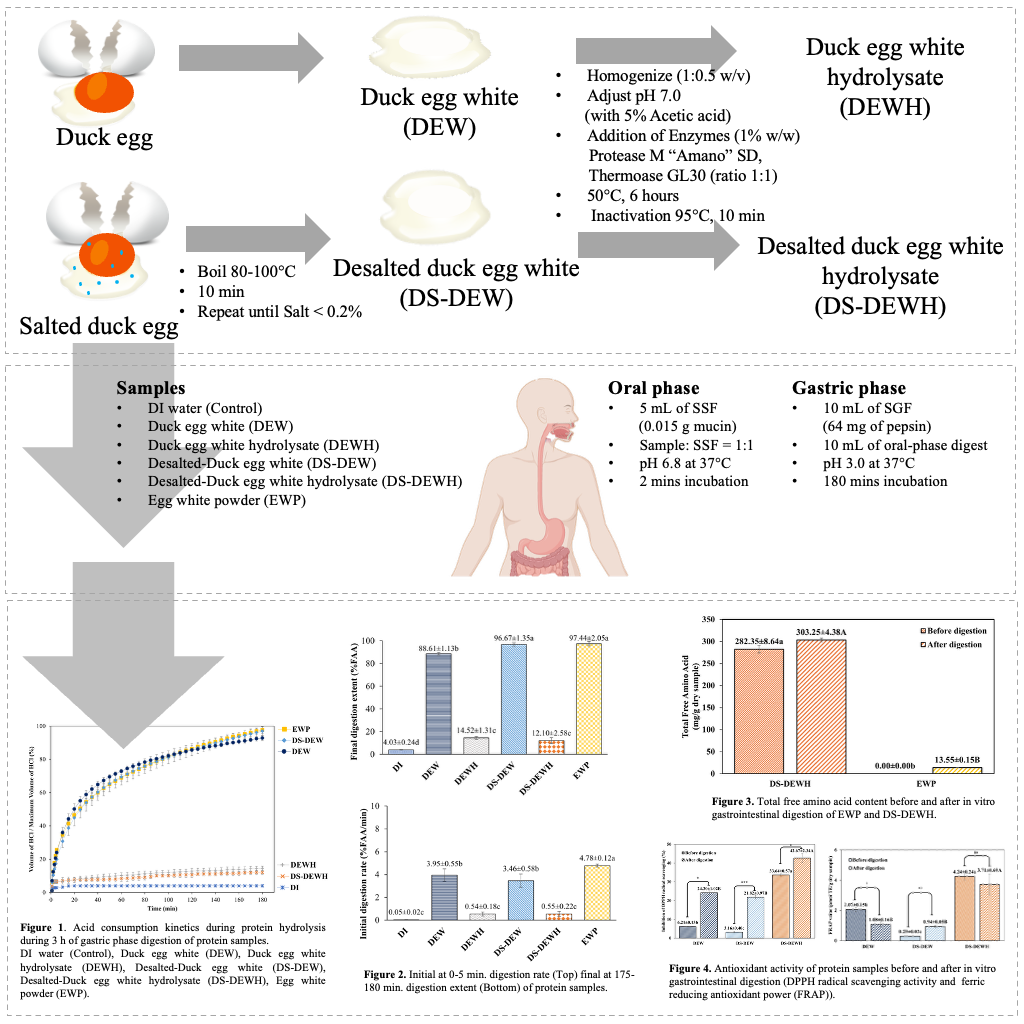
Downloads
References
Y Jiang, C Brennan, J Sun, X Zeng, J Chan-drapala, B Sun and M Majzoobi. Recent pro-gress of food-derived bioactive peptides: Ex-traction, purification, function, and encapsula-tion. Food Frontiers 2024; 5(3), 1240-1264.
ECY Li-Chan. Bioactive peptides and protein hydrolysates: Research trends and challenges for application as nutraceuticals and function-al food ingredients. Current Opinion in Food Science 2015; 1(1), 28-37.
Y Sheng, WY Wang, MF Wu, YM Wang, WY Zhu, CF Chi and B Wang. Eighteen novel bio-active peptides from monkfish (Lophius litulon) swim bladders: Production, identifica-tion, antioxidant activity, and stability. Marine Drugs 2023; 21(3), 169.
YM Wang, MX Ge, SZ Ran, X Pan, CF Chi and B Wang. Antioxidant peptides from miiuy croaker swim bladders: ameliorating effect and mechanism in NAFLD cell model through regulation of hypolipidemic and antioxidant capacity. Marine Drugs 2025; 23(2), 63.
CC Udenigwe and RE Aluko. Food protein-derived bioactive peptides: Production, pro-cessing, and potential health benefits. Journal of Food Science 2012; 77(1), 11-24.
ZF Bhat, S Kumar and HF Bhat. Bioactive pep-tides of animal origin: A review. Journal of Food Science and Technology 2015; 52(9), 5377-5392.
Y Jiang, J Sun, J Chandrapala, M Majzoobi, C Brennan, XA Zeng and B Sun. Recent progress of food-derived bioactive peptides: Extraction, purification, function, and encapsulation. Food Frontiers 2024; 5(3),1240-1264
M Pan, K Liu, J Yang, S Liu and S Wang. Ad-vances on food-derived peptidic antioxidants - a review. Antioxidants 2020; 9(9), 799.
RJ Elias, SS Kellerby and EA Decker. Antioxi-dant activity of proteins and peptides. Critical Reviews in Food Science and Nutrition 2008; 48(5), 430-441.
TB Zou, TP He, HB Li, HW Tang and EQ Xia. The structure-activity relationship of the anti-oxidant peptides from natural proteins. Mole-cules 2016; 21(1), 21010072.
N Yang and RS Jiang. Recent advances in duck egg research. Asian-Australasian Journal of Animal Sciences 2014; 27(3), 355-362.
C Sun, Z Liu and N Yang. Proteomic compari-son of duck and chicken egg whites reveals species-specific protein patterns. Journal of Agricultural and Food Chemistry 2018; 66, 721-731.
ED Abeyrathne, HY Lee and DU Ahn. Egg white proteins and their potential use in food processing or as nutraceutical and pharmaceu-tical agents - a review. Poultry Science 2014; 92(12), 3292-3299.
R Yu, Y Chi, Y Ma, Y Chi and L Wang. Differ-ences in protein composition and functional properties of egg whites from 4 chicken varie-ties. Food Bioscience 2022; 46, 101614.
Y Liu, M Huang, X Liu and M Hu. Structural characterization and functional properties of egg white protein treated by electron beam ir-radiation. Innovative Food Science and Emerging Technologies 2023; 84, 103262.
Y Ren, H Wu, X Li, F Lai and X Xiao. Purifica-tion and characterization of high antioxidant peptides from duck egg white protein hydroly-sates. Biochemical and Biophysical Research Communications 2014; 452(4), 888-894.
YF Liu, I Oey, P Bremer, A Carne and P Sil-cock. Bioactive peptides derived from egg pro-teins: A review. Critical Reviews in Food Sci-ence and Nutrition 2018; 58(15), 2508-2530.
AH Manninen. Protein hydrolysates in sports nutrition. Nutrition and Metabolism 2009; 6(1), 38.
Q Liu, B Kong, YL Xiong and X Xia. Antioxi-dant activity and functional properties of por-cine plasma protein hydrolysate as influenced by the degree of hydrolysis. Food Chemistry 2010; 118(2), 403-410.
Y Chen, P Han, B Ma, X Wang, M Ma, N Qiu and X Fu. Effect of thermal treatment on the antioxidant activity of egg white hydrolysate and the preparation of novel antioxidant pep-tides. International Journal of Food Science and Technology 2022; 57(5), 2590-2599.
Y Mine. Recent advances in the understanding of egg white protein functionality. Trends in Food Science & Technology 1995; 6, 225-232.
GWJ Latimer. Official methods of analysis of AOAC International. Oxford University Press, Oxford, England, 2023.
A Brodkorb, L Egger, M Alminger, P Alvito, R Assunção, S Ballance, T Bohn, C Bourlieu-Lacanal, R Boutrou, F Carrière, A Clemente, M Corredig, D Dupont, C Dufour, C Edwards, M Golding, S Karakaya, B Kirkhus, S Le Feun-teun, …, I Recio. INFOGEST static in vitro simulation of gastrointestinal food digestion. Nature Protocols 2019; 14(4), 991-1014.
RA Siddiqi, TP Sinngh, M Rani, DS Sogi and MA Bhat. Diversity in grain, flour, amino acid composition, protein profiling, and proportion of total flour proteins of different wheat culti-vars of North India. Frontiers in Nutrition 2020; 7, 00141.
Q Cui, Y Sun, J Cheng and M Guo. Effect of 2-step enzymatic hydrolysis on the antioxidant properties and proteomics of hydrolysates of milk protein concentrate. Food Chemistry 2022; 366, 130711.
Q Shi, M Wei, H Chen, J Gao and P Tong. De-salination of duck egg white by biocoagulation to obtain peptide-ferrous chelate as iron deliv-ery system: Preparation, characterization, and Fe2+ release evaluation in vitro. Journal of Food Science 2021; 86(10), 4678-4690.
A Dávalos, M Miguel, B Bartolomé and R López-Fandiño. Antioxidant activity of pep-tides derived from egg white proteins by en-zymatic hydrolysis. Journal of Food Protec-tion 2004; 67(9), 1939-1944.
ID Nwachukwu and RE Aluko. Structural and functional properties of food protein-derived antioxidant peptides. Journal of Food Bio-chemistry 2019; 43(1), e12761.
MF Sbroggio, MS Montilha, V Ribeiro, G De Figueiredo, SR Georgetti and LE Kurozawa. In-fluence of the degree of hydrolysis and type of enzyme on antioxidant activity of okara pro-tein hydrolysates. Food Science and Technol-ogy 2016; 36(2), 375-381.
A Dryáková, A Pihlanto, P Marnila, L Čurda and HJ Korhonen. Antioxidant properties of whey protein hydrolysates as measured by 3 methods. European Food Research and Tech-nology 2010; 230(6), 865-874.
H Zhao, W Jiao, K Cui, X Fan, C Shu, W Zhang, J Cao and W Jiang. Near-freezing temperature storage enhances chilling tolerance in nectar-ine fruit through its regulation of soluble sug-ars and energy metabolism. Food Chemistry 2019; 289, 426-435.
Y Wu, X Li, M Ma, G Hu, X Fu and J Liu. Characterization of the dynamic gastrointesti-nal digests of the preserved eggs and their ef-fect and mechanism on HepG2 cells. Foods 2023; 12(4), 800.
F Shahidi and Y Zhong. Measurement of anti-oxidant activity. Journal of Functional Foods 2015; 18, 757-781.
Published
How to Cite
Issue
Section
License
Copyright (c) 2025 Walailak University

This work is licensed under a Creative Commons Attribution-NonCommercial-NoDerivatives 4.0 International License.





