
Surface Modification of Banana Pseudo-Stem Cellulose Using Fenton Oxidation: Adsorption Kinetics, Isotherms, and Optimization
DOI:
https://doi.org/10.48048/tis.2026.12722Keywords:
Fenton, Modified cellulose, Adsorption, MB dye, Kinetic, BBD-RSM, Fenton, Modified cellulose, Adsorption, MB dye, Kinetic, BBD-RSMAbstract
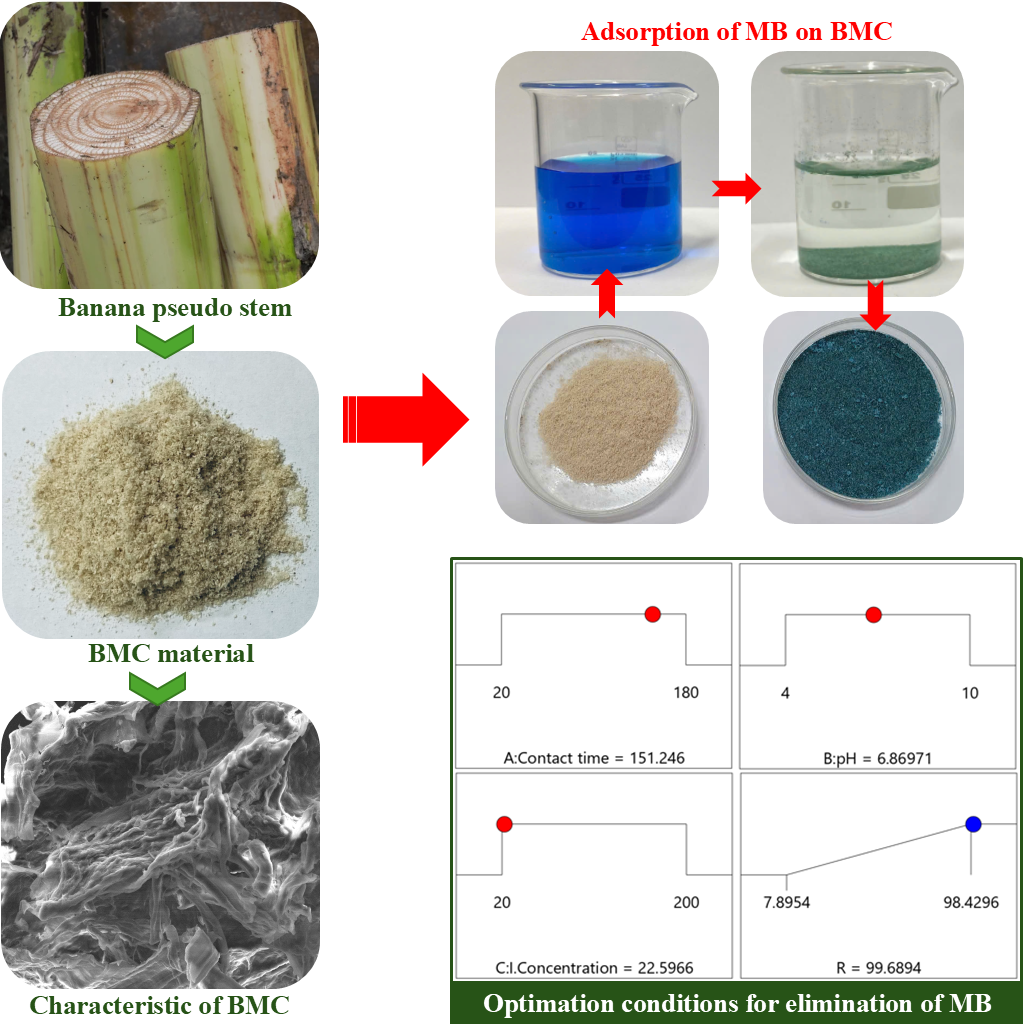
Surface-modified cellulose derived from banana pseudo-stem (BMC), as an abundant, cost-effective, and environmentally-friendly adsorbent, was used to remove methylene blue dye (MB) from water. At first, the banana pseudo-stem underwent several physicochemical treatments to isolate cellulose and followed by Fenton oxidation to introduce desired functional groups onto its surface. The adsorbent was characterized by SEM, TEM, EDS, FTIR, and XRD for understanding its characteristics. Next, the effect of adsorption time, pH, initial concentration, and temperature for MB adsorption was investigated in batch experiments. The MB adsorption kinetic and equilibrium data were consistently explained by pseudo-second-order and Langmuir models, respectively, with a calculated maximum adsorption capacity of 56.6 mg/g. Thermodynamic studies indicated that the adsorption is an exothermic and spontaneous process. In an optimization study, response surface methodology based on the Box-Behnken method was applied and revealed that under the optimal condition (contact time of 151 min, pH of 6.9, and initial concentration of 22.6 mg/L), the maximum removal efficiency was 99.7%. This study suggests a promising strategy to prepare an economical and biodegradable adsorbent from agricultural residue for efficient purification of wastewater.
HIGHLIGHTS
- Waste banana pseudo-stem-derived cellulose as an efficient adsorbent for methylene blue removal
- MB adsorption followed pseudo-second-order kinetics and Langmuir isotherms: chemical sorption
- Box-Behnken response surface methodology optimized contact time, pH, and initial concentration
- Optimal conditions reached at 151 min, pH 6.9, and 22.6 mg/L for maximum MB removal
GRAPHICAL ABSTRACT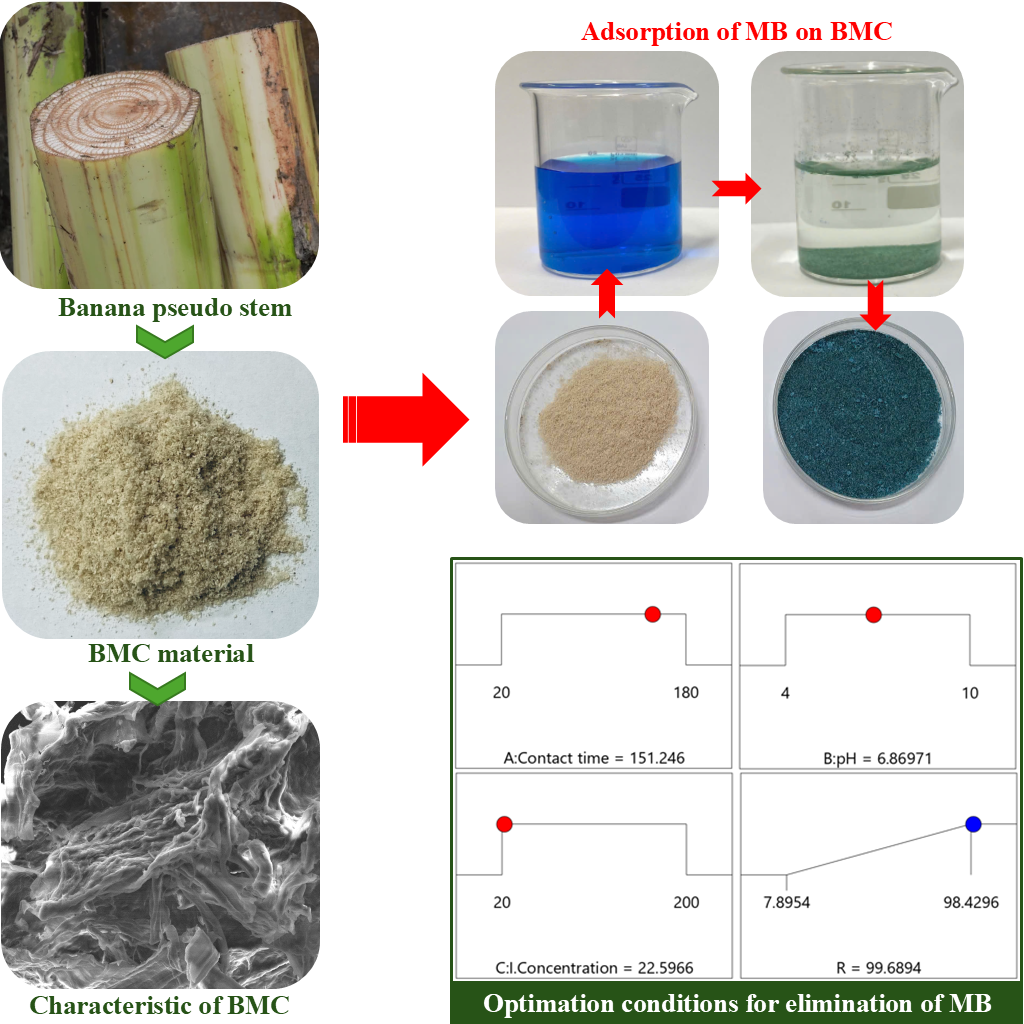
Downloads
References
B Lellis, CZ Fávaro-Polonio, JA Pamphile and JC Polonio. Effects of textile dyes on health and the environment and bioremediation potential of living organisms. Biotechnology Research and Innovation 2019; 3(2), 275-290,
JB Adeoye, SY Lau, YH Tan, YY Tan, T Chiong, NM Mubarak, G Anbuchezhiyan, M Khalid and JTW Ng. A comprehensive review on adsorption technologies for methylene blue elimination: Efficiency, mechanisms, and future perspectives. Discover Applied Sciences 2025; 7(11), 1285.
SH Paiman, MA Rahman, T Uchikoshi, N Abdullah, MHD Othman, J Jaafar, KH Abas and AF Ismail. Functionalization effect of Fe-type MOF for methylene blue adsorption. Journal of Saudi Chemical Society 2020; 24(11), 896-905.
F Ebrahimzadeh and A Akbari. Investigation the adsorption mechanisms, chemical resistance and mechanical strength of the synthesized chitosan/activated carbon composite in methylene blue removal. Scientific Reports 2025; 15(1), 37820,
KH Alharbi. Efficient removal of methylene blue from aqueous solutions using mixed oxides of cobalt oxide and tungsten trioxide modified graphene oxide. Journal of Saudi Chemical Society 2024; 28(1), 101802,
AM Metwally, SAA Aly, SO Makled and AMS Abdelkader. Biosorption of methylene blue from industrial wastewater using silicon dioxide nanoparticles and Cladophora glomerata. Alexandria Engineering Journal 2025; 130, 115-138.
L Ma, W Liu, B Liu and Y Tang. Removal of methylene blue by acrylic polymer adsorbents loaded with magnetic iron manganese oxides: Synthesis, characterization, and adsorption mechanisms. Chemosphere 2024; 346, 140588.
G Mosoarca, C Vancea, S Popa, ME Radulescu-Grad, M Dan, C Tanasie and S Boran. Adsorption of methylene blue onto environmentally friendly lignocellulosic material obtained from mature coltsfoot (Tussilago farfara) Leaves. Polymers 2025; 17(11), 1549.
D Dimbo, M Abewaa, E Adino, A Mengistu, T Takele, A Oro and M Rangaraju. Methylene blue adsorption from aqueous solution using activated carbon of spathodea campanulata. Results in Engineering 2024; 21, 101910.
J Fito, M Abewaa, A Mengistu, K Angassa, AD Ambaye, W Moyo and T Nkambule. Adsorption of methylene blue from textile industrial wastewater using activated carbon developed from Rumex abyssinicus plant. Scientific Reports 2023; 13(1), 5427.
D Sachdev, K Shah, D Sharma, G Verma, N Kaur and O Sahu. Adsorptive removal of methylene blue dye by extracted banana stem fibers. Materials Today: Proceedings 2022; 68, 728-733,
A El Mahdaoui, S Radi, A Elidrissi, MAF Faustino, MGPMS Neves and NMM Moura. Progress in the modification of cellulose-based adsorbents for the removal of toxic heavy metal ions. Journal of Environmental Chemical Engineering 2024; 12(5), 113870.
T Nikiforova, V Kozlov, P Razgovorov, N Politaeva, K Velmozhina, P Shinkevich and V Chelysheva. Heavy metal ions(II) sorption by a cellulose-based sorbent containing sulfogroups. Polymers 2023; 15(21), 4212.
D Suteu, S Coseri, C Zaharia, G Biliuta and I Nebunu. Modified cellulose fibers as adsorbent for dye removal from aqueous environment. Desalination and Water Treatment 2017; 90, 341-349.
P Groszewicz, P Mendes, B Kumari, J Lins, T Gutmann and G Buntkowsky. N-Hydroxysuccinimide-activated esters as a functionalization agent for amino cellulose: Synthesis and solid-state NMR characterization. Cellulose 2020; 27, 1239-1254.
XM Fan, HY Yu, DC Wang, ZH Mao, J Yao and KC Tam. Facile and green synthesis of carboxylated cellulose nanocrystals as efficient adsorbents in wastewater treatments. ACS Sustainable Chemistry & Engineering 2019; 7(21), 18067-18075.
Y Gong, Q Zhang, H Yuan and X Luo. Fabrication of carboxylated cellulose microspheres via Fe2+/H2O2 oxidation method and their application in vitamin B12 efficient loading and controlled release. Journal of Drug Delivery Science and Technology 2025; 104, 106515.
D Ortiz, M Munoz, J Nieto-Sandoval, C Romera-Castillo, ZM de Pedro and JA Casas. Insights into the degradation of microplastics by Fenton oxidation: From surface modification to mineralization. Chemosphere 2022; 309, 136809.
B Belahrach, M Farah, Y Belaoufi, M Bensemlali, H Nasrellah, N Labjar, A Baraket, A Dahrouch and S El Hajjaji. Optimization of process parameters for methylene blue dye removal using “Eriobotrya Japonica” grains via box-behnken design based on response surface methodology. Eng 2025; 6(6), 123.
NH Abdullah, M Mohamed, NA Mohd Shohaimi, AM Lazim, AZA Halim, NM Shukri and MKAA Razab. Enhancing the decolorization of methylene blue using a low-cost super-absorbent aided by response surface methodology. Molecules 2021; 26(15), 4430.
SJ Peighambardoust, M Azari, PM Pakdel, R Mohammadi and R Foroutan. Carboxymethyl cellulose grafted poly(acrylamide)/magnetic biochar as a novel nanocomposite hydrogel for efficient elimination of methylene blue. Biomass Conversion and Biorefinery 2024; 15, 15193-15209.
H Holilah, Asranudin, N El Messaoudi, M Ulfa, A Hamzah, Z Hamid, D Ramadhani, L Suryanegara, M Mahardika, A Melenia, A Pratama and D Prasetyoko. Fabrication a sustainable adsorbent nanocellulose-mesoporous hectorite bead for methylene blue adsorption. Case Studies in Chemical and Environmental Engineering 2024; 10, 100850.
V Ngwenya, NR Sibanda Ndebele, LK Ncube, NZ Nkomo, S Gadlula and LN Ndlovu. Enhanced technique for removal of methylene blue dye from water using Luffa microcrystalline cellulose. South African Journal of Chemistry 2024; 78, 113-121.
HT Kara, ST Anshebo, FK Sabir, GA Workineh and MA Delele. Removal of methylene blue dye from wastewater using periodiated modified nanocellulose. International Journal of Chemical Engineering 2021; 2021(1), 1-16.
N Somsesta, V Sricharoenchaikul and D Aht-Ong. Adsorption removal of methylene blue onto activated carbon/cellulose biocomposite films: Equilibrium and kinetic studies. Materials Chemistry and Physics 2020; 240, 122221.
KB Tan, AZ Abdullah, BA Horri and B Salamatinia. Adsorption mechanism of microcrystalline cellulose as green adsorbent for the removal of cationic methylene blue dye. Journal of the Chemical Society of Pakistan 2016; 38(4), 651-664.
H Bai, J Chen, X Zhou and C Hu. Single and binary adsorption of dyes from aqueous solutions using functionalized microcrystalline cellulose from cotton fiber. Korean Journal of Chemical Engineering 2020; 37(11), 1926-1932.
M Diarsa and A Gupte. Preparation, characterization and its potential applications in Isoniazid drug delivery of porous microcrystalline cellulose from banana pseudostem fibers. 3 Biotech 2021; 11(7), 334.
Holilah, Asranudin, N El Messaoudi, M Ulfa, A Hamzah, ZAA Hamid, DV Ramadhani, L Suryanegara, M Mahardika, AT Melenia, AW Pratama and D Prasetyoko. Fabrication a sustainable adsorbent nanocellulose-mesoporous hectorite bead for methylene blue adsorption. Case Studies in Chemical and Environmental Engineering 2024; 10, 100850.
R Gomez-Garcia, SC Sousa, OL Ramos, DA Campos, CN Aguilar, AR Madureira and M Pintado. Obtention and characterization of microcrystalline cellulose from industrial melon residues following a biorefinery approach. Molecules 2024; 29(14), 3285.
R Randis, DB Darmadi, F Gapsari and AAA Sonief. Isolation and characterization of microcrystalline cellulose from oil palm fronds biomass using consecutive chemical treatments. Case Studies in Chemical and Environmental Engineering 2024; 9, 100616.
Z Xiao, Y Pan, Q Zhao, J Yang, H Wang, L Yu, X Ding and J Huang. Surface cationization of cellulose via Fenton oxidation for remedying dye contaminants: Adsorption performance and mechanism. International Journal of Biological Macromolecules 2025; 312, 144040.
V Jakka, A Goswami, AK Nallajarla, U Roy, K Srikanth and S Sengupta. Coconut coir-derived nanocellulose as an efficient adsorbent for removal of cationic dye safranin-O: A detailed mechanistic adsorption study. Environmental Science and Pollution Research 2025; 32(32), 19026-19047.
AS El-Zeny, ESRH El-Gharkawy, TA Gad-Allah and MA Akl. Novel aminothiazole-supported chlorocellulose composite for the efficient removal of cationic dyes from wastewater. RSC Advances 2025; 15(48), 40501-40518.
ZU Zango and SS Imam. Evaluation of microcrystalline cellulose from groundnut shell for the removal of crystal violet and methylene blue. Nanoscience and Nanotechnology 2018; 8(1), 1-6.
M Naushad, AA Alqadami, ZA AlOthman, IH Alsohaimi, MS Algamdi and AM Aldawsari. Adsorption kinetics, isotherm and reusability studies for the removal of cationic dye from aqueous medium using arginine modified activated carbon. Journal of Molecular Liquids 2019; 293, 111442.
HA Said, I Ait Bourhim, A Ouarga, I Iraola-Arregui, M Lahcini, A Barroug, H Noukrati and HB Youcef. Sustainable phosphorylated microcrystalline cellulose toward enhanced removal performance of methylene blue. International Journal of Biological Macromolecules 2023; 225, 1107-1118.
CHC Tan, S Sabar, MKM Haafiz, ZN Garba and MH Hussin. The improved adsorbent properties of microcrystalline cellulose from oil palm fronds through immobilization technique. Surfaces and Interfaces 2020; 20, 100614.
CHC Tan, S Sabar and MH Hussin. Development of immobilized microcrystalline cellulose as an effective adsorbent for methylene blue dye removal. South African Journal of Chemical Engineering 2018; 26, 11-24.
K Phumivanichakit, T Borsu, J Maneerat, P Kaewmaneerat and P Wangsirikul. Utilizing jackfruit peel as a sustainable adsorbent for methylene blue dye: Adsorption efficiency and isotherm analysis. Engineering and Technology Horizons 2025; 42(3), 420308.
TTC Truong, NTT Vo, KD Nguyen and HM Bui. Preparation of cellulose-based hydrogel derived from tea residue for the adsorption of methylene blue. Cellulose Chemistry and Technology 2019; 53, 573-582.
SJ Peighambardoust, S Rezaei-Aghdam, JS Niroumand, PM Pakdel and M Sillanpää. Efficient methylene blue elimination from water media by nanocomposite adsorbent-based carboxymethyl cellulose-grafted poly(acrylamide)/magnetic biochar decorated with ZIF-67. RSC Advances 2025; 15, 32407-32423,
NB Allou, MA Tigori, AA Koffi, M Halidou, NS Eroi, P Atheba and A Trokourey. Methylene blue magnetic adsorption separation process from aqueous solution using corn cob. Scientific African 2023; 21, e01828,
H Melese and H Kara. Cellulose based adsorbent for cationic methylene blue dye removal. Discover Applied Sciences 2024; 6(2), 46.
S Afshin, Y Rashtbari, M Vosough, A Dargahi, M Fazlzadeh, A Behzad and M Yousefi. Application of Box-Behnken design for optimizing parameters of hexavalent chromium removal from aqueous solutions using Fe3O4 loaded on activated carbon prepared from alga: Kinetics and equilibrium study. Journal of Water Process Engineering 2021; 42, 102113.
Published
How to Cite
Issue
Section
License
Copyright (c) 2025 Walailak University

This work is licensed under a Creative Commons Attribution-NonCommercial-NoDerivatives 4.0 International License.





