
Chlorogenic Acid Ameliorates Testicular Damage and Hormonal Imbalance in Diabetic Male Wistar Rats
DOI:
https://doi.org/10.48048/tis.2026.12673Keywords:
Chlorogenic acid, Diabetes mellitus, Luteinizing hormone, Follicle-stimulating hormone, Testosterone, Spermatogenesis, Johnsen score, Chlorogenic acid, Diabetes mellitus, Luteinizing hormone, Follicle-stimulating hormone, Testosterone, Spermatogenesis, Johnsen scoreAbstract
Diabetes mellitus (DM) is a metabolic disorder characterized by hyperglycemia that may lead to multiple complications, including male reproductive dysfunction. This study aimed to evaluate the effects of chlorogenic acid (CGA) administration on blood glucose levels (BGLs), reproductive hormones, testicular histology, and spermatogenesis in male Wistar rats with type 2 diabetes mellitus (T2DM). Thirty rats were divided into a healthy control group (n = 5) and a diabetic group (n = 25). T2DM was induced using a high-fat diet (HFD) combined with streptozotocin (STZ) and nicotinamide (NA). The diabetic rats were further divided into five subgroups: Untreated diabetic (DM), diabetic + metformin 500 mg/kg BW (DMet), diabetic + CGA 6.25 mg/kg BW (DMCGA 6.25mg), diabetic + CGA 12.5 mg/kg BW (DMCGA 12.5mg), and diabetic + CGA 25 mg/kg BW (DMCGA 25mg). CGA was administered intraperitoneally (i.p.) once daily for 31 days. Serum of luteinizing hormone (LH), follicle-stimulating hormone (FSH), and testosterone were measured using ELISA, and testicular structure and spermatogenesis were evaluated histologically and scored using the Johnsen system. CGA administration significantly reduced BGLs (p < 0.05), increased LH, FSH, and testosterone levels, and improved seminiferous tubule diameter, epithelial thickness, and Johnsen score. The CGA dose of 25 mg/kg BW showed the most pronounced effect, reducing blood glucose to 93.80 ± 5.31 mg/dL, comparable to the metformin group (104.40 ± 6.11 mg/dL), and increasing testosterone levels to 1,642.57 ± 38.66 pg/mL, approaching the normal control (1,763.86 ± 23.05 pg/mL). The 25 mg/kg BW CGA group demonstrated the most pronounced restorative effect, comparable to the metformin group. In conclusion, CGA exhibits antidiabetic and testicular protective effects by enhancing endocrine and spermatogenic functions in diabetic male rats.
HIGHLIGHTS
- Chlorogenic acid (CGA) was administered to male Wistar mice of a diabetic induced model with a diet high in fat and Streptozotocin–nicotinamide.
- Administration of CGA significantly lowered blood glucose levels in DM Type 2 (DMT2) rats.
- CGA increases levels of reproductive hormones such as LH, FSH, and testosterone hormones and improves hormonal balance.
- The histological structure of the testicles and the process of spermatogenesis, including the Johnsen score, experienced significant improvement after the administration of CGA.
- CGA has the potential to be developed as a natural therapeutic agent to prevent male reproductive dysfunction due to diabetes.
GRAPHICAL ABSTRACT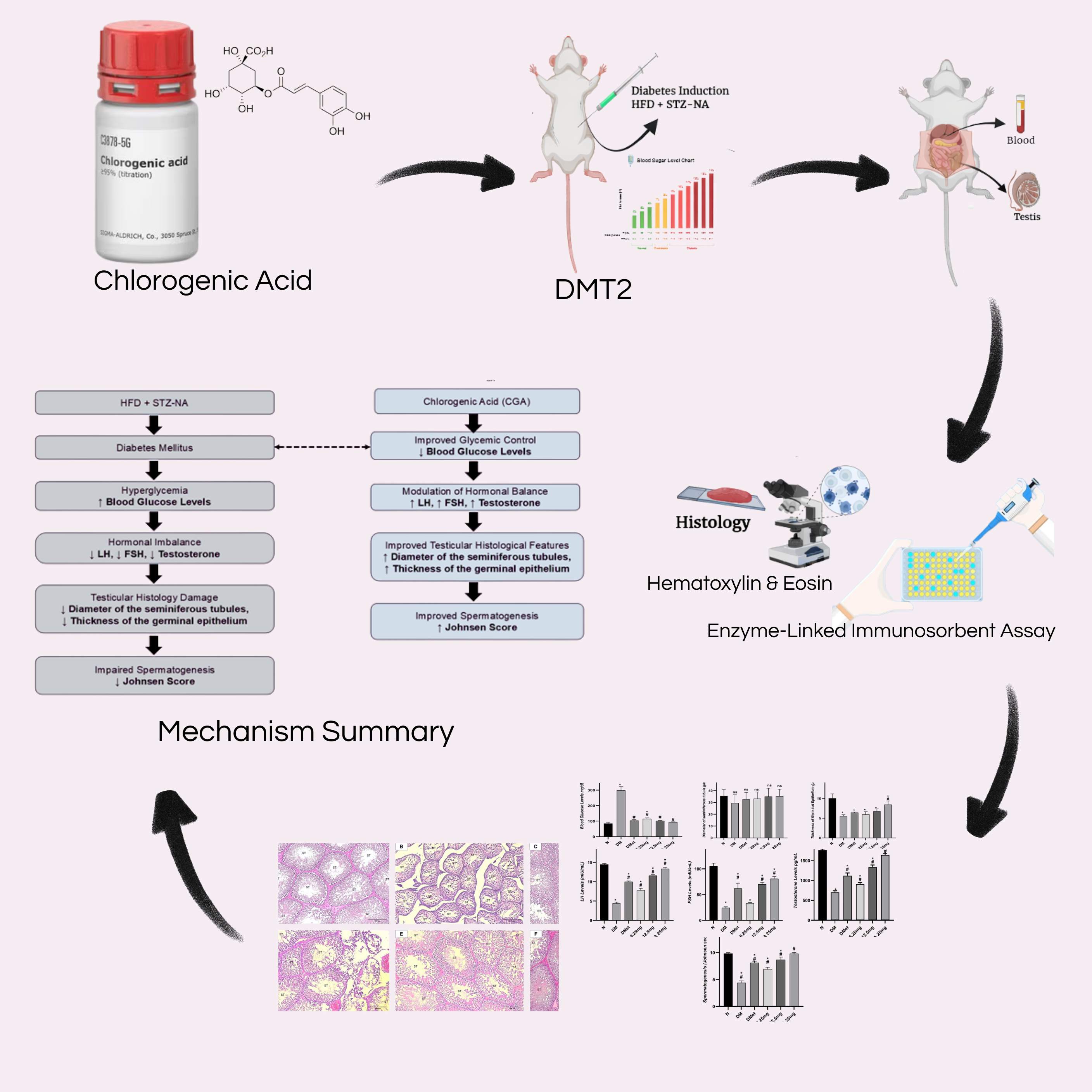
Downloads
References
NE Asmar, BM Arafah and CK Smith. Diabetes mellitus. In: PM Paulman, RB Taylor, AA Paulman and LS Nasir (Eds.). Family Medicine. Springer, Cham, 2022, p. 173-187.
A Monjed. Diabetes Mmellitus. In: W Al-Mohaimeed, M Al-Bishri and M Al-Agha (Eds.). Skills in Rheumatology. Springer, Singapore, 2021, p. 445-460.
M Younes, G Aquilina, L Castle, GH Degen, KH Engel, PJ Fowler, P Fürst, R Gürtler, J König, C Lambré, A Mortensen, C Schlatter and D Arcella. Flavouring Group Evaluation 413 (FGE.413): Naringenin. EFSA Journal 2024; 22(4), e8747.
MF El-Khadragy, WA Al-Megrin, S Alomar, AF Alkhuriji, DM Metwally, S Mahgoub, SS Abdel-Maksoud and MA Arisha. Chlorogenic acid abates male reproductive dysfunction in arsenic-exposed mice via attenuation of testicular oxido-inflammatory stress and apoptotic responses. Chemico-Biological Interactions 2021; 333, 109333.
A Kumar, R Gangwar, AA Zargar, R Kumar and A Sharma. Prevalence of diabetes in India: A review of IDF Diabetes Atlas 10th edition. Current Diabetes Reviews 2024; 20(1), 105-114.
PR Roshni and B Baby. Amylin in diabetes mellitus. In: A Kumar and M Siddiqui (Eds.). Diabetes mellitus: A Review. Elsevier, Amsterdam, 2025.
P Pandey, V Jakhmola, S Saha and A Gaurav. Recent developments in diabetes management: Exploring receptors, pathways and compounds. BIO Integration 2025; 6(1), 1-28.
O Ameen, RM Samaka and RAA Abo-Elsoud. Metformin alleviates neurocognitive impairment in aging via activation of AMPK/BDNF/PI3K pathway. Scientific Reports 2022; 12(1), 17084.
E Rahmanian, N Salari, M Mohammadi and R Jalali. Evaluation of sexual dysfunction and female sexual dysfunction indicators in women with type 2 diabetes: A systematic review and meta-analysis. Diabetology & Metabolic Syndrome 2019; 11, 73.
EN Sofyanita, AZ Juniarto, A Suwondo and H Nugroho. The effect of chlorogenic acid content in coffee can reduce malondialdehyde (MDA) and increase testosterone hormone levels in DM conditions. Gema Lingkungan Kesehatan 2025; 23(1), 20-26.
N Abedpour, MZ Javanmard, M Karimipour and AP Liqvan. Effect of chlorogenic acid on follicular development, hormonal status and biomarkers of oxidative stress in rats with polycystic ovary syndrome. Veterinary Research Forum 2022; 13(4), 513-520.
N Gusti, T Heriansyah and I Saputra. Association between admission blood sugar levels and length of stay among patients with acute heart failure: A cross-sectional study in Aceh, Indonesia. Narra X 2023; 1(2), e75.
J Rong, X Leng, K Jiang, J Tan and M Dong. Systemic impacts of diabetes on spermatogenesis and intervention strategies: Multilayered mechanism analysis and cutting-edge therapeutic approaches. Reproductive Biology and Endocrinology 2025; 23(1), 122.
W Zhang, L Tong, B Jin and D Sun. Diabetic testicular dysfunction and spermatogenesis impairment: Mechanisms and therapeutic prospects. Frontiers in Endocrinology 2025; 16, 1653975.
OC Badejogbin, OP Akano, OEB Julius, MO Agunloye, MV Olubiyi, OE Chijioke-Agu, MA Obekpa, AP Arikawe and KS Olaniyi. Potential role of CREM in diabetes-associated testicular dysfunction: Current evidence and future perspectives. Reproductive Medicine and Biology 2025; 24(1), e12661.
H Shoorei, A Khaki, M Shokoohi, AA Khaki, A Alihemmati, M Moghimian and SH Abtahi-Eivary. The ameliorative effect of carvacrol on oxidative stress and germ cell apoptosis in testicular tissue of adult diabetic rats. Biomedicine & Pharmacotherapy 2019; 111, 568-578.
H Shoorei, A Khaki, M Shokoohi, AA Khaki, A Alihemmati, M Moghimian and SH Abtahi-Eivary. Evaluation of carvacrol on pituitary and sexual hormones and their receptors in the testicle of male diabetic rats. Human & Experimental Toxicology 2020; 39(8), 1019-1030.
ZC Jia, SJ Liu, TF Chen, ZZ Shi, XL Li, ZW Gao, Q Zhang and CF Zhong. Chlorogenic acid can improve spermatogenic dysfunction in rats with varicocele by regulating mitochondrial homeostasis and inhibiting the activation of NLRP3 inflammasomes by oxidative mitochondrial DNA and cGAS/STING pathway. Bioorganic Chemistry 2024; 150, 107571.
AK Singh and AK Pandey. Alleviation of diabetes mellitus–induced reproductive dysfunction by chlorogenic acid in male rats via combating redox imbalance. Indian Journal of Clinical Biochemistry 2025; 40(1), 1-9.
YMA El-Hakim, AAR Mohamed, SI Khater, AH Arisha, MMM Metwally, MA Nassan and ME Hassan. Chitosan-stabilized selenium nanoparticles and metformin synergistically rescue testicular oxidative damage and steroidogenesis-related genes dysregulation in high-fat diet/streptozotocin-induced diabetic rats. Antioxidants 2021; 10(1), 17.
CY Liu, TC Chang, SH Lin, ST Wu, TL Cha and CW Tsao. Metformin ameliorates testicular function and spermatogenesis in male mice with high-fat and high-cholesterol diet-induced obesity. Nutrients 2020; 12(7), 1932.
M Venditti, MZ Romano, S Boccella, A Haddadi, A Biasi, S Maione and S Minucci. Type 1 diabetes impairs the activity of rat testicular somatic and germ cells through NRF2/NLRP3 pathway-mediated oxidative stress. Frontiers in Endocrinology 2024; 15, 1399256.
IO Kazaz, S Demir, G Kerimoglu, F Colak, NT Alemdar, SY Dogan and S Bostan. Chlorogenic acid ameliorates torsion/detorsion-induced testicular injury via decreasing endoplasmic reticulum stress. Journal of Pediatric Urology 2022; 18(3), 289.e1-289.e7.
I Sari, DM Rizal and RA Syarif. The effect of chlorogenic acid on endoplasmic reticulum stress and steroidogenesis in the testes of diabetic rats: Study of mRNA Expressions of GRP78, XBP1s, 3β-HSD, and 17β-HSD. BIO Web of Conferences 2022; 49, 01001.
C Dunn, D Brettle, M Cockroft, E Keating, C Revie and D Treanor. Quantitative assessment of H & E staining for pathology: Development and clinical evaluation of a novel system. Diagnostic Pathology 2024; 19(1), 42.
REP Köprülü, ME Okur, B Kolbaşi, İ Keskin and H Ozbek. Effects of vincamine on testicular dysfunction in alloxan-induced diabetic male rats. Iranian Journal of Pharmaceutical Research 2022; 21(1), e132265.
JF Hair, GTM Hult, CM Ringle and M Sarstedt. A primer on partial least squares structural equation modeling (PLS-SEM). Sage Publications Inc., Thousand Oaks, 2017.
N Nazaruddin, TN Siregar, A Sutriana, S Wahyuni and T Armansyah. The impact of streptozotocin-induced diabetes on testosterone hormone and androgen receptor expression and correlation with sperm quality impairment in Sprague Dawley rats. Trends in Sciences 2025; 22(9), 10409.
F Marino, N Salerno, M Scalise, L Salerno, A Torella, C Molinaro, A Chiefalo, A Filardo, C Siracusa, G Panuccio, C Ferravante, G Giurato, F Rizzo, M Torella, M Donniacuo, AD Angelis, G Viglietto, K Urbanek, A Weisz, D Torella and E Cianflone. Streptozotocin-induced type 1 and 2 diabetes mellitus mouse models show different functional, cellular and molecular patterns of diabetic cardiomyopathy. International journal of molecular sciences 2023; 24(2), 1132.
S Ramachandran, R Nandhini and R Felix. Streptozotocin-induced diabetes: Mechanisms, toxicity and experimental considerations. In: Advances in Experimental Pharmacology. Springer, Singapore, 2022, p. 87-112.
KI Jung, JS Han and CK Park. Neuroprotective effects of nicotinamide (vitamin b₃) on neurodegeneration in diabetic rat retinas. Nutrients 2022; 14(6), 1162.
LJ Yan. The nicotinamide/streptozotocin rodent model of type 2 diabetes: Renal pathophysiology and redox imbalance features. Biomolecules 2022; 12(9), 1225.
M Sianturi, N Susilaningsih, H Nugroho, N Suci, TN Kristina and M Suryani. Effect of lycopene and metformin combination on phagocytosis, glycemic control, and oxidative stress in rats with type 2 diabetes. Medical Journal of Indonesia 2023; 32(1), 1-6.
F Zamani-Garmsiri, G Ghasempour, M Aliabadi, SMR Hashemnia, S Emamgholipour and R Meshkani. Combination of metformin and chlorogenic acid attenuates hepatic steatosis and inflammation in high-fat diet fed mice. IUBMB Life 2021;73(1), 252-263.
V Nguyen, EG Taine, D Meng, T Cui and W Tan. Chlorogenic acid: A systematic review on the biological functions, mechanistic actions, and therapeutic potentials. Nutrients 2024; 16(7), 924.
D Pan, L Xu and M Guo. The role of protein kinase C in diabetic microvascular complications. Frontiers in Endocrinology 2022; 13, 973058.
EN Sofyanita, MR Maulana, P Lestari and Burhannudin. The effect of robusta coffee (Coffea canephora) on the expression of sod and nrf-2 in diabetes mellitus condition (animal model). Jurnal Ilmu Kesehatan 2024; 18(3), 256-262.
M Du, S Chen, Y Chen, X Yuan and H Dong. Testicular fat deposition attenuates reproductive performance via decreased follicle-stimulating hormone level and sperm meiosis and testosterone synthesis in mouse. Animal Bioscience 2024; 37(1), 50-60.
W He, H Liu, L Hu, Y Wang, L Huang, A Liang, X Wang, Q Zhang, Y Chen, Y Cao, S Li, J Wang and X Lei. Icariin improves testicular dysfunction via enhancing proliferation and inhibiting mitochondria-dependent apoptosis pathway in high-fat diet and streptozotocin-induced diabetic rats. Reproductive Biology and Endocrinology 2021; 19(1), 168.
B Muchtaromah, AM Firdaus, AN Ansori, MR Duhita, EB Minarno, A Hayati, M Ahmad and I Analisa. Effect of pegagan (Centella Asiatica) nanoparticle coated with chitosan on the cytokine profile of chronic diabetic mice. Narra J 2024; 4(1), e697.
JA Kanaley, SR Colberg, MH Corcoran, SK Malin, NR Rodriguez, CJ Crespo, JP Kirwan and JR Zierath. Exercise/physical activity in individuals with type 2 diabetes: A consensus statement from the American College of Sports Medicine. Medicine and Science in Sports and Exercise 2022; 54(2), 353-368.
Y Tian, W Song, D Xu, X Chen, X Li and Y Zhao. Autophagy induced by ROS aggravates testis oxidative damage in diabetes via breaking the feedforward loop linking p62 and Nrf2. Oxidative Medicine and Cellular Longevity 2020; 2020, 7156579.
S Nikbin, A Derakhshideh, SK Jafari, A Mirzahamedani, A Moslehi, S Ourzamani, E Barati, F Amini, FS Zolfaghari and MA Azarbayjani. Investigating the protective effect of aerobic exercise on oxidative stress and histological damages of testicular tissue associated with chlorpyrifos in male rats. Andrologia 2020; 52(2), e13468.
RA Septiani, IS Hamid, EK Sabdoningrum, A Ma’Ruf, EP Hestianah and M Mafruchati. Tomato (Lycopersicon esculentum Mill.) juice restored the number of Leydig cells and the diameter of the seminiferous tubules of mice (Mus musculus) exposed to lead acetate. Ovozoa Journal of Animal Reproduction 2022; 11(3), 123-129.
M Yahayu, Z Begam, S Hamid, H Adawi, DJ Dailin, RA Malek, S Zulaiha Hanapi, A Boumehira, N Sulaiman, I Yusoff, T Ho and H El-Enshasy. Antioxidant activity in green and roasted coffee: A critical review. Bioscience Research 2020; 17(3), 2249-2263.
WA Al-Megrin, MF El-Khadragy, MH Hussein, S Mahgoub, DM Abdel-Mohsen, H Taha, AAA Bakkar, AEA Moneim and HK Amin. Green coffea arabica extract ameliorates testicular injury in high-fat diet/streptozotocin-induced diabetes in rats. Journal of Diabetes Research 2020; 2020, 6762709.
A Mansour, MR Mohajeri-Tehrani, M Samadi, M Qorbani, S Merat, H Adibi and H Poustchi. Effects of supplementation with main coffee components including caffeine and/or chlorogenic acid on hepatic, metabolic, and inflammatory indices in patients with non-alcoholic fatty liver disease and type 2 diabetes: A randomized, double-blind, placebo-c. Nutrition Journal 2021; 20, 35.
SY Guo, XY Zhang, YX Yu, LQ Xie and CQ Chang. Effects of chlorogenic acid on glucose tolerance and its curve characteristics in high-fat diet-induced obesity rats. Journal of Peking University Health Sciences 2020; 52(2), 269-274.
F Namvarjah, HS Afra, HM Sardareh, RB Khorzoughi, P Pasalar, G Panahi and R Meshkani. Chlorogenic acid improves anti-lipogenic activity of metformin by positive regulating of AMPK signaling in HepG2 cells. Cell Biochemistry and Biophysics 2022; 80, 537-545.
E Hermawati, N Arfian, Mustofa and G Partadiredja. Chlorogenic acid ameliorates memory loss and hippocampal cell death after transient global ischemia. European Journal of Neuroscience 2020; 51(2), 651-669.
EA Demir, S Demir, SA Mungan, NT Alemdar, A Menteşe and Y Aliyazıcıoğlu. Chlorogenic acid protects against cisplatin-induced testicular damage: A biochemical and histological study. Institute for Medical Research and Occupational Health 2025; 76(2), 130-137.
SE Owumi, RA Anaikor, UO Arunsi, OA Adaramoye and AK Oyelere. Chlorogenic acid co-administration abates tamoxifen-mediated reproductive toxicities in male rats: An experimental approach. Journal of Food Biochemistry 2021; 45(2), e13615.
E Pavlova, R Ivanov, D Abadjieva, Y Gluhcheva, E Petrova, I Vladov, E Lakova and N Atanassova. Evaluation of rat testicular cell populations in experimental condition of diabetes induced in early postnatal life. Cells 2025; 14(21), 1714.
RF Alenezi, A Abdelkhalek, G El-Sayed, I Pet, M Ahmadi, ESE Sherbini, D Pușcașiu and AH Arisha. A natural polyphenol, chlorogenic acid, attenuates obesity-related metabolic disorders in male rats via miR-146a–IRAK1–TRAF6 and NRF2-mediated antioxidant pathways. Biomolecules 2025; 15(8), 1086.
Z Zhang, C Shi and Z Wang. Therapeutic effects and molecular mechanism of chlorogenic acid on polycystic ovarian syndrome: Role of HIF-1alpha. Nutrients 2023; 15(3), 2833.
FR Tehrani, V Ghasemi and MSG Naz. A systematic review and meta ‑ analysis of follicle ‑ stimulating hormone levels among men with type 2 diabetes. Basic and Clinical Andrology 2025; 35(1), 11.
S Kumar, J Jain and A Jain. Biochemical correlation of sex hormone profile with diabetes mellitus type 2 in indian men- a case-control study. Medical and Health Science Journal 2023; 7(1), 9-20.
M Gül, GI Russo, H Kandil, F Boitrelle, R Saleh, E Chung, P Kavoussi, T Mostafa, R Shah and A Agarwal. Male infertility: New developments, current challenges, and future directions. The World Journal of Men’s Health 2024; 42(3), 502-517.
N Cortez, C Villegas, V Burgos, L Ortiz, JRC Pardo and C Paz. Therapeutic potential of chlorogenic acid in chemoresistance and chemoprotection in cancer treatment. International Journal of Molecular Sciences 2024; 25(10), 5189.
O Golovinskaia and CK Wang. The hypoglycemic potential of phenolics from functional foods and their mechanisms. Food Science and Human Wellness 2023; 12(4), 986-1007.
EN Sofyanita, A Suwondo, H Nugroho and AJ Juniarto. Global research trends on the role of chlorogenic acid on antidiabetic mechanisms and reproductive hormone regulation (2015-2025): A bibliometric analysis. Media Publikasi Promosi Kesehatan Indonesia 2025; 8(12), 1617-1632.
F Dimitriadis, M Papaioannou, I Sokolakiset, F Aikaterini, H Dimitrios and A Apostolos. The effect of low-intensity extracorporeal shockwave treatment on the urinary bladder in an experimental diabetic rat model. International Neurourology Journal 2021; 25(1), 34-41.
MB Ekong, FN Odinukaeze, AC Nwonu, CC Mbadugha and AA Nwakanma. Brain activities of streptozotocin-induced diabetic Wistar rats treated with gliclazide: Behavioural, biochemical and histomorphology studies. IBRO Neuroscience Reports 2022; 12, 271-279.
Published
How to Cite
Issue
Section
License
Copyright (c) 2025 Walailak University

This work is licensed under a Creative Commons Attribution-NonCommercial-NoDerivatives 4.0 International License.





