
Chemical Composition and Anti-Skin Cancer Potential of Eucalyptus tereticornis Essential Oils from Vietnam: An In Vitro and In Silico Study
DOI:
https://doi.org/10.48048/tis.2026.12566Keywords:
Eucalyptus tereticornis, Eucalyptus camaldulensis, Anti-skin cancer, Molecular dockingAbstract
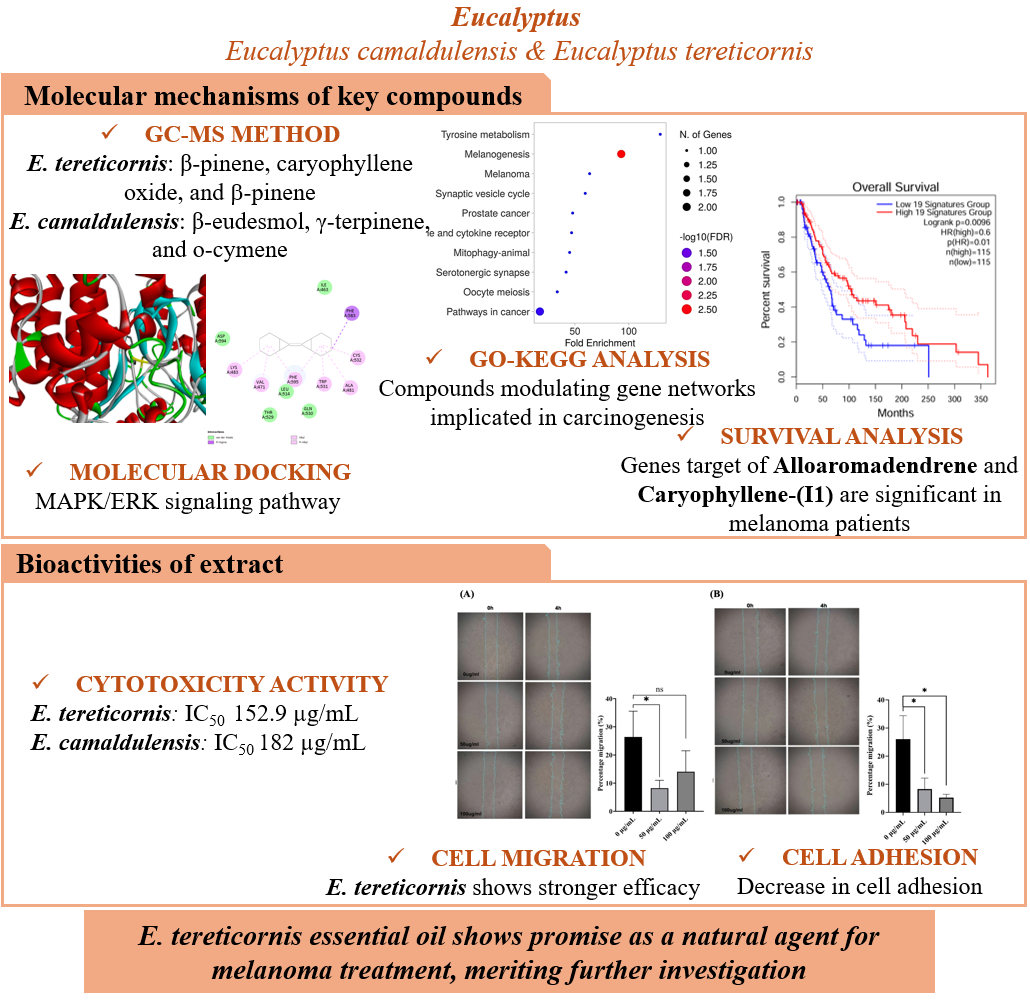
This study aimed to explore the therapeutic potential of Eucalyptus tereticornis essential oil in skin cancer treatment, with E. camaldulensis serving as a well-documented reference, both species collected in Vietnam. A multidisciplinary approach was employed to investigate chemical composition, cytotoxicity, anti-metastatic effects, and molecular mechanisms. The chemical constituents of the oils were characterized using gas chromatography-mass spectrometry (GC-MS). Cytotoxic effects were evaluated on murine melanoma B16F10 cells using the MTT assay. Anti-metastatic potential was investigated through cell migration (wound healing assay) and adhesion assays. To elucidate possible molecular mechanisms, molecular docking simulations were performed against key melanoma-related protein targets, including BRAF, NRAS, AKT3, FAK, and HDAC, and gene expression survival analysis stratified melanoma patient outcomes. GO and KEGG enrichment analyses were used to interpret functional roles. In cytotoxicity assays, E. tereticornis displayed a higher IC50 (152.9 µg/mL) compared to E. camaldulensis (182 µg/mL), suggesting higher anticancer efficacy. Moreover, E. tereticornis significantly inhibited B16F10 cell migration and adhesion, indicating potential anti-metastatic activity. GC-MS identified 46 compounds across both species. The dominant constituents in E. tereticornis were β-pinene, caryophyllene oxide, and a-pinene, while β-eudesmol, γ-terpinene, and o-cymene were major in E. camaldulensis. Docking results showed the strongest binding affinity to BRAF with the bicyclo[4.1.0]heptane, 7-bicyclo[4.1.0]hept-7-ylidene derivative (−8.5 kcal/mol). Survival analysis revealed significant prognostic associations for alloaromadendrene and caryophyllene-(I1) in melanoma patients (p < 0.05). Eucalyptus essential oils, particularly from E. tereticornis, exhibit promising antioxidant and anticancer activities, suggesting potential in melanoma therapy.
HIGHLIGHTS
- Eucalyptus camaldulensis and Eucalyptus tereticornis were evaluated for their antioxidant and anticancer potential against skin cancer.
- Eucalyptus tereticornis exhibited stronger cytotoxic and anti-metastatic effects compared to Eucalyptus camaldulensis.
- β-eudesmol, γ-terpinene, and o-cymene predominated in Eucalyptus camaldulensis, whereas β-pinene, caryophyllene oxide, and α-pinene were dominant in Eucalyptus tereticornis.
- Major phytoconstituents demonstrated strong binding affinity toward BRAF kinase in molecular docking analysis.
- These findings suggest a potential mechanistic basis for the anticancer activity of the studied Eucalyptus
GRAPHICAL ABSTRACT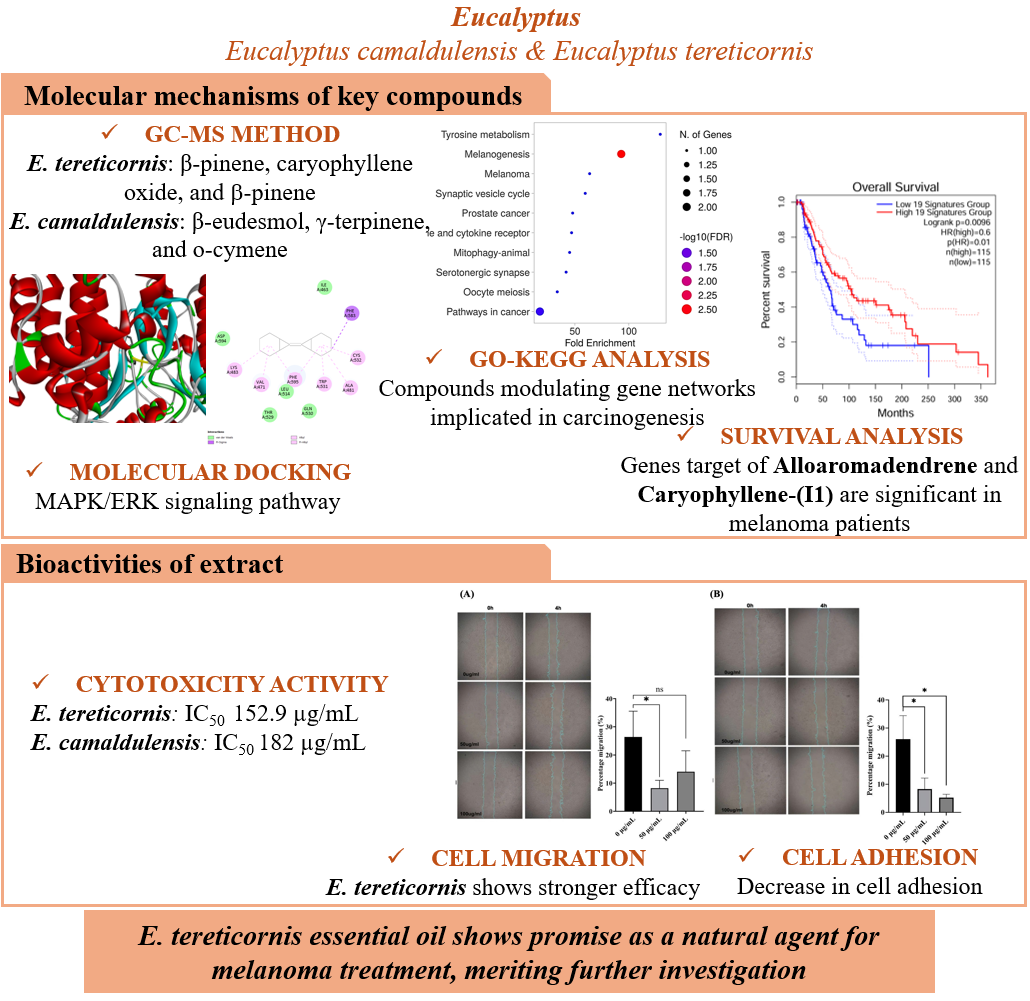
Downloads
References
AH Roky, MM Islam, AMF Ahasan, MS Mostaq, MZ Mahmud, MN Amin and MA Mahmud. Overview of skin cancer types and prevalence rates across continents. Cancer Pathogenesis and Therapy 2025; 3(2), 89-100.
W Mingyue, G Xinghua and Z Li. Recent global patterns in skin cancer incidence, mortality, and prevalence. Chinese Medical Journal 2025; 138(2), 185-192.
RL Siegel, TB Kratzer, AN Giaquinto, H Sung and A Jemal. Cancer statistics, 2025. CA: A Cancer Journal for Clinicians 2025; 75(1), 10-45.
N Chandorkar, S Tambe, P Amin and C Madankar. A systematic and comprehensive review on current understanding of the pharmacological actions, molecular mechanisms, and clinical implications of the genus Eucalyptus. Phytomedicine Plus 2021; 1(4), 100089.
L Alonso, J Picos and J Armesto. Mapping Eucalyptus species using worldview 3 and random forest. The International Archives of the Photogrammetry, Remote Sensing and Spatial Information Sciences 2022; 2022, 819-825.
H Khazraei, SA Shamsdin and M Zamani. In vitro cytotoxicity and apoptotic assay of Eucalyptus globulus essential oil in colon and liver cancer cell lines. Journal of Gastrointestinal Cancer 2022; 53, 363-369.
HC Huang, YC Ho, JM Lim, TY Chang, CL Ho and TM Chang. Investigation of the anti-melanogenic and antioxidant characteristics of Eucalyptus camaldulensis flower essential oil and determination of its chemical composition. International Journal of Molecular Sciences 2015; 16(5), 10470-10490.
Y Huang, M An, A Fang, OJ Olatunji and FN Eze. Antiproliferative activities of the lipophilic fraction of Eucalyptus camaldulensis against MCF-7 breast cancer cells, UPLC-ESI-QTOF-MS metabolite profile, and antioxidative functions. ACS Omega 2022; 7(31), 27369-27381.
Anju, A Kumar and P Yadav. Chemical composition, in vitro and in silico evaluation of essential oil from Eucalyptus tereticornis leaves for lung cancer. Natural Product Research 2023; 37(10), 1656-1661.
B Dey and A Mitra. Chemo-profiling of eucalyptus and study of its hypoglycemic potential. World Journal of Diabetes 2013; 4(5), 170-176.
AK Dhakad, VV Pandey, S Beg, JM Rawat and A Singh. Biological, medicinal and toxicological significance of Eucalyptus leaf essential oil: A review. Journal of the Science of Food and Agriculture 2018; 98(3), 833-848.
B Rodenak-Kladniew, A Castro, P Stärkel, M Galle and R Crespo. 1,8-Cineole promotes G0/G1 cell cycle arrest and oxidative stress-induced senescence in HepG2 cells and sensitizes cells to anti-senescence drugs. Life Sciences 2020; 243, 117271.
ND Kien, G Jansson, C Harwood and C Almqvist. Clonal variation and genotype by environment interactions in growth and wood density in Eucalyptus camaldulensis at three contrasting sites in Vietnam. Silvae Genetica 2010; 59(1), 17-28.
HD Manh, DT Hue, NTT Hieu, DTT Tuyen and OT Tuyet. The mosquito larvicidal activity of essential oils from Cymbopogon and Eucalyptus species in Vietnam. Insects 2020; 11(2), 128.
DNX Lâm, NT Nhựt, VTB Ngọc, TT Trĩnh and LHH Hạ. Chemical composition and current use trend of essential oils from leaves of genus eucalyptus (Eucalyptus sp.) in Vietnam and the world: A review. Cantho Journal of Medicine and Pharmacy 2022; 46, 145-154.
XY Meng, HX Zhang, M Mezei and M Cui. Molecular Docking: A powerful approach for structure-based drug discovery. Current Computer-Aided Drug Design 2011; 7(2), 146-157.
Z Tang, C Li, B Kang, G Gao, C Li and Z Zhang. GEPIA: A web server for cancer and normal gene expression profiling and interactive analyses. Nucleic Acids Research 2017; 45(1), 98-102.
The Gene Ontology Consortium. Gene Ontology Consortium: Going forward. Nucleic Acids Research 2015; 43(1), 1049-1056.
M Kanehisa, Y Sato, M Kawashima, M Furumichi and M Tanabe. KEGG as a reference resource for gene and protein annotation. Nucleic Acids Research 2016; 44(1), 457-462.
TH Ngau. Assessment of phytochemical composition, antimicrobial, antioxidant activities, and cytotoxicity of the ethanol extract from Cordyceps militaris. Journal of Science Technology and Food 2022; 22(3), 13-23.
TT Le, HT Duong and CH Nguyen. Characterization of in vitro antimicrobial activity of gyrophoric acid isolated from Parmotrema indicum on methicillin-resistant Staphylococcus aureus. Journal of Applied Pharmaceutical Science 2024; 14(3), 45-54.
TH Ngau, TTB Ngoc, LTY Nhi, NH Chuong and DTP Thao. Anticancer property of marine coral-derived Streptomyces sp. SS162 against A549 lung adenocarcinoma cancer cells. Journal of Applied Pharmaceutical Science 2023; 13(10), 188-198.
VTK Tran, TT Le, CH Nguyen, TNT Tran and V Hoang. Chemical composition, antibacterial, anticancer, and anti-a-glucosidase activities of essential oils from Alpinia nelumboides. Journal of Applied Pharmaceutical Science 2024; 14(12), 68-75.
B Buranrat. Cratoxylum formosum leaf extracts inhibit growth, induce apoptosis, and decrease metastasis of hela human cervical cancer cells. Pharmacognosy Magazine 2022; 18(78), 296-303.
X Bai, J Wang, L Zhang, J Ma, H Zhang, S Xia, M Zhang, X Ma, Y Guo, R Rong, S Cheng, W Shu, Y Wang and J Leng. Prostaglandin E₂ receptor EP1-mediated phosphorylation of focal adhesion kinase enhances cell adhesion and migration in hepatocellular carcinoma cells. International Journal of Oncology 2013; 42(5), 1833-1841.
H Assaggaf, NE Hachlafi, ME fadili, A Elbouzidi, H Ouassou, M Jeddi, S Alnasser, A Qasem, A Attar, A Al-Farga, OA Alghamdi, EE Mehana and HN Mrabti. GC/MS Profiling, In vitro antidiabetic efficacy of origanum compactum benth. essential oil and in silico molecular docking of its major bioactive compounds. Catalysts 2023; 13(11), 1429.
TD Nguyen,CDM Huynh,TT Le, PNT Dao, HTT Nguyen, THT Vo, NH Phan, BT Ngo-Huynh and V Hoang. Chemical composition and antifungal activities of Vitex rotundifolia essential oil from Vietnam: In vitro and in silico study. Journal of Essential Oil-Bearing Plants 2025; 28(6), 1369-1380.
W Guo, H Wang and C Li. Signal pathways of melanoma and targeted therapy. Signal Transduction and Targeted Therapy 2021; 6, 424.
Y Liu, X Yang, J Gan, S Chen, ZX Xiao and Y Cao. CB-Dock2: Improved protein-ligand blind docking by integrating cavity detection, docking and homologous template fitting. Nucleic Acids Research 2022; 50(1), 159-164.
A Daina, O Michielin and V Zoete. SwissADME: A free web tool to evaluate pharmacokinetics, drug-likeness and medicinal chemistry friendliness of small molecules. Scientific Reports 2017; 7, 42717.
CA Lipinski. Lead- and drug-like compounds: The rule-of-five revolution. Drug Discovery Today: Technologies 2004; 1(4), 337-341.
A Daina, O Michielin and V Zoete. SwissTargetPrediction: Updated data and new features for efficient prediction of protein targets of small molecules. Nucleic Acids Research 2019; 47(1), 357-364.
M Liao, JJ Xiao, LJ Zhou, Y Liu, XW Wu, RM Hua, GR Wang and HQ Cao. Insecticidal activity of melaleuca alternifolia essential oil and RNA-Seq analysis of Sitophilus zeamais transcriptome in response to oil fumigation. PLoS One 2016; 11(12), 0167748.
SX Ge and D Jung. ShinyGO: A web application for in-depth analysis of gene sets. Bioinformatics 2020; 36(8), 2628-2629.
Kaplan-Meier Plotter, Available at: http://www.kmplot.com/analysis, accessed December 2025.
V Kuete, O Karaosmanoğlu and H Sivas. Chapter 10 - anticancer activities of African medicinal spices and vegetables. RELX, London, 2017, p. 271-297.
S Sangthong, I Promputtha, P Pintathong and P Chaiwut. Chemical constituents, antioxidant, anti-tyrosinase, cytotoxicity, and anti-melanogenesis activities of Etlingera elatior (Jack) leaf essential oils. Molecules 2022; 27(11), 3469.
PF de Oliveira, JM Alves, JL Damasceno, RAM Oliveira, HJ Dias, AEM Crotti and DC Tavares. Cytotoxicity screening of essential oils in cancer cell lines. Revista Brasileira de Farmacognosia 2015; 25(2), 183-188.
M Sharma, K Grewal, R Jandrotia, DR Batish, HP Singh and RK Kohli. Essential oils as anticancer agents: Potential role in malignancies, drug delivery mechanisms, and immune system enhancement. Biomedicine & Pharmacotherapy 2022; 146, 112514.
TA Pham, IS Mohammad, VT Vu, XL Hu, C Birendra, A Ulah, C Guo, XY Lü, WC Ye and H Wang. Phloroglucinol derivatives from the Fruits of Eucalyptus globulus and their cytotoxic activities. Chemistry & Biodiversity 2018; 15(6), 1800052.
E Taheri, S Ghorbani, M Safi, NS Sani, FF Amoodizaj, M Heidari, R Chavoshi, S Hajazimian, A Isazadeh and M Heidari. Inhibition of colorectal cancer cell line CaCo-2 by essential oil of eucalyptus camaldulensis through induction of apoptosis. Acta Medica Iranica 2020: 58(6), 260-265.
A Joshi, A Sharma, RK Bachheti and DP Pandey. A comparative study of the chemical composition of the essential oil from Eucalyptus globulus growing in dehradun (India) and around the World. Oriental Journal of Chemistry 2016; 32(1), 331-340.
MD Martile, S Garzoli, R Ragno and DD Bufalo. Essential oils and their main chemical components: The Past 20 Years of preclinical studies in melanoma. Cancers 2020; 12, 2650.
CH Yang, YC Huang, ML Tsai, CY Cheng, LL Liu, YW Yen and WL Chen. Inhibition of melanogenesis by β-caryophyllene from lime mint essential oil in mouse B16 melanoma cells. International Journal of Cosmetic Science 2015; 37(5), 550-554.
KJS Kumar, MG Vani, PC Wu, HJ Lee, YH Tseng and SY Wang. Essential oils of Alpinia nantoensis retard forskolin-induced melanogenesis via ERK1/2-Mediated proteasomal degradation of MITF. Plants 2020; 9(12), 1672.
K Sebei, F Sakouhi, W Herchi, ML Khouja and S Boukhchina. Chemical composition and antibacterial activities of seven Eucalyptus species essential oils leaves. Biological Research 2015; 48, 7.
M Burotto, VL Chiou, JM Lee and EC Kohn. The MAPK pathway across different malignancies: A new perspective. Cancer 2014; 120(22), 3446-3456.
R Acharya, S Chacko, P Bose, A Lapenna and SP Pattanayak. Structure based multitargeted molecular docking analysis of selected furanocoumarins against breast cancer. Scientific Reports 2019; 9, 15743.
D Ramachandhiran, C Sankaranarayanan, R Murali, S Babukumar and V Vinothkumar. β-Caryophyllene promotes oxidative stress and apoptosis in KB cells through activation of mitochondrial-mediated pathway: An in-vitro and in-silico study. Archives of Physiology and Biochemistry 2022; 128, 148-162.
F Mannino, G Pallio, R Corsaro, L Minutoli, D Altavilla, G Vermiglio, A Allegra, AH Eid, A Bitto, F Squadrito and N Irrera. Beta-caryophyllene exhibits anti-proliferative effects through apoptosis induction and cell cycle modulation in multiple myeloma cells. Cancers 2021; 13(22), 5741.
MT Mahanthesh, D Ranjith, R Yaligar, R Jyothi, G Narappa and MV Ravi. Swiss ADME prediction of phytochemicals present in Butea monosperma (Lam.) Taub. Journal of Pharmacognosy and Phytochemistry 2020, 9(3), 1799-1809.
TT Le, TD Nguyen, MT Nguyen-Van, TNB Huynh, TT Dinh, CDM Huynh, PDT Nguyen, TNV Ho, H Tran-Van and V Hoang. Antifungal mechanisms of Melaleuca bracteata F. Mueall essential oil against Candida albicans: From chemical profiling to molecular targets. European Journal of Integrative Medicine 2025; 80, 102570.
RW Dellinger, HH Matundan, AS Ahmed, PH Duong and FLM Jr. Anti-cancer drugs elicit re-expression of UDP-Glucuronosyltransferases in melanoma cells. PLoS One 2012; 7(10), 47696.
Y Yamauchi, K Furukawa, K Hamamura and K Furukawa. Positive feedback loop between PI3K-Akt-mTORC1 signaling and the lipogenic pathway boosts Akt signaling: Induction of the lipogenic pathway by a melanoma antigen. Cancer Research 2011; 71(14), 4989-4997.
A Yamazaki, I Omura, Y Kamikawa, M Hide, A Tanaka, M Kaneko, K Imaizumi and A Saito. Unfolded protein response modulates Tyrosinase levels and melanin production during melanogenesis. Journal of Dermatological Science 2025; 117(2), 36-44.
Published
How to Cite
Issue
Section
License
Copyright (c) 2026 Walailak University

This work is licensed under a Creative Commons Attribution-NonCommercial-NoDerivatives 4.0 International License.





