
First Spatial Resistance Mapping of Fall Armyworm in Jambi, Indonesia
DOI:
https://doi.org/10.48048/tis.2026.12540Keywords:
Bioassay, Choropleth map, Resistance management, Probit analysis, Fall armywormAbstract
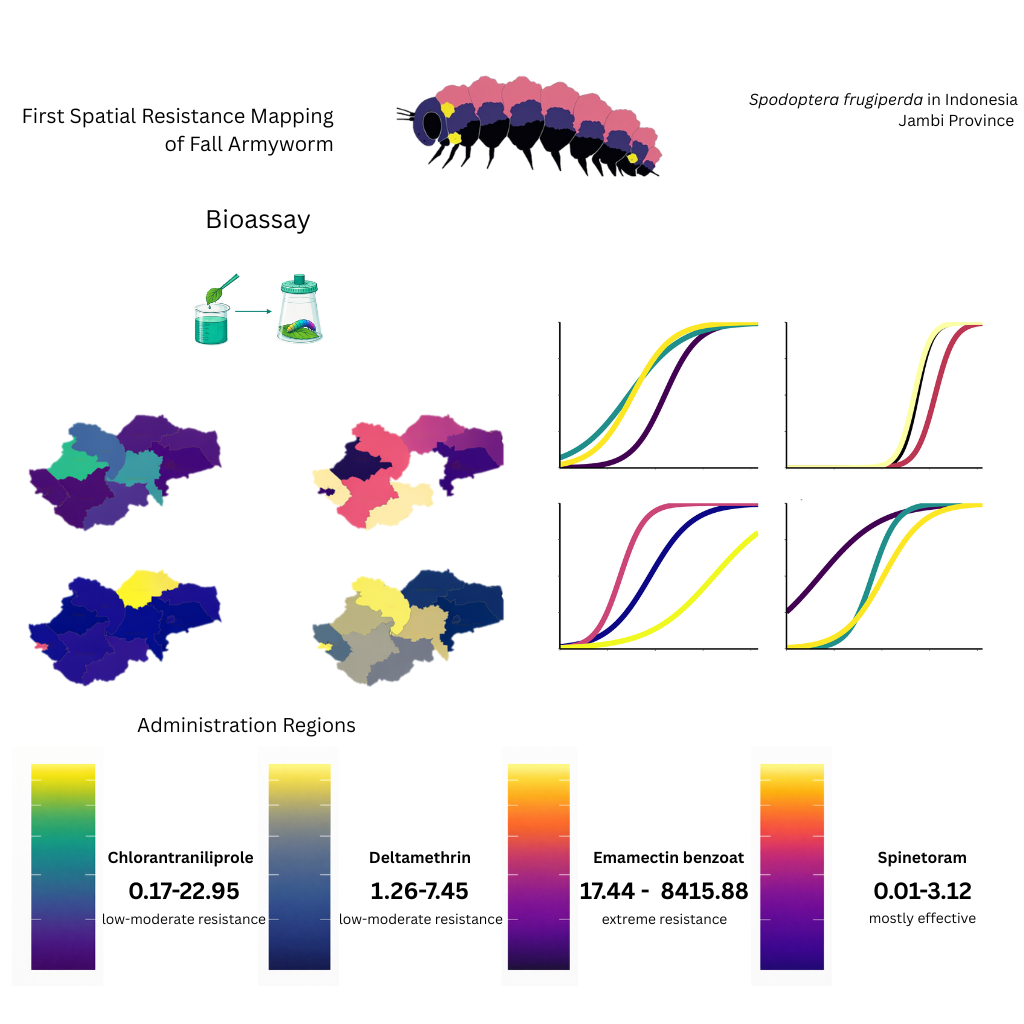
1) Introduction: The fall armyworm (Spodoptera frugiperda) has rapidly expanded across Indonesia since its first detection in 2019 and continues to threaten maize production. Reliance on repeated applications of chemical insecticides raises concern for emerging resistance, yet spatial patterns of resistance remain poorly documented and no spatially integrated resistance monitoring has been conducted in Indonesia. 2) Materials and methods: Eleven field populations from Jambi Province and one susceptible laboratory population were assessed for susceptibility to four commonly used insecticides: Chlorantraniliprole, deltamethrin, emamectin benzoate, and spinetoram. Diet-dipping bioassays were performed, and concentration mortality responses were analyzed using probit regression to estimate LC₅₀ values and resistance ratios. Spatial visualization was conducted in RStudio (version 2024.12.0 Build 467) using sf and ggplot2 packages to generate choropleth maps showing variation in resistance intensity across administrative regions. 3) Results and discussion: Resistance varied widely among locations and insecticides. Chlorantraniliprole showed low–moderate resistance (RR 0.17 - 22.95), highest in Kerinci. Deltamethrin resistance was widespread (RR 1.26 - 7.45), especially in Jambi City and Sarolangun. Emamectin benzoate showed extreme resistance (RR 17.44 - 8415.88), with hotspots in Tanjab Barat and Sungai Penuh. Spinetoram remained mostly effective (RR 0.01 - 3.12). Spatial patterns indicated localized selection pressure. Spatial patterns indicated localized selection pressure. 4) Conclusions: The findings confirm emerging resistance risks and spatially structured resistance hotspots across Jambi. These results underscore the need for region-specific insecticide rotation, routine resistance surveillance, and integration of chemical control with broader IPM and IRM strategies to maintain long term effectiveness and slow resistance evolution.
HIGHLIGHTS
- Insecticide resistance of Spodoptera frugiperda was spatially assessed across 11 agricultural sites in Jambi Province, Indonesia.
- LC₅₀ values and resistance ratios were estimated using diet residue bioassays and probit analysis, with spatial patterns visualized using R-based choropleth mapping.
- Strong geographic variation in susceptibility was observed, including high resistance to chlorantraniliprole and widespread resistance to deltamethrin.
- Emamectin benzoate resistance was documented for the first time in Indonesia, with pronounced hotspots in Sungai Penuh and Tanjab Timur.
- Spinetoram remained largely effective, although early resistance signals highlight the need for proactive IPM/IRM-based rotation strategies.
GRAPHICAL ABSTRACT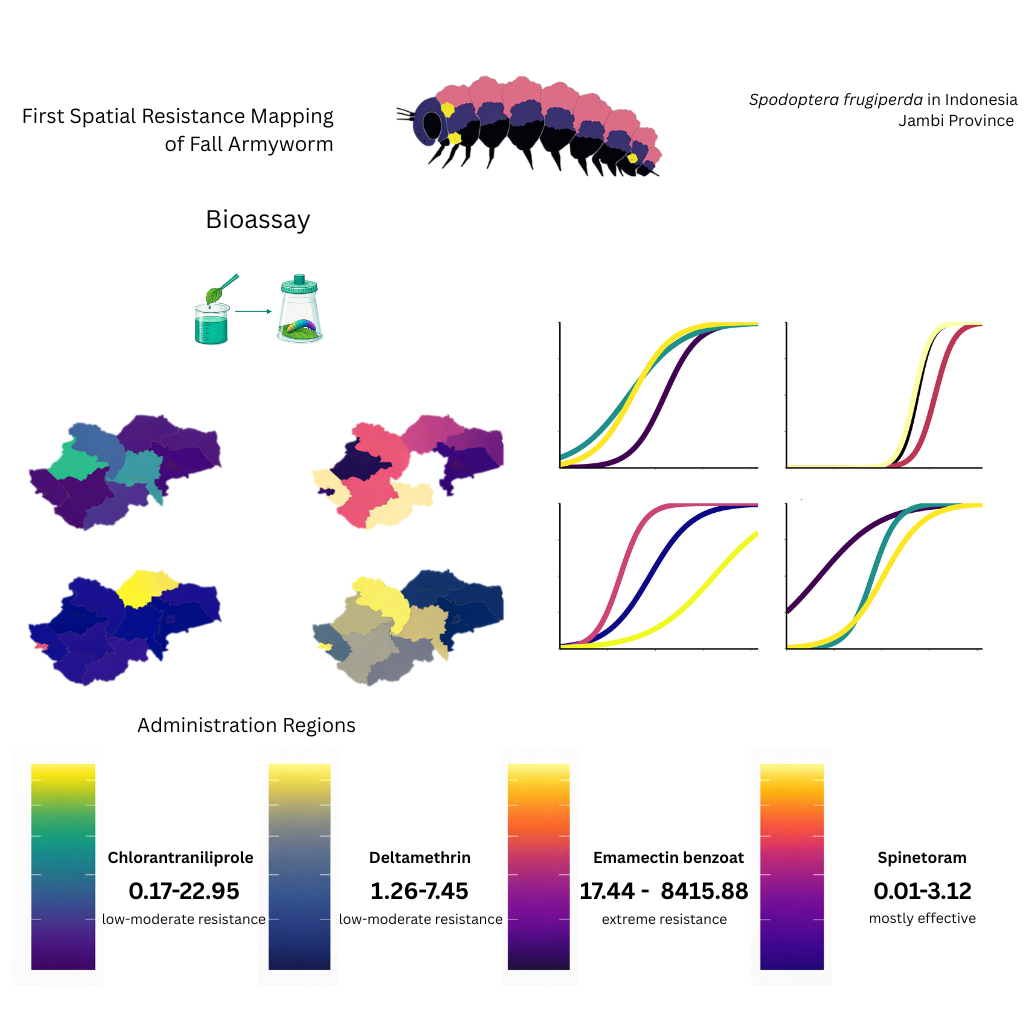
Downloads
References
I Rwomushana. Spodoptera frugiperda (Fall armyworm). CABI Compendium 2019. https://doi.org/10.1079/cabicompendium.29810
YA Trisyono, S Suputa, VEF Aryuwandari, M Hartaman and J Jumari. Occurrence of heavy infestation by the fall armyworm Spodoptera frugiperda, a new alien invasive pest, in corn Lampung Indonesia. Jurnal Perlindungan Tanaman Indonesia 2019; 23(1), 156.
N Nonci, S Pakki and A Muis. Field testing of synthetic insecticides on fall armyworm (Spodoptera frugiperda J.E. Smith) in corn plant. IOP Conference Series: Earth and Environmental Science 2021; 911, 012059.
MK Kansiime, I Mugambi, I Rwomushana, W Nunda, JL Godwin, H Rware, NA Phiri, G Chipabika, M Ndlovu and R Day. Farmer perception of fall armyworm (Spodoptera frugiperda J.E. Smith) and farm-level management practices in Zambia. Pest Management Science 2019; 75(10), 2840-2850.
B Sisay, T Tefera, M Wakgari, G Ayalew and E Mendesil. The efficacy of selected synthetic insecticides and botanicals against fall armyworm Spodoptera frugiperda in maize. Insects 2019; 10(2), 45.
Y Cai, H Chen, M Hu, X Wang and L Zhang. Discovery of novel potential insecticide-resistance mutations in Spodoptera frugiperda. Insects 2024; 15, 186.
L Zhang, B Liu, W Zheng, C Liu, D Zhang, S Zhao, Z Li, P Xu, K Wilson, A Withers, CM Jones, JA Smith, G Chipabika, DL Kachigamba, K Nam, E D’Alençon, B Liu, X Liang, M Jin, C Wu, S Chakrabarty, X Yang, Y Jiang, J Liu, X Liu, W Quan, G Wang, W Fan, W Qian, K Wu and Y Xiao. Genetic structure and insecticide resistance characteristics of fall armyworm populations invading China. Molecular Ecology Resources 2020; 20(6), 1682-1696.
RA Carvalho, C Omoto, LM Field, MS Williamson and C Bass. Investigating the molecular mechanisms of organophosphate and pyrethroid resistance in the fall armyworm Spodoptera frugiperda. PLoS One 2013; 8(4), e62268.
HL Chen, A Hasnain, QH Cheng, LJ Xia, YH Cai, R Hu, CW Gong, XM Liu, J Pu, L Zhang and XG Wang. Resistance monitoring and mechanism in the fall armyworm Spodoptera frugiperda for chlorantraniliprole from Sichuan Province, China. Frontiers in Physiology 2023; 14, 1180655.
V Matti, CP Mallapur, DN Kambrekar, UK Hulihalli and SI Harlapur. Laboratory evaluation of newer insecticides and biorationals against Spodoptera frugiperda (J.E. Smith). Journal of Experimental Zoology India 2023; 26(2), 1791-1796.
A Meilin, R Rubiana, J Jumakir, K Suheiti, WS Murni, R Rustam and J Bobihoe. Study of pest attacks on maize plantation in oil palm replanting land of Jambi Province. IOP Conference Series: Earth and Environmental Science 2021; 752, 012008.
IRAC Brazil Guidelines. Insec&cide resistance management guidelines for insect pests of corn, soybean and cotton in Brazil. IRAC Brazil Guidelines, Brazil, 2017.
YX Zhao, JM Huang, H Ni, D Guo, FX Yang, X Wang, SF Wu and CF Gao. Susceptibility of fall armyworm Spodoptera frugiperda to eight insecticides in China, with special reference to lambda-cyhalothrin. Pesticide Biochemistry and Physiology 2020; 168, 104623.
JT Hardke, GM Lorenz and BR Leonard. Fall armyworm (Lepidoptera: Noctuidae) ecology in Southeastern cotton. Journal of Integrated Pest Management 2015; 6(1), 10.
R Salamat, B Siddique, MBS Afzal, A Banazeer, JE Serrao, MI Akram, A Sajjad, M Younus and AA Sial. Resistance of Spodoptera frugiperda to the diamides chlorantraniliprole and flubendiamide: Resistance development, heritability, inheritance and implications for management. Journal of Economic Entomology 2025; 118(6), 3157-3172.
OA Posos-Parra, BR Pittendrigh, JC Wise, C DiFonzo, E Petterson and DM Sanchez. Inheritance and resistance mechanisms of field-evolved resistance to pyrethroids in a fall armyworm strain from Puerto Rico. Insects 2024; 15(12), 912.
RK Thumar, MB Zala, HS Varma, CB Dhobi, BN Patel and PK Borad. Evaluation of insecticides against fall armyworm Spodoptera frugiperda infesting maize. International Journal of Chemical Studies 2020; 8(4), 100-104.
M Oplopoiou, J Elias, R Slater, C Bass and CT Zimmer. Characterization of emamectin benzoate resistance in Plutella xylostella. Pest Management Science 2023; 80(2), 498-507.
J Zhang, J Jiang, K Wang, Y Zhang, Z Liu and N Yu. A binary mixture of emamectin benzoate and chlorantraniliprole supplemented with an adjuvant effectively controls Spodoptera frugiperda. Insects 2022; 13(12), 1157.
JN Suryani, YA Trisyono and E Martono. Susceptibility of Spodoptera frugiperda collected from central java province to emamectin benzoate. Jurnal Perlindungan Tanaman Indonesia 2022; 26(2), 159-166.
DS Muraro, E Salmeron, JVS Cruz, FSA Amaral, AS Guidolin, ARB Nascimento, JB Malaquias, O Berbardi and C Omoto. Evidence of field-evolved resistance in Spodoptera frugiperda to emamectin benzoate in Brazil. Crop Protection 2022; 162, 106071.
L Depalo, A Masetti, J Avilla, D Bosch and E Pasqualini. Toxicity and residual activity of spinetoram to neonate larvae of Grapholita molesta (Busck) and Cydia pomonella (L.) (Lepidoptera: Tortricidae): Semi-field and laboratory trials. Crop Protection 2016; 89, 32-37.
XZ Wang, JS Chen, W Wang, DB Niu, HZ Wu, SR Palli, HQ Cao and CW Sheng. Knockdown of the glutamate-gated chloride channel gene decreases emamectin benzoate susceptibility in the fall armyworm, Spodoptera frugiperda. Pesticide Biochemistry and Physiology 2023; 196, 105636.
A Mahajan, M Devi, P Mehra, A Kaur and S Kaur. Impact of chlorantraniliprole exposure on susceptible and resistant populations of Spodoptera litura. Journal of Applied Entomology 2025; 149(3), 1090-1104.
BM Prasanna, A Bruce, Y Beyene, D Makumbi, M Gowda, M Asi, S Martinelli, GP Head and S Parimi. Host plant resistance for fall armyworm management in maize: Relevance, status and prospects in Africa and Asia. Theoretical and Applied Genetics 2022; 135(11), 3897-3916.
PM Matova, CN Kamutando, C Magorokosho, D Kutywayo, F Gutsa and M Labuschagne. Fall armyworm invasion: Control practices and resistance breeding in Sub-Saharan Africa. Crop Science 2020; 60(6), 2951-2970.
Published
How to Cite
Issue
Section
License
Copyright (c) 2025 Walailak University

This work is licensed under a Creative Commons Attribution-NonCommercial-NoDerivatives 4.0 International License.





