
Identification and Prediction of Bioactive Peptides from Anchovy (Engraulidae) Based on Processing Methods: Sub-Fragment Analysis via LC-HRMS Proteomics
DOI:
https://doi.org/10.48048/tis.2026.12467Keywords:
Anchovies, Bioactive peptides, LC-HRMS, Fortification, BIOPEP, PeptideRankerAbstract
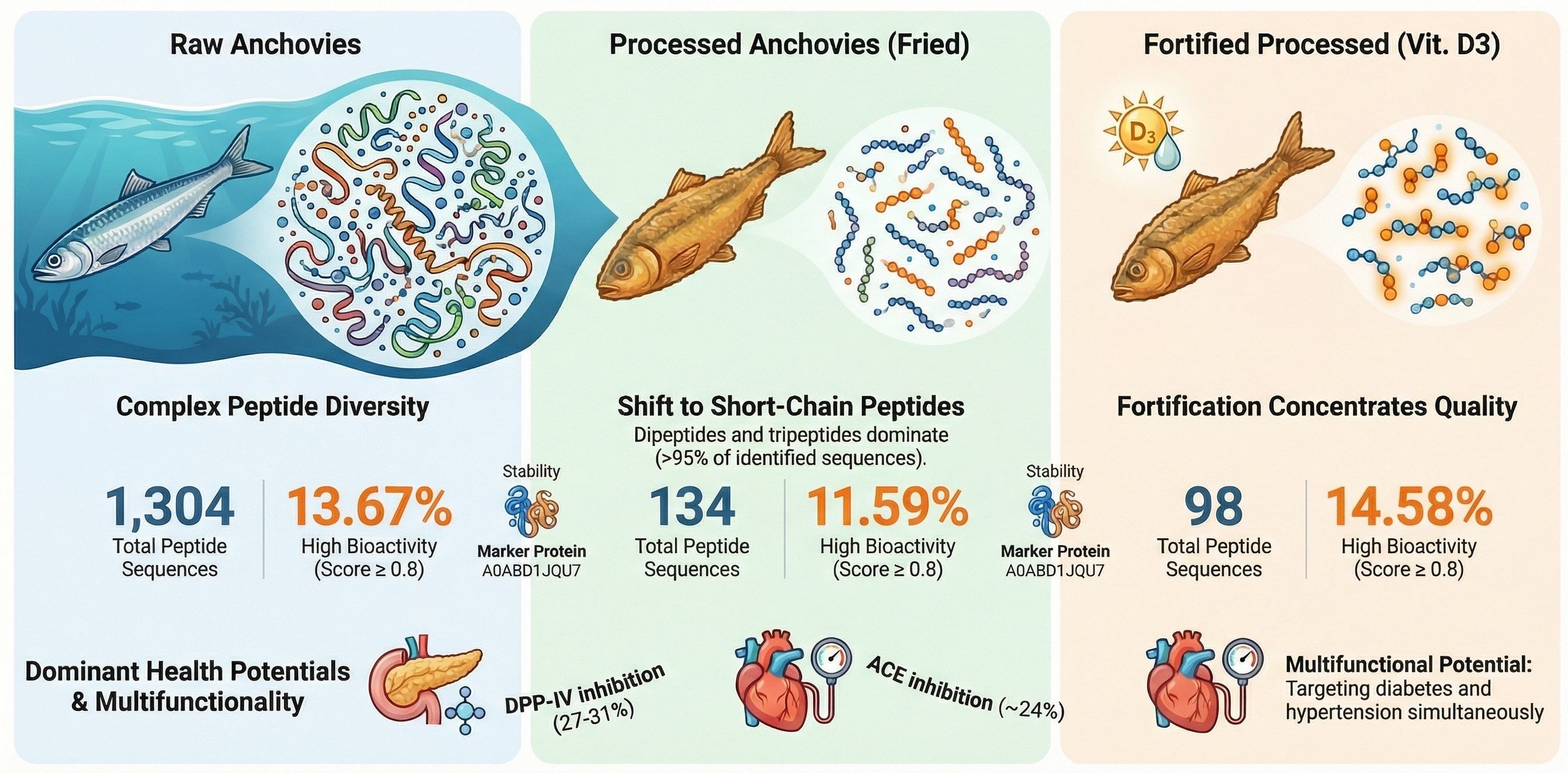
This exploratory study aimed to identify and compare peptide profiles and predicted bioactivities of anchovies (Engraulidae) in 3 forms - Raw, processed, and fortified processed - using LC HRMS based proteomics combined with BIOPEP UWM and PeptideRanker analyses. Peptides generated by tryptic digestion were analyzed by LC HRMS, matched to an Engraulidae protein database, and evaluated in silico to annotate potential biological activities and estimate intrinsic bioactivity scores. In this non replicated dataset, raw anchovies showed the highest proteomic complexity (254 protein IDs and 1,304 peptide sequences), whereas processed and fortified samples exhibited fewer proteins and peptides, particularly with chain lengths ≥ 4 amino acids. Across all samples, the most frequent predicted activities were Dipeptidyl Peptidase IV (DPP IV) (27% - 31%) and Angiotensin Converting Enzyme (ACE) inhibition (± 24%), supported by antioxidant, neprilysin inhibitory (3% - 6%), and other enzyme inhibitory annotations. Short peptides (2 - 3 amino acids) dominated the predicted bioactive profiles, especially in processed and fortified products, indicating a shift toward shorter chains. Although total peptide numbers decreased after processing, the proportion of peptides with multiple annotated activities and high PeptideRanker scores (≥ 0.8) was descriptively higher in fortified samples (14.58%). These findings provide a preliminary molecular map suggesting that anchovy proteins can act as precursors of peptides with putative multifunctional bioactivities and may represent candidates for anchovy based functional foods or nutraceuticals. However, all functional inferences are based solely on sequence level, in silico predictions from single run LC HRMS data; the patterns observed are hypothesis generating and require confirmation through replicated experiments and targeted in vitro and in vivo validation.
HIGHLIGHTS
- Comparative proteomic analysis was performed on raw, processed, and vitamin D₃-fortified anchovy samples.
- LC-HRMS identified 254 proteins and 1,304 peptides in raw anchovies, with fewer peptides detected in processed and fortified samples.
- Processing reduced peptide complexity but increased the proportion of multifunctional (multiactive) peptides.
- DPP-IV and ACE inhibitory peptides remained dominant across all treatments, including fortification.
- Fortified anchovies exhibited the highest proportion of peptides with high predicted bioactivity (PeptideRanker ≥ 0.8).
- Anchovy-derived peptides show strong potential for multifunctional food and nutraceutical development.
GRAPHICAL ABSTRACT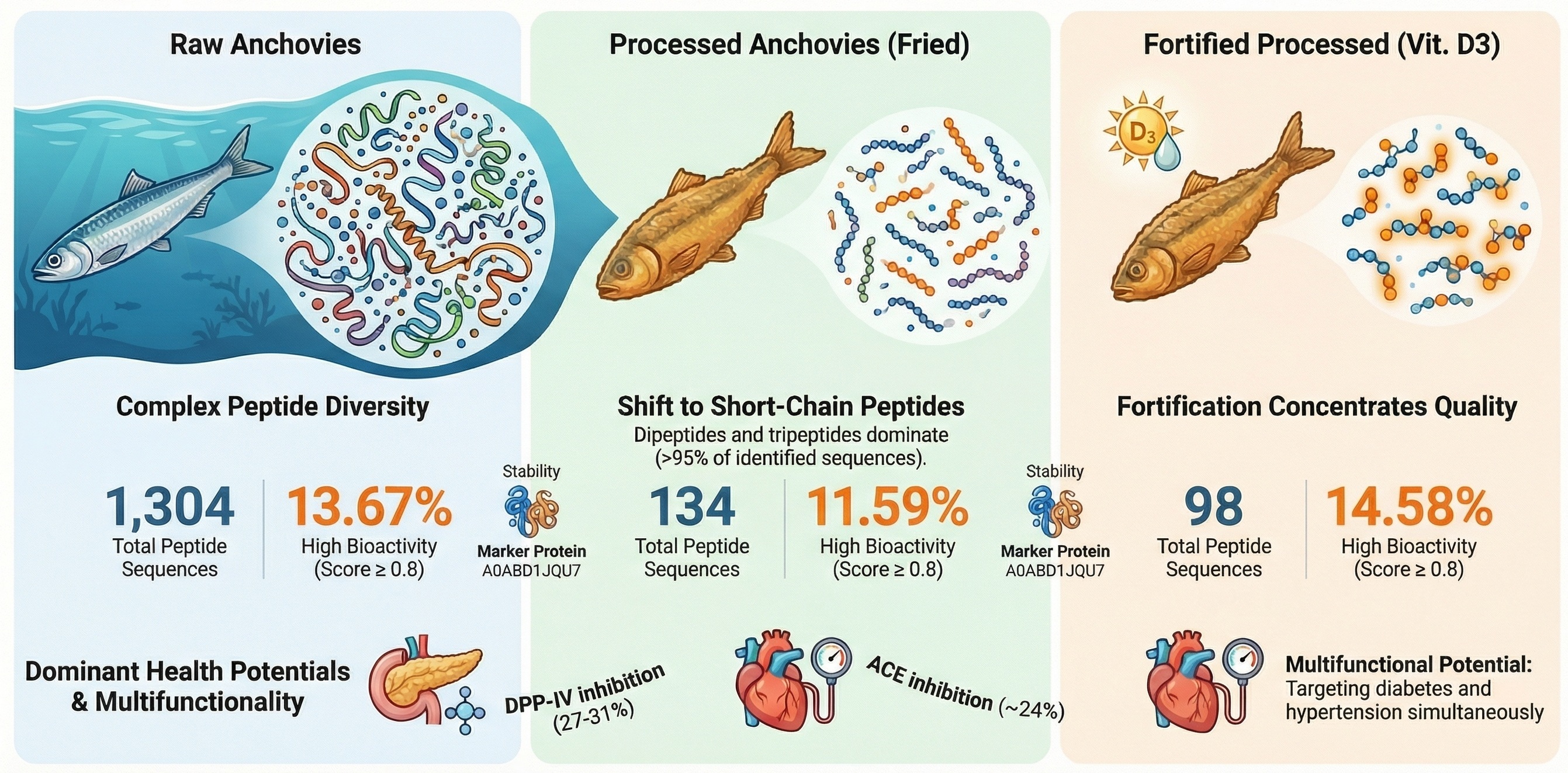
Downloads
References
JYH Toy, LL Yu and D Huang. Functional foods for health: Evidence and insights. In: D Huang and LL Yu (Eds.). Evidence-based nutraceuticals and functional foods. Royal Society of Chemistry, London, 2025. p. 1-15.
M Fekete, A Lehoczki, A Kryczyk-Poprawa, V Zábó, JT Varga, M Bálint, V Fazekas-Pongor, T Csípő, E Rząsa-Duran and P Varga. Functional foods in modern nutrition science: Mechanisms, evidence, and public health implications. Nutrients 2025; 17(13), 2153.
A Vignesh, TC Amal, A Sarvalingam and K Vasanth. A review on the influence of nutraceuticals and functional foods on health. Food Chemistry Advances 2024; 5, 100749.
TR Nuringtyas, L Hidayati, Z Rohmah, DK Paramita, A Suparmin, HH Prinanda, QN Febryzalita, SL Utami, LF Zulfa, BK Ardiansyah, SN Dewi and YA Purwestri. Bioactive peptides from sea cucumbers and sea urchins: Therapeutic roles and mechanistic insights. Trends in Sciences 2025; 22(5), 9513.
RJS de Castro and HH Sato. Biologically active peptides: Processes for their generation, purification and identification and applications as natural additives in the food and pharmaceutical industries. Food Research International 2015; 74, 185-198.
J Stadnik and P Kęska. Meat and fermented meat products as a source of bioactive peptides. Acta Scientiarum Polonorum, Technologia Alimentaria 2015; 14(3), 181-190.
F Shahidi and A Saeid. Bioactivity of marine-derived peptides and proteins: A review. Marine Drugs 2025; 23(4), 157.
V Manikkam, T Vasiljevic, ON Donkor and ML Mathai. A review of potential marine-derived hypotensive and anti-obesity peptides. Critical Reviews in Food Science and Nutrition 2016; 56(1), 92-112.
L Xing, Z Wang, Y Hao and W Zhang. Marine products as a promising resource of bioactive peptides: Update of extraction strategies and their physiological regulatory effects. Journal of Agricultural and Food Chemistry 2022; 70(10), 3081-3095.
E Daliri, D Oh and B Lee. Bioactive peptides. Foods 2017; 6(5), 32.
I Perkons, MS Varunjikar and JD Rasinger. Unveiling the potential of proteomics in addressing food and feed safety challenges. EFSA Journal 2023; 21, e211013.
SA Tadesse and SA Emire. Production and processing of antioxidant bioactive peptides: A driving force for the functional food market. Heliyon 2020; 6(8), e04765.
C Aydoğan. Recent advances and applications in LC-HRMS for food and plant natural products: A critical review. Analytical and Bioanalytical Chemistry 2020; 412(9), 1973-1991.
M Hayes, A Naik, L Mora, B Iñarra, J Ibarruri, C Bald, T Cariou, D Reid, M Gallagher, R Dragoy, J Galino, A Deya, S Albrektsen, L Thoresen and RG Solstad. Generation, characterisation and identification of bioactive peptides from mesopelagic fish protein hydrolysates using in silico and in vitro approaches. Marine Drugs 2024; 22(7), 297.
NM Kari, SH Azmi, TC Tuan Zainazor, AI Zamri and F Ahmad. Anchovy’s protein as a potential precursor of Angiotensin-I Converting Enzyme (ACE) inhibitory peptide and Dipeptidyl Peptidase-IV (DPP-IV) inhibitory peptide by an in silico approach. Food Research 2023; 7(2), 248-261.
DM Pampanin, E Larssen, F Provan, M Sivertsvik, P Ruoff and MO Sydnes. Detection of small bioactive peptides from Atlantic herring (Clupea harengus L.). Peptides 2012; 34(2), 423-426.
MAS Imran, M Carrera, S Pérez-Polo, J Pérez, L Barros, S Dios and C Gestal. Insights into common octopus (Octopus vulgaris) ink proteome and bioactive peptides using proteomic approaches. Marine Drugs 2023; 21(4), 206.
M Nemati, SR Shahosseini and P Ariaii. Review of fish protein hydrolysates: Production methods, antioxidant and antimicrobial activity and nanoencapsulation. Food Science and Biotechnology 2024; 33(8), 1789-1803.
J Du, M Xiao, N Sudo and Q Liu. Bioactive peptides of marine organisms: Roles in the reduction and control of cardiovascular diseases. Food Science & Nutrition 2024; 12(8), 5271-5284.
ES Okeke, RE Ita, EJ Egong, LE Udofia, CL Mgbechidinma and OD Akan. Metaproteomics insights into fermented fish and vegetable products and associated microbes. Food Chemistry: Molecular Sciences 2021; 3, 100045.
C Litaay, Indriawati, L Nuraini, CEW Anggara, Sriharti, A Triyono and T Hidayat. The value of the nutritional composition of fresh fish and flour-anchovy. IOP Conference Series: Earth and Environmental Science 2023; 1273, 012074
RW Kusumaningtyas, T Sudiarti and N Laily. Development and nutritional value of instant anchovy (Stolephorus indicus) soup as vitamin D-rich meal for pregnant women. Journal of Food Technology Research 2025; 12(2), 102--113.
PA Aneesh, J Varkey, R Anandan, S Mathew, KK Asha, PT Lakshmanan and VT Shankar. Proximate composition, amino acid and fatty acid profiles of commerson’s anchovy (Stolephorus commersonii) and Indian mackerel (Rastrelliger Kanagurta). Biochemical and Cellular Archives 2012; 12, 371-376.
L Najafian L and AS Babji. Fractionation and identification of novel antioxidant peptides from fermented fish (pekasam). Journal of Food Measurement and Characterization 2018; 12(3), 2174-2183.
MA Kurnianto, F Syahbanu, H Hamidatun, Yushinta and A Sanjaya. Prediction and mapping of potential bioactive peptide from traditional fermented anchovy (Rusip) using bioinformatics approaches. Squalen Bulletin of Marine and Fisheries Postharvest and Biotechnolog 2023; 18(2), 93-105.
D Jelić, M Vraneš, S Zeljković, S Veličković, F Veljković, A Cvetkovski, B Pejova and S Papovic. Advancing food fortification with kinetics: Stabilizing vitamin D3 through calcium carbonate-based vehicles. Food Chemistry 2025; 487, 144811.
C Litaay, TA Mutiara, A Indriati, F Novianti, L Nuraini and N Rahman. Fortifikasi tepung ikan teri (Stolephorus sp.) terhadap karakteristik fisik dan mikrostruktur mi berbasis sagu (in Indonesian). Jurnal Pengolahan Hasil Perikanan Indonesia 2023; 26(1), 127-138.
MEL Diogenes, FF Bezerra, EP Rezende, MF Taveira, I Pinhal and CM Donangelo. Effect of calcium plus vitamin D supplementation during pregnancy in Brazilian adolescent mothers: A randomized, placebo-controlled trial. The American Journal of Clinical Nutrition 2013; 98(1), 82-91.
M Mogan and E Trisnawati. Pengaruh suplemen kalsium dan vitamin D Pada ibu hamil dengan hipertensi di puskesmas sentani (in Indonesian). Gema Kesehatan 2022; 14, 188-195.
V Kumar, RJ Shakila, AU Muzaddadi, G Jeyasekaran, D Sukumar and P Padmavathy. In vitro stability of ACE-Inhibitory peptides of rohu fish waste to heat, pH and gastrointestinal enzymes. Turkish Journal of Fisheries and Aquatic Sciences 2024; 24(3), TRJFAS23788.
Y Gong, M Feng and J Sun. Effect of different thermal processing methods and thermal core temperatures on the protein structure and in vitro digestive characteristics of beef. Food Chemistry 2025; 464, 141751.
GJ Fadimu, TT Le, H Gill, A Farahnaky, OO Olatunde and T Truong. Enhancing the biological activities of food protein-derived peptides using non-thermal technologies: A review. Foods 2022; 11(13), 1823.
JM Jacobs, HM Mottaz, LR Yu, DJ Anderson, RJ Moore, WNU Chen, KJ Auberry, EF Strittmatter, ME Monroe, BD Thrall, DG Camp and RD Smith. Multidimensional proteome analysis of human mammary epithelial cells. Journal of Proteome Research 2004; 3(1), 68-75.
MR Hoopmann, GE Merrihew, PD von Haller and MJ MacCoss. Post analysis data acquisition for the iterative MS/MS sampling of proteomics mixtures. Journal of Proteome Research 2009; 8(4), 1870-1875.
B Ryu, KH Shin and SK Kim. Muscle protein hydrolysates and amino acid composition in fish. Marine Drugs 2021; 19(7), 377.
M Senevirathne and S Kim. Production and health effects of peptides from fish proteins. In: SK Kim (Ed.). Marine proteins and peptides: Biological activities and applications. Wiley, New Jersey, 2013, p. 737-751.
JT Ryan, RP Ross, D Bolton, GF Fitzgerald and C Stanton. Bioactive peptides from muscle sources: Meat and fish. Nutrients 2011; 3(9), 765-791.
M Senevirathne and SK Kim. Development of bioactive peptides from fish proteins and their health promoting ability. Advances in Food and Nutrition Research 2012; 65, 235-248.
Y Zhao and YH Lin. Whole-cell protein identification using the concept of unique peptides. Genomics Proteomics Bioinformatics 2010; 8(1), 33-41.
DL Swaney, CD Wenger and JJ Coon. Value of using multiple proteases for large-scale mass spectrometry-based proteomics. Journal of Proteome Research 2010; 9(3), 1323-1329.
Y Zhao and YH Lin. Whole-cell protein identification using the concept of unique peptides. Genomics Proteomics Bioinformatics 2010; 8(1), 33-41.
M Chevallet, H Diemer, S Luche, A van Dorsselaer, T Rabilloud and E Leize-Wagner. Improved mass spectrometry compatibility is afforded by ammoniacal silver staining. Proteomics 2006; 6(8), 2350-2354.
R Li, N Raak and L Roman. Recent advances in processing-induced changes in the structure, techno-functional properties and nutritional quality of animal- and plant-based food proteins. Foods 2025; 14(5), 764.
W Ogugua. Role of processing conditions in enhancing peptide stability and bioactivity in foods. Journal of Food Processing & Technology 2023; 14, 1001068.
S Mäkinen, J Hiidenhovi, X Huang, ADS Lima, L Azevedo, J Setälä, AL Valimaa, P Mattila and D Granato. Production of bioactive peptides from baltic herring (Clupea harengus Membras): Dipeptidyl peptidase-4 inhibitory, antioxidant and antiproliferative properties. Molecules 2022; 27(18), 5816.
SJ Chen and WT Jiaang. Current advances and therapeutic potential of agents targeting dipeptidyl peptidases-IV, -II, 8/9 and fibroblast activation protein. Current Topics in Medicinal Chemistry 2011; 11, 1447-1463.
L Fleury, B Deracinois, C Dugardin, AB Nongonierma, RJ FitzGerald, C Flahaut, B Cudennec and R Ravallec. In vivo and in vitro comparison of the DPP-IV inhibitory potential of food proteins from different origins after gastrointestinal digestion. International Journal of Molecular Sciences 2022; 23(15), 8365.
DY Pujiastuti, MNG Amin, MA Alamsjah and JL Hsu. Marine organisms as potential sources of bioactive peptides that inhibit the activity of angiotensin i-converting enzyme: A review. Molecules 2019; 24(14), 2541.
CD Cinq-Mars and ECY Li-Chan. Optimizing angiotensin I-converting enzyme inhibitory activity of pacific hake (Merluccius productus) fillet hydrolysate using response surface methodology and ultrafiltration. Journal of Agricultural and Food Chemistry 2007; 55(23), 9380-9388.
W Cao, C Zhang, H Ji and J Hao. Optimization of peptic hydrolysis parameters for the production of angiotensin I‐converting enzyme inhibitory hydrolysate from Acetes chinensis through Plackett-Burman and response surface methodological approaches. Journal of the Science of Food and Agriculture 2012; 92(1), 42-48.
X Zhang, C Hu, E Tian, Y Shen, W Liu and J Li. Comprehensive review on neprilysin (NEP) inhibitors: Design, structure-activity relationships, and clinical applications. Frontiers in Pharmacology 2024; 15, 1501407.
N Esser and S Zraika. Neprilysin inhibition: A new therapeutic option for type 2 diabetes? Diabetologia 2019; 62(7), 1113-1122.
DV Ferraris, K Shukla and T Tsukamoto. Structure-activity relationships of glutamate carboxypeptidase II (GCPII) inhibitors. Current Medicinal Chemistry 2012; 19(9), 1282-1294.
KT Jegani, A Balde and RA Nazeer. A review on anti-inflammatory and antioxidant peptides derived from marine organisms: Mechanism of action and therapeutic applications. Food Bioscience 2025; 63, 105745.
VK Khavinson. Peptides, genome, aging. Advances in Gerontology 2014; 4(4), 337-345.
DJ Daroit and A Brandelli. In vivo bioactivities of food protein-derived peptides - a current review. Current Opinion in Food Science 2021; 39, 120-129.
ZF Bhat, JD Morton, AEA Bekhit, S Kumar and HF Bhat. Thermal processing implications on the digestibility of meat, fish and seafood proteins. Comprehensive Reviews in Food Science and Food Safety 2021; 20(5), 4511-4548.
S Avilés-Gaxiola, I García-Aguiar, LA Jiménez-Ortega, EP Gutiérrez-Grijalva and JB Heredia. Bioactive plant peptides: Physicochemical features, structure-function insights and mechanism of action. Molecules 2025; 30(18), 3683.
S Windarto, VE Herawati, YJ Wijaya and DA Indriati. Exploring the bioactive potential of peptides derived from the RuBisCO protein in Caulerpa racemosa: An in silico approach. Biotech Studies 2025; 34(2), 71-85.
B Tamam, D Syah, HN Lioe, MT Suhartono and WA Kusuma. Beberapa penciri berbasis sekuens untuk mengenali sifat fungsional peptida bioaktif: Studi eksplorasi (in Indonesian). Jurnal Sains dan Teknologi Pangan 2018; 29(1), 1-9.
K Purohit, N Reddy and A Sunna. Exploring the potential of bioactive peptides: From natural sources to therapeutics. International Journal of Molecular Sciences 2024; 25(3), 1391.
Suwarjoyowirayatno, C Hidayat, TD Wahyuningsih and R Indrati. Identification of bioactive peptide inhibitors of cyclooxygenase-2 from peanut worm (Siphonosoma australe): An in silico studies. Trends in Sciences 2025; 22(5), 9565.
L Amigo, D Martínez-Maqueda and B Hernández-Ledesma. In silico and in vitro analysis of multifunctionality of animal food-derived peptides. Foods 2020; 9(8), 991.
M Akbarian, A Khani, S Eghbalpour and VN Uversky. Bioactive peptides: Synthesis, sources, applications, and proposed mechanisms of action. International Journal of Molecular Sciences 2022; 23(3), 1445.
BP Singh, PF Santos, S Luna-Suárez and CJ Martínez. Editorial: Advances in bioactive peptides and functional properties of foods. Frontiers in Chemistry 2025; 12, 1538944.
P Kęska, KM Wójciak and J Stadnik. Bioactive peptides from beef products fermented by acid whey - in vitro and in silico study. Scientia Agricola 2019; 76(4), 311-320.
Published
How to Cite
Issue
Section
License
Copyright (c) 2025 Walailak University

This work is licensed under a Creative Commons Attribution-NonCommercial-NoDerivatives 4.0 International License.





