
Antimalarial Activity of Endophytic Fungi from Breadfruit (Artocarpus altilis) Leaves: Heme Polymerization Inhibition, Metabolite Profiling, and Molecular Docking Analysis
DOI:
https://doi.org/10.48048/tis.2026.12442Keywords:
Antimalarial compounds, Endophytic fungi, Artocarpus altilis, Aspergillus flavus, Heme polymerization, Inhibition assay, Secondary metabolites, LC-MS/MS profiling, Molecular docking, Antimalarial compounds, Artocarpus altilis, Endophytic fungi, Heme polymerization, Molecular dockingAbstract
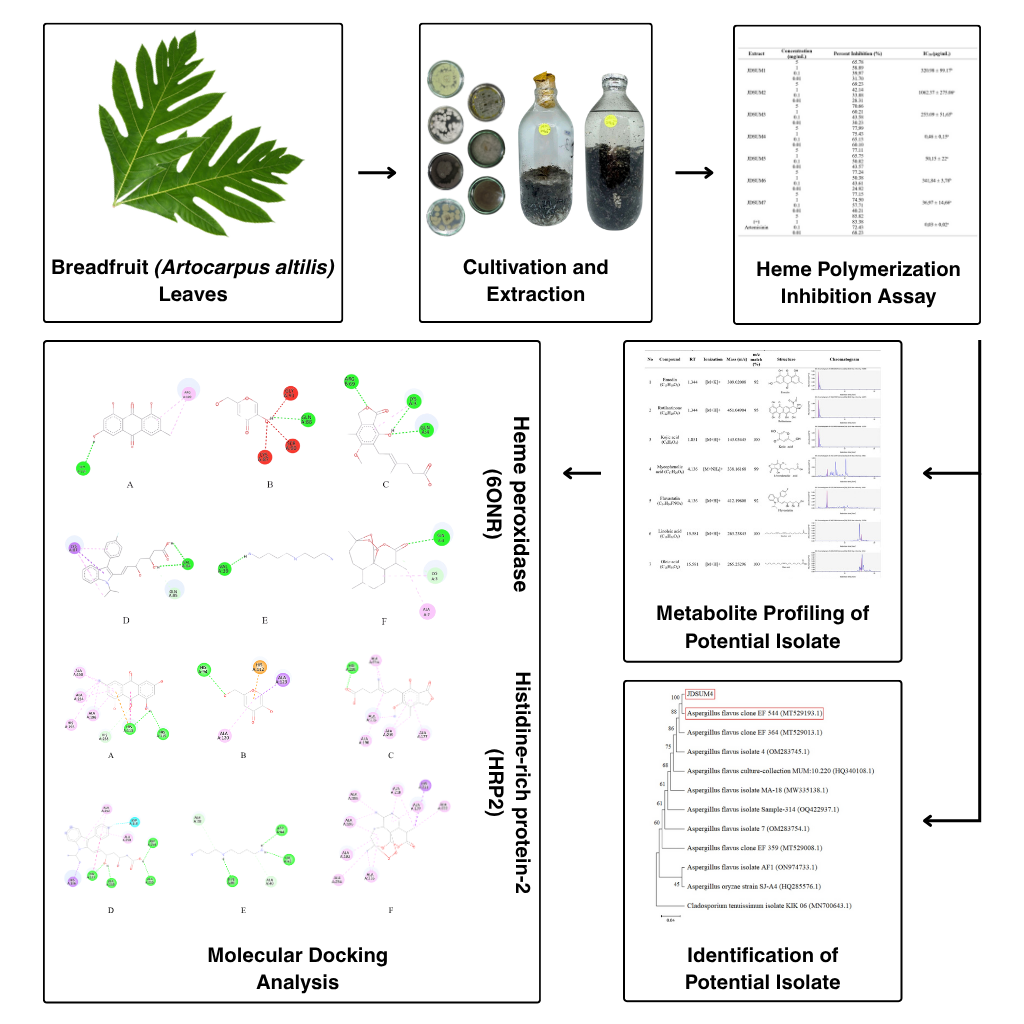
Malaria remains a major global health challenge and requiring the continuous discovery of new and effective antimalarial agent to combat drug resistance. The production of natural antimalaria drugs often requires large amount of plant biomass that raising seriuos concern about plany consevation and resource sustainability. Endophytic fungi, which biosynthesize the same metabolites as their host plant, represent an alternative source of bioactive compounds with therapeutic potential, including antimalarial activity. This study aimed to isolate and characterize endophytic fungi from breadfruit (Artocarpus altilis) leaves, evaluate their antimalarial activity, identify their major metabolites, and analyze their molecular interactions with Plasmodium falciparum heme detoxification proteins. Endophytic fungi were isolated using the surface sterilization method and cultured on PDA medium, and then on rice medium. The ethyl acetate extracts of the selected isolates were evaluated for antimalarial activity against P. falciparum using the heme polymerization inhibition assay. The most active extract derived from JDSUM4 isolate (IC50 = 0.46 ± 0.15 µg/mL), was molecularly identified as Aspergillus flavus. The extract was subsequently analyzed using LC-MS/MS, which revealed ten major secondary metabolites. These compounds were selected based on Lipinski’s Rule of Five and subsequently subjected to molecular docking against heme peroxidase and histidine-rich protein 2 (HRP-2). Docking analysis showed that all compounds possessed favorable binding affinities, ranging from −4.0 to −6.3 kcal/mol for heme peroxidase and −4.2 to −8.1 kcal/mol for HRP-2. Among them, emodin, fluvastatin, and mycophenolic acid exhibited the strong affinity toward both targets, comparable to artemisinin as a positive control. Collectively, these findings indicate that metabolites from A. altilis leaf endophytic fungi, particularly those produced by isolate JDSUM4, hold promise as novel sources of natural antimalarial compounds targeting multiple heme detoxification pathways.
HIGHLIGHTS
- Endophytic fungi from Artocarpus altilis were explored as a sustainable alternative source of antimalarial compounds.
- Seven isolates were screened, with Aspergillus flavus JDSUM4 showing the most potent activity (IC50 = 0.46 ± 0.15 µg/mL).
- LC-MS/MS profiling revealed diverse metabolites, including anthraquinones, diterpenoids, and fatty acids with potential synergistic effects.
- Molecular docking analysis identified emodin, fluvastatine, and mycophenolic acid as the secondary metabolites that show strongest interaction to heme detoxification related protein.
- This study demonstrates a eco-friendly approach for discovering antimalarial agent from fungal endophytes.
GRAPHICAL ABSTRACT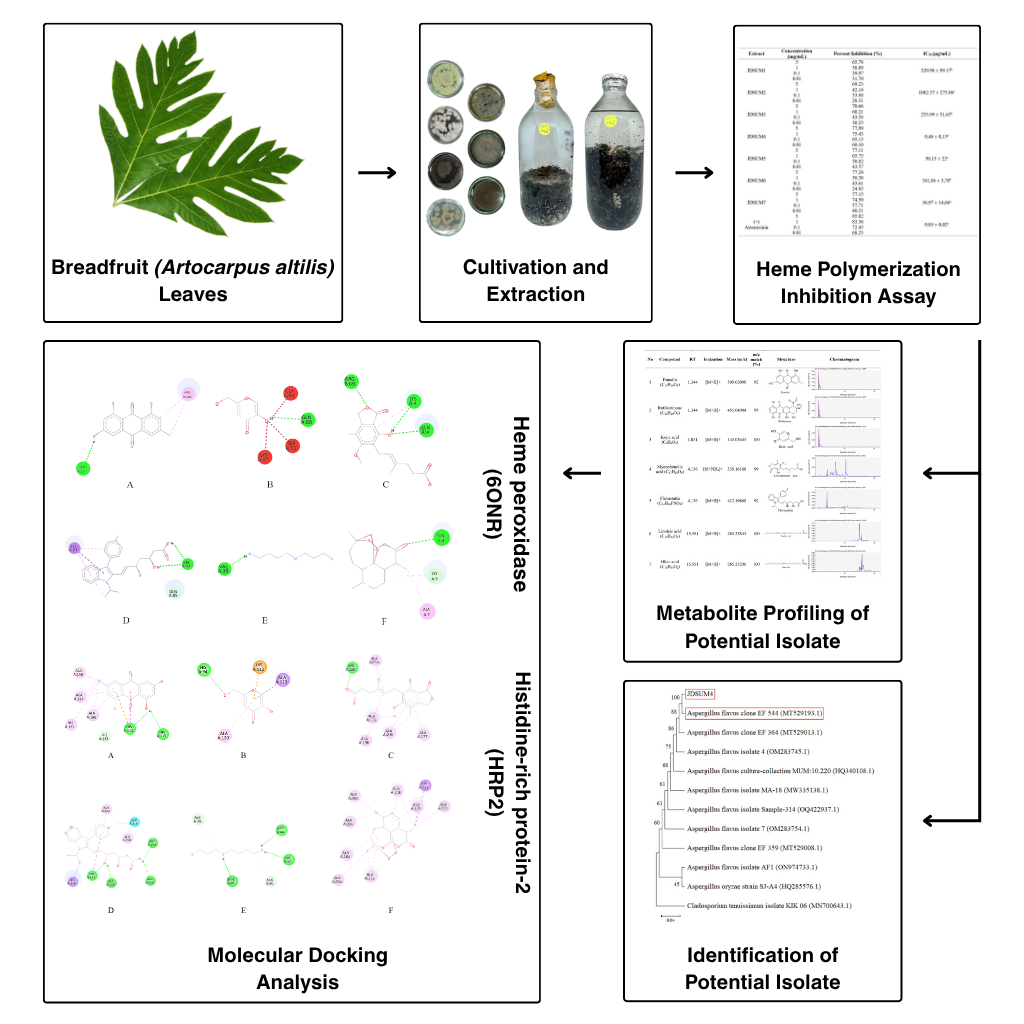
Downloads
References
J Talapko, I Škrlec, T Alebić, M Jukić and A Včev. Malaria: The past and the present. Microorganisms 2019; 7(6), 179.
P Venkatesan. WHO world malaria report 2024. Lancet Microbe 2025; 6(4), 101073.
V Baraka, A Nhama, P Aide, Q Bassat, A David, S Gesase, J Gwasupika, S Hachizovu, G Makenga, CR Ntizimira, O Obunge, KA Tshefu, M Cousin, N Otsyula, R Pathan, C Risterucci, G Su and C Manyando. Prescription patterns and compliance with World Health Organization recommendations for the management of uncomplicated and severe malaria: A prospective, real-world study in sub-Saharan Africa. Malaria Journal 2023; 22(1), 215.
M Balmith, C Basson and SJ Brand. The malaria burden: A South African perspective. Journal of Tropical Medicine 2024; 2024(1), 6619010.
A Valavanidis. Discovery OF ANTIMALARIAL DRUG ARTEMISININ by Tu Youyou an insight into the challenges of carrying research during the upheavals of the “cultural revolution” in China. Available online at: https://www.sciencedirect.com/journal/ecotoxicology-and-environmental-safety/vol/296/suppl/C, accessed November 2025.
AM Dondorp, F Nosten, P Yi, D Das, AP Phyo, J Tarning, KM Lwin, F Ariey, W Hanpithakpong, SJ Lee, P Ringwald, K Silamut, M Imwong, K Chotivanich, P Lim, T Herdman, SS An, S Yeung, P Singhasivanon, ..., NJ White. Artemisinin resistance in Plasmodium falciparum malaria. New England Journal of Medicine 2009; 361(5), 455-467.
AF Hafid, RP Septiani, LH Fabriana, N Febrianty, D Ranggaditya and A Widyawaruyanti. Antimalarial activity of crude extracts of Artocarpus heterophyllus, Artocarpus altilis and Artocarpus camansi. Asian Journal of Pharmaceutical and Clinical Research 2016; 9(1), 279-281.
AR Hidayati, A Widyawaruyanti, H Ilmi, M Tanjung, T Widiandani, Siswandono, D Syafruddin and AF Hafid. Antimalarial activity of flavonoid compound isolated from leaves of Artocarpus altilis. Pharmacognosy Journal 2020; 12(4), 835-842.
LK Basco and J Le Bras. In vitro activity of artemisinin derivatives against African isolates and clones of Plasmodium falciparum. American Journal of Tropical Medicine and Hygiene 1993; 49(3), 301-307.
H Ginsburg and E Deharo. A call for using natural compounds in the development of new antimalarial treatments–an introduction. Malaria Journal 2011; 10(S1), S1.
P Habibi, Y Shi, MF Grossi-de-Sa and I Khan. Plants as sources of natural and recombinant antimalaria agents. Molecular Biotechnology 2022; 64(11), 1177-1197.
AA Mengistu. Endophytes: Colonization, behaviour, and their role in defense mechanism. International Journal of Microbiology 2020; 2020(1), 6927219.
AS Abdel-Razek, ME El-Naggar, A Allam, OM Morsy and SI Othman. Microbial natural products in drug discovery. Processes 2020; 8(4), 470.
P Tiwari and H Bae. Endophytic fungi: Key insights, emerging prospects, and challenges in natural product drug discovery. Microorganisms 2022; 10(2), 360.
A Stierle, G Strobel and D Stierle. Taxol and taxane production by Taxomyces andreanae, an endophytic fungus of Pacific yew. Science 1993; 260(5105), 214-216.
AS El-Sayed, SA Khalaf, HA Azez, HA Hussein, SH EL-Moslamy, B Sitohy and AF El-Baz. Production, bioprocess optimization and anticancer activity of Camptothecin from Aspergillus terreus and Aspergillus flavus, endophytes of Ficus elastica. Process Biochemistry 2021; 107, 59-73.
R Ayunin, TG Giantana, A Nurramadhani, RA Chairunnisa, MA Artasasta and IC Nisa. Antibiotic-promising Aspergillus endophytic fungi. Malaysian Journal of Microbiology 2024; 20(4), 511-519.
MH Sharaf, AM Abdelaziz, MH Kalaba, AA Radwan and AH Hashem. Antimicrobial, antioxidant, cytotoxic activities and phytochemical analysis of fungal endophytes isolated from Ocimum basilicum. Applied Biochemistry and Biotechnology 2022; 194(3), 1271-1289.
G Strobel, E Ford, J Worapong, JK Harper, AM Arif, DM Grant, PCW Fung and RM Wah Chau. Isopestacin, an isobenzofuranone from Pestalotiopsis microspora, possessing antifungal and antioxidant activities. Phytochemistry 2002; 60(2), 179-183.
MC Ferreira, CL Cantrell, DE Wedge, VN Gonçalves, MR Jacob, S Khan, CA Rosa and LH Rosa. Antimycobacterial and antimalarial activities of endophytic fungi associated with the ancient and narrowly endemic neotropical plant Vellozia gigantea from Brazil. Memórias do Instituto Oswaldo Cruz 2017; 112(10), 692-697.
JET Ateba, RMK Toghueo, AF Awantu, BM Mba’ning, S Gohlke, D Sahal, E Rodrigues-Filho, E Tsamo, FF Boyom and BN Lenta. Antiplasmodial properties and cytotoxicity of endophytic fungi from Symphonia globulifera (Clusiaceae). Journal of Fungi 2018; 4(2), 70.
Y Hapsari, GA Mahayoga, W Kusharyoto and P Simanjuntak. Aktivitas antimalaria berbasis penghambatan β-hematin dalam ekstrak air daun jung rahab (Baeckea frutescens L) (in Indonesian). Chimica et Natura Acta 2019; 7(1), 46-50.
E Septiana, D Gianny and P Simanjuntak. Toksisitas dan aktivitas antimalaria melalui penghambatan polimerisasi hem secara in vitro ekstrak daun sambiloto (Andrographis paniculata) (in Indonesian). Media Penelitian dan Pengembangan Kesehatan 2017; 27(4), 255-262.
P Gupta, S Mehrotra, A Sharma, M Chugh, R Pandey, A Kaushik, S Khurana, N Srivastava, T Srivastava, A Deshmukh, A Panda, P Aggarwal, NS Bhavesh, RK Bhatnagar, A Mohmmed, D Gupta and P Malhotra. Exploring heme and hemoglobin binding regions of plasmodium heme detoxification protein for new antimalarial discovery. Journal of Medicinal Chemistry 2017; 60(20), 8298-8308.
KA de Villiers and TJ Egan. Heme detoxification in the malaria parasite: A target for antimalarial drug development. Accounts of Chemical Research 2021; 54(11), 2649-2659.
DJ Sullivan, IY Gluzman and DE Goldberg. Plasmodium Hemozoin Formation Mediated by Histidine-Rich Proteins. Science 1996; 271(5246), 219-222.
A Lynn, S Chandra, P Malhotra and VS Chauhan. Heme binding and polymerization by Plasmodium falciparum histidine rich protein II: Influence of pH on activity and conformation. FEBS Letters 1999; 459(2), 267-271.
JH Lee, HR Kim, JH Lee, SK Lee, Y Chun, SO Han, HY Yoo, C Park and SW Kim. Enhanced In-vitro hemozoin polymerization by optimized process using histidine-rich protein II (HRP II). Polymers 2019; 11(7), 1162.
S Suryelita, R Riga, SB Etika, MH Ikhsan, F Febria, M Yolanda, M Ulfah and MA Artasasta. Phytochemical screening and biological activities of fungal Phyllosticta capitalensis derived from Andrographis paniculata. Moroccan Journal of Chemistry 2023; 11(2), 553-565.
D Handayani and MA Artasasta. Antibacterial and cytotoxic activities screening of symbiotic fungi extract isolated from marine sponge Neopetrosia chaliniformis AR-01. Journal of Applied Pharmaceutical Science 2017; 7(5), 66-69.
JBA dos Reis, AS Lorenzi and HMM do Vale. Methods used for the study of endophytic fungi: A review on methodologies and challenges, and associated tips. Archives of Microbiology 2022; 204(11), 675.
N Kurniasari, NA Hidayati and T Wahyuni. Identifikasi cendawan yang berpotensi menyebabkan penyakit busuk kuning pada batang tanaman buah naga (in Indonesian). EKOTONIA: Jurnal Penelitian Biologi, Botani, Zoologi dan Mikrobiologi 2019; 4(1), 1-6.
IR Hasibuan, NS Antara and IMM Wijaya. Isolasi dan karakterisasi jamur pelapuk putih pendegradasi lignin dari limbah cair pulp dan kayu lapuk eukaliptus (Eucalyptus sp) (in Indonesian). Jurnal Rekayasa dan Manajemen Agroindustri 2021; 9(1), 119.
MA Artasasta, A Djamaan, Y Yanwirasti and M Taher. The cytotoxic activity of marine sponge-derived fungus Aspergillus nomius NC06 against HT29 colon cancer cells. Journal of Tropical Life Science 2024; 14(1), 39-44.
J Kjer, A Debbab, AH Aly and P Proksch. Methods for isolation of marine-derived endophytic fungi and their bioactive secondary products. Nature Protocols 2010; 5(3), 479-490.
MA Artasasta, Y Yanwirasti, M Taher, A Djamaan, NP Ariantari, RA Edrada-Ebel and D Handayani. Apoptotic activity of new oxisterigmatocystin derivatives from the marine-derived fungus Aspergillus nomius NC06. Marine Drugs 2021; 19(11), 631.
MA Artasasta, Yanwirasti, A Djamaan and D Handayani. Cytotoxic activity screening of ethyl acetate fungal extracts derived from the marine sponge Neopetrosia chaliniformis AR-01. Journal of Applied Pharmaceutical Science 2017; 7(12), 174-178.
E Septiana, B Bustanussalam, F Rachman, Y Hapsari and P Simanjuntak. Potensi ekstrak kapang endofit asal rimpang kunyit sebagai antimalaria dan antioksidan. Jurnal Kefarmasian Indonesia 2017; 7(1), 1-9.
TS Julianto, RA Tama and A Setyawati. Synthesis of aryl amino alcohol derivate from turpentine oil as a potential antimalarial drug. AIP Conference Proceedings 2021; 2370(1), 070002.
C Maicheen and J Ungwitayatorn. Antimalarial and $beta$-hematin formation inhibitory activities of chromone derivatives. ScienceAsia 2019; 45(3), 221-228.
Arnida, ZA Siti Humairah, Sutomo and Fadlillahturrahmah. Heme polymerization inhibitory activity and phytochemical screening of ethyl acetate fraction in manuran (Coptosapelta tomentosa Valeton ex K. Heyne) stem. Jurnal Jamu Indonesia 2021; 6(1), 1-7.
MC Gessler, MHH Nkunya, LB Mwasumbi, M Heinrich and M Tanner. Screening Tanzanian medicinal plants for antimalarial activity. Acta Tropica 1994; 56(1), 65-77.
C Ramalhete, D Lopes, S Mulhovo, EV Rosario and FUM Jose. Antimalarial activity of some plants traditionally used in mozambique. Workshop Plantas Medicinais e Fitoterapêuticas nos Trópicos 2008; 29(30), e31.
S Suryelita, R Riga, SB Etika, M Ulfah and MA Artasasta. Antibacterial screening of endophytic fungus Xylaria sp. derived from Andrographis paniculata (sambiloto). Open Access Macedonian Journal of Medical Sciences 2021; 9(A), 971-975.
D Handayani, RI Muslim, N Syafni, MA Artasasta and R Riga. Endophytic fungi from medicinal plant Garcinia cowa Roxb. ex Choisy and their antibacterial activity. Journal of Applied Pharmaceutical Science 2024; 14(9), 182-188.
W Yu, H Jin, A Shen, L Deng, J Shi, X Xue, Y Guo, Y Liu and X Liang. Purification of high-purity glycyrrhizin from licorice using hydrophilic interaction solid phase extraction coupled with preparative reversed-phase liquid chromatography. Journal of Chromatography B 2017; 1040, 47-52.
ID Bafarawa, MSA Ghani, MN Azmi, AP Ramadani, DN Salsabila, AT Nugraha, S Werdyani, MBH Othman, MN Ibrahim, K Awang, M Litaudon and MTC Omar. Isolation, characterization, molecular docking, and antimalarial activity of chemical constituents of Diospyros adenophora. Malaysian Journal of Chemistry 2024; 26(1), 120-133.
O Trott and AJ Olson. AutoDock Vina: Improving the speed and accuracy of docking with a new scoring function, efficient optimization, and multithreading. Journal of Computational Chemistry 2010; 31(2), 455-461.
Y Yang, W Luo, W Zhang, MAU Mridha, SN Wijesinghe, EHC McKenzie and Y Wang. Cladosporium species associated with fruit trees in Guizhou Province, China. Journal of Fungi 2023; 9(2), 250.
TTT Nguyen, M Pangging, NK Bangash and HB Lee. Five new records of the family Aspergillaceae in Korea, Aspergillus europaeus, A. pragensis, A. tennesseensis, Penicillium fluviserpens, and P. scabrosum. Mycobiology 2020; 48(2), 81-94.
DE Bustamante, M Oliva, S Leiva, JE Mendoza, L Bobadilla, G Angulo and MS Calderon. Phylogeny and species delimitations in the entomopathogenic genus Beauveria (Hypocreales, Ascomycota), including the description of B. peruviensis sp. nov. MycoKeys 2019; 58, 47-68.
S Suresh, D Arumugam, G Zacharias, S Palaninathan, R Vishwanathan and V Venkatraman. Prevalence and clinical profile of fungal rhinosinusitis. Allergy & Rhinology 2016; 7(2), 77-81.
C Luo, F Chen, R Phookamsak, F Sun, J Xu and H Jiang. Polyphasic taxonomic study of Absidia menglianensis sp. nov. (Cunninghamellaceae, Mucorales) isolated from an avocado plantation in Yunnan, China. Studies in Fungi 2024; 9(1), e018.
EN Setiawan, N Mita and A Ibrahim. Karakterisasi dan identifikasi metabolit sekunder isolat jamur endofit daun sukun (Artocarpus altilis). Proceeding of Mulawarman Pharmaceuticals Conferences 2015; 2, 82-88.
SF Novita. 2022, Isolasi dan seleksi jamur endofit daun tanaman sukun (artocarpus altilis) yang berpotensi sebagai antibakteri terhadap bakteri staphylococcus aureus dan Escherichia coli. Ph. D. Dissertation. Universitas Islam Negeri Maulana Malik Ibrahim, Malang, Indonesia.
J Chen, KS Akutse, HSA Saqib, X Wu, F Yang, X Xia, L Wang, MS Goettel, M You and GM Gurr. Fungal endophyte communities of crucifer crops are seasonally dynamic and structured by plant identity, plant tissue and environmental factors. Frontiers in Microbiology 2020; 11, 1519.
ZW Lü, HY Liu, CL Wang, X Chen, YX Huang, MM Zhang, QL Huang and GF Zhang. Isolation of endophytic fungi from Cotoneaster multiflorus and screening of drought-tolerant fungi and evaluation of their growth-promoting effects. Frontiers in Microbiology 2023; 14, 1267404.
L Nan, K Wang, B Pang, Y Zhong, X Zhang, Y Li, F Tao, R Yang and Y Liu. Isolation and identification of endophytes from carrots. AIP Conference Proceedings 2019; 2079, 020018.
N Eevers, M Gielen, A Sánchez-López, S Jaspers, JC White, J Vangronsveld and N Weyens. Optimization of isolation and cultivation of bacterial endophytes through addition of plant extract to nutrient media. Microbial Biotechnology 2015; 8(4), 707-715.
B Alam, J Lǐ, Q Gě, MA Khan, J Gōng, S Mehmood, Y Yuán and W Gǒng. Endophytic fungi: from symbiosis to secondary metabolite communications or vice versa? Frontiers in Plant Science 2021; 12, 791033.
S Gouda, G Das, SK Sen, HS Shin and JK Patra. Endophytes: a treasure house of bioactive compounds of medicinal importance. Frontiers in Microbiology 2016; 7, 1538.
C Dong, L Wang, Q Li and Q Shang. Epiphytic and endophytic fungal communities of tomato plants. Horticultural Plant Journal 2021; 7(1), 38-48.
S Kumar, M Guha, V Choubey, P Maity and U Bandyopadhyay. Antimalarial drugs inhibiting hemozoin (β-hematin) formation: A mechanistic update. Life Sciences 2007; 80(9), 813-828.
M Krugliak, J Zhang and H Ginsburg. Intraerythrocytic Plasmodium falciparum utilizes only a fraction of the amino acids derived from the digestion of host cell cytosol for the biosynthesis of its proteins. Molecular and Biochemical Parasitology 2002; 119(2), 249-256.
M Chugh, V Sundararaman, S Kumar, VS Reddy, WA Siddiqui, KD Stuart and P Malhotra. Protein complex directs hemoglobin-to-hemozoin formation in Plasmodium falciparum. Proceedings of the National Academy of Sciences of the United States of America 2013; 110(14), 5392-5397.
T Herraiz, H Guillén, D González-Peña and VJ Arán. Antimalarial quinoline drugs inhibit β-hematin and increase free hemin catalyzing peroxidative reactions and inhibition of cysteine proteases. Scientific Reports 2019; 9(1), 15398.
E Hempelmann, C Motta, R Hughes, SA Ward and PG Bray. Plasmodium falciparum: Sacrificing membrane to grow crystals? Trends in Parasitology 2003; 19(1), 23-26.
DJ Sullivan, IY Gluzman, DG Russell and DE Goldberg. On the molecular mechanism of chloroquine’s antimalarial action. Proceedings of the National Academy of Sciences of the United States of America 1996; 93(21), 11865-11870.
N Fathallah, WM Elkady, SA Zahran, KM Darwish, SS Elhady and YA Elkhawas. Unveiling the multifaceted capabilities of endophytic Aspergillus flavus isolated from Annona squamosa fruit peels against Staphylococcus isolates and HCoV 229E - in vitro and in silico investigations. Pharmaceuticals 2024; 17(5), 656.
HA EL-khawaga, AE Mustafa, MA El khawaga, AY Mahfouz and GE Daigham. Bio-stimulating effect of endophytic Aspergillus flavus AUMC 16068 and its respective ex-polysaccharides in lead stress tolerance of Triticum aestivum plant. Scientific Reports 2024; 14(1), 11952.
F Abdel-Motaal, N Kamel, S El-Zayat and M Abou-Ellail. Early blight suppression and plant growth promotion potential of the endophyte Aspergillus flavus in tomato plant. Annals of Agricultural Sciences 2020; 65(2), 117-123.
Ismail, M Hamayun, A Hussain, S Afzal Khan, A Iqbal and IJ Lee. Aspergillus flavus promoted the growth of soybean and sunflower seedlings at elevated temperature. BioMed Research International 2019; 2019(1), 1295457.
RA Maia, M Barbosa, AC Franco, Y Oki, MCC Romano, AI Siqueira-Silva, EG Pereira, LH Rosa, HM Duarte, J Aguirre-Gutiérrez and GW Fernandes. The role of Aspergillus flavus in modulating the physiological adjustments of sunflower to elevated CO2 and temperature. Environmental and Experimental Botany 2024; 228, 105992.
MA Artasasta, DM Faradilla, H Rasyid, D Listyorini, WE Putra, D Handayani, R Riga, PC Kuo, H Li and PH Chang. Antimalarial activity screening from endophytic fungus of red ginger (Zingiber officinale): in vitro and in silico studies. Sains Malaysiana 2025; 54(6), 1523-1534.
RM Kouipou Toghueo, EAM Kemgne, D Sahal, M Yadav, DU Kenou Kagho, B Yang, BJ Baker and FF Boyom. Specialized antiplasmodial secondary metabolites from Aspergillus niger 58, an endophytic fungus from Terminalia catappa. Journal of Ethnopharmacology 2021; 269, 113672.
DMA Khalil, SA El-Zayat and MA El-Sayed. Phytochemical screening and antioxidant potential of endophytic fungi isolated from Hibiscus sabdariffa. Journal of Applied Biotechnology Reports 2020; 7(2), 116-124.
Elfita, M Muharni, M Munawar, S Salni and A Oktasari. Senyawa antimalaria dari jamur endofitik tumbuhan sambiloto (Andographis paniculata Nees) (in Indonesian). Jurnal Natur Indonesia 2010; 13(2), 123-129.
S Siddiquee. Recent advancements on the role of biologically active secondary metabolites from Aspergillus. In: VK Gupta and S Rodriguez-Couto (Eds.). New and future developments in microbial biotechnology and bioengineering Penicillum system properties and applications. Elsevier, Amsterdam, Netherlands, 2018, p. 69-94.
B Mouhamadou, L Sage, S Périgon, V Séguin, V Bouchart, P Legendre, M Caillat, H Yamouni and D Garon. Molecular screening of xerophilic Aspergillus strains producing mycophenolic acid. Fungal Biology 2017; 121(2), 103-111.
CP Osman and NH Ismail. Antiplasmodial anthraquinones from medicinal plants: The chemistry and possible mode of actions. Natural Product Communications 2018; 13(12), 1591-1597.
L Veletzky, K Rehman, T Lingscheid, W Poeppl, F Loetsch, H Burgmann and M Ramharter. In vitro activity of immunosuppressive drugs against Plasmodium falciparum. Malaria Journal 2014; 13(1), 476.
B Pradines, M Torrentino-Madamet, A Fontaine, M Henry, E Baret, J Mosnier, S Briolant, T Fusai and C Rogier. Atorvastatin is 10-fold more active in vitro than other statins against Plasmodium falciparum. Antimicrobial Agents and Chemotherapy 2007; 51(7), 2654-2655.
MS de Sá, JFO Costa, AU Krettli, MG Zalis, GL de A Maia, IMF Sette, C de A Câmara, JMB Filho, AM Giulietti-Harley, R Ribeiro Dos Santos, et al. Antimalarial activity of betulinic acid and derivatives in vitro against Plasmodium falciparum and in vivo in P. berghei-infected mice. Parasitology Research 2009; 105(1), 275-279.
P Melariri, W Campbell, P Etusim and P Smith. Antiplasmodial properties and bioassay-guided fractionation of ethyl acetate extracts from Carica papaya leaves. Journal of Parasitology Research 2011; 2011, 104954.
SS Sawant, SY Gabhe and KK Singh. In vitro effect on Plasmodium falciparum and in vivo effect on Plasmodium berghei of annomaal, an oily fraction obtained from the seeds of Annona squamosa. Molecules 2023; 28(14), 5472.
D Palla, AI Antoniou, M Baltas, C Menendez, P Grellier, E Mouray and CM Athanassopoulos. Synthesis and antiplasmodial activity of novel fosmidomycin derivatives and conjugates with artemisinin and aminochloroquinoline. Molecules 2020; 25(20), 4858.
V Kumar, V Garg and H Dureja. Role of traditional herbal medicine in treatment of malaria. TMR Modern Herbal Medicine 2022; 5(4), 20.
D Shahinas. 2012, Targeting plasmodium falciparum heat shock protein 90 (Pfhsp90): A strategy to reverse antimalarial resistance. Ph. D. Dissertation. University of Toronto, Toronto, Canada.
AG Rodrigues. Secondary metabolism and antimicrobial metabolites of aspergillus. In: VK Gupta (Ed.). New and Future developments in microbial biotechnology and bioengineering aspergillus system properties and applications. Elsevier, Amsterdam, Netherland, 2016. p. 81-93.
WA Andayi, TJ Egan and K Chibale. Kojic acid derived hydroxypyridinone-chloroquine hybrids: Synthesis, crystal structure, antiplasmodial activity and β-haematin inhibition. Bioorganic & Medicinal Chemistry Letters 2014; 24(15), 3263-3267.
CA Lipinski, F Lombardo, BW Dominy and PJ Feeney. Experimental and computational approaches to estimate solubility and permeability in drug discovery and development settings. Advanced Drug Delivery Reviews 2001; 46(1-3), 3-26.
AA Wani. Comprehensive analysis of clustering algorithms: exploring limitations and innovative solutions. PeerJ Computer Science 2024; 10, e2286.
R Sharma, AS Lawrenson, NE Fisher, AJ Warman, AE Shone, A Hill, A Mbekeani, C Pidathala, RK Amewu, S Leung, P Gibbons, DW Hong, P Stocks, GL Nixon, J Chadwick, J Shearer, I Gowers, D Cronk, SP Parel, . . . NG Berry. Identification of novel antimalarial chemotypes via chemoinformatic compound selection methods for a high-throughput screening program against the novel malarial target, PfNDH2: Increasing hit rate via virtual screening methods. Journal of Medicinal Chemistry 2012; 55(7), 3144-3154.
D Lagorce, D Douguet, MA Miteva and BO Villoutreix. Computational analysis of calculated physicochemical and ADMET properties of protein-protein interaction inhibitors. Scientific Reports 2017; 7(1), 46277.
AM Silva, C Martins-Gomes, TL Silva, TE Coutinho, EB Souto and T Andreani. In vitro assessment of pesticides toxicity and data correlation with pesticides physicochemical properties for prediction of toxicity in gastrointestinal and skin contact exposure. Toxics 2022; 10(7), 378.
YS Kiani and I Jabeen. Lipophilic metabolic efficiency (LipMetE) and drug efficiency indices to explore the metabolic properties of the substrates of selected cytochrome P450 Isoforms. ACS Omega 2020; 5(1), 179-188.
D Ramírez and J Caballero. Is it reliable to take the molecular docking top scoring position as the best solution without considering available structural data? Molecules 2018; 23(5), 1038.
L Sanik, W Fadil Amrulloh, N Harmastuti, A Prasetiyo and R Herowati. Analysis of molecular docking and dynamics simulation of Mahogany (Swietenia macrophylla King) compounds against the PLpro enzyme SARS-CoV-2. Jurnal Farmasi dan Ilmu Kefarmasian Indonesia 2023; 10(3), 347-359.
H Memariani, M Memariani and A Ghasemian. Quercetin as a promising antiprotozoan phytochemical: Current knowledge and future research avenues. BioMed Research International 2024; 2024, 7632408.
A Hernández-Santoyo, AY Tenorio-Barajas, V Altuzar, H Vivanco-Cid and C Mendoza-Barrera. Protein-protein and protein-ligand docking. In: T Ogawa (Ed.). Protein engineering - technology and application. InTech, Rileka, Croatia, 2013.
A Madushanka, RT Moura, N Verma and E Kraka. Quantum mechanical assessment of protein–ligand hydrogen bond strength patterns: Insights from semiempirical tight-binding and local vibrational mode theory. International Journal of Molecular Sciences 2023; 24(7), 6311.
C Chakraborty, A Lu, Z Ge and H Zhu. Mechanism of artemisinin resistance for malaria PfATP6 L263 mutations and discovering potential antimalarials: An integrated computational approach. Scientific Reports 2016; 6(1), 30106.
D Chen, N Oezguen, P Urvil, C Ferguson, SM Dann and TC Savidge. Regulation of protein-ligand binding affinity by hydrogen bond pairing. Science Advances 2022; 2(3), e1501240.
Published
How to Cite
Issue
Section
License
Copyright (c) 2026 Walailak University

This work is licensed under a Creative Commons Attribution-NonCommercial-NoDerivatives 4.0 International License.





