
In vitro Antibiofilm and Anti-Quorum Sensing Effects of Bromelain against Dual-Species Biofilms of Streptococcus mutans and Fusobacterium nucleatum
DOI:
https://doi.org/10.48048/tis.2026.12398Keywords:
Periodontitis, Oral pathogens, Streptococcus mutans, Fusobacterium nucleatum, Chromobacterium violaceum, Dual-species, Biofilm, Quorum sensing, Pineapple, Bromelain, Periodontitis, Oral pathogens, Streptococcus mutans, Fusobacterium nucleatum, Chromobacterium violaceum, Dual-species, Biofilm, Quorum sensing, Pineapple, BromelainAbstract
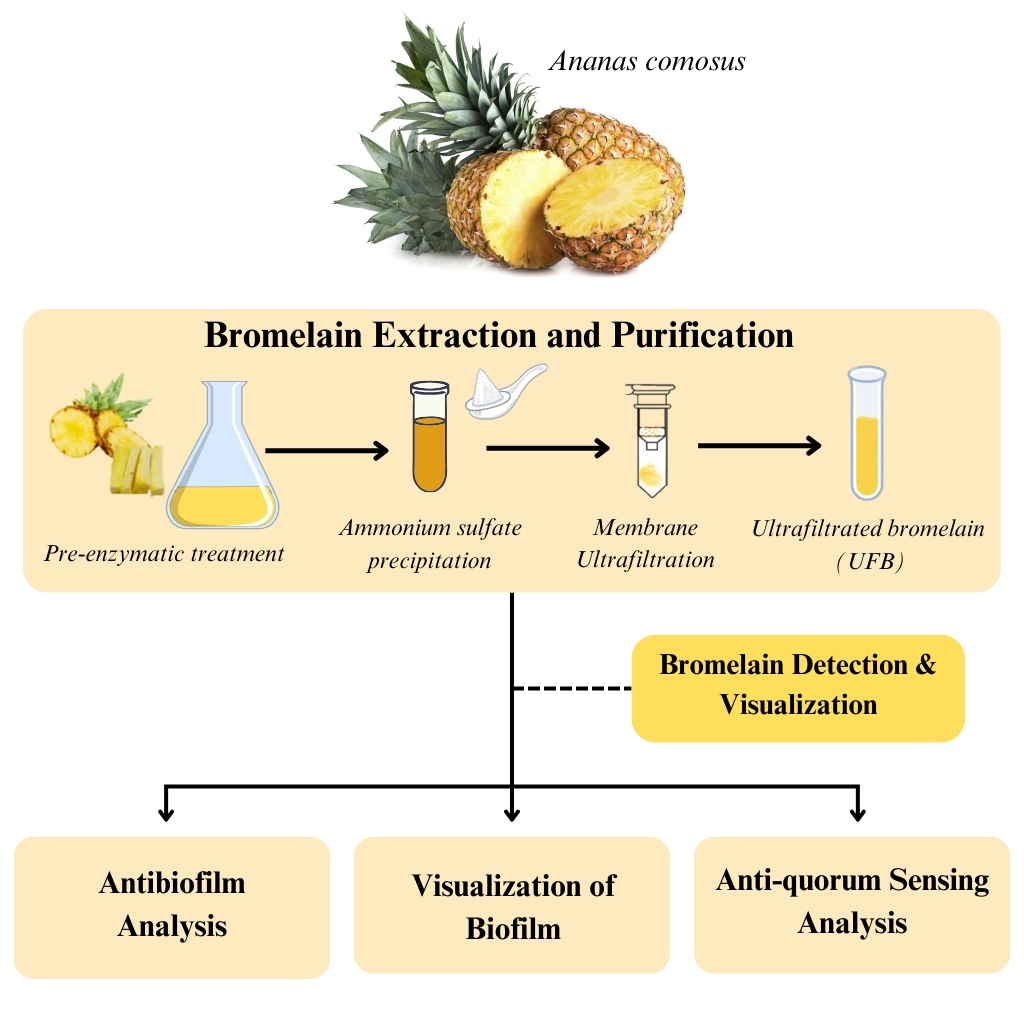
Periodontitis is a prevalent chronic oral disease strongly associated with biofilm formation and quorum sensing (QS) among pathogenic bacteria. Current therapeutic approaches rely on mechanical removal and antibiotics but resistance and side effects highlight the need for alternatives strategies. In this study, bromelain, a cysteine protease derived from pineapple (Ananas comosus) core was evaluated as a potential natural bioactive agent against biofilm-associated oral infections. Ultrafiltrated bromelain (UFB) was obtained by ammonium sulphate precipitation and ultrafiltration with SDS-PAGE confirming a bromelain protein band at 25 kDa. Antibiofilm activity was assessed using dual-species biofilms of Streptococcus mutans and Fusobacterium nucleatum. Crystal violet assays revealed concentration-dependent inhibition with biofilm biomass reduced by 23.6% at 31.25 μg/mL and up to 63.8% at 1,000 μg/mL. SEM confirmed decreased biofilm density and disrupted EPS while bacterial cell morphology remained intact suggesting matrix destabilisation rather that bactericidal effect. Furthermore, QS inhibition was evaluated using Chromobacterium violaceum as a biosensor. UFB significantly reduced violacein production in a concentration-dependent manner, with noticeable inhibition from 500 µg/mL (3.16%) and significant QS-inhibition of 43.23% at 1,000 μg/mL which indicated interference with QS-regulated bacterial communication and virulence. These findings demonstrated that bromelain not only disrupts biofilm formation but also impairs QS pathways, highlighting its dual role as antibiofilm and anti-QS in attenuating microbial pathogenicity. Together, this study supports the potential application of bromelain derived from pineapple core as a sustainable and natural adjunct for periodontitis management.
HIGHLIGHTS
- Ultrafiltrated bromelain (UFB) was successfully isolated from pineapple core waste through a combined ammonium sulfate precipitation and ultrafiltration approach.
- This study demonstrated the successful development of a dual-species oral biofilm integrating Streptococcus mutans and Fusobacterium nucleatum.
- UFB demonstrated an anti-biofilm activity of up to 63.8% and an anti-quorum sensing activity of 43.24% at the concentration of 1000 µg/mL.
- UFB exerted dual functional activity by reducing biofilm matrix stability and inhibiting violacein pigment formation.
GRAPHICAL ABSTRACT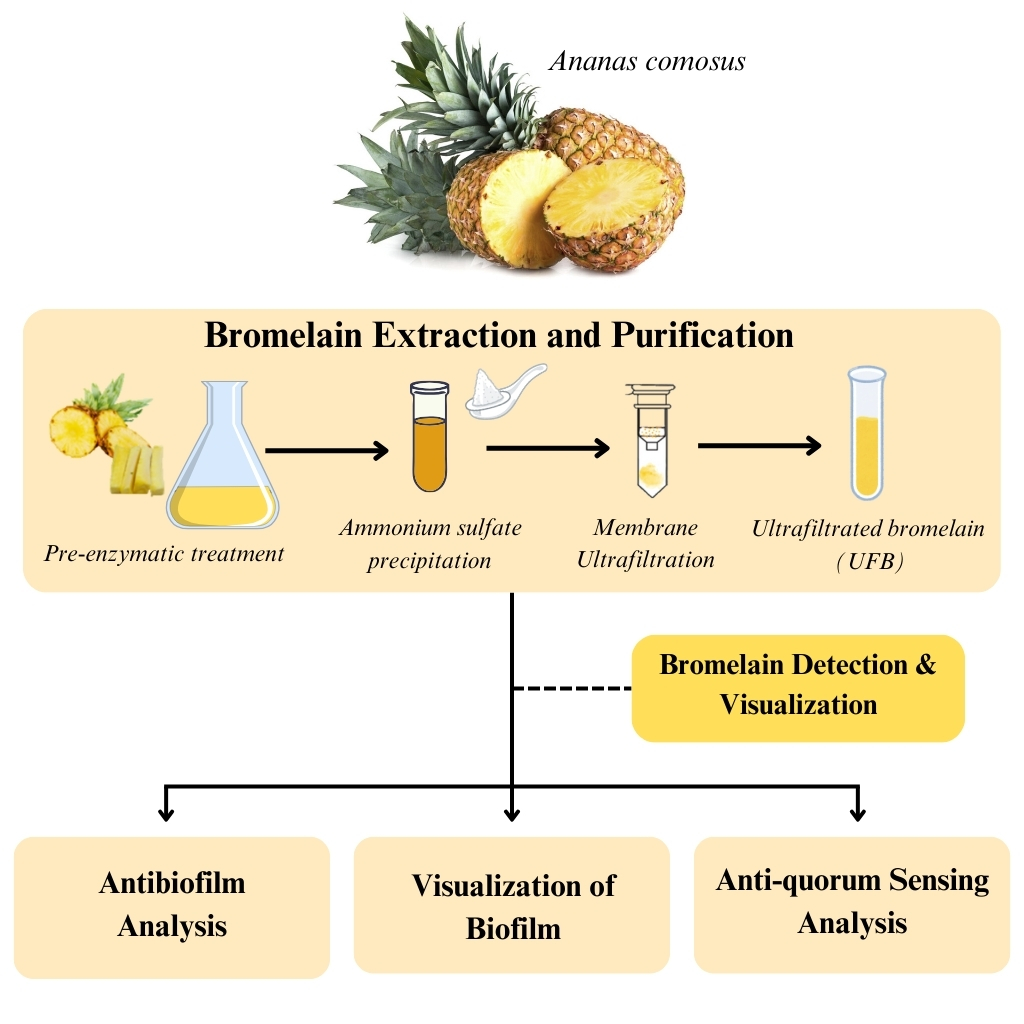
Downloads
References
AB Lagha, B Haas and D Grenier. Tea polyphenols inhibit the growth and virulence properties of Fusobacterium nucleatum. Scientific Reports 2017; 7, 44815.
YJ Jung, HK Jun and BK Choi. Porphyromonas gingivalis suppresses invasion of Fusobacterium nucleatum into gingival epithelial cells. Journal of Oral Microbiology 2017; 9(1), 1320193.
M Hung, R Kelly, A Mohajeri, L Reese, S Badawi, C Frost, T Sevathas and MS Lipsky. Factors associated with periodontitis in younger individuals: A scoping review. Journal of Clinical Medicine 2023; 12(20), 6442.
X Wen, H Li, S Li, B Chang, S Chen, H Li, C Liu and G Li. Associated factors of periodontitis and predicted study among young man in China: A population-based cross-sectional study. BMC Public Health 2024; 24(1), 1235.
GBD 2021 Oral Disorders Collaborators. Trends in the global, regional, and national burden of oral conditions from 1990 to 2021: A systematic analysis for the Global Burden of Disease Study 2021. The Lancet 2025; 405(10482), 897-910.
SM Zayed, MM Aboulwafa, AM Hashem and SE Saleh. Biofilm formation by Streptococcus mutans and its inhibition by green tea extracts. AMB Express 2021; 11(1), 73.
CJ Henley-Smith, AM Kok, FS Botha, C Baker and N Lall. The effect of a poly-herbal plant extract on the adhesion of Streptococcus mutans to tooth enamel. BMC Complementary Medicine and Therapies 2024; 24(1), 402.
M Muchova, DL Balacco, MM Grant, ILC Chapple, SA Kuehne and J Hirschfeld. Fusobacterium nucleatum subspecies differ in biofilm forming ability in vitro. Frontiers in Oral Health 2022; 3, 853618.
M Adnan, AJ Siddiqui, SA Ashraf, MS Ashraf, SO Alomrani, M Alreshidi, B Tepe, M Sachidanandan, C Danciu and M Patel. Saponin-derived silver nanoparticles from Phoenix dactylifera (Ajwa Dates) exhibit broad-spectrum bioactivities combating bacterial infections. Antibiotics 2023; 12(9), 1415.
AMT Lim, GG Oyong, MCS Tan, CC Shen, CY Ragasa and EC Cabrera. Quorum quenching activity of Andrographis paniculata (Burm f.) Nees andrographolide compounds on metallo-β-lactamase-producing clinical isolates of Pseudomonas aeruginosa PA22 and PA247 and their effect on lasR gene expression. Heliyon 2021; 7(5), 07002.
M Patel, LI Alnajjar, SO Alomrani, N Alshammari, MS Ashraf and M Adnan. Embelia ribes Burm.f. fruit extract inhibit quorum sensing-dependent production of virulence factors and biofilm formation: An integrated in vitro and in silico approach. South African Journal of Botany 2024; 165, 307-323.
K Sauer, P Stoodley, DM Goeres, L Hall-Stoodley, M Burmølle, PS Stewart and T Bjarnsholt. The biofilm life cycle: Expanding the conceptual model of biofilm formation. Nature Reviews Microbiology 2022; 20(10), 608-620.
P Tritripmongkol, S Sangkanu, R Boripun, J Jeenkeawpieam, J Chuprom, V Nissapatorn, MDL Pereira, AK Paul and W Mitsuwan. Robusta coffee extracts inhibit quorum sensing activity in Chromobacterium violaceum and reduce biofilms against Bacillus cereus and Staphylococcus aureus. Veterinary World 2022; 15(10), 2391-2398.
Samreen, FA Qais and I Ahmad. Anti-quorum sensing and biofilm inhibitory effect of some medicinal plants against gram-negative bacterial pathogens: In vitro and in silico investigations. Heliyon 2022; 8(10), 11113.
M Venkatramanan, PS Ganesh, R Senthil, J Akshay, AV Ravi, K Langeswaran, J Vadivelu, S Nagarajan, K Rajendran and EM Shankar. Inhibition of quorum sensing and biofilm formation in Chromobacterium violaceum by fruit extracts of Passiflora edulis. ACS Omega 2020; 5(40), 25605-25616.
CA Santos, FA Almeida, BXV Quecán, PAP Pereira, KMB Gandra, LR Cunha and UM Pinto. Bioactive properties of Syzygium cumini (L.) skeels pulp and seed phenolic extracts. Frontiers in Microbiology 2020; 11, 990.
M Molnár, E Fenyvesi, Z Berkl, I Németh, I Fekete-Kertész, R Márton, E Vaszita, E Varga, D Ujj and L Szente. Cyclodextrin-mediated quorum quenching in the Aliivibrio fischeri bioluminescence model system - Modulation of bacterial communication. International Journal of Pharmaceutics 2021; 594, 120150.
SJ Khalid, Q Ain, SJ Khan, A Jalil, MF Siddiqui, T Ahmad, M Badshah and F Adnan. Targeting Acyl Homoserine Lactones (AHLs) by the quorum quenching bacterial strains to control biofilm formation in Pseudomonas aeruginosa. Saudi Journal of Biological Sciences 2022; 29(3), 1673-1682.
M Podkowik, AI Perault, G Putzel, A Pountain, J Kim, A Dumont, E Zwack, RJ Ulrich, TK Karagounis, C Zhou, AF Haag, J Shenderovich, GA Wasserman, J Kwon, J Chen, AR Richardson, JN Weiser, CR Nowosad, DS Lun, D Parker, ..., B Shopsin. Quorum-sensing agr system of Staphylococcus aureus primes gene expression for protection from lethal oxidative stress. bioRxiv 2024. https://doi.org/10.1101/2023.06.08.544038
HY Liu, EL Prentice and MA Webber. Mechanisms of antimicrobial resistance in biofilms. NPJ Antimicrobials and Resistance 2024; 2(1), 27.
U Kansakar, V Trimarco, MV Manzi, E Cervi, P Mone and G Santulli. Exploring the therapeutic potential of bromelain: Applications, benefits, and mechanisms. Nutrients 2024; 16(13), 2060.
C Locci, E Chicconi and R Antonucci. Current uses of bromelain in Children: A narrative review. Children 2024; 11(3), 377.
O Insuan, P Janchai, B Thongchuai, R Chaiwongsa, S Khamchun, S Saoin, W Insuan, P Pothacharoen, W Apiwatanapiwat, A Boondaeng and P Vaithanomsat. Anti-inflammatory effect of pineapple rhizome bromelain through downregulation of the NF-κB- and MAPKs-signaling pathways in lipopolysaccharide (LPS)-stimulated RAW264.7 cells. Current Issues in Molecular Biology 2021; 43(1), 93-106.
NC Praveen, A Rajesh, M Madan, VR Chaurasia, NV Hiremath and AM Sharma. In vitro evaluation of antibacterial efficacy of pineapple extract (bromelain) on periodontal pathogens. Journal of International Oral Health 2014; 6(5), 96-98.
MP Silva, MA Calomino, LA Teixeira, RR Barros, GR de Paula and FL Teixeira. Antibiofilm activity of bromelain from pineapple against Staphylococcus aureus. Acta Scientiarum Biological Sciences 2023; 45(1), 65725.
NH Tarmizi, NS Kamarudin, AS Johari, NA Zulkepli, N Mokhtar and MK Ya’Kub. Purification of bromelain enzyme from MD2 hybrid pineapple core by ultrafiltration and its antioxidative potential. Science, Engineering and Health Studies 2023; 17, 23030004.
KY Tsai, PL Wei, M Azarkan, N MʼRabet, PT Makondi, HA Chen, CY Huang and YJ Chang. Cytotoxic properties of unfractionated and fractionated bromelain alone or in combination with chemotherapeutic agents in colorectal cancer cells. PLoS One 2023; 18(6), 0285970.
PA Hu, SH Wang, CH Chen, BC Guo, JW Huang and TS Lee. New mechanisms of bromelain in alleviating non-alcoholic fatty liver disease-induced deregulation of blood coagulation. Nutrients 2022; 14(11), 2329.
AS Johari, NH Tarmizi, Y Mk, NA Zulkepli, S Sarmoko and N Mokhtar. In vitro antibacterial and antibiofilm activities of ultrafiltrated-bromelain against dental caries pathogens. Journal of Health and Translational Medicine 2023; 2, 233-240.
A Arumugam and V Ponnusami. Pineapple fruit bromelain recovery using recyclable functionalized ordered mesoporous silica synthesized from sugarcane leaf ash. Brazilian Journal of Chemical Engineering 2013; 30(3), 477-486.
E Millhouse, A Jose, L Sherry, DF Lappin, N Patel, AM Middleton, J Pratten, S Culshaw and G Ramage. Development of an in vitro periodontal biofilm model for assessing antimicrobial and host modulatory effects of bioactive molecules. BMC Oral Health 2014; 14, 80.
AA Djais, Jemmy, N Putri, AR Putri and SA Soekanto. Description of Streptococcus mutans, Streptococcus sanguinis, and Candida albicans biofilms after exposure to propolis dentifrice by using OpenCFU method. Saudi Dental Journal 2020; 32(3), 129-134.
T Roth, E Zelinger, T Kossovsky and G Borkow. Scanning electron microscopy analysis of biofilm-encased bacteria exposed to cuprous oxide-impregnated wound dressings. Microbiology Research 2024; 15(4), 2358-2368.
RO Adeyemo, IM Famuyide, JP Dzoyem and MGL Joy. Anti-biofilm, antibacterial, and anti-quorum sensing activities of selected south african plants traditionally used to treat diarrhoea. Evidence-Based Complementary and Alternative Medicine 2022; 2022, 1307801.
Y Liu, SG Daniel, HE Kim, H Koo, J Korostoff, F Teles, K Bittinger and G Hwang. Addition of cariogenic pathogens to complex oral microflora drives significant changes in biofilm compositions and functionalities. Microbiome 2023; 11(1), 123.
DK Fitri, N Tuygunov, WHAW Harun, IA Purwasena, A Cahyanto and MN Zakaria. Key virulence genes associated with Streptococcus mutans biofilm formation: A systematic review. Frontiers in Oral Health 2025; 6, 1654428.
Y Chen, T Shi, Y Li, L Huang and D Yin. Fusobacterium nucleatum: The opportunistic pathogen of periodontal and peri-implant diseases. Frontiers Microbiology 2022; 13, 860149.
A Luo, F Wang, D Sun, X Liu and B Xin. Formation, development, and cross-species interactions in biofilms. Frontiers in Microbiology 2022; 12, 757327.
H Fu, X Li, R Zhang, J Zhu and X Wang. Global burden of periodontal diseases among the working-age population from 1990-2021: Results from the Global Burden of Disease Study 2021. BMC Public Health 2025; 25(1), 1316.
L Rudin, N Roth, J Kneubühler, BN Dubey, MM Bornstein and V Shyp. Inhibitory effect of natural flavone luteolin on Streptococcus mutans biofilm formation. Microbiology Spectrum 2023; 11(5), 0522322.
Y Ham and TJ Kim. Synergistic inhibitory activity of Glycyrrhizae Radix and Rubi Fructus extracts on biofilm formation of Streptococcus mutans. BMC Complementary Medicine and Therapies 2023; 23(1), 22.
A Fissore, M Marengo, V Santoro, G Grillo, S Oliaro-Bosso, G Cravotto, FD Piaz and S Adinolfi. Extraction and characterization of bromelain from Pineapple core: A strategy for Pineapple waste valorization. Processes 2023; 11(7), 2064.
FMC Gamarra, JCC Santana, SAV Llanos, JAH Pérez, FR Flausino, APB Quispe, PC Mendoza, RM Vanalle, C Carreño-Farfan, FT Berssaneti, RR de Souza and EB Tambourgi. High retention and purification of bromelain enzyme (Ananas comosus L. Merrill) from pineapple juice using plain and hollow polymeric membranes techniques. Polymers 2022; 14(2), 264.
IRAP Bresolin, ITL Bresolin, E Silveira, EB Tambourgi and PG Mazzola. Isolation and purification of bromelain from waste peel of Pineapple for therapeutic application. Brazilian Archives of Biology and Technology 2013; 56(6), 971-979.
MZM Nor, L Ramchandran, M Duke and T Vasiljevic. Performance of a two-stage membrane system for bromelain separation from Pineapple waste mixture as impacted by enzymatic pretreatment and diafiltration. Food Technology and Biotechnology 2018; 56(2), 218-227.
A Sathiaseelan, KP Song, HS Tan and WS Choo. Antibiofilm activity of Clitoria ternatea flowers anthocyanin fraction against biofilm-forming oral bacteria. FEMS Microbiology Letters 2025; 372, 035.
A Tada, H Nakayama-Imaohji, H Yamasaki, M Elahi, T Nagao, H Yagi, M Ishikawa, K Shibuya and T Kuwahara. Effect of thymoquinone on Fusobacterium nucleatum‑associated biofilm and inflammation. Molecular Medicine Reports 2020; 22(2), 643-650.
F Moradi, N Hadi and A Bazargani. Evaluation of quorum-sensing inhibitory effects of extracts of three traditional medicine plants with known antibacterial properties. New Microbes and New Infections 2020; 38, 100769.
PD Dimitrova, V Ivanova, A Trendafilova and T Paunova-Krasteva. Anti-biofilm and anti-quorum-sensing activity of Inula extracts: A strategy for modulating Chromobacterium violaceum virulence factors. Pharmaceuticals 2024; 17(5), 573.
Published
How to Cite
Issue
Section
License
Copyright (c) 2025 Walailak University

This work is licensed under a Creative Commons Attribution-NonCommercial-NoDerivatives 4.0 International License.





