
Natural Deep Eutectic Solvent (NADES) Extract of Curcuma Xanthorrhiza Roxb Attenuates Physical Fatigue and Increases Exercise Tolerance in Mice
DOI:
https://doi.org/10.48048/tis.2026.12246Keywords:
AMPK, ATP, AMPK, ATP, Choline chloride-sucrose, Deep eutectic solvent, Fatigue, Taurine, XanthorrhizolAbstract
Background: Fatigue, a common problem in modern society, reduces quality of life and productivity, highlighting the need for natural remedies. Curcuma xanthorrhiza Roxb., a well-known Indonesian plant medicine, is recognized for its diverse bioactivities, mainly attributed to its marker compound xanthorrhizol (XTZ). Aim: This study investigated the antifatigue activity of C. xanthorrhiza extracts extracted by an eco-friendly natural deep eutectic solvent (NADES), composed of choline chloride and sucrose (CC-Suc 3:1, 10% water). Methods: Male Balb/c mice were randomly divided into seven groups (n = 4). Each group was orally administered for 28 days vehicles (carboxymethyl cellulose and CC-Suc), the positive control (taurine 700 mg/kg/BW), C. xanthorrhiza extracted by CC-Suc or ethanol equivalent to 10 or 25 mg XTZ/kg BW. The effect of treatment on exercise performance was evaluated by forced swimming test (FST) and changes in fatigue-related parameters. Results: C. xanthorrhiza extracts prolonged FST time in a dose-dependent manner, increased muscle ATP and adenosine 5-monophosphate- (AMP-) activated protein kinase (AMPK) levels. Treatment with ethanol extracts of C. xanthorrhiza reduced serum urea nitrogen in a dose dependent trend compared with the vehicle group. No significant differences were observed in hepatic alanine aminotransferase (ALT) and aspartate aminotransferase (AST), indicating absence of liver toxicity. Conclusions: These findings demonstrate that NADES-based C. xanthorrhiza extract improves exercise endurance, possibly through modulation of energy metabolism. Moreover, the choline chloride–sucrose NADES serves as a safe and sustainable extraction solvent and delivery medium, supporting potential use of C. xanthorrhiza as a functional food ingredient against fatigue.
HIGHLIGHTS
- This study presented a pre-clinical study of the antifatigue effect of Curcuma xanthorrhiza extracted using natural deep eutectic solvent (NADES).
- NADES composed of choline chloride and sucrose was used to extract xanthorrhizol (XTZ), a key marker of xanthorrhiza.
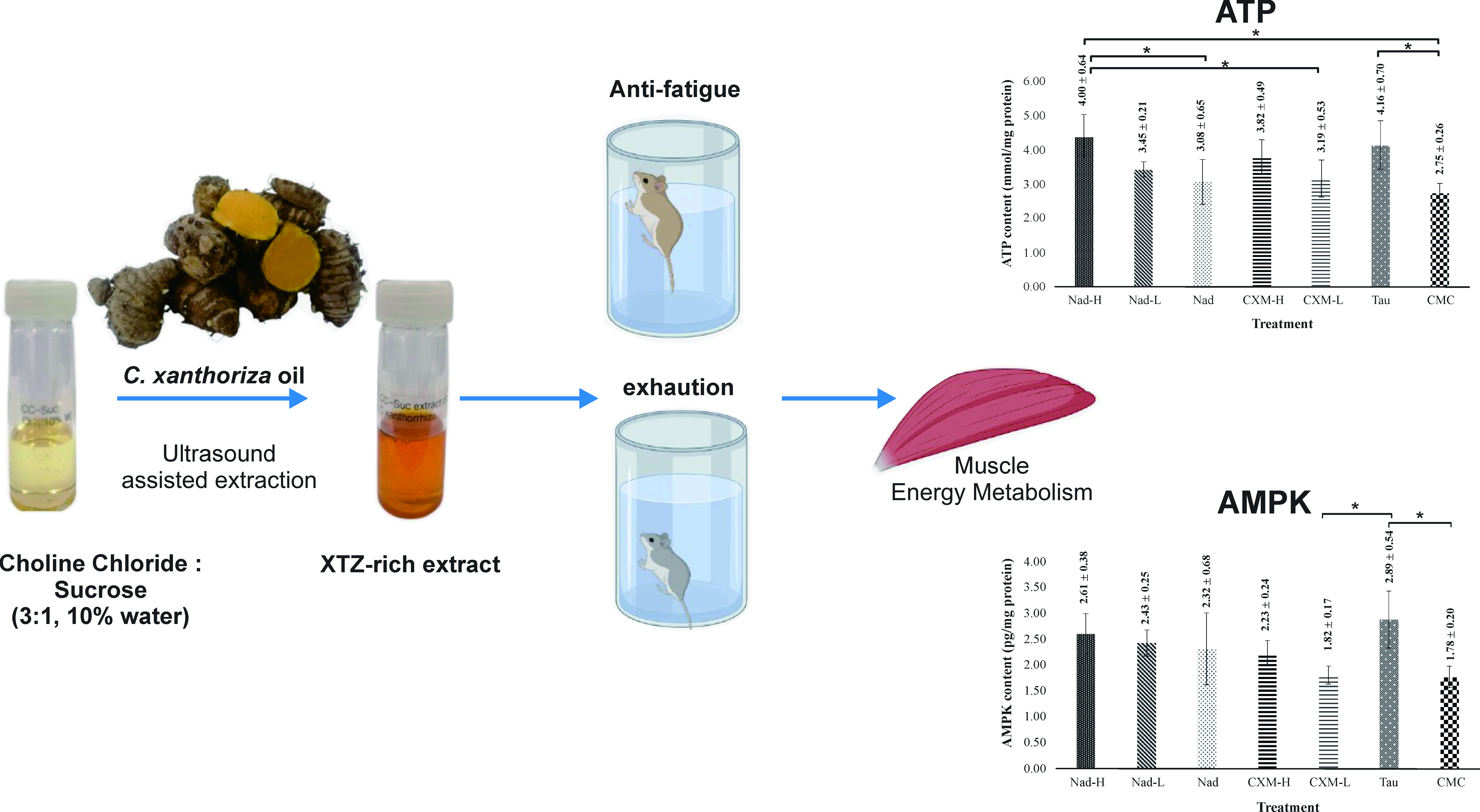
- Treatment of Balb/c mice with XTZ-rich extract improved swimming performance, increased muscle ATP and AMPK levels when compared to taurine.
- Findings suggest NADES-based extract of xanthorrhiza is a potential antifatigue agent to prolong endurance, highlighting dual roles of NADES as extraction media and formulation system.
GRAPHICAL ABSTRACT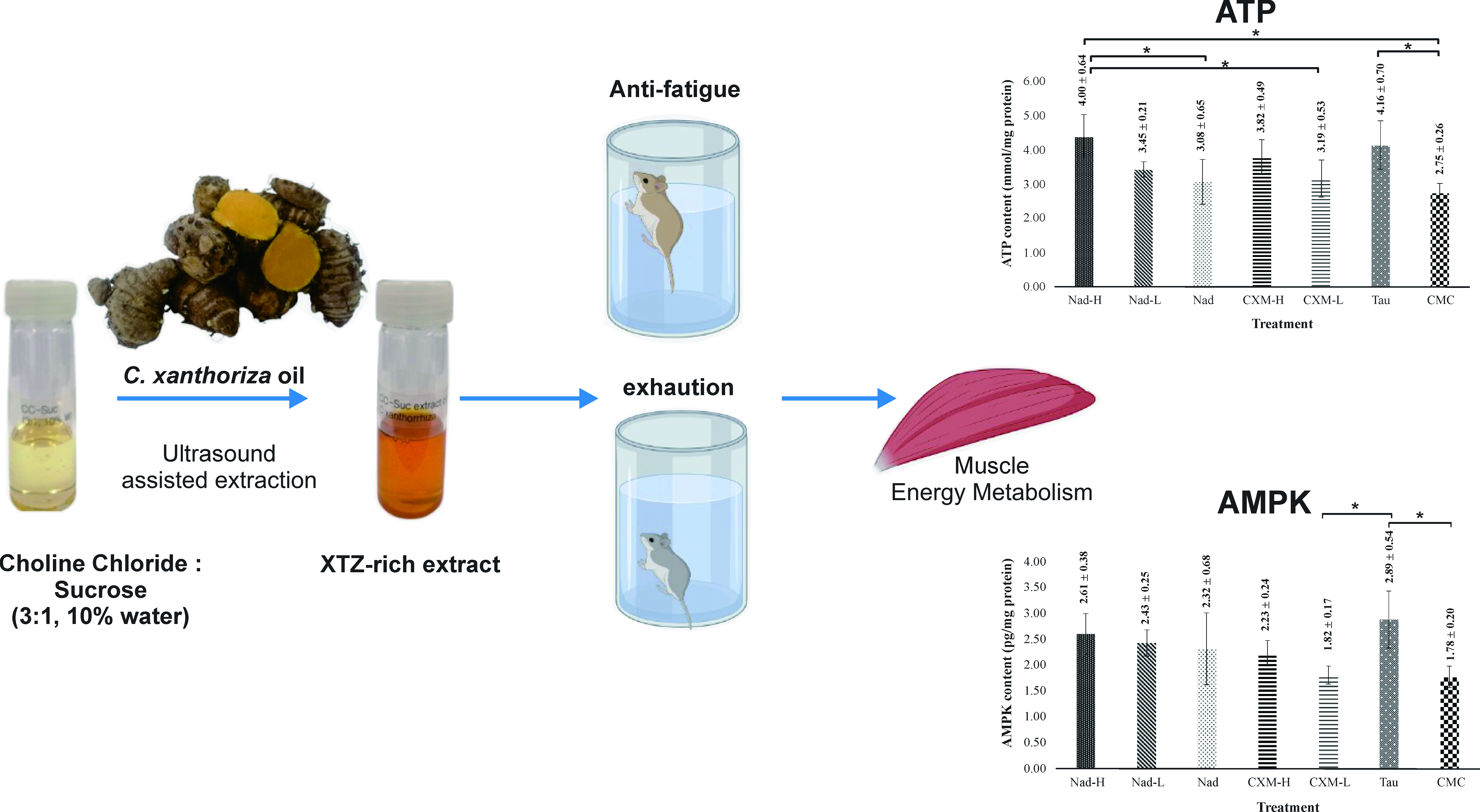
Downloads
References
JH Yoon, NH Park, YE Kang, YC Ahn, EJ Lee and CG Son. The demographic features of fatigue in the general population worldwide: A systematic review and meta-analysis. Frontiers in Public Health 2023; 11, 1192121.
Y Zhou, Z Chu, Y Luo, F Yang, F Cao, F Luo and Q Lin. Dietary polysaccharides exert anti-fatigue functions via the gut-muscle axis: Advances and prospectives. Foods 2023; 12(16), 3083.
F Torri, P Lopriore, V Montano, G Siciliano, M Mancuso and G Ricci. Pathophysiology and management of fatigue in neuromuscular diseases. International Journal of Molecular Sciences 2023; 24(5), 5005.
W Yu, C Song, Z Lei, Y Li, X He, J Yu and X Yang. Anti-fatigue effect of traditional chinese medicines: A review. Saudi Pharmaceutical Journal 2023; 31(4), 597-604.
G Lu, Z Liu, X Wang and C Wang. Recent advances in panax ginseng c.A. Meyer as a herb for anti-fatigue: An effects and mechanisms review. Foods 2021; 10(5), 1030.
H Zhang, R Kang, T Song, F Ren, J Liu and J Wang. Advances in relieving exercise fatigue for curcumin: Molecular targets, bioavailability, and potential mechanism. Journal of Food Science 2024; 89(8), 4604-4619.
BF Wahidah, N Hayati, UN Khusna, TPD Rahmani, R Khasanah, I Kamal, F Husain and AI Setiawan. The ethnobotany of zingibraceae as the traditional medicine ingredients utilized by colo muria mountain villagers, central java. Journal of Physics: Conference Series 2021; 1796(1), 012113.
ME Klau, E Rohaeti, M Rafi, IM Artika, L Ambarsari and W Nurcholis. Metabolite profiling of curcuma xanthorriza varieties grown in different regions using uhplc-q-orbitrap-hrms and chemometrics analysis. Biointerface Research in Applied Chemistry 2023; 13(1), 1-13.
S Jinyuan. Effects of curcumin on physical fatigue and oxidative damage in forced swimming mice. E3S web of conferences. E3S Web of Conferences 2020; 189, 02021.
S Kim, K Kim, J Park and W Jun. Curcuma longa l. Water extract enhances endurance exercise capacity by promoting intramuscular mitochondrial biogenesis in mice. Journal of Medicinal Food 2022; 25(2), 138-145.
W Nurcholis, AA Munshif and L Ambarsari. Xanthorrhizol contents, α-glucosidase inhibition, and cytotoxic activities in ethyl acetate fraction of curcuma zanthorrhiza accessions from indonesia. Revista Brasileira de Farmacognosia 2018; 28(1), 44-49.
C Cannavacciuolo, S Pagliari, J Frigerio, CM Giustra, M Labra and L Campone. Natural deep eutectic solvents (nadess) combined with sustainable extraction techniques: A review of the green chemistry approach in food analysis. Foods 2023; 12(1), 56-64.
A Simamora, KH Timotius, H Setiawan, MY Putra and A Mun’Im. Natural deep eutectic solvent extraction of xanthorrhizol and curcuminoids from curcuma xanthorrhiza roxb and simultaneous determination by high-performance liquid chromatography. Journal of Pharmacy & Pharmacognosy Research, 2023; 11(6), 1056-1071.
I Rukavina, MJ Rodrigues, CG Pereira, I Mansinhos, A Romano, S Slusarczyk, A Matkowski and L Custódio. Greener is better: First approach for the use of natural deep eutectic solvents (nades) to extract antioxidants from the medicinal halophyte polygonum maritimum l. Molecules 2021; 26(20), 6136.
Y Dai, GJ Witkamp, R Verpoorte and YH Choi. Tailoring properties of natural deep eutectic solvents with water to facilitate their applications. Food Chemistry 2015; 187, 14-19.
C Villa, D Caviglia, FS Robustelli Della Cuna, G Zuccari and E Russo. Nades application in cosmetic and pharmaceutical fields: An overview. Gels 2024; 10(2), 107.
AS Amartya. 2022, The use of choline chloride sugar based- natural deep eutectic solvents for extraction of curcuma xanthorrhiza roxb. Bachelor Thesis, Universitas Indonesia, Jawa Barat, Indonesia.
Kementerian Kesehatan Republik Indonesia and Kemenkes. Farmakope herbal indonesia edisI II. Kementerian Kesehatan Republik Indonesia and Kemenkes, Jakarta, Indonesia, 2017.
WN Arifin and WM Zahiruddin. Sample size calculation in animal studies using resource equation approach. Malaysian Journal of Medical Science 2017; 24(5), 101-105.
MB Kim, C Kim, Y Song and JK Hwang. Antihyperglycemic and anti-inflammatory effects of standardized curcuma xanthorrhiza roxb. Extract and its active compound xanthorrhizol in high-fat diet-induced obese mice. Evidence-based Complementary and Alternative Medicine 2014; 2014, 205915.
T Miyazaki, Y Matsuzaki, T Ikegami, S Miyakawa, M Doy, N Tanaka and B Bouscarel. Optimal and effective oral dose of taurine to prolong exercise performance in rat. Amino Acids 2004; 27(3-4), 291-298.
WC Huang, WC Chiu, HL Chuang, DW Tang, ZM Lee, L Wei, FA Chen and CC Huang. Effect of curcumin supplementation on physiological fatigue and physical performance in mice. Nutrients 2015; 7(2), 905-921.
P Jauregi, L Esnal-Yeregi and J Labidi. Natural deep eutectic solvents (nades) for the extraction of bioactives: Emerging opportunities in biorefinery applications. PeerJ Analytical Chemistry 2024; 6(8), e32.
J Chen, X Lu, P Chen, Y Shen, B Zheng and Z Guo. Anti-fatigue effect of glycoprotein from hairtail (trichiurus lepturus) by-products in a behavioral mouse model. Food Chemistry: X 2023; 18, 100645.
SH Kim, HJ Kim, S Kim, JS Kang, YT Koo, SH Lee and DH Paik. A comparative study of antifatigue effects of taurine and vitamin c on chronic fatigue syndrome. 2022; 13(8), 300-312.
MA Jung, A Jo, J Shin, H Kang, Y Kim, DR Oh and CY Choi. Anti-fatigue effects of elaeagnus multiflora fruit extracts in mice. Journal of Applied Biological Chemistry 2020; 63(1), 69-74.
JA Kurtz, TA VanDusseldorp, JA Doyle and JS Otis. Taurine in sports and exercise. Journal of the International Society of Sports Nutrition 2021; 18(1), 39.
LFD Gatward, MR Kennard, LIF Smith and AJF King. The use of mice in diabetes research: The impact of physiological characteristics, choice of model and husbandry practices. Diabetic Medicine 2021; 38(12), e14711.
CJ Jong, J Azuma and S Schaffer. Mechanism underlying the antioxidant activity of taurine: Prevention of mitochondrial oxidant production. Amino Acids 2012; 42(6), 2223-2232.
SW Schaffer, CJ Jong, T Ito and J Azuma. Role of taurine in the pathologies of melas and merrf. Amino Acids 2014; 46(1), 47-56.
WD Shen, XY Li, YY Deng, XQ Zha, LH Pan, QM Li and JP Luo. Polygonatum cyrtonema hua polysaccharide exhibits anti-fatigue activity via regulating osteocalcin signaling. International Journal of Biological Macromolecules 2021; 175, 235-241.
HR Spaulding and Z Yan. Ampk and the adaptation to exercise. Annual Review of Physiology 2022; 84, 209-227.
GR Steinberg and DG Hardie. New insights into activation and function of the ampk. Nature Reviews Molecular Cell Biology 2023; 24(4), 255-272.
RS Lee-Young, SR Griffee, SE Lynes, DP Bracy, JE Ayala, OP McGuinness and DH Wasserman. Skeletal muscle amp-activated protein kinase is essential for the metabolic response to exercise in vivo. Journal of Biological Chemistry 2009; 284(36), 23925-23934.
HJ Kim, YJ Kim and JK Seong. Amp-activated protein kinase activation in skeletal muscle modulates exercise-induced uncoupled protein 1 expression in brown adipocyte in mouse model. The Journal of Physiology 2022; 600(10), 2359-2376.
J Kim, S Beak, S Ahn, BS Moon, BS Kim, SJ Lee, S Jun Oh, HY Park, SH Kwon, CH Shin, K Lim and KP Lee. Effects of taurine and ginseng extracts on energy metabolism during exercise and their anti-fatigue properties in mice. Nutrition Research and Practice 2021; 16(1), 33-45.
Z Li, H Zhu, H Hua, C Liu, Y Cheng, Y Guo, P Du and H Qian. Anti-fatigue activity of brassica rapa l. Extract and correlation among biochemical changes in forced swimming mice. Food Bioscience 2022, 47, 101633.
DJ Crona, A Faso, TF Nishijima, KA McGraw, MD Galsky and MI Milowsky. A systematic review of strategies to prevent cisplatin-induced nephrotoxicity. The Oncologist 2017; 22(5), 609-619.
S Chen, Y Minegishi, T Hasumura, A Shimotoyodome and N Ota. Involvement of ammonia metabolism in the improvement of endurance performance by tea catechins in mice. Scientific Reports 2020; 10(1), 6065.
M Holeček. Muscle amino acid and adenine nucleotide metabolism during exercise and in liver cirrhosis: Speculations on how to reduce the harmful effects of ammonia. Metabolites 2022; 12(10), 971.
LLD Santos, JBPD Castro, DG Linhares, AOBD Santos, LDS Cordeiro, CJB Pinheiro and RGDS Vale. Effects of physical exercise on hepatic biomarkers in adult individuals: A systematic review and meta-analysis. Retos: Nuevas Tendencias en Educación Física, Deporte y Recreación 2023; (49), 762-774.
S Thakur, V Kumar, R Das, V Sharma and DK Mehta. Biomarkers of hepatic toxicity: An overview. Current Therapeutic Research 2024; 100, 100737.
PF Surai, K Earle-Payne and MT Kidd. Taurine as a natural antioxidant: From direct antioxidant effects to protective action in various toxicological models. Antioxidants 2021; 10(12), 1876.
Y Wang, T Xu, H Zhao, C Gu and Z Li. Effect of taurine in muscle damage markers and inflammatory cytokines in running exercise. Frontiers in Physiology 2022;13, 1008060.
INE Lister, L Chiuman, MS Mutia, H Hartono, E Girsang, AF Sutendi, HSW Kusuma, DS Hadiprasetyo and W Widowati. Hepatoprotective effects of curcuma xanthorrhiza roxb. Extract via free radical scavenger, inhibiting apoptosis and inflammation mechanisms in acetaminophen-induced liver injury. Iranian Journal of Basic Medical Sciences 2025; 28(8), 1100-1106.
LE Holcomb, P Rowe, CC O’Neill, EA DeWitt and SC Kolwicz. Sex differences in endurance exercise capacity and skeletal muscle lipid metabolism in mice. Physiological Reports 2022; 10(3), e15174.
PS Hafen, AS Law, C Matias, SG Miller and JJ Brault. Skeletal muscle contraction kinetics and ampk responses are modulated by the adenine nucleotide degrading enzyme ampd1. Journal of Applied Physiology 2022; 133(5), 1055-1066.
AM Kaluve, JT Le and BM Graham. Female rodents are not more variable than male rodents: A meta-analysis of preclinical studies of fear and anxiety. Neuroscience & Biobehavioral Reviews 2022; 143, 104962.
E Rahmat, J Lee and Y Kang. Javanese turmeric (curcuma xanthorrhiza roxb.): Ethnobotany, phytochemistry, biotechnology, and pharmacological activities. Evidence-Based Complementary Alternative Medicine 2021; 2021, 9960813.
Published
How to Cite
Issue
Section
License
Copyright (c) 2025 Walailak University

This work is licensed under a Creative Commons Attribution-NonCommercial-NoDerivatives 4.0 International License.





