
MgFe-LDH and MgFe-LDH-Derived Mixed Oxides as Effective Amoxicillin Adsorbents: A Comparison Study
DOI:
https://doi.org/10.48048/tis.2026.12064Keywords:
Amoxicillin, Layered Doubled Hydroxides, Adsorption, Bittern, Co-precipitation, Amoxicillin, Layered doubled hydroxides, Adsorption, Bittern, Co-precipitationAbstract
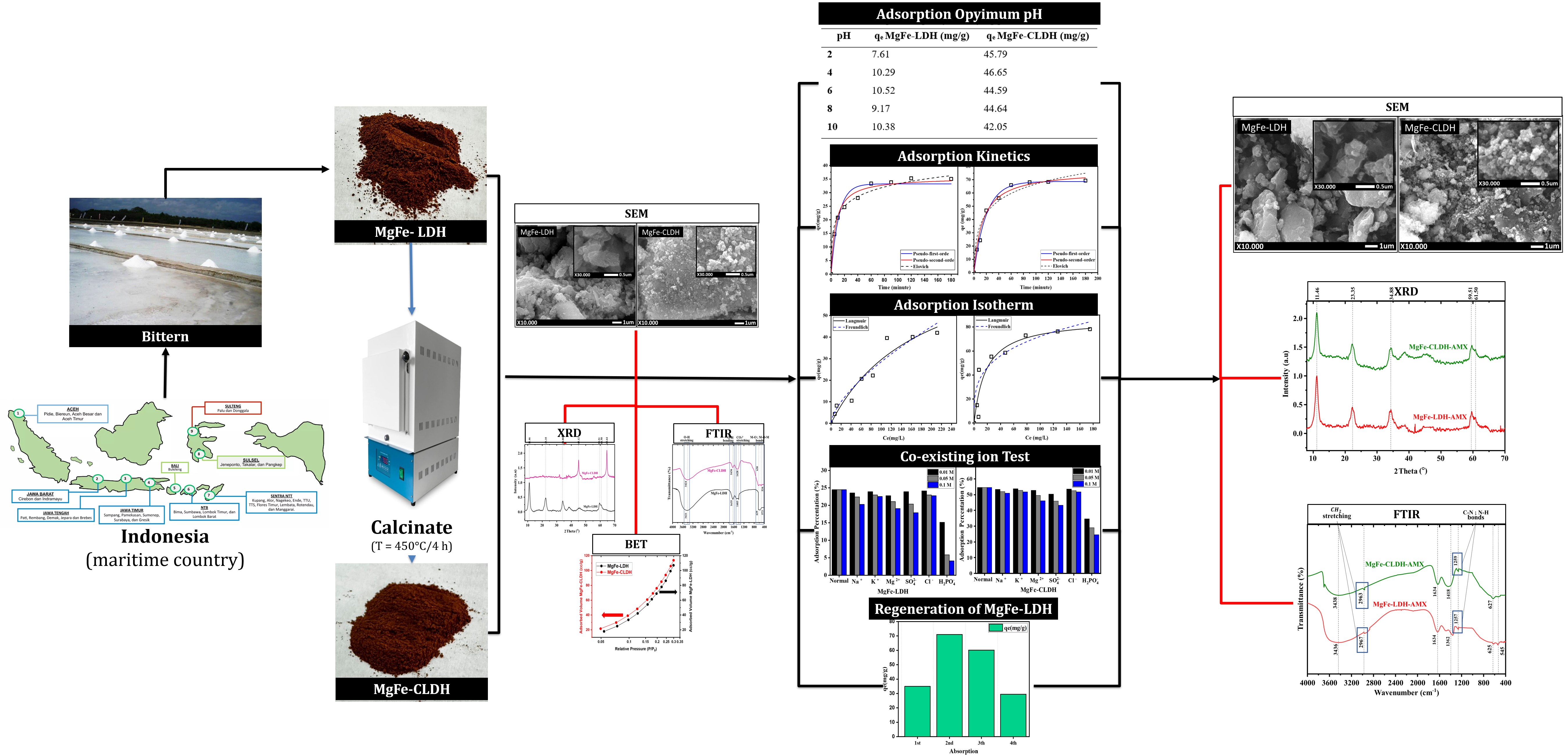
Antibiotic contamination, particularly from amoxicillin, poses serious ecological and health risks due to its persistence in aquatic systems. This study hypothesized that MgFe-layered double hydroxide (MgFe-LDH) synthesized from salt-industry by-product (bittern) and its calcined derivative (MgFe-CLDH) can act as sustainable and efficient adsorbents for amoxicillin removal. MgFe-LDH was prepared via co-precipitation and partially calcined at 450 °C to form MgFe-CLDH. Both materials were characterized by XRD, SEM, FTIR, and BET analyses, and their adsorption behaviors were evaluated under varying pH, contact time, initial concentration, and co-existing ions. MgFe-LDH and MgFe-CLDH exhibited maximum adsorption capacities of 82.79 and 86.94 mg/g, respectively. Kinetic studies showed that MgFe-LDH followed a pseudo-second-order model (chemisorption), whereas MgFe-CLDH followed a pseudo-first-order model (physisorption). Freundlich isotherm fitting indicated multilayer adsorption on heterogeneous surfaces. Regeneration tests confirmed stable reusability, with optimal performance observed after the second adsorption cycle. These findings validate the hypothesis and demonstrate that MgFe-based LDH adsorbents derived from industrial by-products offer a cost-effective route for antibiotic wastewater remediation.
HIGHLIGHTS
- Sustainable MgFe-LDH synthesized from salt industry by-product (bittern).
- Calcined MgFe-CLDH showed enhanced adsorption via memory effect.
- High adsorption capacities: 82.79 mg/g (LDH) and 86.94 mg/g (CLDH).
- Distinct kinetics: LDH fits pseudo-second-order, CLDH fits pseudo-first-order.
- Freundlich isotherm confirmed multilayer adsorption with good reusability.
GRAPHICAL ABSTRACT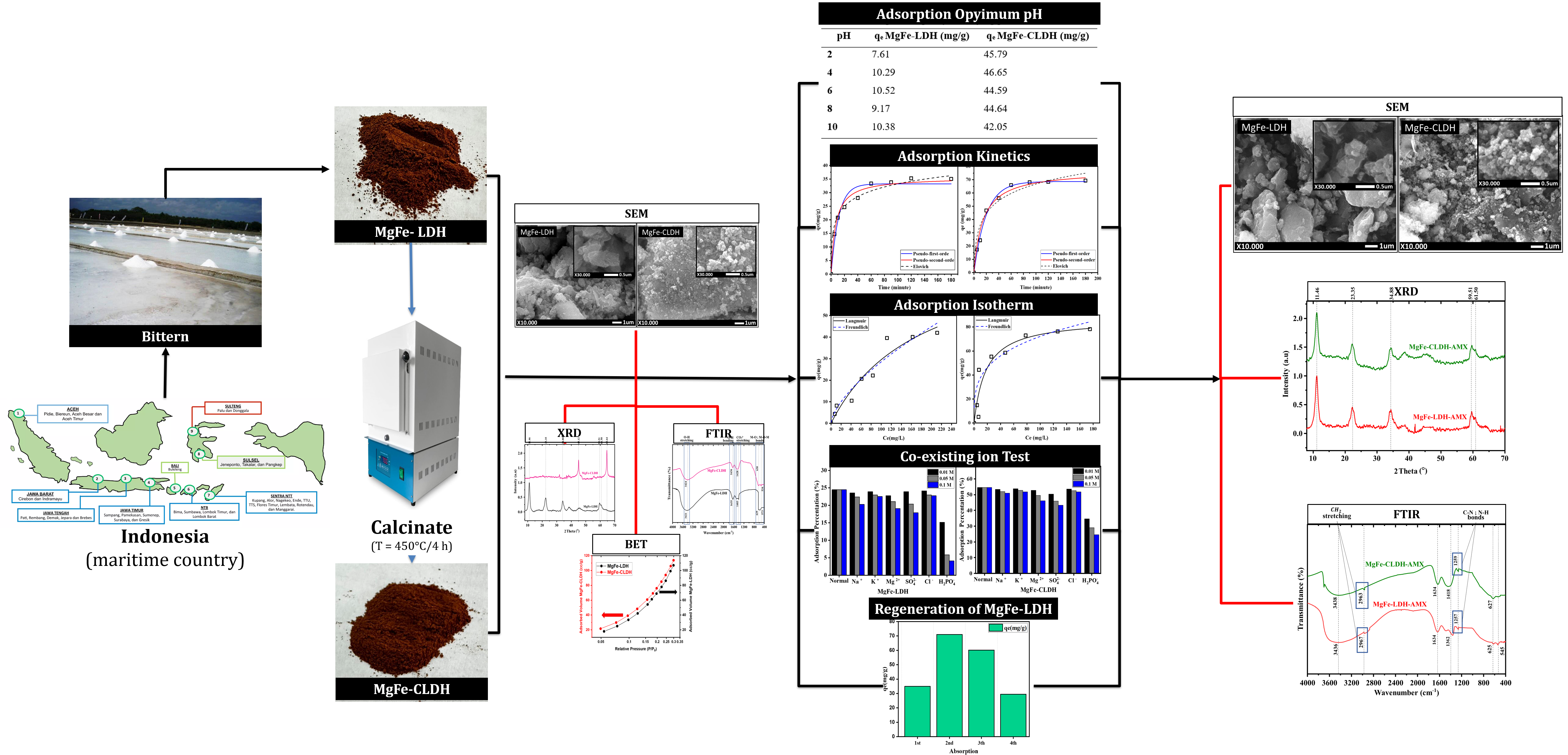
Downloads
References
SK Ahmed, S Hussein, K Qurbani, RH Ibrahim, A Fareeq, KA Mahmood and MG Mohamed. Antimicrobial resistance: Impacts, challenges, and future prospects. Journal of Medicine, Surgery, and Public Health 2024; 2, 100081.
MP Ferraz. Antimicrobial resistance: the impact from and on society according to one health approach. Societies 2024; 14(9), 187.
A Huttner, J Bielicki, MN Clements, N Frimodt-Møller, AE Muller, JP Paccaud and JW Mouton. Oral amoxicillin and amoxicillin-clavulanic acid: properties, indications and usage. Clinical Microbiology and Infection 2020; 26(7), 871-879.
Ö Kerkez-Kuyumcu, ŞS Bayazit and MA Salam. Antibiotic amoxicillin removal from aqueous solution using magnetically modified graphene nanoplatelets. Journal of Industrial and Engineering Chemistry 2016; 36, 198-205.
L Domínguez, M Eduard and D La Cruz. Working toward an environmental risk assessment of emerging contaminants in wastewater: The case of amoxicillin. Water, Air, & Soil Pollution 2025; 236, 366.
M Daliri, S Martinez-Morcillo, M Sharifinia, G Javdan and M Keshavarzifard. Occurrence and ecological risk assessment of antibiotic residues in urban wastewater discharged into the coastal environment of the Persian Gulf (the case of Bandar Abbas). Environmental Monitoring and Assessment 2022; 194(12), 905.
C Li, A Li, X Hui, A Wang, LU Wang and S Chang. Concentrations, probabilistic human and ecological risks assessment attribute to antibiotics residues in river water in China: Systematic review and meta-analysis. Ecotoxicology and Environmental Safety 2024; 285, 117022.
KK Sodhi, M Kumar and DK Singh. Insight into the amoxicillin resistance, ecotoxicity, and remediation strategies. Journal of Water Process Engineering 2021; 39, 101858.
S Li, Y Wu, H Zheng, H Li, Y Zheng, J Nan, J Ma, D Nagarajan and JS Chang. Antibiotics degradation by advanced oxidation process (AOPs): recent advances in ecotoxicity and antibiotic-resistance genes induction of degradation products. Chemosphere 2023; 311, 136977.
MW Nugraha, S Kim, F Roddick, Z Xie and L Fan. A review of the recent advancements in adsorption technology for removing antibiotics from hospital wastewater. Journal of Water Process Engineering 2025; 70, 106960.
P Pourhakkak, A Taghizadeh, M Taghizadeh, M Ghaedi and S Haghdoust. Fundamentals of adsorption technology. Interface Science and Technology 2021; 33, 1-70.
S Daniel and S Thomas. Layered double hydroxides: Fundamentals to applications. In: S Thomas and S Daniel (Eds.). Layered double hydroxide polymer nanocomposites. Woodhead Publishing, Cambridge, 2020.
CO Okoye, R Nyaruaba, RE Ita, SU Okon, CI Addey, CC Ebido, AO Opabunmi, ES Okeke and KI Chukwudozie. Antibiotic resistance in the aquatic environment: analytical techniques and interactive impact of emerging contaminants. Environmental Toxicology and Pharmacology 2022; 96, 103995.
LF Ren, S Zhang, Z Ma, Y Qiu, D Ying, J Jia and Y He. Antibiotics separation from saline wastewater by nanofiltration membrane based on tannic acid-ferric ions coordination complexes. Desalination 2022; 541, 116034.
V Homem and L Santos. Degradation and removal methods of antibiotics from aqueous matrices - a review. Journal of Environmental Management 2011; 92(10), 2304-2347.
AL Johnston, E Lester, O Williams and RL Gomes. Understanding layered double hydroxide properties as sorbent materials for removing organic pollutants from environmental waters. Journal of Environmental Chemical Engineering 2021; 9(4), 105197.
DP De Lima, MF da Silva, AF da Silva, AH Ide and L Meili. Antibiotic removal from water using MgFe/layered double hydroxide as adsorbent. In: Proceedings of the 13th Brazilian Meeting on Adsorption EBA, Fortaleza, Brazil. 2020.
Z Yang, C Zhang, G Zeng, X Tan, H Wang, D Huang, K Yang, J Wei, C Ma and K Nie. Design and engineering of layered double hydroxide based catalysts for water depollution by advanced oxidation processes: a review. Journal of Materials Chemistry A 2020; 8, 4141-4173.
C Park, J Song, G Lee and HJ Hong. Mechanistic study of direct Mg-Al layered double hydroxide formation for the removal of amphoteric ciprofloxacin (CIP) antibiotics from aqueous media. Separation and Purification Technology 2026; 367, 132901.
Z Yan, B Zhu, J Yu and Z Xu. Effect of calcination on adsorption performance of Mg-Al layered double hydroxide prepared by a water-in-oil microemulsion method. RSC Advances 2016; 6(55), 50128-50137.
B Sulistiyo. Analisis indikator kinerja utama kelautan dan perikanan Indonesia: Pengembangan perikanan budidaya (in Indonesian). Pusat Data, Statistik, dan Informasi, Jakarta, Indonesia, 2017.
A Tewari, HV Joshi, C Raghunathan, RH Trivedi and PK Ghosh. The effect of sea brine and bittern on survival and growth of mangrove Avicennia marina (Dicotyledones: Avicenniaceae). Indian Journal of Marine Sciences 2003; 32(1), 52-56.
N Hafid, MB Belaatar, S Ben-Aazza, A Hadfi, M Ezahri and A Driouiche. Characterization of scale formed in drinking water and hot water pipes in the taliouine downtown-morocco. American Journal of Analytical Chemistry 2015; 6(8), 677.
B Zeng, Q Wang, L Mo, F Jin, J Zhu and M Tang. Synthesis of Mg-Al LDH and its calcined form with natural materials for efficient Cr(VI) removal. Journal of Environmental Chemical Engineering 2022; 10(6), 108605.
A Golban, L Lupa, L Cocheci and R Pode. Synthesis of MgFe layered double hydroxide from iron-containing acidic residual solution and its adsorption performance. Crystals 2019; 9(10), 514.
YO Zubair, S Fuchida, K Oyama and C Tokoro. Morphologically controlled synthesis of MgFe-LDH using MgO and succinic acid for enhanced arsenic adsorption: Kinetics, equilibrium, and mechanism studies. Journal of Environmental Sciences 2025; 148, 637-649.
Y Zhang, L Wang, L Zou and D Xue. Crystallization behaviors of hexagonal nanoplatelet MgAlCO3 layered double hydroxide. Journal of Crystal Growth 2010; 312, 3367-3372
J Li, C Li, Q Tang, Z Zuo, L Liu and J Dong. Effect of MgFe-LDH with reduction pretreatment on the catalytic performance in syngas to light olefins. Catalysts 2023; 13(3), 632.
DC Fletcher, R Hunter, W Xia, GJ Smales, BR Pauw, E Blackburn, A Kulak, H Xin and Z Schnepp. Scalable synthesis of dispersible iron carbide (Fe3C) nanoparticles by ‘nanocasting’. Journal of Materials Chemistry A 2019; 7(33), 19506-19512.
J Kang, TG Levitskaia, S Park, J Kim, T Varga and W Um. Nanostructured MgFe and CoCr layered double hydroxides for removal and sequestration of iodine anions. Chemical Engineering Journal 2020; 380, 122408.
NBH Abdelkader, A Bentouami, Z Derriche, N Bettahar and LC De Menorval. Synthesis and characterization of Mg-Fe layer double hydroxides and its application on adsorption of orange G from aqueous solution. Chemical Engineering Journal 2011; 169(1-3), 231-238.
BK Kim, GH Gwak, T Okada and JM Oh. Effect of particle size and local disorder on specific surface area of layered double hydroxides upon calcination-reconstruction. Journal of Solid State Chemistry 2018; 263, 60-64.
BH Alshammari, KD Alanazi, OA Sheej Ahmad, S Sallam, AH Al-Bagawi, AH Alsehli, BM Alshammari and NM El-Metwaly. Tailoring magnetic Sn-MOFs for efficient amoxicillin antibiotic removal through process optimization. RSC Advances 2024; 14(9), 5875-5892.
MN Alnajrani and OA Alsager. Removal of antibiotics from water by polymer of intrinsic microporosity: Isotherms, kinetics, thermodynam¬ics, and adsorption mechanism. Scientific Reports 2020; 10(1), 794.
MF Abed and AA Faisal. Green synthesis of calcium/iron-layered double hydroxides-sodium alginate nanoadsorbent as reactive barrier for antibiotic amoxicillin removal from groundwater. Adsorption Science & Technology 2023. https://doi.org/10.1155/2023/1475278
E Li, L Liao, G Lv, Z Li, C Yang and Y Lu. The interactions between three typical PPCPs and LDH. Frontiers in Chemistry 2018; 6, 16.
H Yuh-Shan. Citation review of Lagergren kinetic rate equation on adsorption reactions. Scientometrics 2004; 59(1), 171-177.
HK Boparai, M Joseph and DM O’Carroll. Kinetics and thermodynamics of cadmium ion removal by adsorption onto nano zerovalent iron particles. Journal of Hazardous Materials 2011; 186(1), 458-465.
YS Ho and G McKay. Pseudo-second order model for sorption processes. Process Biochemistry 1999; 34(5), 451-465.
JC Bullen, S Saleesongsom, K Gallagher and DJ Weiss. A revised pseudo-second-order kinetic model for adsorption, sensitive to changes in adsorbate and adsorbent concentrations. Langmuir 2021; 37(10), 3189-3201.
M Pająk, A Dzieniszewska and J Kyzioł-Komosińska. Natural (clinoptilolite) and synthetic (NaP1) zeolites in the adsorption process for the removal of acid black 1 dye from aqueous solutions. Molecules 2025; 30(8), 1677.
BO Isiuku, PC Okonkwo and CD Emeagwara. Batch adsorption isotherm models applied in single and multicomponent adsorption systems - a review. Journal of Dispersion Science and Technology 2021; 42(12), 1879-1897.
A Elhaci, F Labed, A Khenifi, Z Bouberka, M Kameche and K Benabbou. MgAl-layered double hydroxide for amoxicillin removal from aqueous media. International Journal of Environmental Analytical Chemistry 2021; 101(15), 2876-2898.
KY Foo and BH Hameed. Insights into the modeling of adsorption isotherm systems. Chemical Engineering Journal 2010; 156(1), 2-10.
Z Tang, Z Qiu, S Lu and X Shi. Functionalized layered double hydroxide applied to heavy metal ions absorption: A review. Nanotechnology Reviews 2020; 9(1), 800-819.
YH Ye, S Liu, D Yu, X Zhou, L Qin, C Lai, F Qin, M Zhang, W Chen, W Chen and L Xiang. Regeneration mechanism, modification strategy, and environment application of layered double hydroxides: Insights based on memory effect. Coordination Chemistry Reviews 2022; 450, 214253.
K Takehira. Recent development of layered double hydroxide-derived catalysts - rehydration, reconstitution, and supporting, aiming at commercial application. Applied Clay Science 2017; 136, 112-141.
A Navajas, I Campo, A Moral, J Echave, O Sanz, M Montes, JA Odriozola, G Arzamendi and LM Gandía. Outstanding performance of rehydrated Mg-Al hydrotalcites as heterogeneous methanolysis catalysts for the synthesis of biodiesel. Fuel 2018; 211, 173-181.
W Xu, M Mertens, T Kenis, E Derveaux, P Adriaensens and V Meynen. Can high temperature calcined Mg-Al layered double hydroxides (LDHs) fully rehydrate at room temperature in vapor or liquid condition? Materials Chemistry and Physics 2023; 295, 127113.
T Bajda, A Grela, J Pamuła, J Kuc, A Klimek, J Matusik, W Franus, SKK Alagarsamy, T Danek and P Gara. Using zeolite materials to remove pharmaceuticals from water. Materials 2024; 17(15), 3848.
D Hu and L Wang. Adsorption of amoxicillin onto quaternized cellulose from flax noil: Kinetic, equilibrium and thermodynamic study. Journal of the Taiwan Institute of Chemical Engineers 2016; 64, 227-234.
P Pinthong, P Praserthdam and B Jongsomjit. Effect of calcination temperature on Mg-Al layered double hydroxides (LDH) as promising catalysts in oxidative dehydrogenation of ethanol to acetaldehyde. Journal of Oleo Science 2019; 68(1), 95-102.
P Pandey, A Shankar, M Biney and VK Saini. Enhancement in amoxicillin adsorption and regeneration properties of SBA-15 after surface modification with polyaniline. Colloids and Interface Science Communications 2021; 43, 100432.
JYJ Yeo, DS Khaerudini, FE Soetaredjo, GL Waworuntu, S Ismadji, J Sunarso and S Liu. Isotherm data for adsorption of amoxicillin, ampicillin, and doripenem onto bentonite. Data in Brief 2023; 48, 109159.
L El Azzouzi, S El Aggadi, M Ennouhi, A Ennouari, OK Kabbaj and A Zrineh. Removal of the Amoxicillin antibiotic from aqueous matrices by means of an adsorption process using Kaolinite clay. Scientific African 2022; 18, e01390.
L Ren, D Zhou, J Wang, T Zhang, Y Peng and G Chen. Biomaterial-based flower-like MnO2@ carbon microspheres for rapid adsorption of amoxicillin from wastewater. Journal of Molecular Liquids 2020; 309, 113074.
Published
How to Cite
Issue
Section
License
Copyright (c) 2026 Walailak University

This work is licensed under a Creative Commons Attribution-NonCommercial-NoDerivatives 4.0 International License.





