
In Vivo Evaluation of the Immunomodulatory and Anti-Inflammatory Effects of Crude Red Fruit (Pandanus Conoideus Lamk.) Oil
DOI:
https://doi.org/10.48048/tis.2026.12030Keywords:
Anti-inflammatory, Immunomodulator, Oil, Pandanus conoideusAbstract
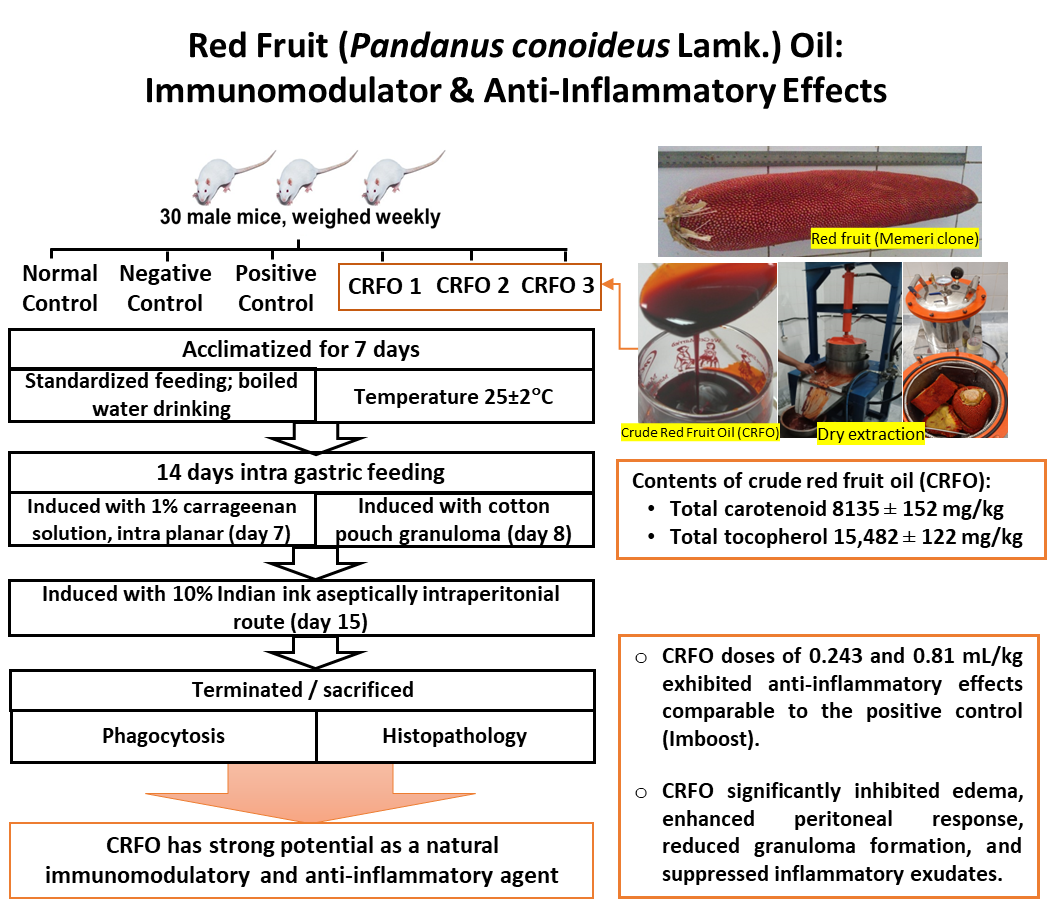
This study evaluates the effectiveness of crude red fruit oil (CRFO) as an immunomodulator and anti-inflammatory agent through in vivo testing on Sprague Dawley (SD) rats. The red fruit oil was extracted using a dry extraction method and administered to male rats, which were divided into six treatment groups (n=5) in a completely randomized design. Acute inflammation was induced using carrageenan injection, while immunomodulatory effects were tested through the cotton pellet granuloma method. The treatment groups consisted of normal control, negative (Na-CMC 0.5%), positive (imboost) and CRFO at doses of 0.081, 0.243 and 0.813 mL/kg body weight, except normal control, all treatment groups were involving phagocytosis and acute-chronic inflammation. Data were analyzed using Analysis of Variance (ANOVA) followed by Duncan’s Multiple Range Test for statistical significance (p-value < 0.05). The results showed that CRFO contained 8,135 ± 152 mg/kg carotenoids and 15,482 ± 122 mg/kg tocopherols, contributing to its antioxidant and anti-inflammatory activity. CRFO significantly inhibited edema by up to 62.60%, enhanced peritoneal macrophage phagocytosis capacity (p-value < 0.05), reduced granuloma formation (p-value < 0.05) and suppressed inflammatory exudates (p-value < 0.05). The CRFO doses of 0.243 and 0.813 mL/kg body weight provided anti-inflammatory effects comparable to the positive control. Moreover, these CRFO levels demonstrated good safety profiles without significantly affecting the rats’ physiological parameters. This study provides scientific evidence that CRFO has strong potential as a natural immunomodulatory and anti-inflammatory agent. These findings support the development of CRFO as an adjunctive therapy for managing inflammatory conditions and as a functional supplement to enhance immune system function. This discovery offers a safer, nature-based alternative to existing commercial supplements.
HIGHLIGHTS
- The first study shows that CRFO (dry extraction) outperforms the commercial immunomodulator Imboost in in vivo immunomodulatory and anti-inflammatory effects.
- Optimal CRFO dosage of 243 mL/kg body weight effectively inhibits edema, enhances
- phagocytosis, and reduces granuloma formati
- Findings support CRFO as a safe, effective natural therapeutic for inflammation and immune-related conditions.
GRAPHICAL ABSTRACT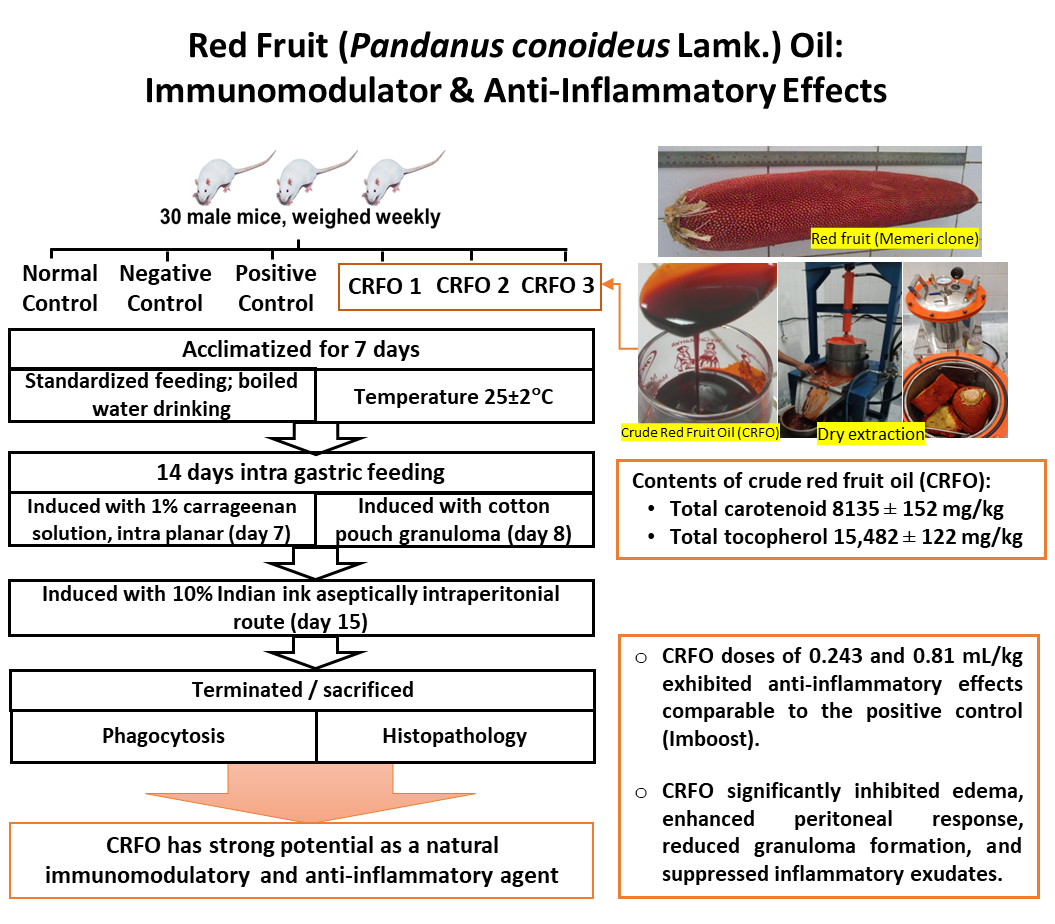
Downloads
References
W Feleszko, GA Rossi, R Krenke, GW Canonica, LV Gerven and O Kalyuzhin. Immunoactive preparations and regulatory responses in the respiratory tract: Potential for clinical application in chronic inflammatory airway diseases. Expert Review of Respiratory Medicine 2020; 14(6), 603-619.
E Fitria, N Wulandari, P Hariyadi and H Wijaya. Identification and fractionation of carotenoids in red fruit oil (Pandanus conoideus) (in Indonesian). Warta IHP 2020; 37(1), 7-19.
ZL Sarungallo, P Hariyadi, N Andarwulan and EH Purnomo. Analysis of α-cryptoxanthin, β-cryptoxanthin, α-carotene, and β-carotene of Pandanus conoideus oil by high-performance liquid chromatography (HPLC). Procedia Food Science 2015; 3, 231-243.
ZL Sarungallo, P Hariyadi, N Andarwulan and EH Purnomo. Characterization of chemical properties, lipid profile, total phenol and tocopherol content of oils extracted from nine clones of red fruit (Pandanus conoideus). Agriculture and Natural Resources 2015; 49(2), 237-250.
A Rohman, S Riyanto, N Yuniarti, WR Saputra, R Utami and W Mulatsih. Antioxidant activity, total phenolic, total flavanoid of extracts and fractions of red fruit (Pandanus conoideus Lam). International Food Research Journal 2010; 17, 97-106.
Achadiyani, L Septiani, A Faried, HMS Bolly and D Kurnia. Role of the red fruit (Pandanus conoideus Lamk) ethyl acetate fraction on the induction of apoptosis vs. downregulation of survival signaling pathways in cervical cancer cells. Europe Journal of Medicinals Plants 2016; 13(2), 1-9.
T Tambaip, MB Karo, M Hatta, R Dwiyanti, R Natzir, MN Massi, AA Islam and K Djawad. Immunomodulatory effect of orally red fruit (Pandanus conoideus) extract on the expression of CC chemokine receptor 5-mRNA in HIV patients with antiretroviral therapy. Journal of Immunology Research 2018; 11(1), 15-21.
YH Rhee, YK Park and JS Kim. Pandanus conoideus Lamk oil protects against inflammation through regulating reactive oxygen species in LPS-induced murine macrophages. Natural Product Communications 2020; 15(9), 1-8.
N Xia, C Schirra, S Hasselwander, U Förstermann and H Li. Red fruit (Pandanus conoideus Lam) oil stimulates nitric oxide production and reduces oxidative stress in endothelial cells. Journal of Functional Foods 2018; 51, 65-74.
P Annamalai and EB Thangam. Local and systemic profiles of inflammatory cytokines in carrageenan-induced paw inflammation in rats. Immunological Investigations 2016; 46(3), 274-283.
ZL Sarungallo, P Hariyadi, N Andarwulan and EH Purnomo. The effect of extraction method on the chemical quality and fatty acid composition of red fruit (Pandanus conoideus) oil (in Indonesian). Journal of Agroindustry Technology 2014; 24(3), 209-217.
ZL Sarungallo, P Hariyadi, N Andarwulan and EH Purnomo. Effect of heat treatment prior to extraction on the yield and quality of red fruit (Pandanus conoideus) oil. Food Research 2020; 4(3), 659-665.
G Knockaert, L Lemmens, S Van-Buggenhout, M Hendrickx and A Van-Loey. Changes in β-carotene bioaccessibility and concentration during processing of carrot puree. Food Chemistry 2012; 133(1), 60-67.
ML Wong, RE Timms and EM Goh. Colorimetric determination of total tocopherols in palm olein and stearin. Journal of the American Oil Chemists’ Society 1988; 65(2), 258-261.
S Sarkhel. Evaluation of the anti-inflammatory activities of Quillaja saponaria Mol. saponin extract in mice. Toxicology Report 2015; 3, 1-3.
A Fountain, M Mansat, T Lackraj, MC Gimenez, S Moussaoui, M Ezzo, S Soffiaturo, E Urdaneta, MB Verdawala, K Fung, C Lancaster, E Somerville, B Hinz, MR Terebiznik and RJ Botelho. Depletion of endomembrane reservoirs drives phagocytic appetite exhaustion in macrophages. Journal of Cell Science 2025; 138(16), 263539.
H Tazeze, S Mequanente, D Nigussie, B Legesse, E Makonnen and T Mengie. Investigation of wound healing and anti-inflammatory activities of leaf gel of Aloe trigonantha L.C. leach in rats. Journal of Inflammation Research 2021; 14, 5567-5580.
ZL Sarungallo, B Santoso, RU Situngkir, MK Roreng and MM Lisangan. Determination of chemical properties, composition of fatty acid, carotenoids and tocopherols of degummed and neutralized red fruit (Pandanus conoideus) oil. Jurnal Teknologi 2020; 82(6), 71-78.
M Rodriguez-Concepcion, J Avalos, ML Bonet, A Boronat, L Gomez-Gomez and D Hornero- Mendez, MC Limon, AJ Meléndez-Martínez, B Olmedilla-Alonso, A Palou, J Ribot, MJ Rodrigo, L Zacarias and C Zhu. A global perspective on carotenoids: Metabolism, biotechnology, and benefits for nutrition and health. Progress in Lipid Research 2018; 70, 62-93.
O Merhan. The biochemistry and antioxidant properties of carotenoids. In: J Dragan and GS Nikolic (Eds.). Carotenoids. IntechOpen, London, 2017, p. 51-66.
R Li, Y Yang, P Hong, Z Zhang, L Li, J Hui, X Zheng. β-carotene attenuates weaning-induced apoptosis via inhibition of PERK-CHOP and IRE1-JNK/p38 MAPK signalling pathways in piglet jejunum. Journal of Animal Physiology and Animal Nutrition 2020; 104(1), 280-290.
HKM Alboaklah and DS Leake. Effect of vitamin E on low density lipoprotein oxidation at lysosomal pH. Free Radical Research 2020; 54(8-9), 574-584.
S Syarkiah, LE Fitri and A Pudjirahaju. The effect of red fruit (Pandanus conoideus) oil toward the formation of foam cells in aorta of wistar strain rat (Rattus norvegicus) with atherogenic diet (in bahasa Indonesia). Jurnal Kedokteran Brawijaya 2008. https://doi.org/10.21776/ub.jkb.2008.024.01.1
N Karim, I Khan, W Khan, I Khan, A Khan, SA Halim, H Khan, J Hussain and A Al-Haarasi. Anti-nociceptive and anti-inflammatory activities of asparacosin a involve selective cyclooxygenase 2 and inflammatory cytokines inhibition: An in-vitro, in-vivo, and in-silico Approach. Frontier Immunollogy 2019; 10, 00581.
JM Al-Khayri, GR Sahana, P Nagella, BV Joseph, FM Alessa and MQ Al-Mssallem. Flavonoids as potential anti-inflammatory molecules: A Review. Molecules 2022; 27(9), 2901.
PV Pakale, CC Khanwelkar and SA Jadhav. Study of anti-inflammatory activity of aqueous and methanolic extracts of fresh rhizome of Zingiber officinale in Wistar rats. International Journal of Health Sciences 2022; 6(S3), 2209-2217.
AA Cassado, MRD Lima and KR Bortoluci. Revisiting mouse peritoneal macrophages: Heterogeneity, development, and function. Frontiers in Immunology 2015; 6, 225.
KH Lin, KC Lin, WJ Lu, PA Thomas, T Jayakumar and JR Sheu. Astaxanthin, a carotenoid, stimulates immune responses by enhancing IFN-γ and IL-2 secretion in primary cultured lymphocytes in vitro and ex vivo. International Journal of Molecular Science 2016; 17(1), 44.
HJ Justil-Guerrero, JL Arroyo-Acevedo, JP Rojas-Armas, CO García-Bustamante, M Palomino-Pacheco, RD Almonacid-Román and JWC Torres. Evaluation of bioactive compounds, antioxidant capacity, and anti-inflammatory effects of lipophilic and hydrophilic extracts of the pericarp of Passiflora tripartita var. mollissima at two stages of ripening. Molecules 2024; 29(20), 4964.
Published
How to Cite
Issue
Section
License
Copyright (c) 2025 Walailak University

This work is licensed under a Creative Commons Attribution-NonCommercial-NoDerivatives 4.0 International License.





