
Innovative Polyherbal Nanoemulsion for Cardioprotection in Diabetes: Impact on Cardiac Biomarker
DOI:
https://doi.org/10.48048/tis.2026.11985Keywords:
Biomarker cardiotoxic, Cardiac enzyme, Nanoemulsion polyherbal, Diabetic rat, Cardioprotective, Streptozotocin-induced cardiotoxic, NanoencapsulationAbstract
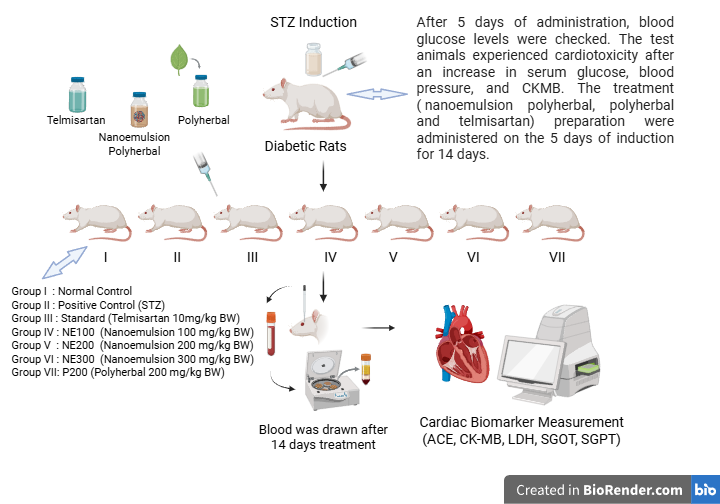
Diabetes mellitus is a chronic metabolic disease that increases the risk of cardiovascular disease, which is the leading cause of death in people with diabetes. One of the main mechanisms contributing to cardiovascular complications in diabetes is an increase in cardiac enzyme levels, such as ACE, NO, CK-MB, LDH, and liver enzymes SGOT and SGPT. This study aims to explore the cardioprotective potential of a novel polyherbal nanoemulsion formulation containing Nigella sativa oil, Centella asiatica, and Moringa oleifera in streptozotocin (STZ)-induced diabetic rats. The focus of this study was to measure the impact of nanoemulsion therapy on cardiac biomarker levels, namely ACE, NO, CK-MB, LDH, SGOT, and SGPT, which play an important role in monitoring heart function in diabetes. The results showed that administration of polyherbal nanoemulsion significantly reduced the levels of these cardiac enzymes, including ACE, NO, CK-MB, LDH, SGOT, and SGPT, compared to the positive control group that was only given STZ. Therapy with higher doses of polyherbal nanoemulsion showed better therapeutic effects, indicating that nanoemulsion technology can increase the bioavailability and therapeutic efficacy of bioactive compounds from these plants in protecting the heart. These findings suggest that polyherbal nanoemulsion may be a promising therapeutic approach for reducing the risk of cardiovascular complications in diabetic patients, particularly through the regulation of cardiac biomarkers associated with heart damage.
HIGHLIGHTS
Cardioprotective Potential of Polyherbal Nanoemulsion: This study revealed the ability of nanoemulsion containing Nigella sativa, Centella asiatica, and Moringa oleifera to reduce heart damage in streptozotocin (STZ)-induced diabetic rats by measuring the levels of ACE, CK-MB, LDH, SGOT, and SGPT enzymes. Polyherbal nanoemulsion therapy successfully lowered the elevated levels of ACE, CK-MB, LDH, SGOT, and SGPT enzymes caused by diabetes, demonstrating a protective effect on vital organs.
GRAPHICAL ABSTRACT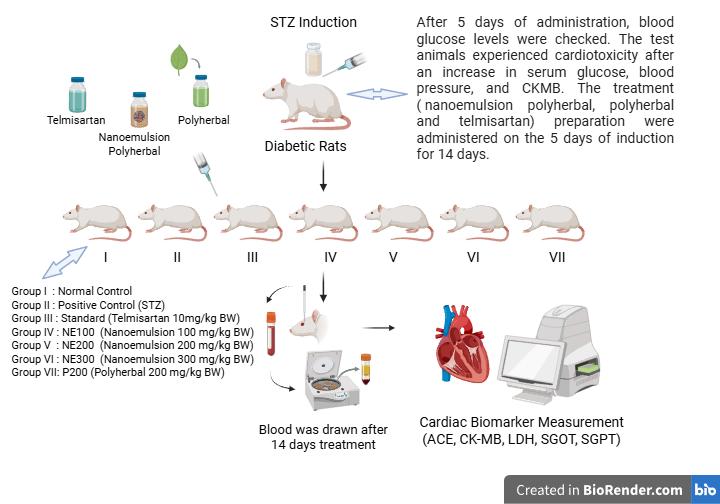
Downloads
References
BK Sarkar, J Das, A Das, P Dodak, KS Kumar, R Akter, P Modak, S Halder and SA Prosun. Diabetes mellitus: A Comprehensive review. Journal of Pharmacognosy and Phytochemistry 2019; 8(6), 2362-2371.
D Glovaci, W Fan and ND Wong. Epidemiology of diabetes mellitus and cardiovascular disease. Current Cardiology Reports 2019; 21(21), 1-8.
G Jia, MA Hill and JR Sowers. Diabetic cardiomyopathy: An update of mechanisms contributing to this clinical entity. Circulation Research 2019; 122(4), 624-638.
RF Mapanga and MF Essop. Damaging effects of hyperglycemia on cardiovascular function: Spotlight on glucose metabolic pathways. American Journal of Physiology-Heart and Circulatory Physiology 2016; 310(2), H153-H173.
G Frati, L Schirone, I Chimenti, D Yee, G Biondi-Zoccai, M Volpe and S Sciarretta. An overview of the inflammatory signalling mechanisms in the myocardium underlying the development of diabetic cardiomyopathy. Cardiovascular Research 2017; 113(4), 378-388.
HTK Pham, TTM Kieu, TD Duong, KD Van Nguyen, NQ Tran, TH Tran and JYS Ng. Direct medical costs of diabetes and its complications in Vietnam: A national health insurance database study. Diabetes Research and Clinical Practice 2020; 162, 108051.
B Hidayat, RV Ramadani, A Rudijanto, P Soewondo, K Suastika and JYS Ng. Direct medical cost of type 2 diabetes mellitus and its associated complications in Indonesia. Value in Health Regional Issues 2021; 28, 82-89.
M Naghavi, KL Ong, A Aali, HS Ababneh and YH Abate. Global burden of 288 causes of death and life expectancy decomposition in 204 countries and territories and 811 subnational locations, 1990 - 2021: A systematic analysis for the global burden of disease study 2021. Lancet 2024; 403(10440), 2100-2132.
B De Geest and M Mishra. Role of oxidative stress in diabetic cardiomyopathy. Antioxidants 2022; 11(4), 784.
DM Bravata, N Kim, J Concato and LM Brass. Hyperglycaemia in patients with acute ischaemic stroke: How often do we screen for undiagnosed diabetes? An International Journal of Medicine 2003; 96(7), 491-497.
WA Hsueh and K Wyne. Renin-angiotensin-aldosterone system in diabetes and hypertension. The Journal of Clinical Hypertension 2011; 13(4), 224-237.
T Zhu, Q Han, X Zhang and Q Hou. Effects of xinnaoning combined with trimetazidine on the levels of CK and its isoenzymes, AST, ALT And LDH in patients with myocardial ischemia. American Journal of Translational Research 2021; 13(4), 2875-2882.
MS Alam, YA Kaabi, MM Hoque, F Riyaz, MH Shah, MS Akhter, ZH Hakami and Y Mjery. Association between cardiac enzymes level in type 2 diabetes mellitus from jazan region, Saudi Arabia. South Eastern European Journal of Public Health 2025; 26, 280-286.
PP Swoboda, AK McDiarmid, B Erhayiem, DP Ripley, LE Dobson, P Garg, TA Musa, KK Witte, TM Kearney, JH Barth, R Ajjan, JP Greenwood and S Plein. Diabetes mellitus, microalbuminuria, and subclinical cardiac disease: Identification and monitoring of individuals at risk of heart failure. Journal of the American Heart Association 2017; 6(7), e005539.
E Dal Canto, A Ceriello, L Rydén, M Ferrini, TB Hansen, O Schnell, E Standl and JWJ Beulens. Diabetes as a cardiovascular risk factor: An overview of global trends of macro and micro vascular complications. European Journal of Preventive Cardiology 2019; 26(2), 25-32.
MS Ola, MM Ahmed, HM Abuohashish, SS Al-Rejaie and AS Alhomida. Telmisartan Ameliorates neurotrophic support and oxidative stress in the retina of streptozotocin-induced diabetic rats. Neurochemical Research 2013; 38(8), 1572-1579.
BV Bonifácio, PB Da Silva, MA Dos, S Ramos, KMS Negri, TM Bauab and Marluschorilli. Nanotechnology-based drug delivery systems and herbal medicines: A review. International Journal of Nanomedicine 2014; 9, 1-15.
F Gutama, MI Barliana and IM Puspitasari. Factors associated with health-related quality of life in patients with coronary heart disease. Pharmacia 2022; 69(3), 771-777.
SDS Banjarnahor and N Artanti. Antioxidant properties of flavonoids. Medical Journal of Indonesia 2014; 23(4), 239-244.
A Gugliandolo, C Gabriella, M Claudia, A Osvaldo, R Patrick, P Daniele, I Renato, M Emanuela and C Luigi. α-cyclodextrin/moringin induces an antioxidant transcriptional response activating Nrf2 in differentiated NSC-34 motor neurons. Antioxidants 2024; 13(813), 1-16.
NNM Razali, CT Ng and LY Fong. Cardiovascular protective effects of centella asiatica and its triterpenes: A review. Planta Medica 2019; 85(16), 1203-1215.
T Hidayati, A Akrom and AB Setianto. Black cumin seed oil preparation consumption potentially improves adaptive cellular immune response among healthy volunteers. International Journal of Public Health 2022; 11(2), 680-686.
A Akrom, T Hidayati and AB Setianto. Polyherbal preparations as antioxidant and hepatoprotector in alloxan-induced Sprague Dawley (SD) rats). AIP Conference Proceedings 2024; 3155(1), 080002.
IS Muflihah, S Soetrisno, R Reviono, A Prayitno, B Wasita and EP Pamungkasari. Ovalbumin-induced chronic asthma in female wistar rats: Eosinophilic infiltration, IL-5 profiles and bronchial histopathology. Trends in Sciences 2025; 22(7), 1-14.
R Capritasari, AB Setianto, IR Akrom and Y Sapto. Design and characterization of optimized polyherbal nanoencapsulation: In vitro antioxidant activity targeting Nrf2 and gst pathways. International Journal of Applied Pharmaceutics 2025; 17(3), 50-59.
M Scheen, R Giraud and K Bendjelid. Stress hyperglycemia, cardiac glucotoxicity, and critically ill patient outcomes current clinical and pathophysiological evidence. Physiological Reports 2021; 9(2), 1-19.
BL Furman. Streptozotocin-induced diabetic models in mice and rats. Current Protocols in Pharmacology 2015; 70(1), 5-47.
PA Gerber and GA Rutter. The role of oxidative stress and hypoxia in pancreatic beta-cell dysfunction in diabetes mellitus. Antioxidants Redox Signal 2017; 26(10), 501-518.
N Eguchi, ND Vaziri, DC Dafoe and H Ichii. The role of oxidative stress in pancreatic β cell dysfunction in diabetes. International Journal of Molecular 2021; 22(4), 1-18.
T Szkudelski. The mechanism of alloxan and streptozotocin action in b cells of the rat pancreas. Physiological Research 2001; 50(6), 537-546.
P González, P Lozano, G Ros and F Solano. Hyperglycemia and oxidative stress: An integral, updated and critical overview of their metabolic interconnections. International Journal of Molecular Sciences 2023; 24(11), 9352.
DR Yang, MY Wang, CL Zhang and Y Wang. Endothelial dysfunction in vascular complications of diabetes: A comprehensive review of mechanisms and implications. Frontiers in Endocrinology 2024; 15, 1359255.
N Mylonas, K Drosatos and S Mia. The role of glucose in cardiac physiology and pathophysiology. Current Opinion in Clinical Nutrition & Metabolic Care 2023; 26(4), 323-329.
X Guan, C Zhou, X Zhuo, W Yang and H Wang. The heart of diabetes: Unraveling metabolic drivers of cardiomyopathy. Cardiovascular Diabetology - Endocrinology Reports 2025; 11(1), 18.
M Wang, Y Liu, Y Liang, K Naruse and K Takahashi. Systematic understanding of pathophysiological mechanisms of oxidative stress-related conditions - diabetes mellitus, cardiovascular diseases, and ischemia–reperfusion injury. Frontiers in Cardiovascular Medicine 2021; 8, 649785.
EAE Elbassuoni. Incretin Attenuates diabetes-induced damage in rat cardiac tissue. The Journal of Physiological Sciences 2014; 64(5), 357-364.
RM Singh, T Waqar, FC Howarth, E Adeghate, K Bidasee and J Singh. Hyperglycemia-Induced cardiac contractile dysfunction in the diabetic heart. Heart Failure Reviews 2018; 23(1), 37-54.
KKA Kasar, MH Al-Bahrani and AA Mohsin. Interpreting myocardial enzymatic biomarkers in the setting of acute myocardial infraction AMI. Journal of Techniques 2022; 4(4), 105-110.
A Abdelatty, MS Ahmed, MA Abdel-Kareem, M Dmerdash, R Mady, AS Saad, A Albrakati, KE Kotb, A Elsawak and W Abdo. Acute and delayed doxorubicin-induced myocardiotoxicity associated with elevation of cardiac biomarkers, depletion of cellular antioxidant enzymes, and several histopathological and ultrastructural changes. Life 2021; 11(9), 880.
MA Abeeleh, ZB Ismail, KR Alzaben, SA Abu-Halaweh, MK Al-Essa, J Abuabeele and MM Alsmady. Induction of diabetes mellitus in rats using intraperitoneal streptozotocin: A comparison between 2 strains of rats. European Journal of Scientific Research 2009; 32(3), 398-402.
M Zhang, XY Lv, J Li, ZG Xu and L Chen. The characterization of high-fat diet and multiple low-dose streptozotocin induced type 2 diabetes rat model. Journal of Diabetes Research 2008; 2008, 704045.
SN Goyal, NM Reddy, KR Patil, KT Nakhate, S Ojha, CR Patil and YO Agrawal. Challenges and issues with streptozotocin-induced diabetes - a clinically relevant animal model to understand the diabetes pathogenesis and evaluate therapeutics. Chemico-Biological Interactions 2016; 244, 49-63.
T Micakovic, S Papagiannarou, E Clark, Y Kuzay, K Abramovic, J Peters, C Sticht, N Volk, T Fleming, P Nawroth, HP Hammes, N Alenina, HJ Gröne and SC Hoffmann. The angiotensin II type 2 receptors protect renal tubule mitochondria in early stages of diabetes mellitus. Kidney International 2018; 94(5), 937-950.
N Nazaruddin, TN Siregar, A Sutriana, S Wahyuni and T Armansyah. The Impact of streptozotocin-induced diabetes on testosterone hormone and androgen receptor expression and correlation with sperm quality impairment in sprague dawley rats. Trends in Sciences 2025; 22(9), 10409.
DC Damasceno, AO Netto, IL Iessi, FQ Gallego, SB Corvino, B Dallaqua, YK Sinzato, A Bueno, IMP Calderon, and MVC Rudge. Streptozotocin-induced diabetes models: Pathophysiological mechanisms and fetal outcomes. BioMed Research International 2014; 2014(1), 819065.
H Smulyan, A Lieber and ME Safar. Hypertension, diabetes type II, and their association: Role of arterial stiffness. American Journal of Hypertension 2016; 29(1), 5-13.
G Jia, MA Hill and JR Sowers. Diabetic cardiomyopathy: An update of mechanisms contributing to this clinical entity. Circulation Research 2018; 122(4), 624-638.
N Hadzi-Petrushev, M Angelovski and M Mladenov. Advanced glycation end products and diabetes. Obesity, Diabetes and Inflammation: Molecular Mechanisms and Clinical Management 2023; F1468, 99-127.
R Sayon, A Shruthi and R Suman. Retinal fibrosis in diabetic retinopathy. Experimental Eye Research 2016; 2(74), 71-75.
SH Ihm, K Chang, HY Kim, SH Baek, HJ Youn, KB Seung and JH Kim. Peroxisome proliferator-activated receptor-γ activation attenuates cardiac fibrosis in type 2 diabetic rats: The effect of rosiglitazone on myocardial expression of receptor for advanced glycation end products and of connective tissue growth factor. Basic Research in Cardiology 2010; 105(3), 399-407.
AO Abiodun, DI AlDosari, A Alghamdi, AA Al-Amri, S Ahmad and MS Ola. Diabetes-induced stimulation of the renin-angiotensin system in the rat brain cortex. Saudi Journal of Biological Sciences 2023; 30(9), 103779.
W Chen, L Juan, F Yu, J Yuanyuan, Y Runan, C Jinyu, L Wenxiu, L Yue and Y Xinhua. Cardioprotection of cortistatin against isoproterenol-induced myocardial injury in rats. Annals of Translational Medicine 2020; 8(6), 309-309.
J Peti-Peterdi. High glucose and renin release: The role of succinate and GPR91. Kidney international 2010; 78(12), 1214-1217.
C Savoia, RM Touyz, F Amiri and EL Schiffrin. Selective mineralocorticoid receptor blocker eplerenone reduces resistance artery stiffness in hypertensive patients. Hypertension 2008; 51(2), 432-439.
GA Favre, VLM Esnault and EV Obberghen. Modulation of glucose metabolism by the renin-angiotensin-aldosterone system. American Journal of Physiology-Endocrinology and Metabolism 2015; 308(6), E435-E449.
C Yu and RW Jeremy. Angiotensin, transforming growth factor Β and aortic dilatation in marfan syndrome: Of mice and humans. IJC Heart & Vasculature 2018; 18, 71-80.
JJL Grobe, AP Mecca, M Lingis, RC Speth, MK Raizada and MJ Katovich. Prevention of angiotensin ii-induced cardiac remodeling by angiotensin-(1-7). American Journal of Physiology-Heart and Circulatory Physiology 2007; 292(2), 736-742.
Y Tie, F Tang, D Peng, Y Zhang and H Shi. TGF-beta signal transduction: Biology, function and therapy for diseases. Molecular Biomedicine 2022; 3(1), 45.
Z Deng, T Fan, C Xiao, H Tian, Y Zheng, C Li and J He. TGF-β signaling in health, disease, and therapeutics. Signal Transduction and Targeted Therapy 2024; 9(1), 61.
Y Zhang, D Jin, X Kang, R Zhou, Y Sun, F Lian and X Tong. Signaling pathways involved in diabetic renal fibrosis. Frontiers in Cell and Developmental Biology 2021; 9, 696542.
KL Pan, YC Hsu, ST Chang, CM Chung and CL Lin. The role of cardiac fibrosis in diabetic cardiomyopathy: From pathophysiology to clinical diagnostic tools. International Journal of Molecular Sciences 2023; 24(10), 8604.
JL Gamboa, M Pretorius, KC Sprinkel, NJ Brown and TA Ikizler. Angiotensin converting enzyme inhibition increases adma concentration in patients on maintenance hemodialysis - a randomized cross-over study. BMC Nephrology 2015; 16, 167.
A Krüger-Genge, A Blocki, RP Franke and F Jung. Vascular endothelial cell biology: An update. International Journal of Molecular Sciences 2019; 20(18), 4411.
RAS Santos, AJ Ferreira, T Verano-Braga and M Bader. Angiotensin-converting enzyme 2, angiotensin-(1-7) and mas: New players of the renin-angiotensin system. Journal of Endocrinology 2013; 216(2), R1-R17.
CR Alves, GB Alves, AC Pereira, IC Trombetta, RG Dias, GFA Mota, T Fernandes, JE Krieger, CE Negrão and EM Oliveira. Vascular reactivity and ACE activity response to exercise training are modulated by the +9/-9 bradykinin B2 receptor gene functional polymorphism. Physiological Genomics 2013; 45(12), 487-492.
MG Scioli, G Storti, F D’Amico, R Rodríguez Guzmán, F Centofanti, E Doldo, EMC Miranda and A Orlandi. Oxidative stress and new pathogenetic mechanisms in endothelial dysfunction: Potential diagnostic biomarkers and therapeutic targets. Journal of Clinical Medicine 2020; 9(6), 1-39.
J Herrmann, L Lerman and A Lerman. Simply say yes to no? nitric oxide (NO) sensor-based assessment of coronary endothelial function. European Heart Journal 2010; 31(23), 2834-2836.
A Ancion, J Tridetti, ML Nguyen Trung, C Oury and P Lancellotti. A review of the role of bradykinin and nitric oxide in the cardioprotective action of angiotensin-converting enzyme inhibitors: Focus on perindopril. Cardiology and Therapy 2019; 8(2), 179-191.
O Eldimassi. Angiotensin II binds to one of its two receptors, inducing three major signaling pathways to regulate blood pressure. International Journal of High School Research 2024; 6(2), P26.
G Díaz-Araya, R Vivar, C Humeres, P Boza, S Bolivar and C Muñoz. Cardiac fibroblasts as sentinel cells in cardiac tissue: Receptors, signaling pathways and cellular functions. Pharmacological Research 2015; 101, 30-40.
N Gusti, A Putu, L Santika, AAW Lestari, IW Putu and S Yasa. Relationship between Troponin T (TNT) and Creatine Kinase-Myocardial Band (CK-MB) levels in Acute Myocardial Infarction (AMI) patients at Sanglah General Hospital Denpasar. E-Jurnal Medika Udayana 2018; 7(1), 43-48.
MN Alam, MM Hossain, MM Rahman, N Subhan, MAA Mamun, A Ulla, HM Reza and MA Alam. Astaxanthin prevented oxidative stress in heart and kidneys of isoproterenol-administered aged rats. Journal of Dietary Supplements 2018; 15(1), 42-54.
AMS Gomaa, AT Abdelhafe and HA Aamer. Garlic (Allium Sativum) exhibits a cardioprotective effect in experimental chronic renal failure rat model by reducing oxidative stress and controlling cardiac Na + /K + -atpase activity and Ca2+ levels. Cell Stress Chaperones 2018; 23(5), 913-920.
C Malfitano, CA Barboza, C Mostarda, RK da Palma, CP dos Santos, B Rodrigues, SCF Freitas, A Belló-Klein, S Llesuy, MC Irigoyen and KD Angelis. Diabetic hyperglycemia attenuates sympathetic dysfunction and oxidative stress after myocardial infarction in rats. Cardiovascular Diabetology 2014; 13(1), 1-9.
BR Goyal, K Parmar, RK Goyal and AA Mehta. Beneficial role of telmisartan on cardiovascular complications associated with STZ-induced type 2 diabetes in rats. Pharmacological Reports 2011; 63(4), 956-966.
PM Boarescu, I Boarescu, IC Bocșan, D Gheban, AE Bulboacă, C Nicula, RM Pop, RM Râjnoveanu and SD Bolboacă. Antioxidant and anti-inflammatory effects of curcumin nanoparticles on drug-induced acute myocardial infarction in diabetic rats. Antioxidants 2019; 8(10), 504.
L Brigic, M Ehlimana, K Faris, H Mirela, DN Azra, D Lejla and G Una. Role of lactate dehydrogenase as a biomarker of early cardiac remodeling: A cross-sectional study. Cureus 2024; 16(9), e68906.
R Yang, Q Jia, XF Liu and SF Ma. Effect of genistein on myocardial fibrosis in diabetic rats and its mechanism. Molecular Medicine Reports 2018; 17(2), 2929-2936.
S Garg, KS Irfan, MR Kumar, SM Kumar, K Manoj, K Punit, NT Chandra, R Ruma, B Jagriti and AD Singh. Cardioprotective effects of azilsartan compared with that of telmisartan on an in vivo model of myocardial ischemia-reperfusion injury. Journal of Biochemical and Molecular Toxicology 2021; 35(7), e22785.
H Mollazadeh, HR Sadeghnia, A Hoseini, M Farzadnia and MT Boroushaki. Effects Of pomegranate seed oil on oxidative stress markers, serum biochemical parameters and pathological findings in kidney and heart of streptozotocin-induced diabetic rats. Renal Failure 2016; 38(8), 1256-1266.
C Liu, C Ni, W Liu, X Yang, R Zhang, J Zhang, M Luo, J Xu and J Yu. Effects of long-term nonylphenol exposure on myocardial fibrosis and cardiac function in rats. Environmental Sciences Europe2021; 33(1), 96.
A Aimo, V Castiglione, C Borrelli, LF Saccaro, M Franzini, S Masi, M Emdin and A Giannoni. Oxidative stress and inflammation in the evolution of heart failure: From pathophysiology to therapeutic strategies. European Journal of Preventive Cardiology 2020; 27(5), 494-510.
Preeti, S Sambhakar, R Malik, S Bhatia, A Al Harrasi, C Rani, R Saharan, S Kumar, Geeta and R Sehrawat. Nanoemulsion: An emerging novel technology for improving the bioavailability of drugs. Scientifica 2023; 2023(1), 6640103.
SA Husen, D Winarni, ANM Ansori, RJK Susilo and S Hayaza. Hepatoprotective effect of gamma-mangostin for amelioration of impaired liver structure and function in streptozotocin-induced diabetic mice. IOP Conference Series: Earth and Environmental Science 2019; 217(1), 012031.
EM Youssef and GY Wu. Subnormal serum liver enzyme levels: A review of pathophysiology and clinical significance. Journal of Clinical and Translational Hepatology 2024; 12(4), 428-435.
RD Yudhani, RN Pesik, S Azzahro, AF Anisa and R Hendriyani. Acute toxicity test of amomum cardamomum (kapulaga) seed extract on hepatic trasaminase enzyme in winstar rats. Indonesian Journal of Clinical Pharmacy Volume 2020; 9(4), 288.
NR Rahayu, MS Bachri and LH Nurani. Hepatoprotective potentials of green chireta (Andrographis paniculata) and moringa leaves (Moringa oleifera) extracts against streptozotocin-induced hepatotoxicity in rats. Journal of Research in Pharmaceutical Science 2021; 7(11), 21-27.
S Rahman, MAHM Jamal, A Parvin and MR Islam. Antidiabetic activity of Centella asiatica (L.) urbana in alloxan induced type 1 diabetic model rats. Journal of Bio-Science 2011; 1980, 23-27.
KK Gangopadhyay and P Singh. Consensus statement on dose modifications of antidiabetic agents in patients with hepatic impairment. Indian Journal of Endocrinology and Metabolism 2017; 21(2), 341-354.
EEP Oktaviona, N Qomariyah and F Khaleyla. Aktivitas hepatoprotektif ekstrak daun Phyllanthus acidus L. pada mencit diabetes mellitus tipe 2. LenteraBio: Berkala Ilmiah Biologi 2023; 12(3), 381-388.
NAT Abbas, FA Fayed, RS El Sebaey and HA Hassan. Telmisartan and candesartan promote browning of white adipose tissue and reverse fatty liver changes in high fat diet fed male albino rats. Naunyn-Schmiedeberg’s Archives of Pharmacology 2024; 397(4), 2359-2378.
S Rafaqat, A Sattar, A Khalid and S Rafaqat. Role of liver parameters in diabetes mellitus - a narrative review. Endocrine Regulations 2023; 57(1), 200-220.
M Correale, N Tarantino, R Petrucci, L Tricarico, I Laonigro, M Di Biase and ND Brunetti. Liver disease and heart failure: Back and forth. European Journal of Internal Medicine 2018; 48, 25-34.
V Bhayana and AR Henderson. Biochemical markers of myocardial damage. Clinical Biochemistry 1995; 28(1), 1-29.
NK Isaev, EE Genrikhs and EV Stelmashook. Antioxidant thymoquinone and its potential in the treatment of neurological diseases. Antioxidants 2023; 12(2), 433.
Z Kohandel, T Farkhondeh, M Aschner and S Samarghandian. Anti-inflammatory effects of thymoquinone and its protective effects against several diseases. Biomedicine & Pharmacotherapy 2021; 138, 111492.
A Akrom, T Hidayati, N Umam and GZ Saputri. Combination of black cumin seeds with curcuma xanthorrhiza extract as an antioxidant and immune-modulator agent in the COVID-19 pandemic era. International Journal of Public Health 2022; 11(3), 1073-1081.
A Parlar and SO Arslan. Thymoquinone exhibits anti-inflammatory, antioxidant, and immunomodulatory effects on allergic airway inflammation. Archives of Clinical and Experimental Medicine 2019; 4(2), 60-65.
GH Danaei, B Memar, R Ataee and M Karami. Protective effect of thymoquinone, the main component of nigella sativa, against diazinon cardio-toxicity in rats. Drug and Chemical Toxicology 2019; 42(6), 585-591.
S Pramono and D Ajiastuti. Standardization of gotu kola (Centella asiatica (L.) Urban) herbal extract based on asiaticoside content by TLC-densitometry. Majalah Farmasi Indonesia 2004; 15(3), 118-123.
Y Luo, C Fu, Z Wang, Z Zhang, H Wang and Y Liu. Asiaticoside attenuates the effects of spinal cord injury through antioxidant and anti-inflammatory effects, and inhibition of the P38-MAPK mechanism. Molecular Medicine Reports 2015; 12(6), 8294-8300.
C Xu, L Xia, D Xu, Y Liu, P Jin, M Zhai, Y Mao, Y Wang, A Wen, J Yang and L Yang. Cardioprotective effects of asiaticoside against diabetic cardiomyopathy: Activation of the AMPK/Nrf2 pathway. Journal of Cellular and Molecular Medicine 2024; 28(2), e18055.
G Borgonovo, L De Petrocellis, A Schiano Moriello, S Bertoli, A Leone, A Battezzati, S Mazzini and A Bassoli. Moringin, a stable isothiocyanate from Moringa oleifera, activates the somatosensory and pain receptor TRPA1 channel in vitro. Molecules 2020; 25(4), 1-12.
P. Kashyap, Shiv Riar, Charanjit Singh, Jindal Navdeep, Baniwal Poonam, Guiné Raquel P.F. Correia Paula M.R, Mehra Rahul, and Kumar Harish. Recent advances in drumstick (Moringa oleifera) leaves bioactive compounds: composition, health benefits, bioaccessibility, and dietary applications. Antioxidants 2022; 11(2), 402.
NA Lopez-Rodriguez, M Gaytán-Martínez, M de la Luz Reyes-Vega and G Loarca-Piña. Glucosinolates and isothiocyanates from Moringa oleifera: Chemical and biological approaches. Plant Foods for Human Nutrition 2020; 75(4), 447-457.
Published
How to Cite
Issue
Section
License
Copyright (c) 2025 Walailak University

This work is licensed under a Creative Commons Attribution-NonCommercial-NoDerivatives 4.0 International License.





