
Oxygen-Enriched Air from Natural-Zeolite PSA to Improve Al–Air Battery Discharge Performance
DOI:
https://doi.org/10.48048/tis.2026.11913Keywords:
Oxygen-rich air, Zeolite adsorbent, PSA, Heating time, Discharge products, Al-air batttery, Discharge capacityAbstract
In the present study, oxygen-rich air produced from ambient air over a zeolite adsorbent by a pressure swing adsorption (PSA) system has been investigated for use as a cathode source in aluminum-air (Al-air) batteries. Four types of natural zeolite adsorbent samples were prepared by varying the microwave heating time at a frequency of 2.45 GHz between 30 and 120 min. The synthesized samples were characterized using scanning electron microscopy (SEM) and N2 adsorption-desorption isotherms. The samples were tested to measure the degree of oxygen purity produced by the PSA system. The performance of the produced oxygen was tested as a cathode in discharge experiments in an Al-air battery. The effect of oxygen purity on the cell’s discharge performance was investigated by analyzing the increased amount of discharge products formed on the porous TiO2 cathode. It has been found that the samples prepared with a heating time of 60 min had the highest volume of mesoporous structures and thus generated an oxygen purity of 73.01%. Additionally, the amount of discharge products formed on the porous TiO2 cathode decreases as oxygen purity increases. At an oxygen purity of 73.01%, the lowest percentage of discharge products was found bound to the porous TiO2 cathode surface. This results in a cathode with the highest proportion of mesoporous volume and the highest discharge capacity value of 817.12 mAh/g.
HIGHLIGHTS
- Oxygen-enriched air is produced by natural zeolite PSA and is used as a cathode source for Al-air batteries.
- Natural zeolite prepared by NaOH activation followed by 2.4 GHz microwave heating at 110 °C for 60 min had the highest volume of mesoporous structures and generated the highest oxygen purity of 73.01%.
- A cathode with the highest oxygen purity achieved the highest discharge capacity of 817.12 mAh/g.
- Higher oxygen purity effectively prevents the formation of pore-clogging discharge products on the cathode surface.
- This work demonstrates the technological feasibility of converting ordinary air into commercial oxygen or oxygen-enriched air for industrial processes related to battery storage and conversion technologies.
GRAPHICAL ABSTRACT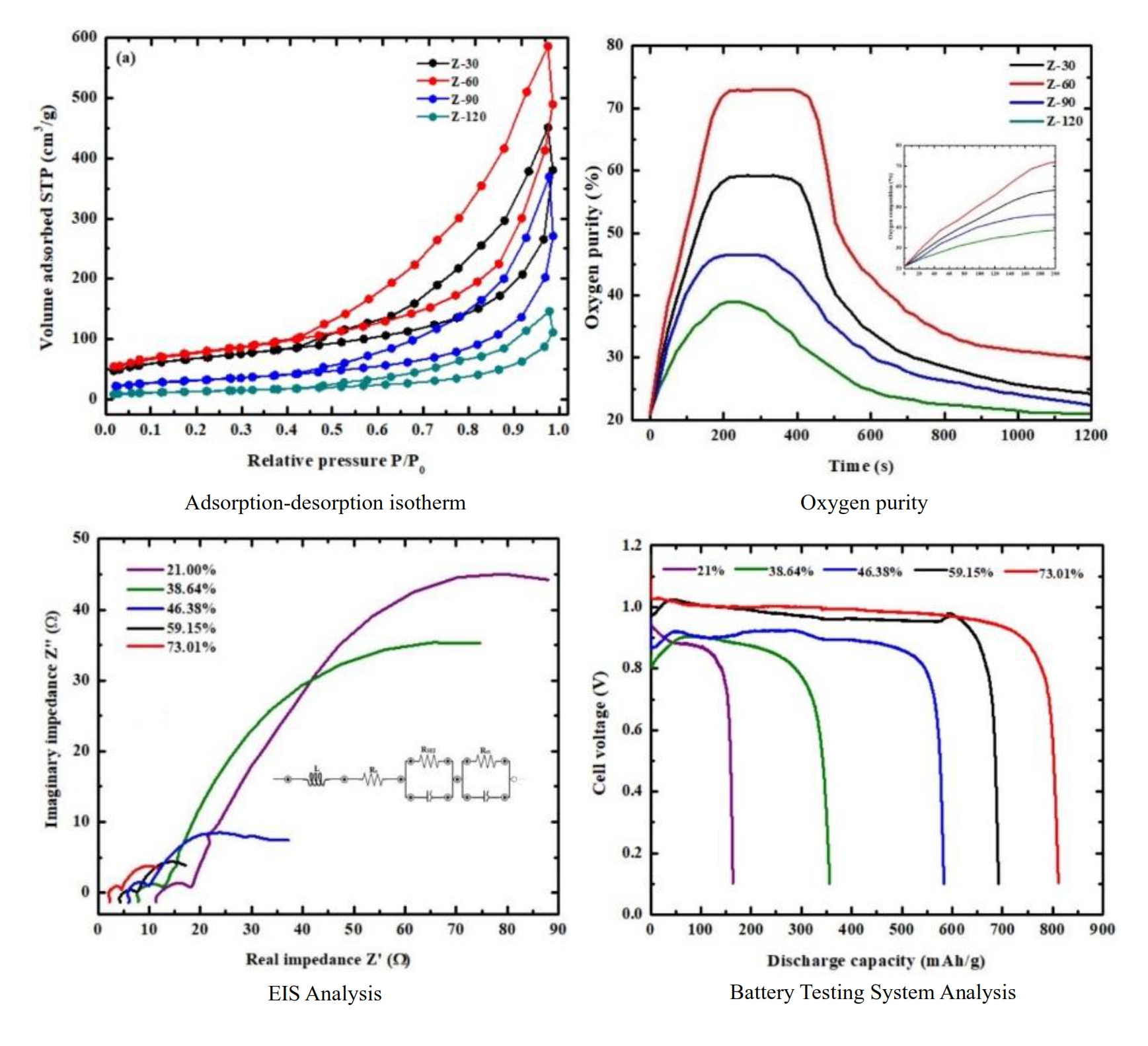
Downloads
References
R El-Araby. Biofuel production: Exploring renewable energy solutions for a greener future. Biotechnology for Biofuels and Bioproducts 2024; 17, 129.
A Pitkaoja and J Ritvanen. Steam-oxygen blown circulating fluidised bed gasification for synthetic biofuel production: Pilot-scale reactor modelling, model-based reactor scale-up and analysis for power-biomass-to-liquid processes. Biomass and Bioenergy 2025; 193, 107540.
C Kodama, G Kuniyoshi, S Koya, M Salem, MM Othman, K Iwamoto, A Abubakar and R Brennan. Medical oxygen as a life-saving medicine: A rapid review of the oxygen landscape and innovative efforts in the World Health Organization eastern mediterranean region in response to COVID-19 and beyond. Medical Research Archives 2023; 11(7.2), 4162.
Y Yuan, L Wang, Y Zhuang, Y Wu and X Bi. Energy and economic assessment of oxy-fuel combustion CO2 capture in coal-fired power plants. Energies 2024; 17(18), 4626.
IT Bello, LA Jolaoso, RA Ahmed and A Bello. Electrochemical energy conversion and storage systems: A perspective on the challenges and opportunities for sustainable energy in Africa. Energy Reviews 2024; 4(1), 100109.
G Nazir, A Rehman, JH Lee, CH Kim, J Gautam, K Heo, S Hussain, M Ikram, AA Al-Obaid, SY Lee and SJ Park. A review of rechargeable zinc–air batteries: Recent progress and future perspectives. Nano-Micro Letters 2024; 16(1), 138.
AG Olabi, ET Sayed, T Wilberforce, A Jamal, AH Alami, K Elsaid, SMA Rahman, SK Shah and MA Abdelkareem. Metal-air batteries: A review. Energies 2021; 14(21), 7373.
M Salado and E Lizundia. Advances, challenges, and environmental impacts in metal–air battery electrolytes. Material Today Energy 2022; 28, 101064.
C Lv, Y Li, Y Zhu, Y Zhang, J Kuang, Q Zhao, Y Tang and H Wang. Quasi-solid-state aluminum–air batteries with ultra-high energy density and uniform aluminum stripping behavior. Advanced Science 2023; 10(29), e2304214.
H Aripin, N Hiron, N Busaeri, FMS Nursuwars, L Faridah and S Sabchevski. Performance of Graphite/SiO2 composites as cathode electronic active layer in Al-Air batteries. In: Proceedings of the IEEE International Conference on Sustainable Engineering and Creative Computing (ICSECC), Jakarta, Indonesia. 2020, p. 136-140.
H Aripin, N Sutisna, N Busaeri and S Sabchevski. Enhancing power supply of Al-Air battery using an optimized conductive material of silica xerogel/graphite composite on an air cathode. In: Proceedings of the 10th International Conference on Chemical Science and Engineering, Springer, Singapore. 2023, p. 65-71.
W Zhong, J Zhang, Z Li, Z Shen, S Zhang, X Wang and Y Lu. Issues and strategies of cathode materials for mild aqueous static zinc-ion batteries. Green Chemical Engineering 2023; 4(3), 264-284.
J Xie and Y Wang. Recent development of CO2 electrochemistry from Li-CO2 batteries to Zn-CO2 batteries. Account of Chemical Research 2019; 52(6), 1721-1729.
R Singla and K Chowdhury. Enhanced oxygen recovery and energy efficiency in a reconfigured single column air separation unit producing pure and impure oxygen simultaneously. Chemical Engineering and Processing - Process Intensification 2021; 162, 108354.
A Imtiaz, MHD Othman, A Jilani, IU Khan, R Kamaludin, J Iqbal and AG Al-Sehem. Challenges, opportunities and future directions of membrane technology for natural gas purification: A critical review. Membranes 2022; 12(7), 646.
R Šulc and M Kos. Experimental performance of pilot-oxygen-pressure swing adsorption unit. Chemical Engineering Transactions 2023; 100, 223-228.
C Chin, Z Kamin, MHV Bahrun and A Bono. The production of industrial-grade oxygen from air by pressure swing adsorption. International Journal of Chemical Engineering 2023; 2023, 2308227.
Y Sun, C Zhang, X Zhu, L Dong and X Sun. Mass and heat transfer of pressure swing adsorption oxygen production process with small adsorbent particles. Processes 2023; 11(8), 2485.
M Al-Yousuf, RF Almilly and R Kamil. Methodological approach for optimizing production of oxygen by adsorption of Nitrogen from air using zeolite Li-LSX. International Journal of Chemical Engineering 2022; 2022, 7254646.
AF Al-Shawabkeh, N Al-Najdawi and AN Olimat. High purity oxygen production by pressure vacuum swing adsorption using natural zeolite. Results in Engineering 2023; 18, 101119.
N Caroko and Sukamta. Analysis of nitrogen adsorption capability at various activation temperatures of Klaten natural zeolite. Jurnal Polimesin 2024; 22(3), 305-309.
JS Bobby, S Bharath, C Madhankumar, K Sudharsanam, U Ummathullah and PBE Prabhakar. Cost efficient oxygen concentrator with PSA technology. Cardiometry 2022; 25, 182-185.
H Aripin, N Busaeri, A Gufroni and S Sabchevski. Activated natural zeolite membrane for separating dissolved impurities in coconut sap. Materials Science Forum 2020; 1000, 293-302.
H Aripin, S Sutisna, E Priatn, IN Sudiana, E Surahman and S Sabchevski. Porous silica derived from sago waste and its application for the preparation of SiO2/C composites as air cathodes for primary aluminum-air batteries. International Journal of Electrochemical Science 2022; 17(12), 221221.
Z Adila, W Trisunaryanti and T Triyono. Modification of natural zeolite from Klaten, Indonesia using ammonium chloride by ion-exchange and its application as catalyst in ethanol dehydration to produce diethyl ether. Indonesian Journal of Chemistry 2024; 24(2), 505-518.
V Novák, M Blazek, CM Schleputza, P Koci and M Stampanonia. Drying of water from porous structures investigated by time-resolved X-ray tomography. Drying Technology 2022; 40(16), 3675-3693.
MR Mazlan, NH Jamadon, A Rajabi, AB Sulong, IF Mohamed, F Yusof and NA Jamal. Necking mechanism under various sintering process parameters e A review. Journal of Materials Research and Technology 2023; 23, 2189-2201.
TP Le, HVT Luong, HN Nguyen, TKT Pham, TLT Le, TBQ Tran and TNM Ngo. Insight into adsorption-desorption of methylene blue in water using zeolite NaY: Kinetic, isotherm and thermodynamic approaches. Results in Surfaces and Interfaces 2024; 16, 100281.
M Bossert, A Grosman, I Trimaille, F Souris, V Doebele, A Benoit-Gonin, L Cagnon, P Spathis, PE Wolf and E Rolley. Evaporation process in porous silicon: Cavitation vs pore-blocking. Langmuir 2021; 37(49), 14419-14428.
C Ding, J He, H Wu and X Zhang. Nanometer pore structure characterization of taiyuan formation shale in the lin‐xing area based on nitrogen adsorption experiments. Minerals 2021; 11(3), 298.
DM Oliveira and AS Andrada. Synthesis of ordered mesoporous silica MCM-41 with controlled morphology for potential application in controlled drug delivery systems. Ceramica 2019; 65(374), 170-179.
SM Faghih, M Salimi and H Mazaheri. Fabrication of Pebax/4A zeolite nanocomposite membrane to enhance CO2 selectivity compared to pure O2, N2, and CH4 gases. International Journal of Engineering Transactions B: Applications 2023; 36(2), 408-419.
VK Yadav, N Choudhary, GK Inwati, A Rai, B Singh, B Solanki, B Paital and D Kumar. Recent trends in the nanozeolites-based oxygen concentrators and their application in respiratory disorders. Frontiers in Medicine 2023; 10, 1147373.
S Arunmetha, NR Dhineshbabu, A Kumar and R Jayavel. Preparation of sulfur doped TiO2 nanoparticles from rutile sand and their performance testing in hybrid solar cells. Journal of Materials Science: Materials in Electronics 2021; 32, 28382-28393.
T Kolar, B Mušič, RC Korošec and V Kokol. Addition of Al(OH)3 versus AlO(OH) nanoparticles on the optical, thermo-mechanical and heat/oxygen transmission properties of microfibrillated cellulose films. Cellulose 2021; 28, 9441-9460.
YV Fedoseeva, EV Lobiak, EV Shlyakhova, KA Kovalenko, VR Kuznetsova, AA Vorfolomeeva, MA Grebenkina, AD Nishchakova, AA Makarova, LG Bulusheva and AV Okotrub. Hydrothermal activation of porous nitrogen-doped carbon materials for electrochemical capacitors and sodium-ion batteries. Nanomaterials 2020; 10(11), 2163.
M Rostami, AH Joshaghani, H Mazaheri and A Shokri. Photo-degradation of p-nitro toluene using modified bentonite based nano-TiO2 photocatalyst in aqueous solution. International Journal of Engineering Transactions A: Basics 2021; 34(4), 756-762.
P Katsoufis, V Mylona, C Politis, G Avgouropoulos and P Liano. Study of some basic operation conditions of an Al-air battery using technical grade commercial aluminum. Journal of Power Sources 2020; 450, 227624.
B Rani, JK Yadav, P Saini, AP Pandey and A Dixit. Aluminum-air batteries: Current advances and promises with future directions. Royal Society of Chemistry Advances 2024; 14(25), 17628-17663.
M Wei, K Wang, L Zhong, THM Pham, Y Zuo, H Wang, P Zhang, Z Chen, S Zhao and P Pei. F− competitive attack decomposing parasitic product Al(OH)3 of hydrogel-based Al-air battery. Energy Storage Materials 2023; 60, 102812.
V Sivaprakash, L Natrayan, R Suryanarayanan, R Narayanan and P Paramasivam. Electrochemical anodic synthesis and analysis of TiO2 nanotubes for biomedical applications. Journal of Nanomaterials 2021; 2021, 9236530.
F Bok, HC Moog and V Brendler. The solubility of oxygen in water and saline solutions. Frontiers in Nuclear Engineering 2023; 2, 1158109.
L Guo, Y Huang, AG Ritacca, K Wang, I Ritacco, Y Tan, Y Qiang, N Al-Zaqri, W Shi and X Zhen. Effect of indole-2-carboxylic acid on the self-corrosion and discharge activity of aluminum alloy anode in alkaline Al-Air battery. Molecules 2023; 28(10), 4193
Y Zuo, Y Yu, H Shi, J Wang, C Zuo and X Dong. Inhibition of hydrogen evolution by a bifunctional membrane between anode and electrolyte of aluminum–air battery. Membranes 2022; 12(4), 407.
HJ Kwon, HC Lee, J Ko, IS Jung, HC Lee, H Lee, M Kim, DJ Lee, H Kim, TY Kim and D Im. Effects of oxygen partial pressure on Li-air battery performance. Journal of Power Sources 2017; 364, 280-287.
J Li, F Yan, Z Su, T Zhang, X Zhang and H Sun. Highly efficient Li−air battery using linear porosity air electrodes. Journal of The Electrochemical Society 2020; 167(9), 090529.
S Matsuda, M Ono, S Yamaguchi and K Uosaki. Criteria for evaluating lithium-air batteries in academia to correctly predict their practical performance in industry. Materials Horizons 2022; 9(3), 856-863.
A Zhuk, G Belyaev, T Borodina, E Kiseleva, E Shkolnikov, V Tuganov, G Valiano and V Zakharov. Magnesium–air battery with increased power using commercial alloy anodes. Energies 2024; 17(2), 400.
P Mao, H Arandiyan, SS Mofarah, P Koshy, C Pozo-Gonzalo, R Zheng, Z Wang, Y Wang, SK Bhargava, H Sun, Z Shao and Y Liu. A comprehensive review of cathode materials for Na-air batteries. Energy Advances 2023; 2(4), 465-502.
H Wen, Z Liu, J Qiao, R Chen, G Qiao and J Yang. Ultrahigh voltage and energy density aluminum-air battery based on aqueous alkaline-acid hybrid electrolyte. International Journal of Energy Research 2020; 44, 10652-10661.
Y Zuo, Y Yu, H Shi, J Wang, C Zuo and X Dong. Inhibition of Hydrogen Evolution by a Bifunctional Membrane between Anode and Electrolyte of Aluminum–Air Battery. Membranes 2022; 12(4), 407.
C Lv, Y Li, Y Zhu, Y Zhang, J Kuang, Q Zhao, Y Tang and H Wang. Quasi-Solid-State Aluminum–Air Batteries with Ultra-high energy density and uniform aluminum stripping behavior. Advanced Science 2023; 10(29), 2304214.
WC Tan, LH Saw, MC Yew, D Sun, Z Cai, WT Chong and PY Kuo. Analysis of the polypropylene-based aluminium-air battery. Frontiers in Energy Research 2021; 9, 599846.

Published
How to Cite
Issue
Section
License
Copyright (c) 2025 Walailak University

This work is licensed under a Creative Commons Attribution-NonCommercial-NoDerivatives 4.0 International License.





